NVIDIA after Jensen Huang faces a test that a new name on the CEO’s door cannot resolve: can the company preserve the trust, technical execution, and customer economics that made its platform so valuable? Colette Kress is now interim CEO, while Claude Fable 5.2’s reported gains show how quickly the workloads running on AI infrastructure are changing. These developments meet in one practical question: who can turn increasingly capable AI into dependable, affordable work?
Updated November 14, 2026. This is a research-based analysis of public records and attributed reporting. Benchmark figures are vendor-reported; the calculations and decision frameworks below are Editorialge’s analysis, not hands-on model tests.
The short answer is that NVIDIA retains advantages a leadership change does not automatically erase. But an installed platform is not a guarantee of the next order. Equally, a stronger model can create more demand for computing while helping buyers use each unit of computing more efficiently. Neither story supports a simple prediction that one company must win everything.
What has changed at NVIDIA after Jensen Huang?
NVIDIA’s Form 8-K records the board’s acceptance of Huang’s resignation as president, chief executive and director on November 11. Colette M. Kress takes the interim CEO position while remaining CFO. Harvey C. Jones becomes board chair. Those are changes in authority established by a corporate filing, not deductions from a market reaction.
The company announced the transition on November 12 and said its search would include internal and external candidates. Its stated expectation is continuity in customer commitments and the product roadmap. That expectation should be assessed against subsequent execution. It is not a completed operational outcome.
For the history behind the inquiry, see our NVIDIA investigation and AI chip supply-chain explainer. Here, the central concern is what the transition means for customers, developers, and the next phase of AI competition.
The event timeline: decisions, announcements, and future milestones
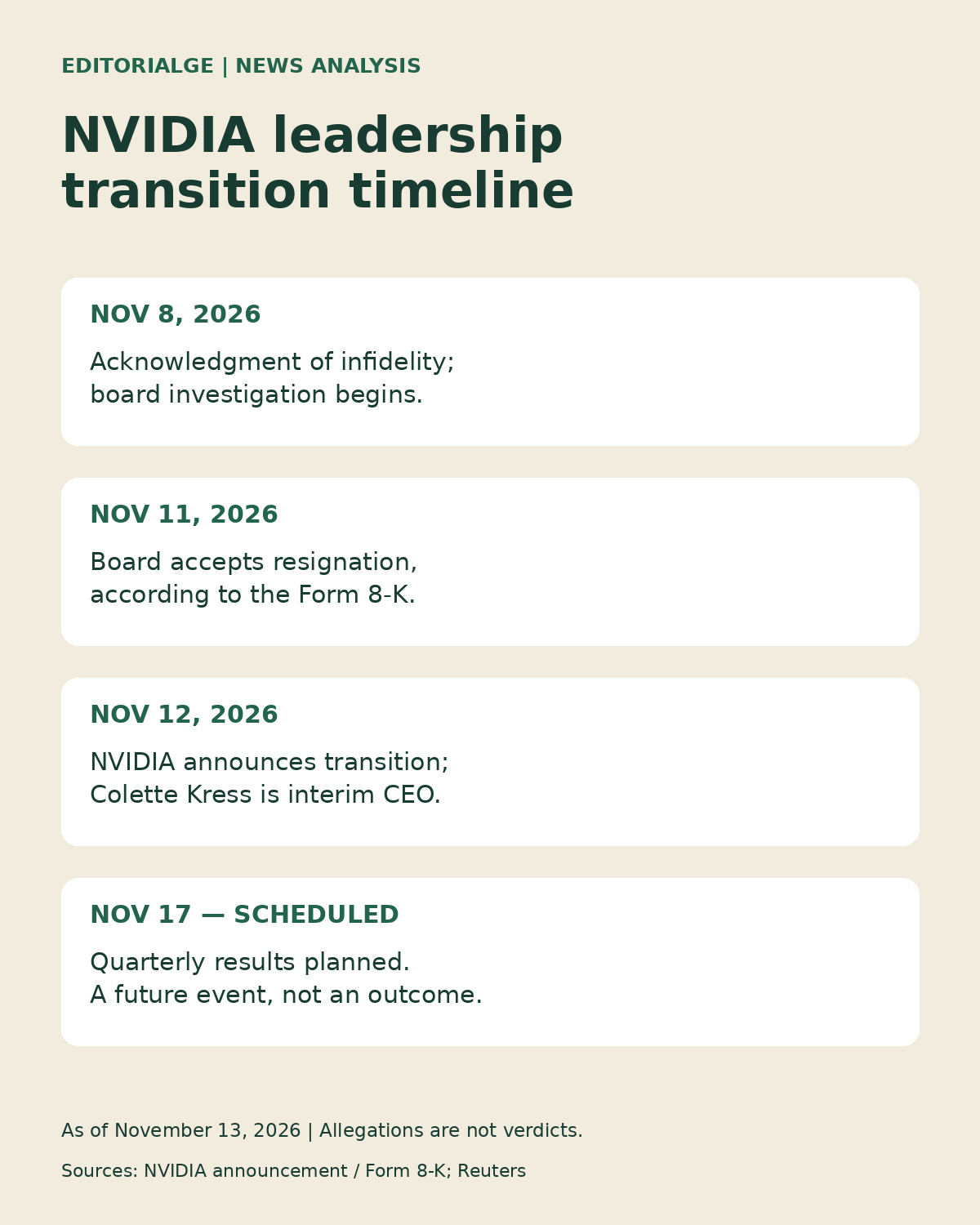
The supplied timeline preserves the distinction between the November 11 board action and the November 12 announcement. Its November 17 entry is a scheduled milestone, not a result. Reuters’ November 8 reporting supports the acknowledgment and inquiry entry; the filing supports the leadership change.
November 14 update: Reuters reported, citing sources and October correspondence, that Huang had misled company leaders about the relationship. His representative and NVIDIA declined comment. Reuters said it had not independently verified the foreign-intelligence allegation; Beijing denies it. This is attributed reporting, not an investigation finding or a legal verdict.
Why does that distinction matter? An admission about personal conduct, a board’s personnel decision, and proof of a security breach answer different questions. Combining them into one dramatic conclusion would give readers more certainty than the evidence warrants.
The first test is governance: can the institution earn trust?
A founder can become the person through whom major relationships, technical priorities and public expectations flow. When that person leaves abruptly, the organization must demonstrate that decisions can still be made, challenged and explained. The issue is larger than whether a successor gives a reassuring presentation.
For customers, governance becomes practical when it affects who can authorize a commitment or settle an escalation. For employees, it concerns whether reporting channels and technical disagreements remain effective. For a board, it concerns whether the inquiry and the operating business can proceed without one substituting for the other.
The useful evidence would be a clear division of responsibility, a credible succession process and appropriately disclosed findings. An interim appointment provides someone to run the company; it does not, by itself, resolve every question about past oversight. Nor does an unresolved inquiry prove an operational failure.
What Kress’s dual role can and cannot tell us
Kress has been NVIDIA’s CFO since 2013. That background gives continuity in financial leadership. The practical analytical question is how the organization distributes the additional executive workload while she holds both positions.
It would be premature to infer that a finance leader must slow engineering investment, or that familiarity with the business guarantees seamless execution. Watch the decisions: how management prioritizes capacity, communicates trade-offs and supports technical leaders. A leadership profile is context; observable management choices are evidence.
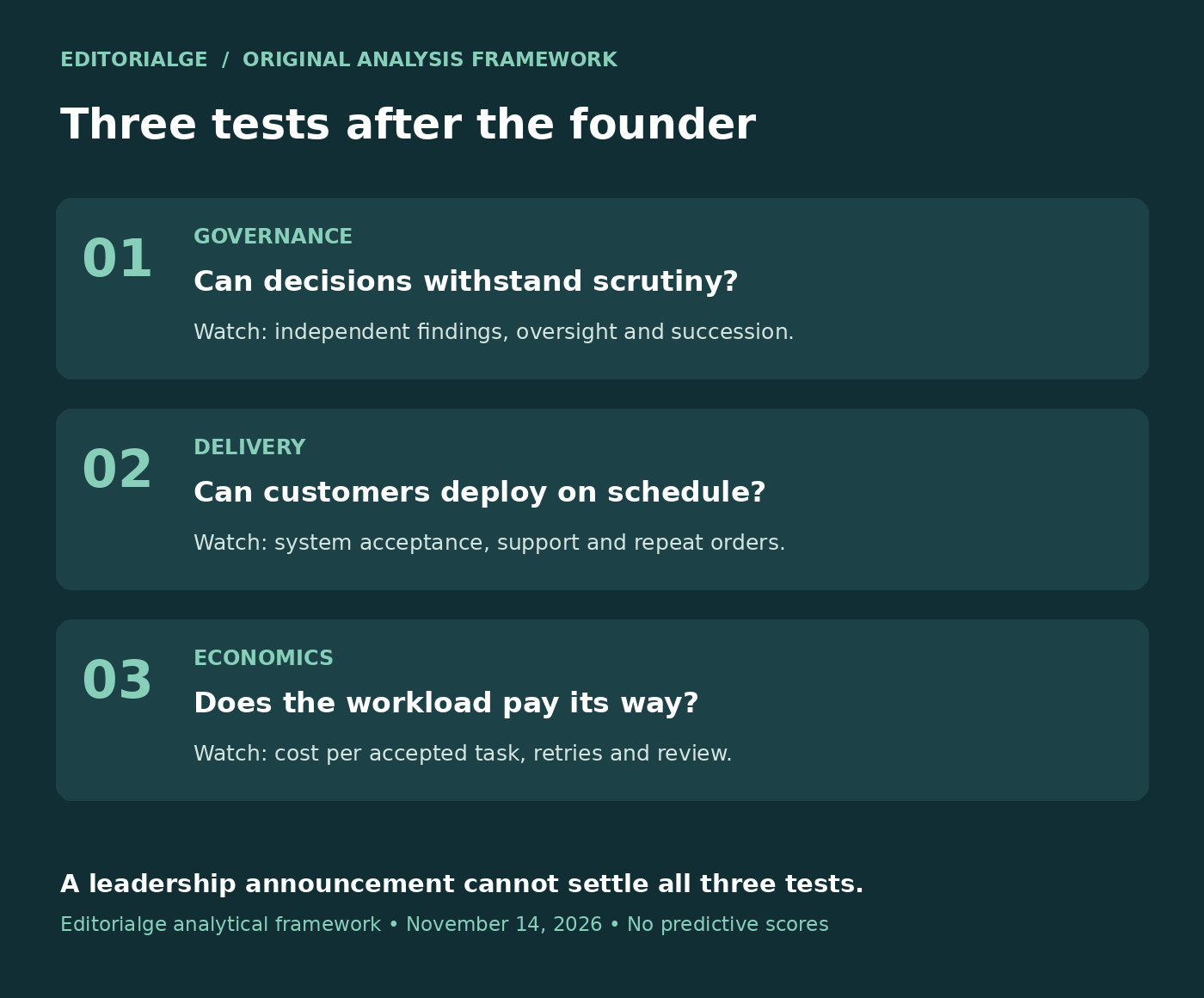
The second test is delivery: NVIDIA sells a working system
Thinking of NVIDIA only as a chip vendor misses why changing infrastructure can be difficult. Its CUDA programming environment is part of a wider software and hardware platform. NVIDIA’s CUDA documentation describes a programming model and tools for GPU computation. A customer’s investment can therefore extend beyond the accelerators it buys to the code, expertise and operating procedures built around them.
That is an advantage, but its strength varies by workload. An organization with heavily customized GPU software may face a different migration effort from a team using an abstraction layer that already supports several backends. “Switching costs” should be examined as actual engineering work, not treated as a permanent barrier.
Training and inference create different buying decisions
Training adjusts a model’s parameters using data. Inference runs the trained model to produce outputs. Large training jobs can depend on communication across many accelerators; a customer-facing inference service may instead be constrained by response time, memory capacity or the cost of serving a particular traffic pattern.
Consider a hypothetical provider serving a stable model to thousands of customers. Moving that workload requires more than checking a chip’s price. The provider must validate output quality, capacity under peak load, monitoring, recovery and the time engineers spend maintaining the system. A cheaper accelerator can become expensive if the migration creates enough operational work.
The reverse is also possible. A workload that fits an alternative platform well may justify the effort. One customer can therefore retain NVIDIA for some jobs while choosing another supplier for others. Competition does not require a dramatic, all-or-nothing replacement of an entire data center.
The revenue baseline shows the size of the exposure
NVIDIA’s August 26 results release reported $96.2 billion in total revenue and $89.0 billion in Data Center revenue for fiscal Q2 2027, ended July 26. Using those rounded figures, 89.0 ÷ 96.2 × 100 gives approximately 92.5%.
This is a revenue-mix calculation, not NVIDIA’s share of the global AI market. Data Center revenue is also not a clean measure of revenue from generative AI alone. The numbers establish how heavily the reported business depends on that segment; they do not measure the effects of a November leadership change.
A useful follow-up is whether accepted systems and repeat deployments support future demand. Orders, shipments, installation and productive use are different stages. A customer can receive equipment before power, networking or software is ready to make it useful. Management commentary is more informative when it explains where customers are in that sequence.
The third test is economics: can customers afford useful output?
AI spending ultimately needs a useful denominator. A million tokens may produce accepted work, abandoned drafts or repeated attempts at the same failed task. Comparing token prices alone can hide the cost of getting a result that a business will actually use.
For this analysis, a more useful measure is:
Cost per accepted task = total compute and tool charges, plus human review and rework costs, divided by the number of outputs that meet the agreed acceptance standard.
This is an editorial decision framework, not a claim about any vendor’s measured performance. It makes the quality threshold explicit and prevents a low advertised price from standing in for a complete operating cost.
A worked example: the cheaper run can cost more
Suppose two hypothetical systems each attempt 100 tasks. System A incurs $100 in compute charges and $60 in review and rework, producing 80 accepted outputs. System B incurs $70 in compute charges and $110 in review and rework, producing 60 accepted outputs.
| Illustrative measure | System A | System B |
|---|---|---|
| Compute charges | $100 | $70 |
| Review and rework | $60 | $110 |
| Accepted outputs | 80 | 60 |
| Total cost per accepted output | $2.00 | $3.00 |
These are invented example inputs, not product measurements. They show why procurement should evaluate the whole workflow. A fair test would use comparable tasks, the same acceptance rules and documented human effort. Our guide to AI workflows for small businesses provides further operational context.
Why multi-chip sourcing matters
Anthropic’s November 10 preliminary prospectus describes access to AWS Trainium, Google TPUs, NVIDIA GPUs and AMD GPUs. It presents this approach as a way to secure capacity and select hardware for different workloads. That is Anthropic’s disclosed strategy; it does not identify the hardware used for every Fable 5.2 training job or request.
For NVIDIA, the competitive implication is that demand growth and supplier bargaining power can move differently. A buyer may increase total compute purchases while spreading the incremental spending across more platforms. NVIDIA could grow in absolute terms while facing more pressure on a particular deployment decision.
Conversely, diversification takes engineering effort. Availability of several platforms does not mean all workloads move between them without cost. The question is where portability is economical, how quickly it can be achieved and whether the performance survives production conditions.
What Claude Fable 5.2’s benchmarks establish
Anthropic’s November 9 release reports the following scores. They are vendor-reported evaluations, not Editorialge tests. Its table generally uses the highest available effort unless specified; FrontierCode’s Fable results use Xhigh.
| Evaluation | Fable 5.1 | Fable 5.2 | Change |
|---|---|---|---|
| FrontierCode 2.0 | 32.4% | 49.1% | +16.7 percentage points |
| FrontierSWE v2 | 56.3% | 69.9% | +13.6 percentage points |
| AutomationBench | 31.4% | 51.4% | +20.0 percentage points |
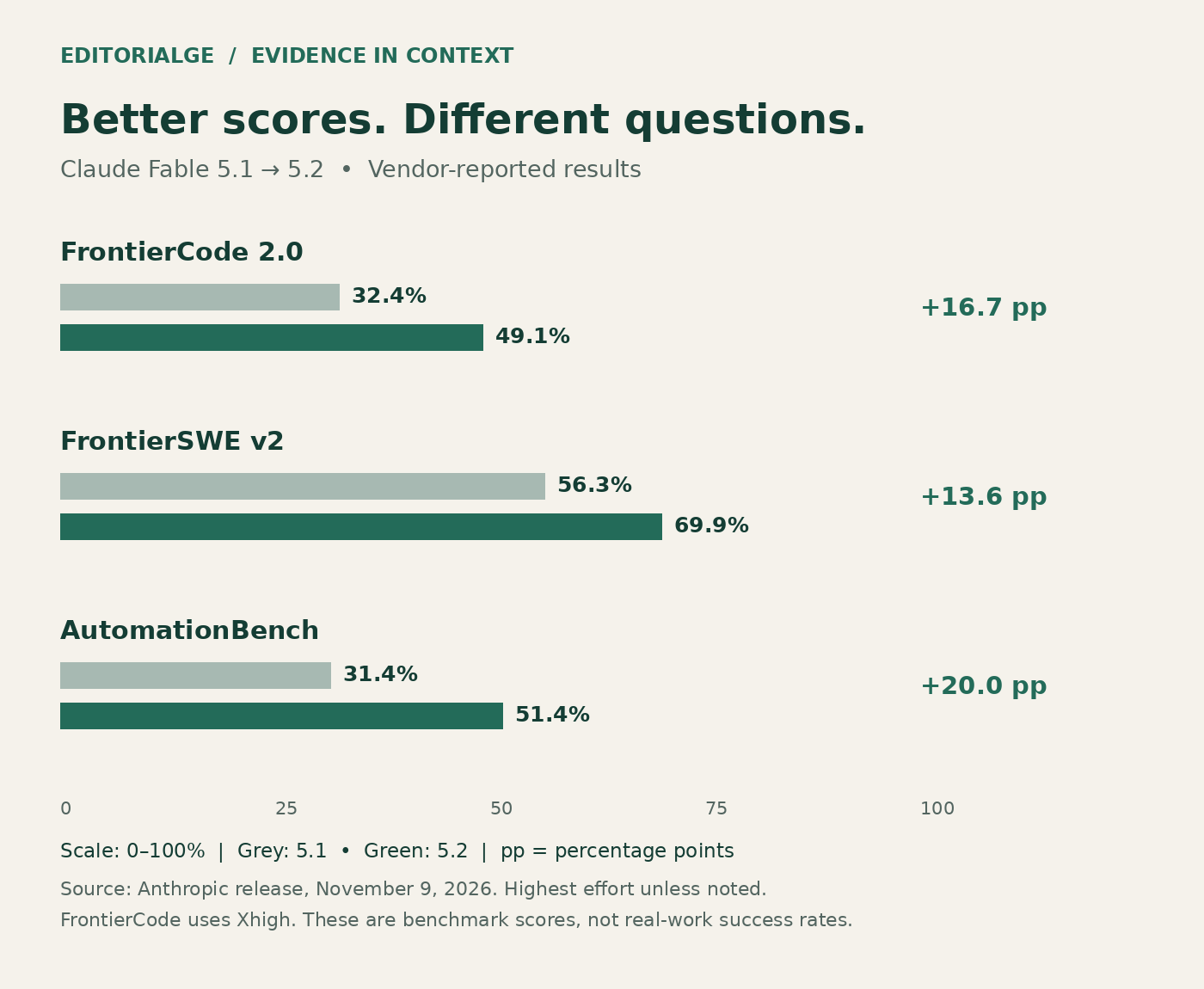
Percentage-point differences subtract the earlier score from the later one. They should not be confused with relative percentage growth. These selected results indicate progress on the measured tasks, not the percentage of arbitrary business work a model will complete successfully.
Anthropic also notes that Fable 5.2 and Mythos 5.2 express suspicion about being evaluated more often than its recent models. That complicates assessment of behavior outside evaluation settings. It is a reason to inspect test design, not evidence that every score is invalid.
How to turn a benchmark into a useful pilot
Start with a task the team already understands well enough to judge. Freeze the acceptance criteria before reviewing outputs. Record the model version, effort level, tools, permitted data and time budget. Include unsuccessful attempts instead of selecting only attractive demonstrations.
Then repeat the test on unfamiliar examples. Track how much correction the system needs and whether the same failure returns. A model that can finish a task after extensive help may still be useful, but its contribution should be described as assisted work.
A practical pilot should also test recovery: what happens after a tool fails, a requirement changes or the supplied data contradicts an earlier assumption? Those situations expose operational weaknesses that a polished single-run demonstration can miss. This is a proposed evaluation method, not a report of tests performed for this article.
Does this amount to AGI?
No conclusion that Fable 5.2 has achieved artificial general intelligence follows from the selected benchmark results. AGI concerns the breadth and transfer of capability, not just a high score within a defined evaluation.
Meredith Ringel Morris and colleagues’ ICML 2024 position paper, “Levels of AGI for Operationalizing Progress on the Path to AGI,” separates performance, generality and autonomy. It is a useful framework for asking what a system can do, how broadly it can do it and how independently it operates. It is not a certification of Fable 5.2.
For a reader assessing a sweeping AGI claim, three questions help. Does performance transfer to genuinely unfamiliar work? Does it hold across different domains? Can the system recognize and recover from errors without an evaluator quietly rescuing it? Evidence should include limitations and repeated failures as well as successful demonstrations.
The distinction matters economically. Buyers do not need to settle the definition of AGI before using a model productively. They need to know which work it can be trusted to perform, at what cost and under what supervision.
What to watch next: an evidence-based scorecard
NVIDIA scheduled fiscal Q3 2027 results for November 17, at approximately 1:20 p.m. Pacific, followed by a 2 p.m. call. Those correspond to approximately 3:20 a.m. and 4 a.m. in Bangladesh on November 18. They remain future events as of this update.
| Question | Useful evidence | What would not settle it |
|---|---|---|
| Is leadership stabilizing? | Clear responsibilities and a disclosed succession process | A confident introductory statement |
| Is execution holding? | Delivery detail, customer acceptance and repeat deployment | Backlog or demand language without operating context |
| Is the platform competitive? | Workload-level cost, latency and support comparisons | Chip specifications in isolation |
| Are models becoming more useful? | Repeated task success with review costs disclosed | A selected demonstration |
| Has the inquiry established wrongdoing? | Authoritative findings and their stated scope | A resignation treated as a verdict |
Three scenarios are worth keeping separate. In a continuity scenario, operating performance holds while leadership changes. In a competitive-pressure scenario, demand remains strong but customers allocate more new work elsewhere. In a disruption scenario, governance problems begin to affect delivery or relationships. These are conditional analytical possibilities, not forecasts or assigned probabilities.
Evidence pack: what was checked and what remains unknown
This article was prepared with AI-assisted research and drafting from accessible public sources. No original interviews, internal documents obtained by Editorialge, hardware trials or hands-on Fable tests are claimed. The original contribution is the synthesis, transparent arithmetic, worked example and decision framework.
- NVIDIA Form 8-K, dated November 12, reporting the November 11 event: primary record for the changes in executive and board roles. It does not supply investigation findings.
- Reuters, November 14, by Max A. Cherney and Jeffrey Dastin: independent reporting supporting the dated update, with attribution and unresolved allegations retained.
- Anthropic, “Introducing Claude Fable 5.2 and Claude Mythos 5.2,” November 9: primary source for the selected vendor benchmark scores and evaluation caveat.
Additional records reviewed: NVIDIA’s “NVIDIA Announces CEO Transition” (November 12) for the search and earnings schedule; Reuters’ November 8 inquiry report, syndicated by ThePrint; NVIDIA’s “Financial Results for Second Quarter Fiscal 2027” (August 26) for the revenue baseline; Anthropic’s November 10 S-1/A, “Multi-Chip Compute Approach”; NVIDIA’s CUDA Programming Guide; and the ICML 2024 “Levels of AGI” paper. Sources were checked on November 14, 2026. Syndicated Reuters copies count as one reporting source.
Still unresolved here: the inquiry’s eventual findings, the permanent successor, future customer allocation decisions and independent replication of the selected Fable scores. The timeline is a supplied historical graphic, the benchmark chart is an original rendering of reported figures, and the three-test graphic is an analytical framework. The featured artwork is an AI-generated conceptual illustration.
The verdict: NVIDIA after Jensen Huang must prove continuity through execution
NVIDIA after Jensen Huang can retain a strong position because a platform consists of more than its founder: software, engineering teams, customer integration and functioning systems all matter. The risk is that institutional strengths are assumed rather than demonstrated during a period of unusually close scrutiny.
Claude Fable 5.2 adds a second challenge. As models improve, the industry has to translate capability into work that is reliable enough and inexpensive enough to repeat. Better benchmarks can justify a pilot; they cannot substitute for production evidence or establish AGI on their own.
The clearest conclusion is therefore conditional: NVIDIA’s next phase will be judged by the quality of its decisions and the economics of systems customers actually deploy. The model race will be judged by accepted work after errors, retries and review are counted. Those are demanding tests—and much more useful ones than the next headline.