A customer searches for a product like yours. Your ad appears, they click—and then discover it is out of stock nearby. You have paid for attention without giving that shopper a way to buy. For an independent brand, choosing a retail media platform starts with a simple question: where can customers actually find your product?
The answer shapes the rest of the decision. If you sell directly on a marketplace, you may be able to advertise a listing from your seller account. If you supply grocery stores, you may need a retailer or media partner to grant access. In either case, fees, available placements and reporting depend on your account and product.
This guide compares 15 US options using the operators’ published information. The list is unranked, and we did not run campaigns. Use it to build a shortlist, then check current eligibility, minimums, costs and stock in the market you want to reach.
Compare the 15 Platforms at a Glance
| Platform | Best starting fit | Documented route |
|---|---|---|
| Amazon Ads | Eligible Amazon listings | Sponsored Products |
| Walmart Connect | Eligible Walmart Marketplace or supplier catalog | Sponsored Search |
| eBay Advertising | Eligible eBay listings | Promoted Listings |
| Etsy Ads | Eligible Etsy shop listings | Onsite listing ads |
| Target Roundel | Products eligible for Target placements | Target Product Ads |
| Instacart Ads | Brands with relevant retail distribution | Sponsored products |
| Kroger Precision Marketing | Kroger-banner assortment | Product listing ads |
| Albertsons Media Collective | Albertsons-banner assortment | Onsite sponsored product ads |
| DoorDash Ads | Eligible CPG items available through DoorDash retail partners | CPG Sponsored Products |
| Uber Advertising | Eligible grocery or retail storefront items | Sponsored Item ads |
| Gopuff Ads | Brands with Gopuff distribution or partnership access | In-app and other retail media formats |
| CVS Media Exchange | Eligible CVS health and wellness products | Sponsored product search |
| Walgreens Advertising Group | Brands relevant to Walgreens shoppers | Retail media using Walgreens audience data |
| Chewy Ads | Eligible pet products sold through Chewy | Sponsored Products |
| The Home Depot Orange Apron Media | Eligible home improvement assortment | Orange Access and retail media campaigns |
Start With Marketplace Ads If You Control the Listing
Already selling on a marketplace? Begin with the listings you control. Check whether your products qualify for ads, where a click takes the shopper, and what you will be charged. Then pick a few products with reliable stock and product pages that answer the questions a buyer is likely to ask.
1. Amazon Ads
Best for: Brands with established Amazon listings and dependable fulfillment.
Why a team might choose it: Sponsored Products can put an individual product in front of shoppers already browsing on Amazon. That makes a small SKU-level test easier to connect to an existing listing than a broad brand-awareness campaign.
What to consider: An ad cannot repair an uncompetitive offer or unavailable inventory. Check Featured Offer eligibility, bid costs and margin after Amazon fees; do not treat attributed sales as proof that every order was incremental.
Start here if Amazon already accounts for meaningful sales and you have a small group of stable listings. Amazon Ads describes Sponsored Products as cost-per-click ads, with professional seller and other eligible account routes. Confirm category and Featured Offer eligibility before budgeting. Fix weak listings and stock coverage before buying clicks.
2. Walmart Connect
Best for: Brands already selling eligible products on Walmart.
Why a team might choose it: The attraction is the chance to promote a product within a retailer where customers can also buy it. Start with a few listings whose price, availability and fulfillment are consistent, then compare spending with SKU-level sales.
What to consider: Winning a placement depends on eligibility, relevance and the auction, not simply a higher budget. Confirm the reporting window and avoid comparing its return directly with a network using different attribution rules.
Use Sponsored Products when a Walmart listing already has reliable price, inventory and fulfillment. Walmart Marketplace Learn documents click-based charges and an auction that considers relevance and bids. Confirm account and item eligibility in your own dashboard. Compare Walmart performance within its own reporting window before drawing conclusions about other stores.
3. eBay Advertising
Best for: eBay sellers who want to promote individual listings.
Why a team might choose it: The general strategy is worth examining when a seller prefers an ad fee tied to an attributed sale; priority campaigns use a different pricing approach. Match the strategy to your margin and willingness to pay for clicks or sales.
What to consider: The advertised fee is only part of the economics: shipping, returns and marketplace charges matter too. Read the applicable attribution rules and fee calculation before assuming a sale-based charge means risk-free advertising.
Consider the general campaign strategy for an existing eBay catalog when you prefer a sale-based ad charge. eBay also documents a priority strategy with a different billing model. Check how the selected strategy attributes a sale and what amount the fee applies to. That matters especially when order value or shipping costs vary.
4. Etsy Ads
Best for: Independent makers and niche shops with eligible Etsy listings.
Why a team might choose it: Etsy Ads lets a seller choose listings and a daily budget, which is useful when testing a small selection rather than promoting the whole shop. Strong photos, clear descriptions and realistic delivery estimates help shoppers evaluate an item after the click.
What to consider: Onsite Etsy Ads and Offsite Ads are separate programs with different terms. Confirm marketplace eligibility and include production time, shipping and ad charges in the cost of each order.
Etsy documents daily budgets and listing selection for ads inside Etsy. This is a practical starting point for eligible makers or specialist shops with clear product photos and a few listings that already convert. Separate Etsy Ads from Offsite Ads when tracking charges. Make sure the product meets Etsy’s marketplace rules before considering spend.
Check Store-Level Availability for Grocery and Delivery
A grocery brand may be available in one city and absent in the next. Before choosing a network, check the retailers and ZIP codes where the advertised item is actually in stock. That helps you concentrate a small test where a shopper can complete the purchase.
5. Target Roundel
Best for: Brands with a relevant Target assortment.
Why a team might choose it: Roundel is attractive when a brand wants to reach customers already shopping at Target. Product ads can support an existing listing, while the retailer relationship may provide opportunities beyond a single search placement.
What to consider: Access, buying route and measurement should be confirmed for the specific advertiser. A listing alone does not establish eligibility, and performance in another retailer is not a substitute for checking Target stock.
Roundel offers product ads that can appear while Target customers search and browse. Consider it if Target is already a distribution channel and the eligible assortment has adequate stock. Ask which buying route applies, which items can run and who provides reporting. A product’s presence at another retailer does not establish Target eligibility.
6. Instacart Ads
Best for: Grocery and household brands available through participating stores.
Why a team might choose it: A brand distributed across multiple grocery stores can evaluate sponsored products against the places people actually shop for delivery or pickup. Begin with a market where the same product is reliably available at several relevant retailers.
What to consider: Store-level availability and accurate item mapping matter: a national distribution map can hide local gaps. Compare the cost of the test with the contribution margin and ask how the reported sales are attributed.
Instacart’s ads documentation describes cost-per-click sponsored products for brands, with placements across search and browsing. This can suit a pantry or household brand carried across several stores. Before launch, check the item mapping and local availability by retailer. A national distribution claim is less useful than confirming a shopper can buy the SKU in the test market.
7. Kroger Precision Marketing
Best for: Brands whose assortment matches Kroger-banner shoppers.
Why a team might choose it: Kroger’s product listing ads provide a way to evaluate promotion close to a grocery purchase. For an independent brand, a focused test in markets where its products are stocked can be more informative than an undifferentiated national campaign.
What to consider: Check which banners, products and buying arrangements apply to your account. Ask how promotions, loyalty activity and stockouts appear in reporting before interpreting an increase in attributed sales.
Look at Kroger when the experiment needs to reflect a specific grocery distribution footprint. KPM documents product listing ads and describes extending them to its shopping assistant. Ask about the buying route and eligible banners, and map inventory to the market you want to reach. Keep a record of the attribution window for comparison later.
8. Albertsons Media Collective
Best for: Grocery suppliers with relevant Albertsons-banner distribution.
Why a team might choose it: The practical advantage is alignment with the retailer’s ecommerce shopping journey. A brand can discuss the relevant banners and markets with the media team and design a test around products shoppers can buy there.
What to consider: Banner coverage, campaign access and available reporting need account-level confirmation. Compare like-for-like markets and record other promotions; otherwise it is difficult to know what contributed to a result.
Albertsons describes sponsored product placements on its ecommerce properties alongside other onsite formats. Consider it when your grocery distribution aligns with a specific banner or group of markets. Confirm whether your account qualifies, what buying route applies and what reporting is available. Avoid combining banner results until you understand what each report includes.
9. DoorDash Ads
Best for: CPG brands with eligible products in local delivery stores.
Why a team might choose it: A product-specific sponsored placement can help a snack or convenience brand appear when shoppers browse participating stores. This is a different decision from advertising a local merchant’s whole storefront.
What to consider: A delivery app may serve one neighborhood well and another poorly. Confirm product eligibility and local stock, and evaluate delivery-related customer demand before extending a campaign across markets.
DoorDash’s CPG playbook documents product-specific pay-per-click ads. This is distinct from the Sponsored Listings product marketed to local merchants. It can fit a snack or convenience product that shoppers already buy through delivery. Confirm eligible stores, supported markets and item availability before using a single national budget.
10. Uber Advertising
Best for: Brands sold through eligible Uber grocery or retail storefronts.
Why a team might choose it: Sponsored Item advertising is relevant when the objective is visibility for a particular product rather than promotion of the store itself. A focused test can help the team evaluate a few items in markets with dependable fulfillment.
What to consider: The storefront and item products have different purposes and access requirements. Verify who controls the campaign, which stores are included and what reporting is available before committing a wider budget.
Uber’s ad product documentation separates storefront Sponsored Listings from Sponsored Item ads for individual products. Compare the item format if the brand is already available through eligible grocery or retail stores. Confirm who can create the campaign and which storefronts or products it covers. If stock is inconsistent, limit the test to markets that can fulfill orders.
11. Gopuff Ads
Best for: Convenience-oriented brands already available through Gopuff.
Why a team might choose it: Gopuff’s shopping journey can be a useful place to consider in-app visibility for products bought for immediate consumption. Start with a clear question, such as whether promoting one stocked product improves its economics in a chosen market.
What to consider: Ask for current placement options, minimum commitments and measurement rather than assuming a self-service route. Seasonal demand, discounts and local inventory can all complicate comparisons.
Gopuff describes advertising formats across its purchase journey, including in-app options. It may suit a convenience-focused product with reliable local distribution. Ask which placements and buying terms are available today, and test in markets where customers can actually order. Treat sampling and offsite placements as separate experiments if your budget permits.
Look at Specialist Networks When the Category Fits
Health, pet and home improvement advertisers can compare the specialist network tied to their existing retail distribution. Ask which products, audiences and placements qualify.
12. CVS Media Exchange
Best for: Health, beauty and wellness brands with suitable CVS distribution.
Why a team might choose it: Sponsored product placements reach shoppers on CVS’s digital properties, making them relevant to a brand whose products and audience fit the retailer. A limited SKU test also makes it easier to check whether the economics work.
What to consider: Some categories and product claims face additional restrictions. Confirm approval requirements, placement access and reporting before spending; avoid extrapolating from one promoted product to the entire portfolio.
CMX documents sponsored product placements on CVS.com and the CVS Pharmacy app. Consider it if CVS distribution already matches your product and customers. Confirm category advertising rules and the eligible buying path, especially for regulated products or claims. Measure the specific promoted SKUs rather than assuming results apply across the brand.
13. Walgreens Advertising Group
Best for: Eligible brands seeking Walgreens shoppers.
Why a team might choose it: Walgreens Advertising Group describes audience-based advertising using its retail and loyalty data. This may appeal when the business question is broader than a single product listing, such as reaching shoppers in a relevant category.
What to consider: Ask which audience, inventory and measurement options are available to your account and what privacy restrictions apply. If a simple listing-level test is the priority, verify that such a route exists for your brand.
WAG describes ad solutions using myWalgreens loyalty and purchase data. Consider it for an audience-focused campaign when Walgreens distribution and the advertised category fit. Confirm available placements and measurement for your account. If you need a simple listing-level pilot, ask whether that buying route is available rather than assuming every brand can use it.
14. Chewy Ads
Best for: Pet brands with products already available on Chewy.
Why a team might choose it: Sponsored placements in shopping grids can put eligible products near a relevant purchasing decision. This is especially useful to investigate for a limited selection with clear product information and reliable supply.
What to consider: Pet products can have repeat-purchase patterns that complicate campaign analysis. Ask how sales and repeat orders are attributed, and calculate whether the margin on the promoted products supports the spend.
Chewy documents sponsored placements within shopping grids. A pet-care brand with an established Chewy assortment can start by checking eligible SKUs, stock and repeat-purchase behavior. Ask what the report counts as a sale and how repeat orders are treated. A narrow group of products gives you a cleaner first test than an entire assortment.
15. The Home Depot Orange Apron Media
Best for: Home improvement brands with a suitable Home Depot assortment.
Why a team might choose it: Orange Access brings planning, activation and reporting into the retail media conversation. It is worth examining when the brand already serves the retailer’s shoppers and has a specific seasonal or product-level objective.
What to consider: Access and available placements depend on the relationship and campaign. For seasonal products, compare periods carefully and document changes to promotions, distribution and stock before attributing the difference to advertising.
The Home Depot describes Orange Access as a tool for planning, activating and reporting on retail media campaigns. It is relevant when your brand already serves home improvement shoppers through that retailer. Confirm access, eligible products and placement options. For seasonal items, compare the campaign with a similar period and note changes in inventory or promotions.
Set a Break-Even Rule Before Spending
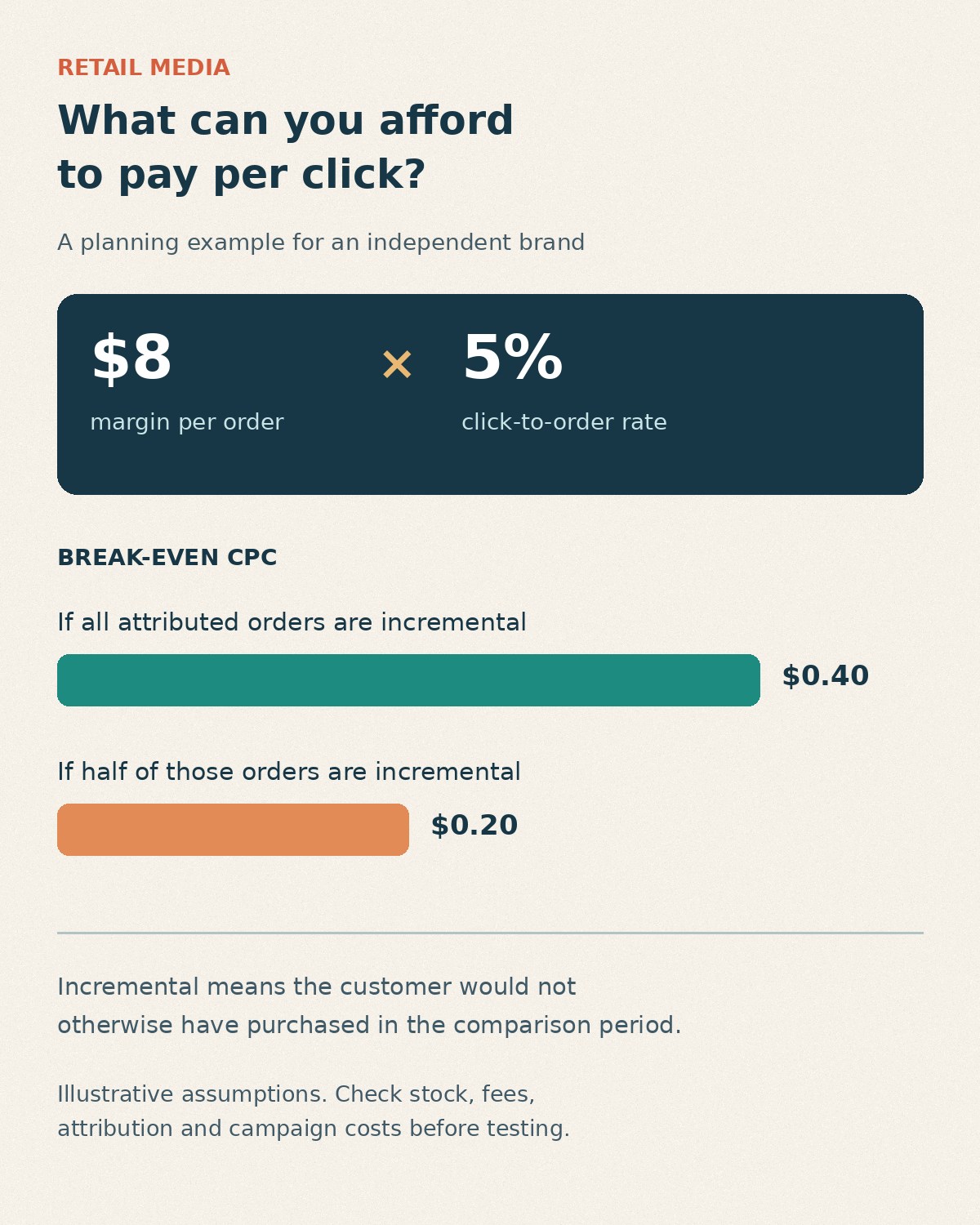
Suppose a hypothetical brand sells a product for $24 and retains $8 in contribution margin after product costs, retailer fees, fulfillment and expected returns, before ads. If 5% of paid clicks generate a sale and every attributed sale is incremental, the break-even cost per click is $0.40 ($8 × 5%). If only half those orders are incremental, the illustrative ceiling falls to $0.20. These figures are a planning example, not platform benchmarks.
- Choose one retailer, one group of in-stock SKUs and one sales objective.
- Write down the account requirements, ad fees, attribution window and minimum budget before launch.
- Track ad-attributed orders alongside total orders, contribution margin, price changes and stockouts. Keep a comparable market or SKU group where feasible.
- Review the results against the break-even rule. Use the next test to investigate what changed rather than expanding spend based on attributed revenue alone.
A useful first campaign does not need to cover every retailer. Pick the place where your product is available, make sure the listing is ready, and set a bid your margin can support. If you are still deciding where retail media fits, start with the broader retail marketing guide, then choose the network that matches your eligible assortment and the question your budget needs to answer.