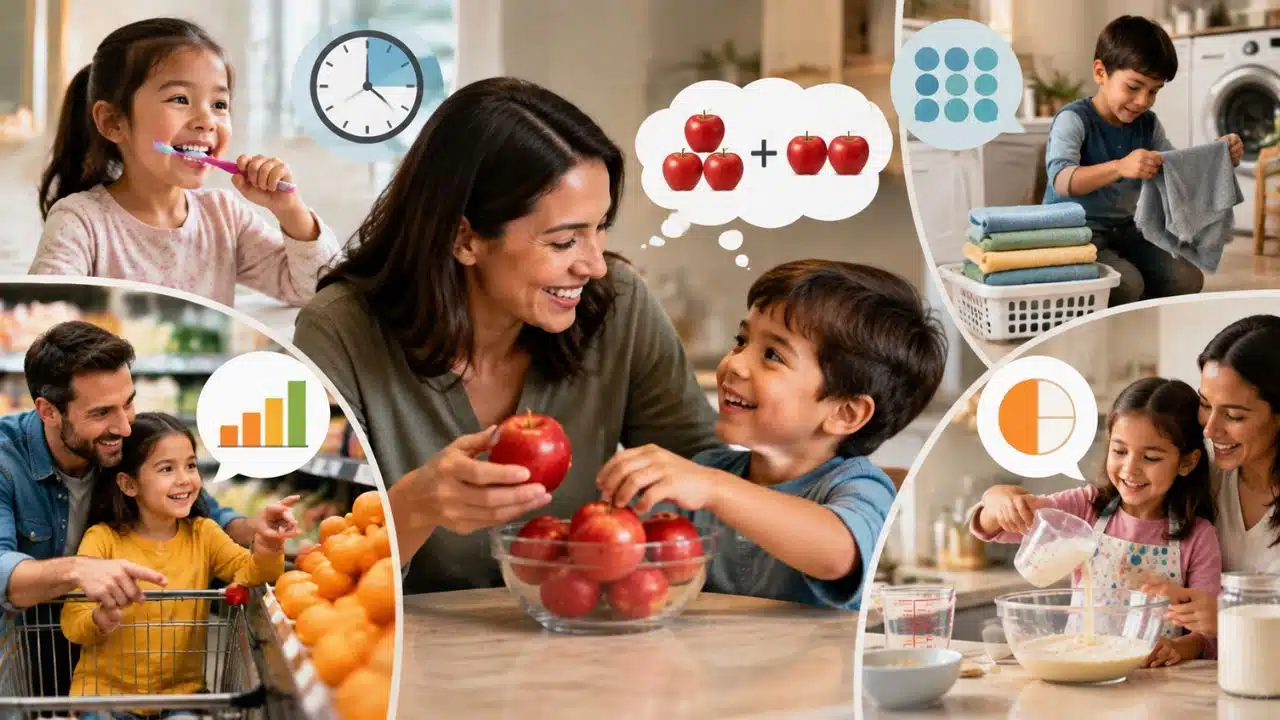
Parents are often told to practice early math at home, but that advice can sound like one more lesson to plan. Most households do not need extra worksheets, number cards, or a special “math time.” The material is already there: plates at breakfast, socks in the laundry, steps outside, containers in the bath, and the order of the bedtime routine.
Talking about math during daily routines means drawing a child’s attention to useful ideas such as quantity, size, shape, position, pattern, and sequence. A conversation may last only 30 seconds. What matters is that the child has something real to count, compare, arrange, predict, or solve.
The strongest moments usually come from a genuine problem. Are there enough cups? Which box will hold the blocks? How can six pieces of fruit be shared? Those questions give mathematics a purpose that a disconnected counting exercise often lacks.
Early Math Does Not Begin and End with Numbers
Counting receives much of the attention in early learning, but children encounter several other areas of mathematics before they can read an equation.
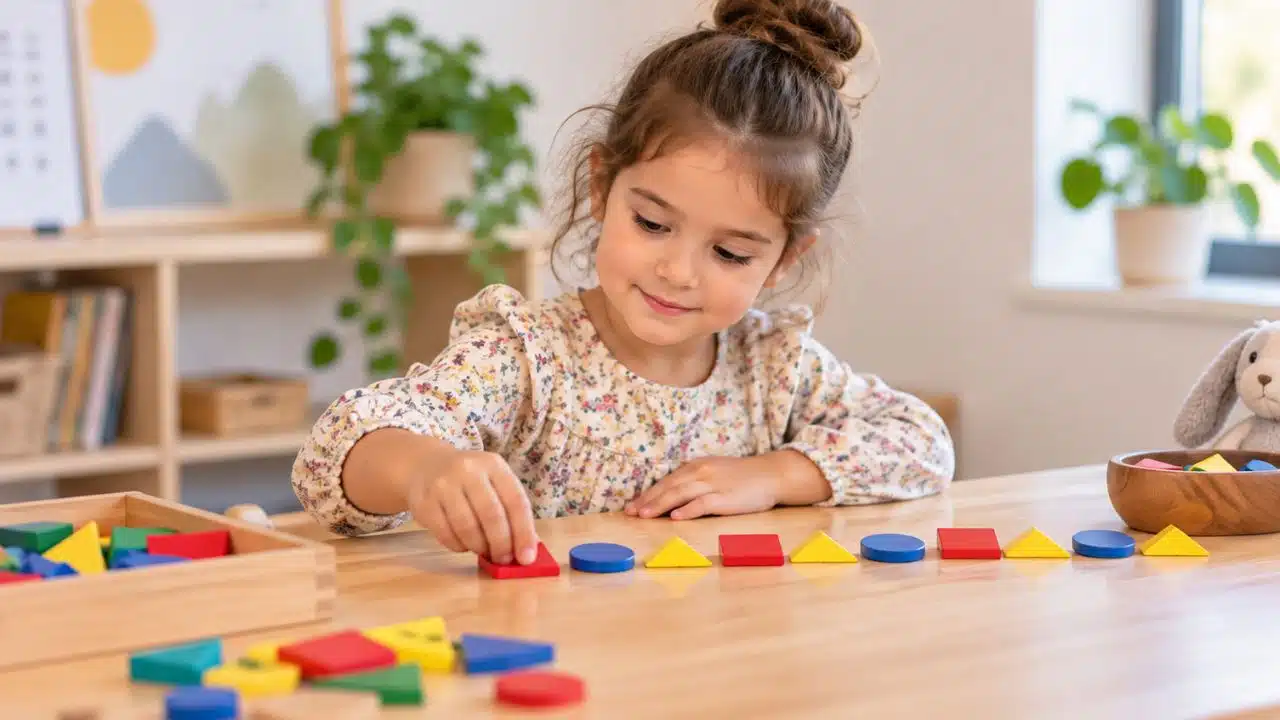
When a child separates large toys from small ones, that is classification and comparison. Arranging red and blue blocks in alternating order involves pattern recognition. Finding space for a book on a crowded shelf calls for spatial reasoning. Deciding which bottle holds more water introduces capacity and measurement.
Early math includes:
- Quantity and counting
- Comparing amounts, sizes, lengths, and weights
- Recognizing and describing shapes
- Understanding position and direction
- Finding, copying, and extending patterns
- Sorting objects by a chosen feature
- Measuring time, distance, length, weight, and capacity
- Joining, removing, dividing, and sharing quantities
- Collecting and comparing simple information
These ideas overlap during ordinary activities. Setting the table may involve counting plates, matching one cup to each person, and deciding where every item belongs.
Counting itself is more complicated than reciting number words. A child must say the numbers in order, connect one number to each object, and understand that the final number represents the total. Those parts do not always develop at the same time. A child may count to ten from memory but lose track when counting six scattered toys.
Moving each toy into a new pile can help. It gives the child a way to see which objects have already been counted.
Better Math Talk Starts with Noticing
Adults often begin by asking, “How many?” Sometimes a comment works better.
“You put all the long blocks together.”
“That bag feels heavier than this one.”
“We have four bowls, but five people are eating.”
A comment introduces mathematical language without demanding an immediate answer. It also shows the child what is worth noticing.
Questions can then open the conversation:
- What do you see?
- How could we check?
- Which one do you think will hold more?
- Do we have enough?
- What should come next?
- Can you arrange these another way?
- How did you work that out?
After asking, pause. Children may need time to understand the question, look at the objects, and decide how to respond. Repeating the question or answering it immediately can take the thinking away from them.
The response may not be spoken. A child might point, move objects, use fingers, draw, or demonstrate an idea. Those actions can reveal more understanding than a quick verbal answer.
If the child does not engage, let the moment pass. Math talk loses its value when every routine becomes an oral test.
Start with Table-Setting
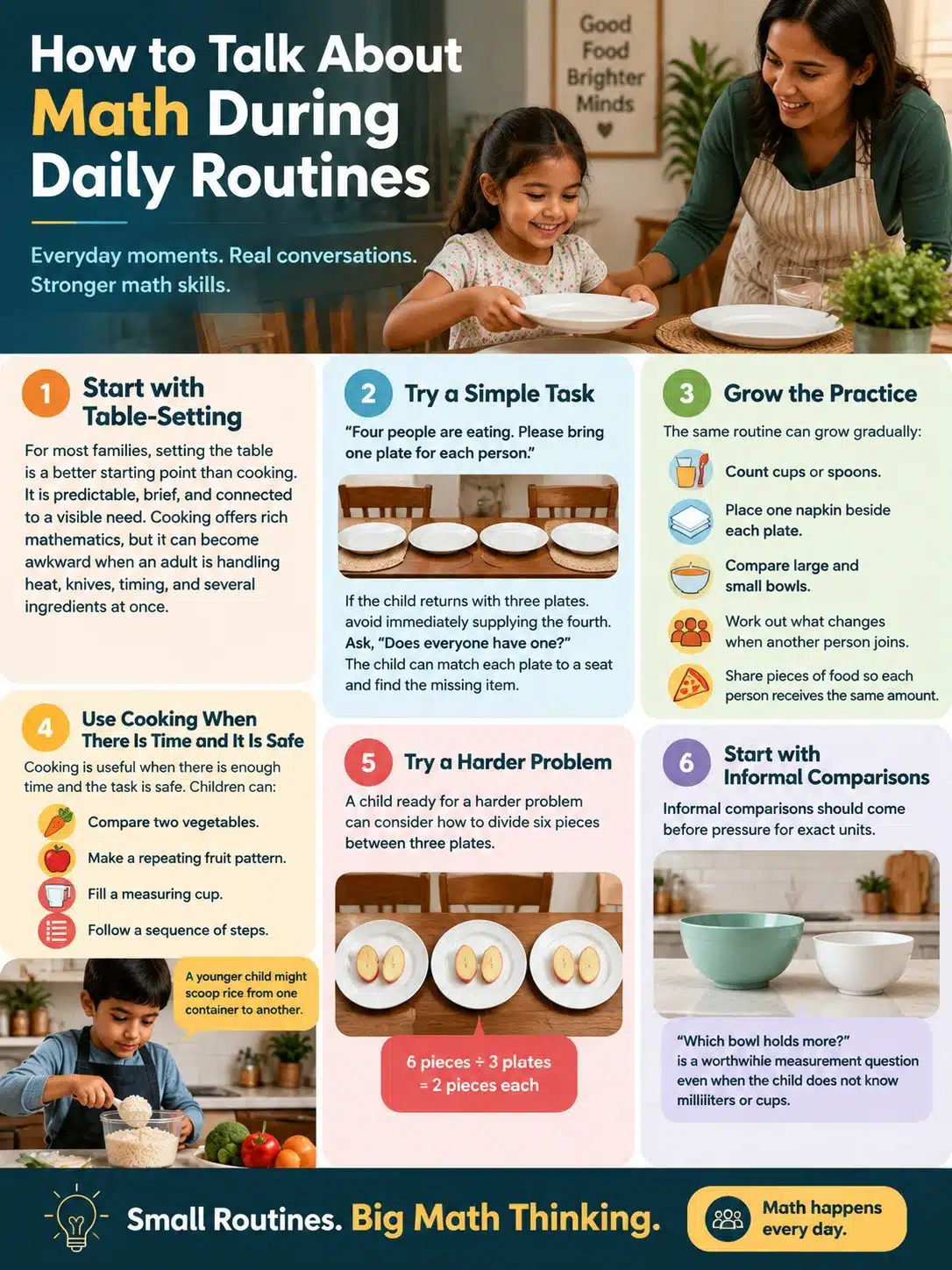
For most families, setting the table is a better starting point than cooking. It is predictable, brief, and connected to a visible need. Cooking offers rich mathematics, but it can become awkward when an adult is handling heat, knives, timing, and several ingredients at once.
Begin with a simple task: “Four people are eating. Please bring one plate for each person.”
If the child returns with three plates, avoid immediately supplying the fourth. Ask, “Does everyone have one?” The child can match each plate to a seat and find the missing item.
The same routine can grow gradually:
- Count cups or spoons.
- Place one napkin beside each plate.
- Compare large and small bowls.
- Work out what changes when another person joins.
- Share pieces of food so each person receives the same amount.
Cooking is useful when there is enough time and the task is safe. Children can compare two vegetables, make a repeating fruit pattern, fill a measuring cup, or follow a sequence of steps.
A younger child might scoop rice from one container to another. A child ready for a harder problem can consider how to divide six pieces between three plates.
Informal comparisons should come before pressure for exact units. “Which bowl holds more?” is a worthwhile measurement question even when the child does not know milliliters or cups.
Getting Dressed: Matching, Order, and Pattern
Clothing makes mathematical ideas easy to see and touch. Ask a child to find two matching socks, then talk about the features used to identify the pair. Color alone may not be enough; the design, length, or texture might also matter.
A near match can be more interesting than an obvious one:
“These socks are both blue. What makes them different?”
Children can also arrange shoes from smallest to largest, count buttons as they are fastened, or describe the pattern on a shirt.
Getting dressed brings in sequence. First comes underwear, then trousers, followed by socks and shoes. Ask what might happen if the shoes went on before the socks. The answer is practical rather than abstract, which is exactly why the example works.
Keep the conversation light on rushed mornings. A child who is already resisting shoes does not need a pattern lesson added to the disagreement.
Use Travel Time for Position and Prediction
A familiar journey can support math during daily routines without requiring extra materials. Street signs contain shapes and numbers. Buildings and landmarks introduce position. Bus or train stops create opportunities to count forward and think about what remains.
Try comments such as:
“The pharmacy is between the bank and the bakery.”
“The bus stop is farther away than the gate.”
“We passed the park, so the bridge comes next.”
A child who knows the route can predict the next landmark. An older child might estimate which part of the trip will take longer or calculate how many stops remain.
Exact answers are not always necessary. Estimation involves making a reasonable judgment and checking it against what happens. If a child predicts that five minutes remain and the journey takes longer, discuss what may have affected the estimate.
Safety limits the activity. A driver should not search for shapes, read signs aloud, or check a timer when attention belongs on the road. The passenger can lead the conversation, or the activity can wait.
Laundry and Cleanup Offer More Than Counting
Cleanup is underrated as a math activity. It already has a purpose, and the objects can often be organized in more than one reasonable way.
Laundry might be sorted by owner, color, size, or type. Toys can be grouped according to shape, material, use, or storage location. Ask the child to choose a sorting rule instead of always providing one.
A red wooden triangle can go with the red objects, the wooden objects, or the triangles. Changing the rule helps children understand that categories depend on the feature being considered.
Unexpected groups are worth investigating. If a child puts dolls, toy animals, and action figures together because they all have faces, that is a consistent classification. Ask for the explanation before rearranging the objects.
Cleanup also provides useful spatial language:
“Place the basket under the table.”
“Put the books beside the shelf.”
“Can the large truck fit behind the box?”
These words are more meaningful when following them changes where an actual object goes.
Shopping Works Best with One Small Job
A shop contains quantities, prices, shapes, weights, and comparisons, but it can also be crowded and overstimulating. Asking a young child to count everything in the cart is unlikely to improve the trip.
Give the child one real responsibility instead:
“We need five apples. Three are in the bag. What should we do next?”
The child can add two more, count the full group, or place one finger against each apple. Different strategies can lead to the same answer.
Other manageable tasks include finding the larger packet, choosing four oranges, comparing two container shapes, or checking whether an item will fit in the basket.
Price is harder than it first appears. The cheapest package may not offer the lowest price per item or unit, and labels vary between retailers and countries. For younger children, compare visible quantities. Older children can examine package size, total price, and displayed unit price when that information is available.
Water Can Show Capacity—But Supervision Comes First
Bath time and water play make capacity visible. A tall, narrow cup may appear to hold more than a short, wide one. Ask the child to predict, then pour the water between the containers to check.
Children can also count floating toys or sort them by color and type. Keep the activity simple and use objects already within reach.
Young children require active adult supervision around water. Do not turn away to collect materials, record results, answer a message, or arrange a complicated experiment. If the math activity competes with supervision, drop the activity.
Keep Bedtime Math Quiet
Bedtime is suited to sequence, position, and gentle comparison. Talk about what comes before brushing teeth, what happens after the story, or where a toy sits in relation to the pillow.
Picture books often contain shapes, groups, patterns, and changes in position. One thoughtful comment may be enough:
“There were three birds on the branch. One flew away.”
Stuffed animals can be arranged from shortest to tallest or placed beside, behind, and between one another. A child might decide whether another toy can fit on the pillow.
Avoid questioning the child on every page. If the child wants the story without a math discussion, read the story. Protecting a calm bedtime routine matters more than fitting in another learning task.
Adjust the Challenge, Not the Child
Children of the same age can differ considerably in language, attention, counting knowledge, motor skills, and familiarity with a task. Narrow age-based checklists can create unnecessary worry or push adults toward activities that are poorly matched to the child.
Watch what the child does.
If five objects are difficult to track, use two or three. If the task is solved immediately, add a small change: “What if one more person joins us?” If speech is difficult, accept pointing, matching, moving, drawing, or the child’s usual communication system.
Families can use the language in which conversation is easiest and most natural. The mathematical idea does not depend on using English terms.
Children also have days when they are tired, hungry, distracted, or uninterested. Refusing a counting question during a difficult morning says little about what the child understands.
Small Habits That Make Math Talk Less Helpful
Frequent testing is the biggest problem. A steady stream of “What shape is this?” and “How many do you see?” can make a child focus on pleasing the adult rather than investigating the problem.
Be careful about:
- Praising speed instead of strategy
- Correcting an answer before hearing the reasoning
- Choosing tasks far beyond the child’s current understanding
- Counting objects too quickly to track them
- Treating fingers, drawings, or physical objects as a weakness
- Practicing numbers while ignoring shapes, space, measurement, and patterns
- Saying “I’m bad at math” around the child
When an answer is incorrect, look at the method. A child who counts an object twice may know the number sequence but need a better way to track the objects. A child who produces a surprising category may be using a rule the adult has not noticed.
Specific feedback is more useful than broad praise. “You moved each cup after counting it, so you did not count any twice” tells the child which action solved the problem.
Final Thoughts
The most sustainable way to introduce math during daily routines is to begin with one moment that already happens every day. Table-setting and cleanup are strong choices because they involve real objects, clear purposes, and little preparation.
Make one observation. Ask one useful question. Give the child time to respond.
There is no need to extract a lesson from every meal, walk, or story. A few well-chosen conversations can help a child notice that mathematics is already part of deciding, organizing, comparing, measuring, and solving ordinary problems.
Frequently Asked Questions About Math During Daily Routines
How often should parents talk about math during daily routines?
A few short conversations each day are enough. There is no need to discuss mathematics during every meal, walk, or household task. Start with one dependable routine, such as setting the table or putting away toys, and let the conversation end when the child loses interest.
Do young children need math worksheets or learning apps?
Not for the activities described here. Children can explore counting, sorting, patterns, measurement, and spatial relationships with ordinary objects. Worksheets may help with a particular school skill later, but they should not replace play, conversation, and hands-on problem-solving.
Should families use English when discussing math at home?
Families can use the language in which they communicate most comfortably. A child can compare sizes, count objects, describe patterns, and explain a solution in any language. Clear conversation matters more than using English mathematical terms before the child is ready.
What should an adult do when a child gives the wrong answer?
Ask how the child reached it before correcting it. The explanation may reveal a small counting problem, such as skipping an object or counting one twice. Use objects, fingers, drawings, or movement to check the answer together. If the child becomes frustrated, simplify the task or return to it another time.