Cooking and food preparation provide an ideal environment for hands-on mathematical learning. Incorporating kitchen activities that teach numbers allows children to gain a concrete understanding of counting, volume, measurement, and spatial relationships through practical, everyday routines.
| Kitchen Activity | Core Math Skill | Sensory & Cognitive Focus | Preparation Level |
| 1. Cookie Sheet Subitizing | Visual pattern recognition | Tactile arrangement & instant set identification | Low (baking sheet + items) |
| 2. Measuring Cup Volume Comparison | Spatial volume & proportional reasoning | Liquid measurement & fraction intuition | Low (measuring cups + water/rice) |
| 3. Recipe Step Sequence Tracking | Ordinal numbers & sequential processing | Step-by-step logic & follow-through | Low (simple written recipe) |
| 4. Snack Portion Sorting & Grouping | Set theory & equal distribution | Categorization & division concepts | Low (snack items + small bowls) |
| 5. Kitchen Timer Countdown | Reverse counting & time magnitude | Temporal awareness & numerical decay | Zero (digital stove timer) |
| 6. Table Setting One-to-One Match | One-to-one correspondence | Physical alignment & spatial pairing | Low (plates, cups, utensils) |
| 7. Pancake & Cookie Size Scaling | Scale comparison & geometry | Visual estimation & diameter comparison | Low (batter + spatula) |
| 8. Muffin Tin Grid Array Counting | Early multiplication & array patterns | Structured spatial grids & skip counting | Low (muffin tin + berries) |
| 9. Grocery Bag Weight vs. Quantity | Weight discrimination & estimation | Physical density vs. numerical count | Medium (unpacked groceries) |
9 Kitchen Activities That Teach Numbers Naturally
1. Cookie Sheet Subitizing and Pattern Counting
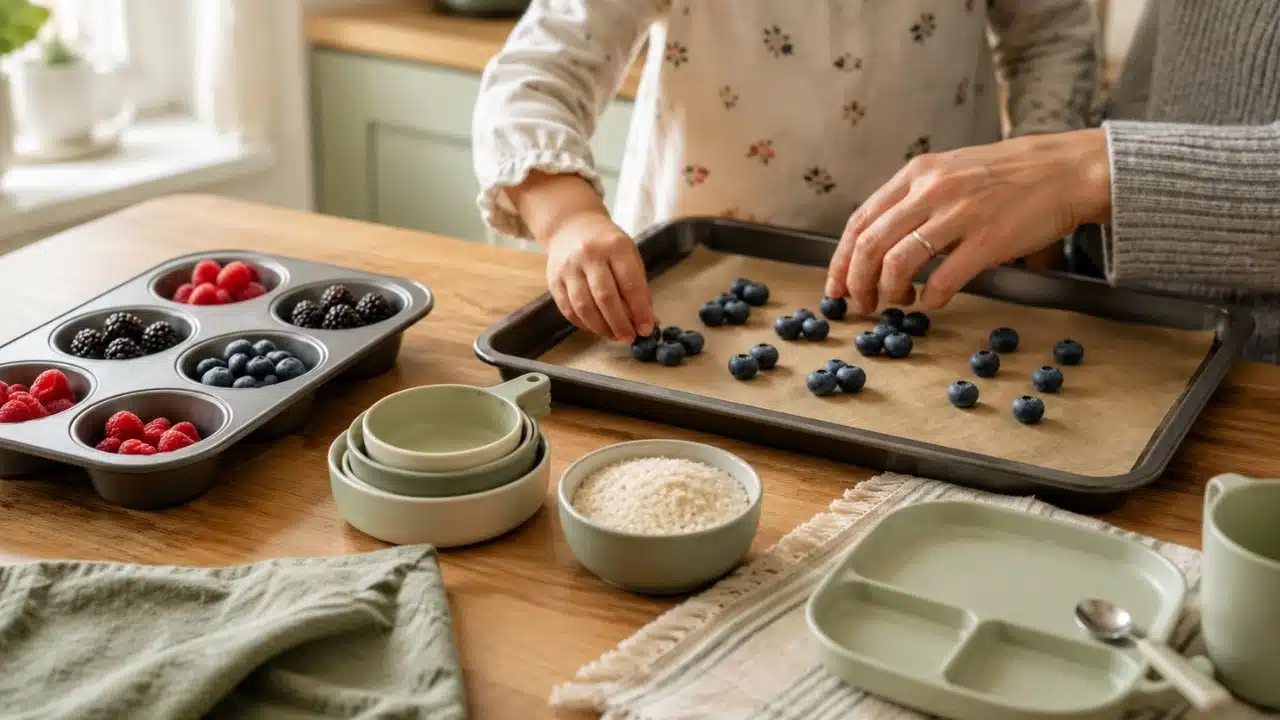
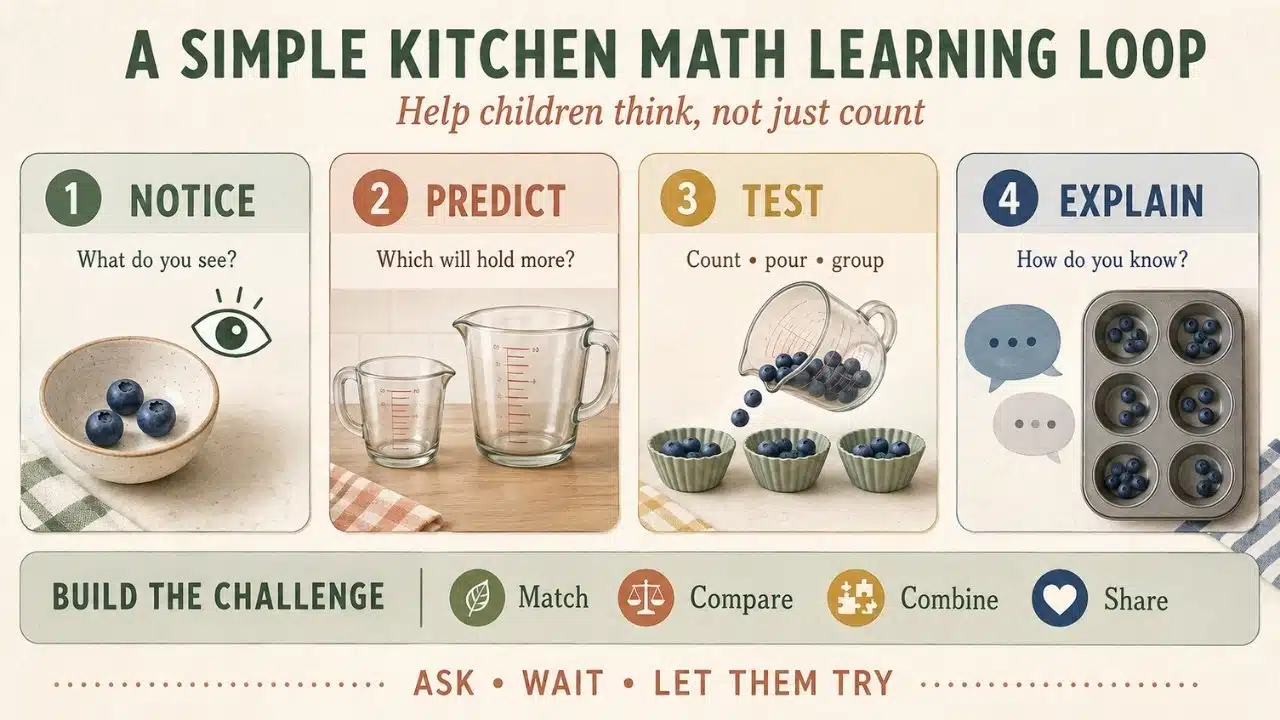
Place small food items like raisins, chocolate chips, or blueberries on a clean cookie sheet. Instead of line-counting every item, arrange them into classic die patterns (such as groups of three or four). Subitizing is the ability to recognize a small group of numbers instantly without counting each unit individually. This activity helps children bridge the gap between counting single objects and recognizing visual number patterns, strengthening spatial math reasoning.
2. Measuring Cup Volume and Fractional Intuition
Fill liquid or dry measuring cups with ingredients like flour, water, or rice. Let your child pour half a cup into a full cup to see how two smaller portions equal one larger whole. This hands-on exploration builds foundational fraction intuition long before formal pencil-and-paper math lessons begin. Children visually and physically experience volume differences, connecting numerical labels directly to real physical quantities.
3. Recipe Step Sequence Tracking
Write down a simple three-to-five-step recipe using clear ordinal numbers (1st, 2nd, 3rd). Have your child act as the head chef who announces which step comes next. Navigating sequential steps reinforces ordinal number concepts and logical ordering. Following early childhood math development frameworks, tracking sequential instructions supports executive function and helps children understand that order matters in both cooking and mathematics.
4. Snack Portion Sorting and Equal Grouping
When serving snacks like pretzels, crackers, or grape tomatoes, invite your child to divide the total collection equally into small bowls for each family member. If there are twelve pretzels and three bowls, guide them to distribute one item at a time into each bowl until none remain. This playful activity introduces early concepts of division, set theory, and fair sharing in a tangible context.
5. Kitchen Timer Countdown and Time Magnitude
Set a digital kitchen timer while waiting for bread to toast, water to boil, or cookies to bake. Encourage your child to watch the numbers count down backward toward zero. Observing a digital countdown builds familiarity with reverse counting and helps children link written digits with the physical passage of time, making abstract temporal concepts concrete.
6. Table Setting One-to-One Correspondence
Assign your child the daily job of setting the dinner table. Ask them to count the total number of people eating, then gather the exact matching number of plates, forks, and napkins. As they place one fork next to each plate, they practice one-to-one correspondence. This foundational math milestone requires matching one physical object to one specific person or spot.
7. Pancake and Cookie Size Scaling
During breakfast or baking sessions, make pancakes or cookies in varying sizes (small, medium, and large). Ask your child to arrange the finished pancakes on a platter in order of size, from smallest diameter to largest. Using interactive early learning strategies proves that comparing spatial dimensions helps children separate physical volume from numerical quantity, deepening visual-spatial discrimination.
8. Muffin Tin Grid Array Counting
Use a standard six-cup or twelve-cup muffin tin as a hands-on math grid. Place a specific number of items, such as cereal loops or sliced strawberries, into each cup compartment. Having your child count items arranged in neat rows and columns lays the groundwork for understanding arrays, skip counting (2, 4, 6, 8), and early multiplication structures.
9. Grocery Bag Weight vs. Quantity Estimation
When unpacking groceries, select two items of different sizes and weights, such as a large bag of light popcorn and a small, heavy can of beans. Ask your child to guess which item has a higher count or heavier weight before checking. This activity breaks the cognitive misconception that larger physical size automatically equals a higher numerical quantity or greater weight.
Deconstructing Kitchen Math: Why Contextual Learning Outperforms Rote Recitation
The primary flaw in traditional early math instruction is reliance on abstract worksheets that isolate numbers from physical reality. Memorizing number names without physical context often leads to superficial comprehension. The kitchen transforms abstract concepts into tangible sensory experiences where numbers represent real measurements, physical groups, and sequential actions.
Looking ahead, as early education increasingly integrates multi-sensory and inquiry-based frameworks, the kitchen serves as an ideal zero-cost laboratory. Engaging children in culinary tasks builds deep numerical intuition, spatial reasoning, and problem-solving confidence that formal testing environments cannot replicate.
Frequently Asked Questions (FAQs) About Kitchen Activities That Teach Numbers
At what age can children start learning math in the kitchen?
Children as young as two years old can participate in basic kitchen math activities, such as counting objects or identifying big versus small items. As fine motor skills develop between ages three and five, activities can progress to measuring, sorting, and tracking timer countdowns.
How does kitchen math help with fine motor development?
Manipulating small ingredients like berries, pouring liquids into measuring cups, and placing single utensils at table spots require precise hand-eye coordination and pincer grasp control. These physical movements strengthen the hand muscles necessary for writing numbers and letters.
What is the difference between counting objects and subitizing in the kitchen?
Counting objects involves pointing to items sequentially to determine a total, while subitizing is the ability to recognize a small group of items (like three blueberries) instantly without counting them one by one. Both skills are essential for complete early math development.
How can I prevent kitchen math activities from becoming messy or stressful?
Focus on low-mess activities during active cooking, such as table setting, timer tracking, or snack sorting. Save liquid pouring and dough shaping for unhurried weekend baking sessions where spills can be part of the learning process.
Does kitchen math prepare children for formal elementary school math?
Yes. Kitchen math covers foundational early childhood math standards, including one-to-one correspondence, cardinality, spatial measurement, array recognition, and basic fractions. Children who grasp these concepts through physical play adapt more easily to abstract mathematical concepts in school.