As a writer, I do not expect Google to guarantee me an audience. Publishing something does not entitle me to traffic, a high ranking, or a permanent place on the first page.
But there should still be a meaningful difference between helping readers discover a piece of work and using that work to make the visit unnecessary.
That difference is disappearing in AI search. Google continues to show links, yet it can now extract information from multiple websites, combine it into a direct response, and handle follow-up questions without sending the user elsewhere. A publisher might receive a citation, but Google keeps the reader inside its own product.
I understand why people prefer an immediate answer. If someone wants a date, definition, or straightforward instruction, opening five webpages can feel needlessly slow. Convenience matters.
What convenience does not settle is who paid to produce the information being summarized, or what happens when the original source no longer receives enough value to keep producing it.
Google’s AI Search is unlikely to destroy the web in one dramatic collapse. The more realistic concern is slower and less visible: it is weakening the exchange that made much of the searchable web financially worth creating.
The Search Bargain Has Changed
The relationship between Google and publishers was never equal, but its basic terms were easy to understand.
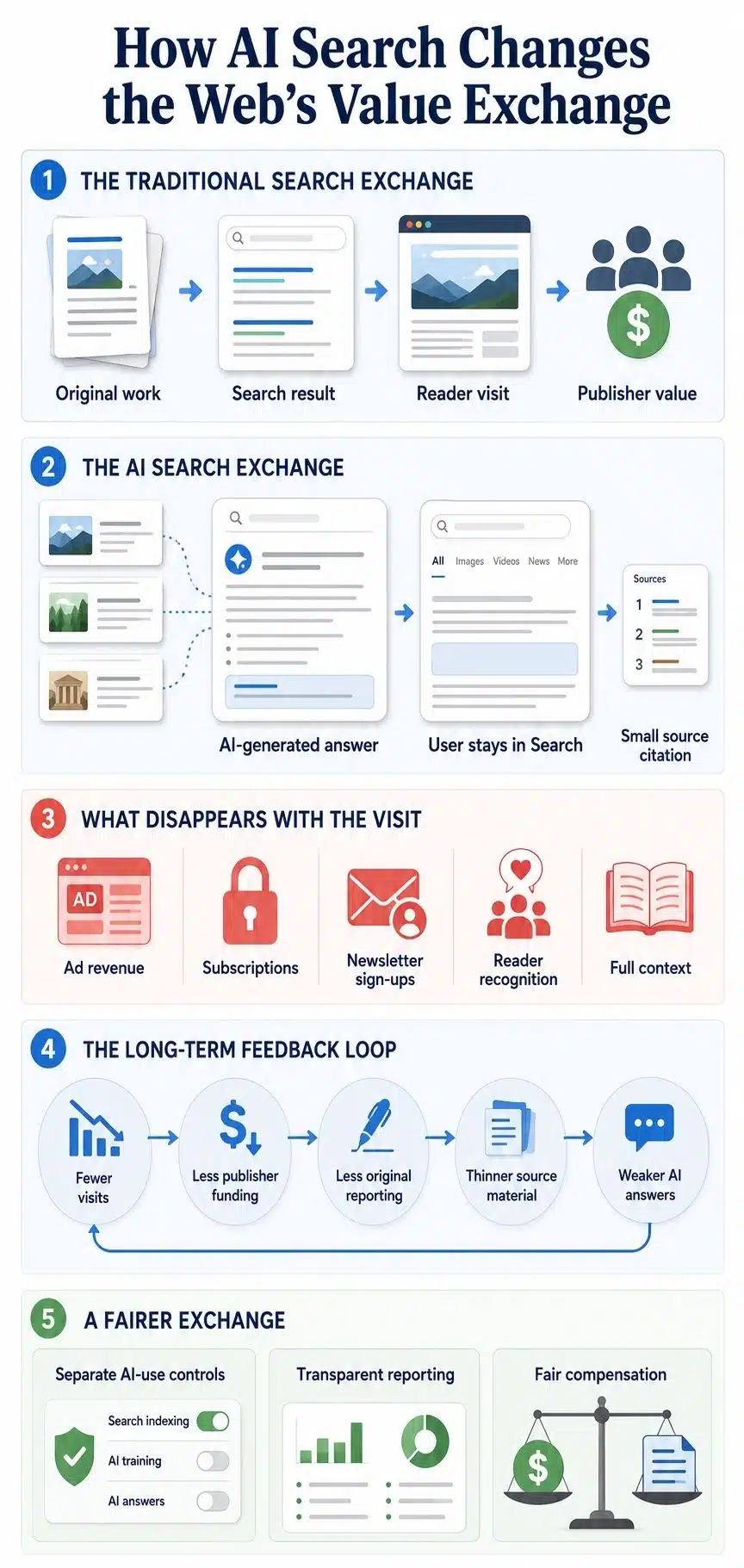
Google crawled and indexed webpages. In return, it sent some searchers to the sites supplying the information. Once those visitors arrived, publishers had an opportunity to show advertising, sell subscriptions, earn affiliate revenue, promote newsletters, or simply become familiar to a new reader.
AI Search changes that journey. Google can now crawl, interpret, synthesize, and answer. A user may get enough information from an AI Overview to finish the search without opening any of the pages behind it.
That is more significant than a new feature appearing above the traditional results. Google is moving from being a route to information toward becoming the place where the information is consumed.
The company argues that its generative results still support the web. They display citations, introduce users to a wider range of sources, and may encourage people to ask questions they previously would not have searched for.
Those benefits are possible. The unresolved question is whether they return enough value to support the work on which the generated answers depend.
A Citation Cannot Do What a Visit Does
Citations are better than unattributed summaries. They help users identify where information came from and offer a path for anyone who wants greater detail.
Still, a citation tucked into an AI-generated response is not equivalent to a reader arriving on the source website.
Pew Research Center examined 68,879 Google searches made by 900 US adults in March 2025. When an AI summary appeared, users clicked a traditional search result in 8% of visits. When no summary appeared, that figure rose to 15%. A link cited inside an AI summary received a click in only 1% of visits.
The comparison requires some care. AI Overviews appeared more often on longer, question-based searches, so the study cannot prove that the summary caused every missing click. User intent and query type also influence whether someone opens a result.
Even with that limitation, the difference is too substantial to ignore. A lost visit can mean losing advertising revenue, an affiliate conversion, a subscription opportunity, or a newsletter sign-up. It also prevents the publication from building recognition and a direct relationship with that reader.
The reader loses something as well. A condensed answer may omit qualifications, methodology, updates, corrections, or disagreements contained in the full page. A citation acknowledges the source, but it cannot reproduce the context or accountability surrounding the original work.
Being named by an answer engine and participating fairly in the information economy are not the same thing.
Google Is Becoming a Destination
AI Overviews were initially easy to treat as another search feature. Google’s wider direction now makes that description feel inadequate.
By June 2026, Google said AI Overviews had more than 2.5 billion monthly active users and AI Mode had passed one billion. It is also developing information agents that can monitor blogs, news sites, social posts, and other sources before delivering synthesized updates.
The traditional search journey required a person to inspect several results and assemble an understanding. Google can increasingly perform that process inside its own interface. Follow-up questions keep the conversation going, while agentic features may reduce the need to conduct a new search at all.
Google is also well positioned to monetize the attention it retains. Alphabet reported $63.3 billion in Google Search and other advertising revenue during the second quarter of 2026, a 17% increase from the previous year. Company executives said AI-assisted searches were creating additional opportunities to show relevant advertising.
Revenue growth at Google does not prove that AI Search directly caused publisher traffic losses. It does reveal the unequal options available to each side. Google can develop new advertising formats around AI-assisted behavior. Most publishers have no comparable way to monetize a citation that produces no visit.
Publishers Helped Create the Problem
Any honest criticism of AI Search must acknowledge that the old web was already struggling with quality.
Search results became crowded with repetitive listicles, padded introductions, rewritten product descriptions, and articles created mainly to target keywords. Some pages stretched a simple answer across 1,500 words because longer visits and additional ad impressions supported the business model.
I do not want Google to preserve that system indefinitely. Someone checking the date of the next full moon should not have to navigate a cluttered article to find it. Shallow, interchangeable SEO content deserves to lose visibility when a faster and clearer answer is available.
The difficult question is what happens when Google applies the same summarizing model to information that was expensive or difficult to produce.
Original reporting, local journalism, specialist analysis, technical tutorials, independent product tests, and firsthand reviews do not appear from nowhere. Someone had to examine the evidence, interview a source, inspect records, test a product, or spend years developing the expertise being condensed.
Calling all of that material “content” makes its production cost easy to overlook.
The Most Valuable Work May Be the Hardest to Sustain
The effects of declining search traffic will not be distributed evenly.
Large media companies can invest in subscriptions, apps, newsletters, events, and recognizable brands. They are not immune to platform dependence, but they have more ways to reach readers directly.
A small local publication or specialist website has fewer options. Search may be the main way a new reader discovers it. If Google uses its reporting to answer the query but does not deliver the visit, the publication loses immediate revenue and the opportunity to earn a returning reader.
The Reuters Institute’s 2026 Digital News Report cited Chartbeat data from more than 2,500 websites. It showed that Google organic-search traffic fell 33% globally and 38% in the United States between November 2024 and November 2025.
AI Overviews cannot reasonably be blamed for that entire decline. Ranking changes, Google Discover, evolving user habits, and differences in query types all affected publisher traffic during the same period.
The scale still matters. Publishers often fund expensive work with revenue generated across the whole site. When broad traffic falls, the first casualty may not be the disposable SEO article. It could be the investigation that takes months, the local reporter covering a public meeting, or the specialist writer whose work costs more than a generic summary.
Opting Out Is Not Yet a Meaningful Global Choice
Publishers have had limited control over how their work appears in Google’s AI features.
Google connected eligibility for AI Overviews and AI Mode to ordinary Search indexing and snippet permissions. Website owners could restrict use through controls such as nosnippet, max-snippet, or noindex, but doing so could also reduce how their pages appeared in conventional search. That is not a clean choice for a publisher that depends on Google for discovery.
Measurement has been another problem. AI Overview and AI Mode activity has generally been grouped into the broader Web category in Search Console. Publishers therefore struggle to separate conventional search performance from the effects of individual AI features.
Google has started responding. Following regulatory intervention in the United Kingdom, it began testing controls that allow selected website owners to opt out of generative AI Search features without treating that choice as a negative ranking signal. It is also developing reporting about which pages appear in AI responses.
The UK Competition and Markets Authority has required Google to provide effective AI opt-out tools, improve attribution, and allow publishers to refuse the use of their work for model fine-tuning. Google has nine months from June 3, 2026, to implement the changes.
This is meaningful progress, but it remains geographically limited and incomplete. If Google can separate traditional indexing from generative use for publishers in the UK, it should make the same distinction available globally.
Google’s Defence Is Not Frivolous
Google says overall organic click volume has remained relatively stable and argues that the clicks it sends are now more valuable. According to the company, visitors coming from AI-assisted searches are less likely to return immediately to the results page.
It also says AI features encourage new kinds of searches, expose users to unfamiliar sources, and generate more engaged visits.
Those claims should not be dismissed simply because they come from Google. The company has increased inline links, added source previews, highlighted subscriptions, and extended Preferred Sources into AI Overviews and AI Mode. It has also introduced labels intended to make original reporting easier to identify.
Google has established commercial content arrangements as well. It says agreements covering extended display rights and new delivery methods involve more than 3,000 publications, platforms, and other providers. A separate AI partnership program includes major publishers such as The Guardian, El País, Der Spiegel, The Times of India, and The Washington Post.
These agreements demonstrate that paying for enhanced use of publisher material is technically and commercially possible.
They do not solve the broader imbalance. A small specialist publisher cannot negotiate on the same terms as a global media group. Google’s aggregate traffic claims are also difficult to evaluate independently while feature-level performance remains unclear.
Better links and selective partnerships may reduce some of the harm. They do not determine whether the overall exchange is fair.
Payment Is Necessary in Some Cases, and Difficult to Design
I support licensing or revenue sharing when an AI answer substantially replaces the value of original publisher work. That does not mean every mention or short summary should generate a payment.
Linking, quoting, and summarizing have always helped information move across the web. Charging for every reference would favor large rights holders, create administrative chaos, and make it harder for smaller sources to be discovered.
The threshold should be substantial substitution: situations in which an AI product reproduces enough of a publisher’s original contribution that most users no longer have a reason to visit the source.
Drawing that line will be difficult. A payment system would need to distinguish original reporting from repeated information, assess how much each source contributed, prevent large publishers from capturing nearly all the revenue, and avoid rewarding high-volume content production over genuine value.
Those complications are real, but complexity is not a reason to pretend the economic problem does not exist. Digital advertising, music streaming, news licensing, and collective rights systems all rely on imperfect methods of assigning value. AI Search will require its own rules rather than leaving Google to decide every term.
AI Search Could Create Its Own Information Shortage
The long-term risk is a feedback loop. Publishers invest in producing original information. Google crawls and synthesizes that work. Generated responses satisfy more users without a visit. Publishers lose opportunities to earn revenue and develop direct audiences. Investment in difficult work becomes harder to justify.
Future AI answers may then draw from a web containing less original reporting, fewer independent tests, and more summaries derived from other summaries.
The web will not disappear. People publish for reputation, community, sales, entertainment, and many reasons unrelated to search traffic. Governments, universities, companies, and large institutions will also continue releasing information.
The vulnerable layer lies between hobby publishing and major institutions: independent reviewers, local outlets, niche publications, and specialist writers whose expertise is valuable but costly to maintain.
AI Search can process the work those publishers have already created. It cannot, by itself, preserve the conditions that allowed them to create it.
What a Fairer AI Search Model Requires
Removing AI from Google Search is neither realistic nor desirable. Immediate explanations, query refinement, and comparisons across multiple sources can be genuinely useful.
A fairer system would give publishers:
- Separate global controls for traditional indexing, AI Search grounding, and model training
- No conventional ranking penalty for refusing generative use
- Dedicated AI Overview and AI Mode reporting in Search Console
- Attribution connected clearly to the claims being summarized
- Independent audits of citations, traffic, and publisher visibility
- Stronger recognition of original reporting and firsthand work
- Licensing or revenue sharing when an answer substantially replaces the source
No version of this system will preserve every website or guarantee the traffic publishers once received. Nor should it protect low-quality pages from better products and changing reader habits.
The goal is a more honest exchange. When Google uses its control over discovery to build an answer from publisher work, retain the audience, and monetize the result, a citation may not be an adequate return.
Google Cannot Feed Forever on a Web It Does Not Sustain
The future of AI search should not be based on the fiction that useful information appears freely and costs nothing to produce.
Behind every worthwhile generated answer is work done somewhere else. A journalist reported the story. A researcher documented the evidence. A specialist explained the subject. A reviewer tested the product. A writer made a complicated idea understandable.
Google increasingly turns that work into a product competing with the source for the same reader’s attention.
I am not asking the company to send people through unnecessary pages when a short answer will do. I am asking it to recognize the difference between helping users navigate the web and consuming the web’s value inside its own interface.
Google does not owe publishers permanent traffic. It does, however, have a responsibility to provide meaningful choice, transparent measurement, and fair compensation when its AI products substantially replace original work.
If Google wants an open web worth searching tomorrow, it cannot keep weakening the reasons to create one today.