Local SEO explained in practical terms is the work of helping a business appear when people search for products, services, or places nearby. It includes website optimization, but it also covers map listings, business information, reviews, local links, and the searcher’s physical location.
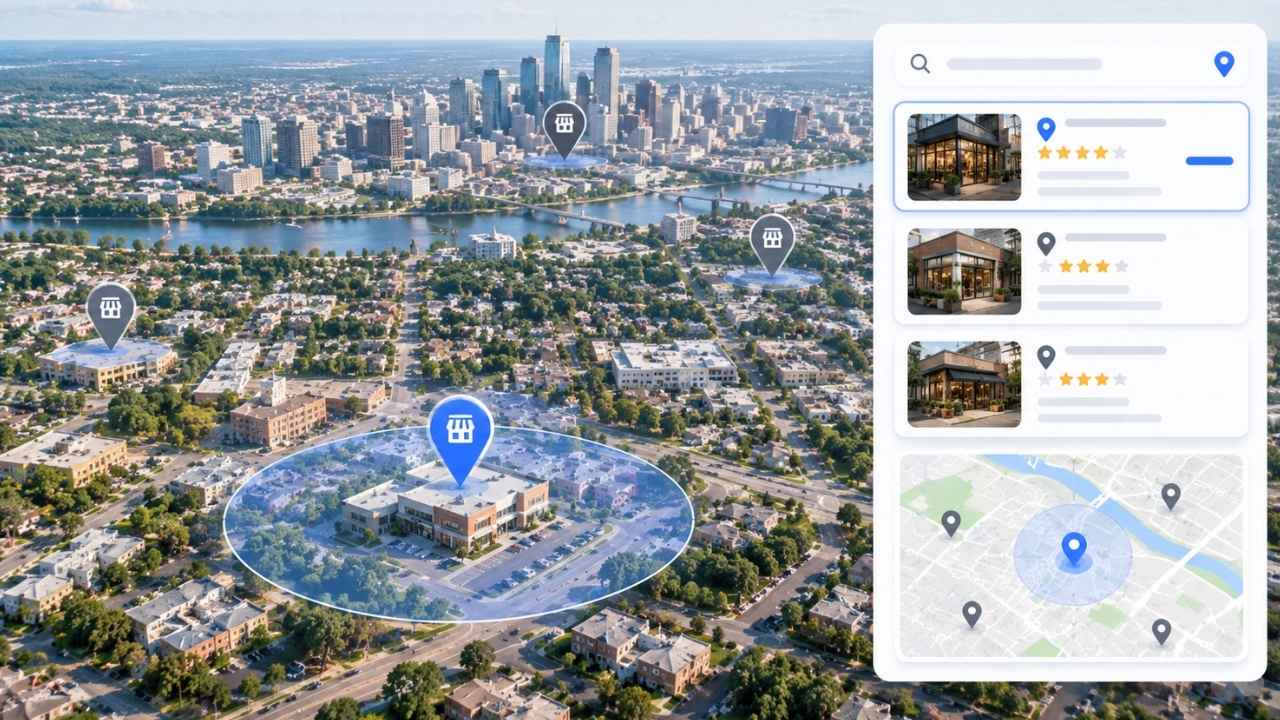
That geographic element changes how results behave. A business may appear near the top around its address and disappear a few miles away. It may perform well in Google Maps but weakly in standard organic search. A multi-location brand can be visible in one city and barely present in another.
Local SEO improves the signals a business can control. It does not remove distance, guarantee a Map Pack position, or create equal visibility across an entire market.
Local SEO Explained: The Parts That Work Together
Traditional SEO concentrates mainly on website pages and their position in organic search. Local SEO adds business entities and physical geography.
Most local campaigns involve four connected areas:
- Business listings on Google, Apple Maps, Bing, and relevant regional platforms
- Website pages explaining services and genuine locations
- Reviews, ratings, links, and local mentions
- Accurate business information across the wider web
Google can compile local listing information from a claimed Business Profile, the company’s website, licensed data, user contributions, reviews, photos, and its own interactions with a place.
That is why correcting only the profile may not solve every problem. An old address on the website, an unmanaged duplicate, or conflicting hours elsewhere can continue to cause confusion.
For most small businesses, the priority is not to appear in every directory. It is to make the important sources agree.
Where Local Visibility Appears
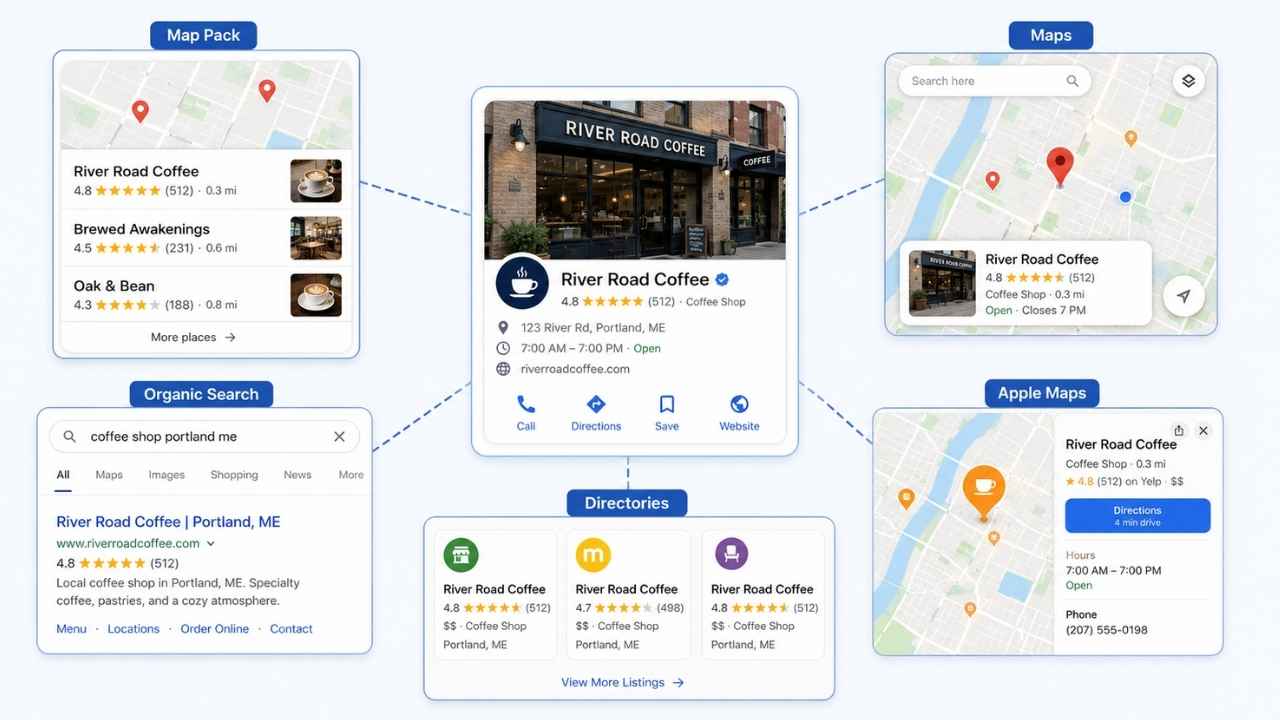
Local search is broader than the familiar group of map listings.
A business may appear in Google’s Map Pack, Google Maps, standard organic results, a business knowledge panel, Apple Maps, Bing Search, Bing Maps, or an industry-specific directory.
Google usually deserves the largest share of attention because Search and Maps often drive direct discovery. Apple and Bing are still worth claiming, particularly for multi-location brands and businesses serving customers across a broad mix of devices.
A small independent shop does not need an elaborate presence everywhere. Claim the major platforms first, then focus on the regional and industry sites customers actually consult.
How Google Chooses Local Results
Google describes three main considerations: relevance, distance, and prominence. These are useful principles, not a public scoring formula.
Relevance
Relevance measures how closely the business matches the search.
A company offering emergency plumbing and bathroom renovation may be suitable for both searches, but the intent is different. Categories, services, profile details, website copy, and information elsewhere on the web help Google understand that difference.
The primary category deserves early attention because Google confirms that categories affect local ranking. Choose the most specific available option that accurately describes the core operation. Additional categories should represent substantial secondary activities rather than every service sold.
A dental practice can be highly relevant for “dentist near me” yet weak for “emergency root canal” if neither its profile nor website clearly supports urgent treatment.
Distance
Distance reflects how far the business is from the searcher or from the place named in the query.
Someone searching for a coffee shop near Manchester Piccadilly gives Google a clearer location than someone simply searching for “coffee shop.” Results can also change as the same person moves across the city.
This is the part businesses control least. Adding service areas or repeating city names does not make the premises physically closer. One manual search from inside the office therefore gives a narrow and sometimes flattering picture of visibility.
Prominence
Prominence reflects how established or well known the business appears.
Reviews, ratings, links, articles, directories, and ordinary organic visibility can all contribute. Prominence is broader than review volume. A company with relevant regional coverage and useful local pages may look more established than one with a sudden collection of vague five-star reviews.
None of these signals overrides every weakness. A prominent business can still lose to a closer or more relevant competitor.
The Business Profile Is the Operational Centre
For an eligible business, Google Business Profile is usually the most visible local SEO asset.
Profiles are intended for businesses that meet customers in person during their stated hours, either at a location or at the customer’s location. Online-only businesses without face-to-face contact and individual properties offered for rent or sale are generally ineligible.
The profile should accurately show the real-world name, address or service-area setup, phone number, website, hours, categories, services, attributes, photos, and supported booking or ordering links.
Accuracy matters more than filling every field. A wrong category weakens relevance. A misplaced pin sends visitors to the wrong entrance. Outdated holiday hours waste a customer’s trip. A business name filled with services and locations can create a policy problem.
Google generally expects one profile per legitimate location, with defined exceptions for eligible departments and some public-facing practitioners. P.O. boxes, remote mailboxes, and virtual offices where the business does not genuinely operate are not acceptable substitutes for a real location.
The Website Provides the Missing Context
A Business Profile gives customers the basics. The website should explain enough for them to decide whether to call, book, or visit.
A useful local page makes the service, location, contact route, opening hours, and local evidence easy to find. A clinic may need practitioner information, parking, accessibility, and appointment details. A contractor may need coverage areas, project types, licences where relevant, and examples of completed work.
Each genuine branch of a multi-location business usually needs its own page. Useful differences may include the address, local phone number, staff, services, directions, photographs, facilities, and nearby landmarks.
Changing only the city name is not enough. Publishing dozens of nearly identical pages that send visitors to the same destination creates weak content and may fall under Google’s doorway-abuse policy.
LocalBusiness structured data can help search engines interpret details such as business type, address, phone number, hours, coordinates, and location URL. Keep the markup consistent with the visible page and validate it.
Structured data supports understanding. It does not guarantee a Map Pack position or special search treatment.
Reviews Influence Visibility and Choice
Reviews sit between reputation, customer service, and local SEO.
They can contribute to prominence, but their commercial value is often more immediate: people read them before deciding whom to trust. A recent, detailed review may be more persuasive than a generic five-star comment left several years ago.
The strongest review process is routine rather than aggressive. Ask after a genuine interaction, such as a completed appointment, delivered order, finished project, or resolved support issue.
Google allows businesses to request honest reviews. It prohibits discounts, free products, payments, or other incentives in exchange for posting, changing, or removing one.
Selective requests are also a problem. Sending satisfied customers to Google while diverting unhappy customers elsewhere is review gating and is prohibited.
Keep requests neutral. Do not pressure customers to leave five stars, mention an employee, or include target keywords.
Review responses deserve similar restraint. A calm reply to criticism may reassure future readers. A long public argument usually makes the complaint more visible and risks exposing information that should remain private.
Citations and Links Serve Different Purposes
A citation is a mention of the business, often including its name, address, and phone number. A backlink is a clickable link from another website.
Accurate citations reduce conflicting information. The useful ones tend to appear on major map services, chambers of commerce, professional associations, trusted industry directories, regional databases, and relevant review platforms.
Submitting the same details to hundreds of weak directories is usually overrated. Correct the platforms that customers and search systems are most likely to encounter, then move on.
Links are harder to earn and can carry stronger editorial value. A regional news feature, supplier profile, university partnership, association page, or useful community resource gives better evidence that the business is established and locally connected.
The strongest local links normally come from real business activity, not bulk submission packages.
Searcher Location Changes the Result
Two people can type the same phrase and see different businesses because they are searching from different places. Results may also shift with query wording, device context, competition, and the location Google believes the search refers to.
This makes casual rank checking unreliable.
Track searches that represent genuine demand: the main service plus city, specialist services, relevant “near me” terms, branded queries, and searches tied to valuable appointments or purchases. Check from several realistic customer locations rather than only from the business premises.
Grid-based rank trackers can show how visibility changes across an area, but they remain samples. A neighbourhood clinic does not need to rank evenly across an entire metropolitan region to attract the right patients.
Multi-Location SEO Needs Tighter Controls
More locations create more chances for information to drift.
Each eligible branch may need its own profile, website page, local hours, contact details, categories, photographs, reviews, and access permissions. Central teams should control naming, categories, page templates, tracking, and escalation. Local managers still need a process for holiday hours, temporary closures, service changes, and customer responses.
The common failure is superficial localisation. Separate pages that repeat the same content do little to help customers choose between branches.
Measure Leads, Not Just Rankings
Rankings are diagnostic data, not the final result.
Google Business Profile performance can include searches, views, calls, website clicks, directions, bookings, product views, menu interactions, and other metrics when they apply. Reports are available only for verified profiles and may combine organic activity with Google Ads activity.
Combine that data with qualified calls, forms, bookings, direction requests, leads by location, conversion rates, and revenue where tracking allows.
A ranking gain for a broad query may produce little business. A smaller improvement for a high-value specialist service can be far more useful. Look for sustained patterns rather than one screenshot showing a top position.
Local SEO Advice That Is Commonly Overrated
- “You need hundreds of citations.” Most businesses need accurate listings on the platforms that matter, not an enormous directory footprint.
- “Post on the Business Profile every day.” Posts may support communication, but they do not repair a weak category, inaccurate location, poor website, or bad customer experience.
- “Add every city you serve.” Service areas describe coverage. They do not make the business physically closer to searchers.
- “Put the service and city everywhere.” Natural local wording helps. Repetition without useful local detail makes a page worse.
- “More reviews solve everything.” Reviews matter, but they cannot fully overcome an ineligible profile, weak relevance, or a major distance disadvantage.
What to Fix First
Use a sensible order:
- Confirm eligibility, ownership, and verification.
- Correct the business name, address, phone number, hours, and map pin.
- Review the primary category and core services.
- Improve the website page linked from the profile.
- Establish a compliant review-request process.
- Correct important directories and mapping platforms.
- Build relevant local links and mentions.
- Track visibility by location and connect it with leads.
Avoid changing every field at once. Large batches of edits make the results harder to diagnose and may trigger additional verification.
Final Thoughts
With local SEO explained in practical terms, the work comes down to three questions: What does the business do? Where does it genuinely operate? What evidence shows that customers and other organisations trust it?
Start with accurate profiles and a useful local website. Build reviews through real customer interactions. Correct the platforms that matter, earn relevant local links, and measure the searches that lead to calls, bookings, visits, or sales.
Local SEO cannot eliminate geography or guarantee a Map Pack position. It can make a legitimate business easier for search platforms to understand and easier for nearby customers to choose.