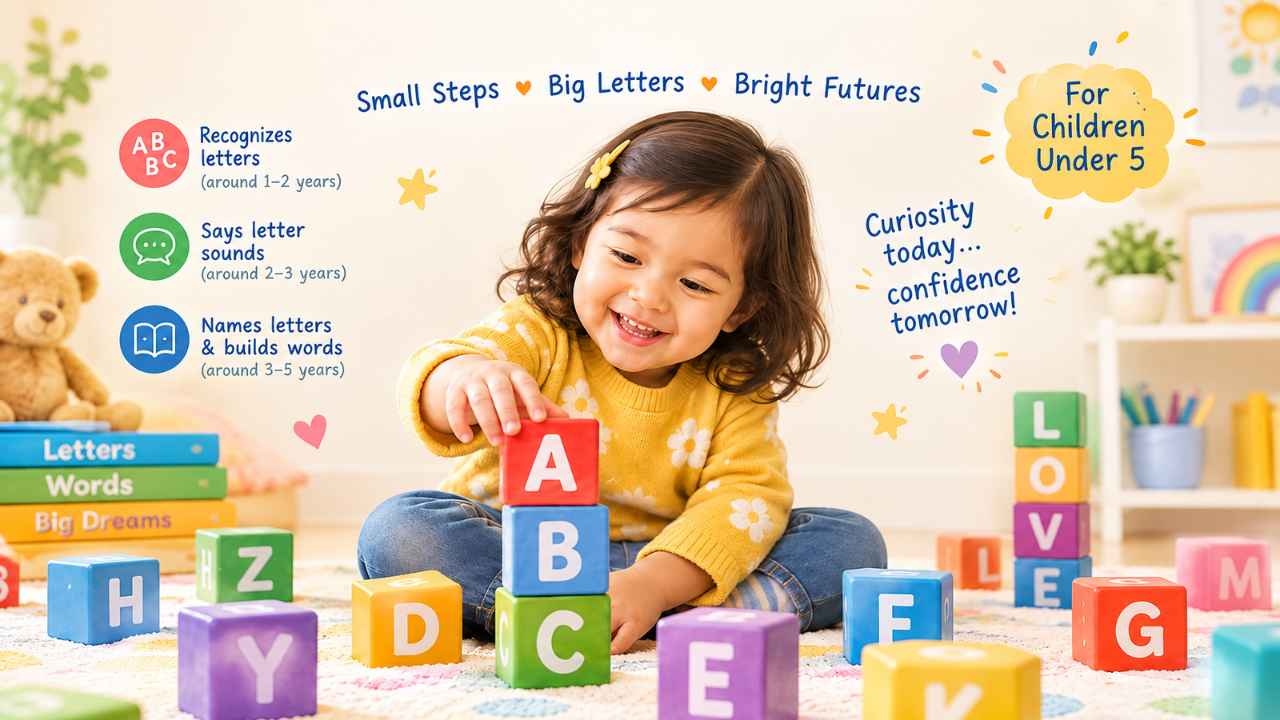
My nephew Zayan could sing the whole ABC song at three. I thought he knew his letters. He didn’t. He knew a tune. That gap is what got me tracking alphabet milestones to watch for age 5 kids, both at home with him and in my work on our kids’ app, Alphabet Magic: Trace & Phonics.
Singing, naming, writing and sounding out letters are four different skills. They show up in a rough order. Below are the nine I watch for, the numbers US early learning guides use, and the signs worth raising with your pediatrician.
What Alphabet Milestones to Watch for Age 5 Kids Look Like in Numbers
By age 5, most children can name some letters when you point to them and write some letters of their own name. That comes from the CDC’s 5-year milestone checklist. The CDC lists skills that about 3 out of 4 children have reached by that age, so it’s a floor, not a goal.
Head Start sets a higher target for the end of preschool. Kindergarten standards then ask for the full alphabet, but only by the end of the kindergarten year.
| Guide | Age | What it expects |
|---|---|---|
| CDC milestones | 5 years | Names some letters, writes some letters in their name |
| Head Start ELOF | 60 months | Names 18 uppercase and 15 lowercase letters, knows several letter sounds |
| Kindergarten standards | End of kindergarten | Names all uppercase and lowercase letters |
So a 5-year-old doesn’t need all 52 letter shapes yet. What matters more is that the skills keep moving in the right order.
The 9 Alphabet Milestones to Watch for Age 5 Kids in Order
The ages are loose. The order is the useful part.
1. Sings or Says the ABC Song (Alphabet Milestones to Watch for Age 5 Kids)
This is often the first alphabet skill parents notice. It’s real progress, but it’s memory for sound, not knowledge of letters.
Try this: point to L on its own. If your child quietly sings “H, I, J, K, L” to find it, they’re using the song as a map. That’s normal early on.
2. Holds a Crayon With Fingers, Not a Fist (Alphabet Milestones to Watch for Age 5 Kids)
This one looks unrelated, but it isn’t. The CDC’s 4-year checklist includes holding a crayon or pencil between the fingers and thumb. Without that grip, writing letters is hard and tiring.
If your 4-year-old still grabs crayons with a whole fist, skip the worksheets for now. Playdough, stickers, tearing paper and coloring build the same hand muscles with far less fuss.
3. Spots the Letters in Their Own Name (Alphabet Milestones to Watch for Age 5 Kids)
A study of 339 preschoolers found that children learn the letters in their own name earlier than other letters. The first letter of their first name had the strongest pull.
That’s why a child might know Z before A. They see it on their things every day. Put your child’s name on their cup and bag. It’s the cheapest letter lesson there is.
4. Names Some Letters When You Point to Them (Alphabet Milestones to Watch for Age 5 Kids)
This is the core skill on the CDC’s 5-year list. Test it out of order, one letter at a time.
Expect capitals to come first. Head Start’s own target, 18 uppercase and 15 lowercase, reflects that. Some letters are also easier than others. The same study found kids learn letters like B, P and F sooner because the letter name holds its sound. Letters like H, W and Y lag. “Double-you” sounds nothing like /w/, so a late W is expected.
What moves this skill is short, repeated review, not long sessions. I’ve written more on why repetition works in alphabet learning.
5. Links a Few Letters to Their Sounds (Alphabet Milestones to Watch for Age 5 Kids)
Knowing that B is called “bee” is one skill. Knowing it says /b/ is another. Head Start expects a child to know the sounds of “several” letters by 60 months. Several, not all.
This is the skill our app’s phonics side is built around: hear a sound, find the letter, then join letters into short words. On paper, you can do the same by holding up a ball and asking, “What letter does the ball start with?”
6. Hears Rhymes and First Sounds (Alphabet Milestones to Watch for Age 5 Kids)
The CDC 5-year list includes using or noticing simple rhymes, like “bat” and “cat.” Head Start adds giving a word that rhymes with “log” and noticing words that start with the same sound.
There are no letters in this one, and it still matters a lot. Reading experts point out that trouble hearing the sounds inside words is a stronger warning sign for later reading problems than mixing up letter shapes. The car is a good place to test it. “What rhymes with ‘dog’? Costs nothing.
7. Writes Some Letters of Their Name (Alphabet Milestones to Watch for Age 5 Kids)
The CDC expects “some letters” at 5. Head Start expects the first name written correctly or close to it by 60 months. Wobbly lines and odd sizes are fine.
Backward letters are fine too. Zayan mixed up b, d, p and q for a long time, and I worried. Reading Rockets notes that reversals are common in young children and are not a sure sign of dyslexia. What helped him most was matching letters to real objects around the house and doing letter hunts. A few months ago I gave him alphabet picture books, his own school bag and pencils with erasers. Now he gets up early to practice on his own.
8. Knows That Words Are Made of Letters (Alphabet Milestones to Watch for Age 5 Kids)
This is print awareness. Head Start lists understanding that written words are groups of letters and points to short words in a book the child knows by heart.
You’ll see it when your child runs a finger under the words in a favorite book or points at a sign and asks, “What does that say?” Answer every time.
9. Tries Invented Spelling (Alphabet Milestones to Watch for Age 5 Kids)
Head Start’s example is writing “K” for kite. This is the top of the ladder before kindergarten, and many kids reach it close to 5, not before.
“KT” for kite isn’t a spelling mistake at this age. It shows your child heard the sounds and matched them to letters. Praise the match. Fix the spelling much later.
When Alphabet Milestones to Watch for Age 5 Kids Seem Late
Missing one item on a checklist is not a diagnosis. The CDC’s lists are built so that about a quarter of kids haven’t hit each skill yet. Still, don’t just wait. Talk to your pediatrician or preschool teacher if, around age 5, your child:
- Names almost no letters after regular, relaxed practice
- Can’t hear rhymes or tell when two words start with the same sound
- Shows no interest in their own name in print
- Loses skills they used to have
For children 3 and older in the US, you can also ask your local public school district for a free evaluation, even if your child isn’t enrolled there.
How I Practice Alphabet Milestones to Watch for Age 5 Kids at Home
The CDC notes that 5-year-olds pay attention for about 5 to 10 minutes during activities. Zayan’s limit is about ten, so our practice stops before he gets bored.
Match practice to what your child already loves. Zayan wants to be a footballer like Cristiano Ronaldo. If your child is the same, “R is for Ronaldo” will stick faster than “R is for rabbit.”
A full disclosure: Alphabet Magic: Trace & Phonics is our team’s app. It’s free to download on iPhone and iPad and Android, and it’s ad-free. It has uppercase and lowercase tracing, letter-sound games and eight mini-games. Use it as a short add-on to books and pencils, not a replacement, and sit with your child while they play. Pediatric guidance puts quality content and shared time ahead of screen minutes.
If you want a plan to follow, here’s our daily home routine for alphabet, phonics and numbers, plus a list of the best alphabet learning games for kids.
Final Thoughts
Skip daily testing. Do one quick check this week instead. Point to five capital letters out of order. Ask what rhymes with “cat.” Ask them to write their name. Write down what you see, then check again in a month.
Alphabet milestones to watch for age 5 kids are a map, not a race. If the skills keep moving in the right order, your child is doing fine. If they stall, you’ll spot it early, and early is when help works best.