October 1 stands as one of the most transformative calendar dates in human history. Across continents, oceans, and millennia, this single day has witnessed the reshaping of global geopolitics, the founding of modern superpowers, groundbreaking leaps in space exploration and medical technology, and the births and passings of cultural icons who redefined art, music, literature, and statecraft.
Whether you are a historian mapping out the intricacies of the Cold War, a cultural anthropologist studying South Asian cinema, or simply a curious mind looking for a fascinating dinner table conversation, the historical footprint of October 1 offers something profoundly compelling. Below is a highly detailed, comprehensive chronicle of what happened on this extraordinary day in history.
At a Glance: Master Historical Timeline of October 1
The Indian subcontinent, and specifically the Bengal region, has a profound connection to October 1. The date marks critical milestones in anti-colonial resistance, the restructuring of modern statehood, and the births of legendary cultural figures who shaped the art of the region.
Major Historical Events
-
1854 – India’s First Half-Anna Postage Stamp Issued: In a major leap for communication infrastructure across the British Raj, the first half-anna postage stamps were officially issued for use throughout India. This revolutionized mail delivery, making long-distance correspondence affordable and accessible for the wider population, ultimately aiding the coordination of later nationalist movements.
-
1953 – Creation of Andhra State & Linguistic Federalism: On October 1, 1953, Andhra State was officially carved out of the Telugu-speaking districts of Madras State following the 56-day hunger strike and tragic martyrdom of freedom fighter Potti Sreeramulu. This marked the very first time an Indian state was organized strictly along linguistic lines. This monumental shift in governance closely echoed the political philosophy of the Bengali Language Movement (Bhasha Andolon) in East Pakistan, establishing linguistic and cultural identity as fundamental pillars of governance in post-colonial South Asia.
-
1958 – India Adopts the Metric System: The Indian government officially introduced the metric system of weights and measures, transitioning away from traditional and imperial units (like maunds, seers, and tolas). This economic standardization was crucial for India’s integration into global trade and modern scientific infrastructure.
-
2001 – Eighth Parliamentary Election in Bangladesh: Held under a non-partisan Caretaker Government led by former Chief Justice Latifur Rahman, Bangladesh conducted its 8th National Parliament election on October 1, 2001. The process was highly anticipated and closely monitored by international observers. The Four-Party Alliance led by the Bangladesh Nationalist Party (BNP) secured a two-thirds majority in the Jatiya Sangsad, leading to Begum Khaleda Zia taking office as Prime Minister.
-
2001 – Jammu & Kashmir Legislative Assembly Attack: A tragic and severe geopolitical event occurred on this day when a terrorist suicide attack struck the Legislative Assembly complex in Srinagar, Jammu and Kashmir, killing 38 people. The incident severely heightened diplomatic and military tensions across the subcontinent.
Expanded Biographies: South Asian Births
-
Sachin Dev Burman (S. D. Burman) (1906 – 1975): Born on October 1 in Comilla (Bengal Presidency, present-day Bangladesh) into the royal family of Tripura, S. D. Burman evolved into one of South Asia’s most influential music composers and playback singers. Burman pioneered the fusion of traditional Bengali folk music—specifically Bhatiali (river songs), Baul, and Dhamail—with classical Hindustani ragas and mainstream Indian cinematic orchestration. His iconic compositions in films such as Guide, Pyaasa, Aradhana, and Taxi Driver permanently reshaped South Asian popular culture. He was honored with the Padma Shri in 1969.
-
A. K. Gopalan (A.K.G.) (1904 – 1977): Born in Kerala, Gopalan was a fierce trade unionist, freedom fighter, and communist leader who led historic peasant revolts against colonial feudal systems. Following India’s independence, he served as the first Leader of the Opposition in India’s Lok Sabha (Lower House of Parliament) from 1952 to 1957, becoming a champion for the working class.
-
Majrooh Sultanpuri (1919 – 2000): Born in Uttar Pradesh, Sultanpuri was one of the premier Urdu poets and lyricists of modern South Asia. Over five decades, he wrote legendary, soul-stirring lyrics for Hindi-Urdu cinema and became the first lyricist to win the Dadasaheb Phalke Award (India’s highest award in cinema) in 1993.
-
Ram Nath Kovind (b. 1945): Born in Kanpur Dehat, Uttar Pradesh, Kovind rose through the ranks of Indian law and politics to serve as the 14th President of India (2017–2022). A lawyer by profession, he worked extensively for marginalized Dalit communities and served as Governor of Bihar before his presidency.
International Observances & Global Holidays
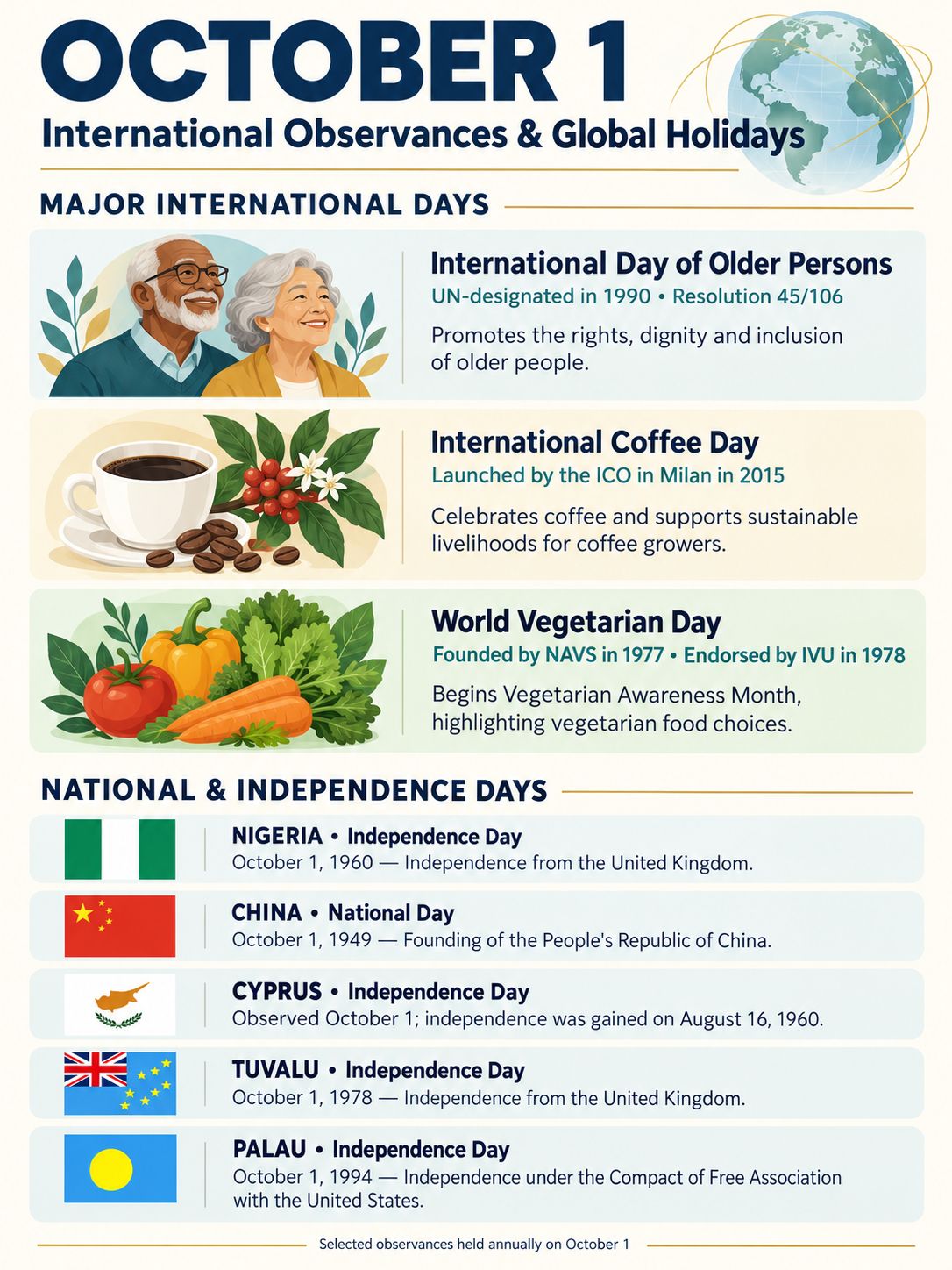
October 1 is designated for several major international awareness movements and national holidays recognized by the United Nations and sovereign governments around the globe.
Major International Days
-
International Day of Older Persons (United Nations): Established by UN General Assembly Resolution 45/106 on December 14, 1990, this day focuses global attention on the massive demographic shift toward an aging population. It promotes elder care rights, fights age discrimination in the workplace, and advocates for inclusive urban planning and lifelong healthcare access.
-
International Coffee Day: Formally launched in 2015 by the International Coffee Organization (ICO) in Milan, Italy. More than just a celebration of the beverage, this day is dedicated to advocating for the millions of coffee farmers globally, promoting supply chain sustainability, and fighting for fair trade standards to protect agricultural workers.
-
World Vegetarian Day: Founded in 1977 by the North American Vegetarian Society (NAVS) and endorsed by the International Vegetarian Union. October 1 kicks off International Vegetarian Week, promoting the ethical, environmental, and nutritional benefits of a plant-based lifestyle in a world facing severe climate challenges.
National & Independence Days
-
Nigeria – Independence Day: On October 1, 1960, Nigeria officially lowered the British Union Jack and raised its green and white flag, gaining full sovereignty to become Africa’s most populous independent nation. The day is celebrated with military parades and cultural showcases in Abuja and Lagos.
-
China – National Day of the People’s Republic of China: Commemorates October 1, 1949, when Mao Zedong proclaimed the founding of the PRC. This day kicks off the massive “Golden Week” holiday in China, marked by widespread travel, fireworks, and patriotic ceremonies in Beijing.
-
Cyprus – Independence Day: Celebrates national sovereignty gained from Great Britain in 1960, featuring a major military parade in Nicosia.
-
Tuvalu – Independence Day: Marks full independence granted by the United Kingdom on October 1, 1978.
-
Palau – Independence Day: Marks October 1, 1994, when Palau transitioned from a United Nations Trusteeship (administered by the United States) into a fully independent sovereign republic.
Global History
To truly understand the depth of October 1, we must look at how the date has served as an anchor for monumental events across North America, Europe, Africa, and Asia.
United States
-
1847 – Maria Mitchell Discovers a Comet: Using a telescope on the roof of a bank in Nantucket, Massachusetts, astronomer Maria Mitchell discovered “Miss Mitchell’s Comet.” This achievement earned her a gold medal from the King of Denmark and established her as a pioneering figure for women in STEM.
-
1890 – Yosemite National Park Created: The US Congress enacted preservation legislation creating Yosemite National Park in California’s Sierra Nevada mountains. Championed by the legendary naturalist John Muir, this law established early precedents for global wilderness conservation and the protection of ancient Sequoia trees.
-
1908 – Mass Production Breakthrough (Ford Model T): The Ford Motor Company completed the very first production Model T at the Piquette Avenue Plant in Detroit, Michigan. Retailing initially for an affordable $850, Henry Ford’s assembly-line engineering popularized civilian automotive ownership, entirely reshaping the American landscape, urban planning, and the global economy.
-
1958 – NASA Begins Operations: Emerging from the intense pressure of the Cold War Space Race (just one year after the Soviet Union launched Sputnik), the National Aeronautics and Space Administration (NASA) officially opened its doors. It absorbed the personnel and research centers of the National Advisory Committee for Aeronautics (NACA), setting the stage for the Apollo moon landings.
-
1962 – Johnny Carson Takes Over The Tonight Show: Johnny Carson broadcast his first episode as the host of NBC’s The Tonight Show, beginning a legendary 30-year run that fundamentally defined American late-night television.
-
1971 – Opening of Walt Disney World: The Walt Disney World Resort officially opened its Magic Kingdom theme park near Orlando, Florida. Built on swamp land, it transformed Central Florida into an international tourism hub and set the gold standard for global themed entertainment.
China
-
1949 – Proclamation of the People’s Republic of China: Following decades of brutal civil conflict and foreign occupation, Communist forces emerged victorious. Standing atop the Gate of Heavenly Peace (Tiananmen) in Beijing, Mao Zedong declared the establishment of the Central People’s Government of the People’s Republic of China to a massive crowd. This event shifted the balance of power in Asia and set the stage for the geopolitics of the latter half of the 20th century.
-
1955 – Xinjiang Uyghur Autonomous Region Established: The Chinese central government officially designated Xinjiang as an autonomous region, reorganizing regional governance across massive swathes of northwestern China.
United Kingdom & Europe
-
331 BC – Battle of Gaugamela: In one of the most brilliant tactical victories in military history, King Alexander the Great of Macedon decisively defeated King Darius III of Persia near modern-day Erbil, Iraq. Alexander’s forces, though heavily outnumbered, shattered the center of the Persian line. The victory destroyed Persian imperial power and cleared the path for Hellenistic culture to expand across Asia.
-
1553 – Coronation of Queen Mary I: Mary Tudor was crowned Queen of England and Ireland at Westminster Abbey. She officially became England’s first undisputed queen regnant in her own right, marking a massive shift in the country’s monarchical history.
-
1936 – Francisco Franco Ascends in Spain: During the devastating Spanish Civil War, General Francisco Franco was officially named head of the Nationalist government in Burgos, Spain, initiating a dictatorship that would last until his death in 1975.
-
1969 – Concorde Achieves Supersonic Flight: The Anglo-French supersonic passenger airliner, Concorde 001, flew faster than the speed of sound (Mach 1 / 741 mph) for the first time during test flights over France. Test pilot André Turcat reported a remarkably smooth transition through the sound barrier, proving commercial supersonic travel was viable.
-
1971 – World’s First Clinical CT Scan: Medical history was revolutionized at Atkinson Morley Hospital in Wimbledon, London. Engineer Sir Godfrey Hounsfield’s brilliant invention, the EMI-Scanner (CT scanner), performed the first brain scan on a living, 41-year-old female patient, revealing a cyst in the frontal lobe. This non-invasive imaging changed diagnostics forever.
Africa & The Middle East
-
1918 – Allied & Arab Forces Enter Damascus: During the chaotic final weeks of World War I, forces of the Arab Revolt led by Emir Faisal and the legendary T. E. Lawrence (“Lawrence of Arabia”), alongside British Empire troops under General Edmund Allenby, successfully entered Damascus. This action effectively ended four centuries of continuous Ottoman administration in the Levant.
-
1985 – Operation Wooden Leg: In a major escalation of Middle Eastern conflict, the Israeli Air Force launched a long-range airstrike against the Palestine Liberation Organization (PLO) headquarters in Tunis, Tunisia, marking the furthest point the IAF had ever struck from Israeli soil.
Major Birth Anniversaries (Global)
October 1 has yielded a remarkable number of individuals who went on to lead nations, win Oscars, and revolutionize their respective industries.
Spotlights on Famous Births
-
Jimmy Carter (b. October 1, 1924): Born in Plains, Georgia, Carter served as a naval officer, peanut farmer, and the 39th President of the United States. He is best remembered for brokering the historic 1978 Camp David Accords between Egypt and Israel. In his post-presidency, he founded The Carter Center, earning the 2002 Nobel Peace Prize for decades of tireless global conflict resolution, disease eradication (particularly the near-eradication of the Guinea worm), and democratic election monitoring.
-
Julie Andrews (b. October 1, 1935): The celebrated English actress and singer who defined classic Hollywood musicals. She starred as iconic leads in Mary Poppins (1964) and The Sound of Music (1965). Her immense talent has been recognized with an Academy Award, two Emmys, three Grammys, and a BAFTA.
-
William Boeing (October 1, 1881 – September 28, 1956): The American industrialist and aviation pioneer who founded the Pacific Aero Products Company in 1916 (which he renamed Boeing Airplane Company in 1917). His vision for large-scale aircraft manufacturing effectively created the global commercial aerospace industry we rely upon today.
-
Ip Man (Yip Man) (October 1, 1893 – December 2, 1972): A legendary Chinese martial arts grandmaster of the Wing Chun style. Teaching out of Foshan and later Hong Kong, his philosophy and martial arts mastery were passed down to numerous notable pupils, most famously the global martial arts icon Bruce Lee.
The world also bid farewell to towering figures of literature, photography, music, and science on this date.
Spotlights on Famous Deaths
-
E. B. White (July 11, 1899 – October 1, 1985): A brilliant American author, essayist, and literary stylist. White authored timeless children’s literary classics that shaped millions of childhoods, including Charlotte’s Web, Stuart Little, and The Trumpet of the Swan. He also co-authored the definitive writing manual, The Elements of Style, with William Strunk Jr.
-
Tom Clancy (April 12, 1947 – October 1, 2013): The American best-selling novelist who single-handedly pioneered the modern techno-thriller genre. His intensely researched, highly detailed military fiction—such as The Hunt for Red October, Patriot Games, and Rainbow Six—spawned massive Hollywood film franchises and billion-dollar video game series.
-
Charles Aznavour (May 22, 1924 – October 1, 2018): A French-Armenian national treasure. As a singer, lyricist, actor, and diplomat, Aznavour recorded over 1,200 songs in eight languages, selling over 180 million records worldwide. Often dubbed “France’s Frank Sinatra,” CNN named him the “Entertainer of the Century” in 1998. He also passionately served as Armenia’s Ambassador to Switzerland and the UN.
“Did You Know?” Historical Trivia
To add some fascinating context to this date, here are five incredible, lesser-known facts that occurred on October 1:
-
A Presidential Hospital First: When Jimmy Carter was born on October 1, 1924, in Plains, Georgia, he made political history before even taking his first step. He became the very first United States President to be born inside a hospital. Prior to Carter, all US presidents had been born at home.
-
The “Thrilla in Manila” Heat: When Muhammad Ali fought Joe Frazier for the third and final time on October 1, 1975, the fight took place at 10:45 AM local time to accommodate international television broadcasts. The temperature inside the Araneta Coliseum, crowded with 28,000 spectators, was estimated to be nearly 120°F (49°C), turning the 14-round bout into a grueling test of human endurance.
-
The Night Concorde Broke Sound: When Concorde 001 accelerated past Mach 1 over the French countryside on October 1, 1969, test pilot André Turcat reported absolute stillness and zero turbulence inside the cockpit during the transition. The engineering was so flawless that passengers on future commercial flights could balance a coin on edge while flying faster than a rifle bullet.
-
“In God We Trust” on Paper Money: The national motto of the United States first appeared on circulating US paper money (starting with the $1 Silver Certificate) on October 1, 1957. This was a direct result of Cold War era legislation signed by President Dwight D. Eisenhower to differentiate the US from state-atheist Soviet communism.
-
The First Vegetarian Day was Born in the USA: While vegetarianism has ancient roots in Indian and Mediterranean cultures, “World Vegetarian Day” was officially established on October 1, 1977, in the United States by the North American Vegetarian Society, meant to bring global awareness to compassionate eating.
Quote of the Day
“I have one simple request: that you love one another. That you respect one another. That you find the goodness in one another.”
— Julie Andrews (Born October 1, 1935).
Final Thoughts
October 1 is a testament to the incredible density of human history. It is a day that proves how a single rotation of the earth can encompass the fall of ancient empires in Mesopotamia, the birth of modern aerospace innovation in the United States, the formation of new republics in Africa and Asia, and the arrival of artistic geniuses who would go on to score our favorite films and write our favorite books.
Reflecting on the events of October 1 provides us with a profound sense of perspective. It reminds us that history is not merely a static list of dates and treaties, but a living, breathing continuum of human ambition. The innovators, leaders, and artists we remember today laid the groundwork for the modern world we navigate, proving that our collective past is always deeply intertwined with our future.