
Email marketing is one of the few channels where the ROI case is essentially settled. It generates $36–$42 for every dollar spent, which means the debate has moved on from whether to use email. The real question is how to run it well.
That’s where the agency vs. DIY platform decision lives. An email marketing agency brings a team of specialists, a tested playbook, and contracted deliverables. A DIY platform gives a business direct control over its list, its sends, and its costs but execution falls entirely on whoever picks it up internally.
Neither option is universally better. The right choice depends on the capacity, expertise, and goals of the business at a specific stage of growth. This article covers the durable principles behind that decision so readers can make it clearly and revisit it as things change.
What Each Option Delivers
Before comparing costs or outcomes, it helps to be precise about what each option puts on the table. The gap between the two is wider than most people expect.
Agency Deliverables: What the Retainer Covers
A full-service email marketing agency typically handles strategy, copywriting, design, segmentation, automation setup, A/B testing, deliverability monitoring, and reporting — all under one retainer. The client doesn’t need to hire a copywriter separately or figure out why open rates dropped; that’s the agency’s job.
The real value is institutional knowledge. An agency running email programs across dozens of clients has already made the expensive mistakes — they know which subject line patterns suppress deliverability, which automation sequences convert, and what a healthy list looks like. They apply an existing, tested playbook rather than building one from scratch on a live audience.
The tradeoff is less day-to-day brand immersion. An agency won’t know a business’s customers the way an internal team does, at least not immediately.
DIY Platform Capabilities: What the Tool Provides and What It Does Not
A DIY email platform — think Mailchimp, Klaviyo, ActiveCampaign, or similar — provides the infrastructure: list management, campaign builders, automation workflows, segmentation tools, and analytics dashboards. Modern platforms are powerful. Automated emails can be significantly more effective at driving revenue than standard broadcast sends.
But the platform is only the tool. It doesn’t write the emails, build the strategy, manage deliverability, or tell the user what to do next. Someone inside the business has to cover copy, basic design, campaign sends, and ongoing optimization. That person needs time, skill, and attention — three things that are often in short supply when a business is also trying to grow.
The True Cost of Each Approach
Cost comparisons between agencies and DIY platforms are almost always misleading at first glance. The honest math requires looking beyond the invoice.
Agency Pricing: What the Numbers Typically Include
Agency retainers for email marketing vary widely depending on scope and specialization. Broader digital marketing agencies can run anywhere from $2,500 to $25,000 per month, though email-focused retainers often sit at the lower end of that range. What that fee typically bundles together: strategy, execution, tooling, and reporting — costs that would be separate line items in a DIY setup.
The cleaner way to evaluate agency pricing is to compare it to the fully loaded cost of doing the same work internally: staff time, platform fees, design tools, and the opportunity cost of attention pulled away from other priorities. Comparing it to a platform subscription alone misses the point.
DIY Total Cost of Ownership: Beyond the Monthly Subscription
A DIY platform subscription looks cheap on paper. The hidden costs show up elsewhere. Platform subscriptions are frequently underused because the business doesn’t have the expertise to activate every feature. Design tools, stock assets, and deliverability monitoring add up. And then there’s founder or staff time — which, priced honestly, can represent $60,000–$150,000 per year in hidden cost for a small business owner doing their own marketing.
There’s also a learning curve cost. Real budget gets spent figuring out what works and what doesn’t. That’s not wasted money if the business is committed to building internal expertise — but it’s a real cost that rarely appears in a DIY budget estimate.
When an Agency Adds Value
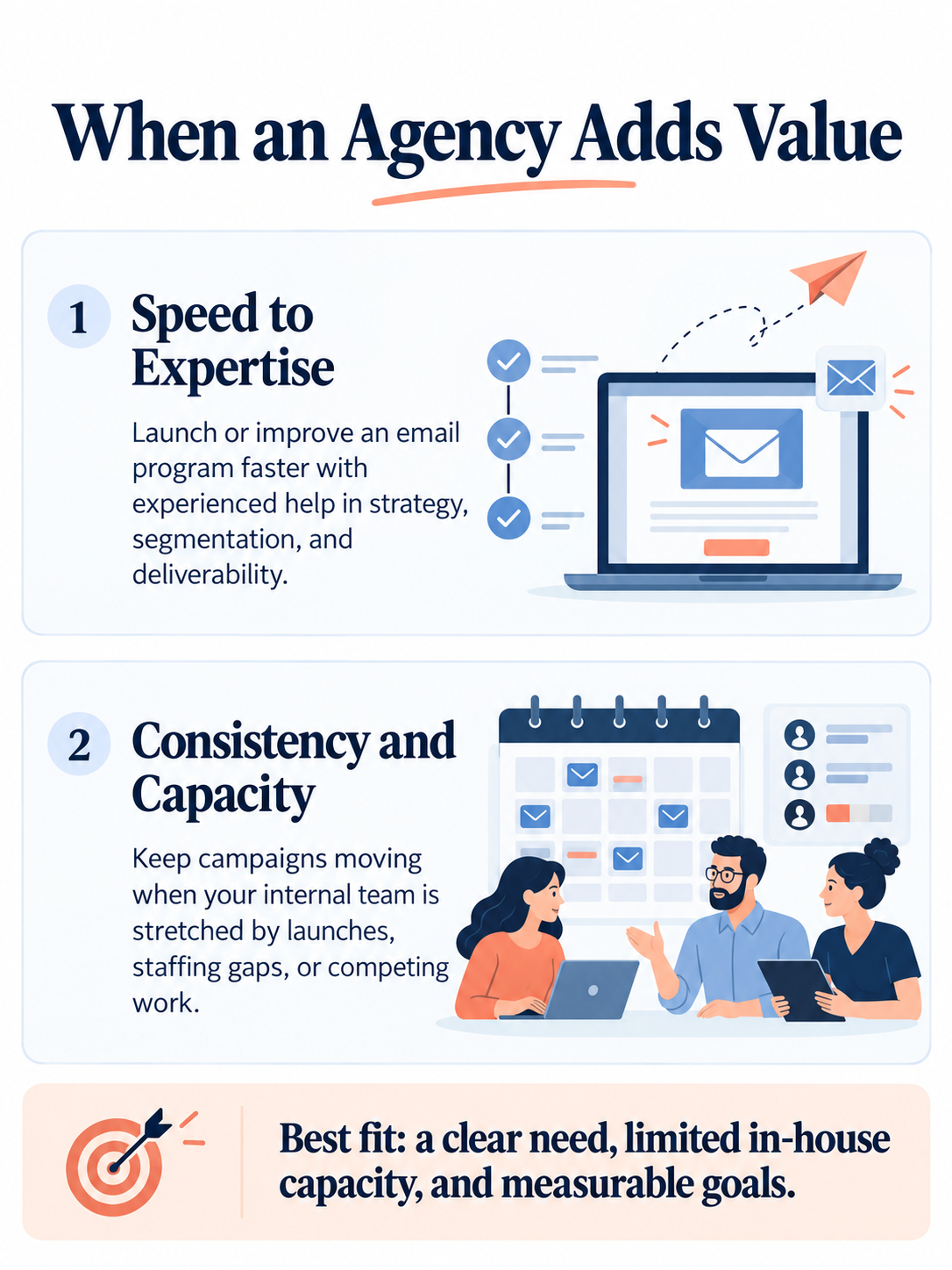
An agency earns its retainer in specific situations. Recognizing those situations is more useful than applying a general rule.
Speed-to-Expertise: Launching or Rescuing a Program Fast
When a business needs to launch an email program quickly — or fix one that’s underperforming — an agency compresses the timeline dramatically. There’s no ramp-up period for learning the platform, no trial-and-error on segmentation strategy, no guessing about deliverability best practices. The agency brings a framework that already works and applies it immediately.
This matters especially when a business has a strong product and an existing list but hasn’t built the internal capability to use either effectively. The cost of delay — missed revenue, list decay, disengaged subscribers — often exceeds the agency fee.
Consistency and Capacity: When Internal Bandwidth Runs Out
Marketing is usually the first task dropped when a business gets busy. An agency removes that variable. Contracted deliverables continue regardless of whether the internal team is dealing with a product launch, a staffing gap, or a difficult quarter. Consistency matters in email marketing — irregular sending patterns hurt deliverability and subscriber engagement over time.
For businesses where one person is expected to cover email alongside other responsibilities, an agency acts as a floor. The program keeps running even when internal capacity is stretched thin.
When a DIY Platform Is the Smarter Choice
An agency isn’t the right answer for every business. In some situations, a DIY platform outperforms the alternative.
Internal Expertise as the Deciding Factor
If a business has someone who can handle copywriting, basic design, and campaign sends — and that person has the time and interest to develop email as a skill — a DIY platform gives them everything they need. The economics shift entirely when internal expertise exists. The platform cost stays low, the execution stays in-house, and the business retains full strategic ownership.
This is often the right model for businesses testing email for the first time, where the goal is to build a baseline and understand the channel before committing to a larger investment.
Program Simplicity and Strategic Ownership
Not every email program needs sophisticated automation, complex segmentation, or multi-channel orchestration. A business sending a weekly newsletter, a welcome sequence, and a promotional campaign each month doesn’t need an agency to manage that. A well-configured DIY platform handles it cleanly.
There’s also a strategic argument for keeping email in-house: the team that runs the program develops institutional knowledge about the audience. That knowledge compounds over time and becomes a genuine asset — one that lives inside the business rather than in an agency’s account.
The Hybrid Model: Internal Ownership With External Expertise
The agency vs. DIY framing implies a binary choice. In practice, many businesses land somewhere in between.
How the Hybrid Structure Works in Practice
In a hybrid model, the business owns the platform, the list, and the strategic direction. An agency or specialist — sometimes a freelancer, sometimes a boutique shop — handles specific execution gaps: copywriting, template design, automation builds, or quarterly audits. The internal team manages day-to-day sends and maintains audience knowledge; the external partner brings depth on the technical or creative side.
This structure keeps costs lower than a full retainer while filling genuine skill gaps. It also means the business retains its data and its list regardless of what happens with the external relationship.
When Hybrid Works — and When It Does Not
Hybrid works well when a business has a capable internal owner for email but specific gaps that need filling. It’s also a natural transition point — businesses often move from full DIY to hybrid as their program grows, then evaluate whether to bring everything in-house or hand more off to an agency.
It doesn’t work well when accountability is unclear. If neither the internal team nor the external partner owns the strategy, the program drifts. The hybrid model requires a clear internal point person who can direct external contributors and own the results.
Final Thoughts
The email marketing agency vs. DIY platform decision comes down to fit, not objective superiority. The right choice reflects where a business is right now — its internal capacity, its expertise, and what it needs from email at this stage of growth.
The right answer at launch often isn’t the right answer at scale. A business that starts with a DIY platform to build baseline knowledge may eventually need an agency to grow beyond what one person can manage. A business that starts with an agency may eventually build enough internal expertise to bring the program in-house.
What matters most is making a deliberate choice and committing to it consistently. The businesses that grow their email programs fastest aren’t necessarily the ones with the biggest budgets — they’re the ones that match their execution model to their stage, then actually execute.
Frequently Asked Questions: Email Marketing Agency vs DIY Platform
Can a Business Switch From DIY to an Agency Without Losing Its List or Data?
Yes — and this is one of the most common concerns, so it’s worth addressing directly. A business’s email list is its own asset. Reputable agencies work within the client’s existing platform account or migrate the list cleanly to a new one. No subscriber data should be lost in a properly managed transition. Before signing any agency agreement, businesses should confirm in writing that they retain ownership of their list and all campaign data.
How Do Businesses Measure Whether an Agency Is Performing?
The core metrics are the same regardless of who runs the program: open rates, click-through rates, conversion rates, revenue attributed to email, and list growth. An agency should provide regular reporting against agreed benchmarks and be able to explain what’s driving changes in either direction.
If an agency can’t clearly connect their work to business outcomes, that’s a problem. Businesses should agree on reporting cadence and KPIs before the engagement starts.
Is a DIY Platform Viable for a Large or Complex Email Program?
Yes, but the complexity shifts to the internal team. Enterprise-tier DIY platforms — Klaviyo, HubSpot, Salesforce Marketing Cloud — can handle sophisticated segmentation, advanced automation, and large list volumes.
The platform itself isn’t the limiting factor; the question is whether the internal team has the expertise to configure and optimize it at that level. Large programs run entirely in-house typically require at least one dedicated email specialist, not a generalist splitting time across channels.
What Should a Business Look For When Evaluating an Email Marketing Agency?
A few things matter more than others: relevant experience in the business’s industry or model, a clear explanation of what’s included in the retainer, transparent reporting with defined KPIs, and explicit confirmation that the client owns their list and data. References from current or past clients are worth requesting.
Businesses should also ask how the agency handles deliverability issues and what their process looks like when a campaign underperforms — the answer reveals how accountable they are.