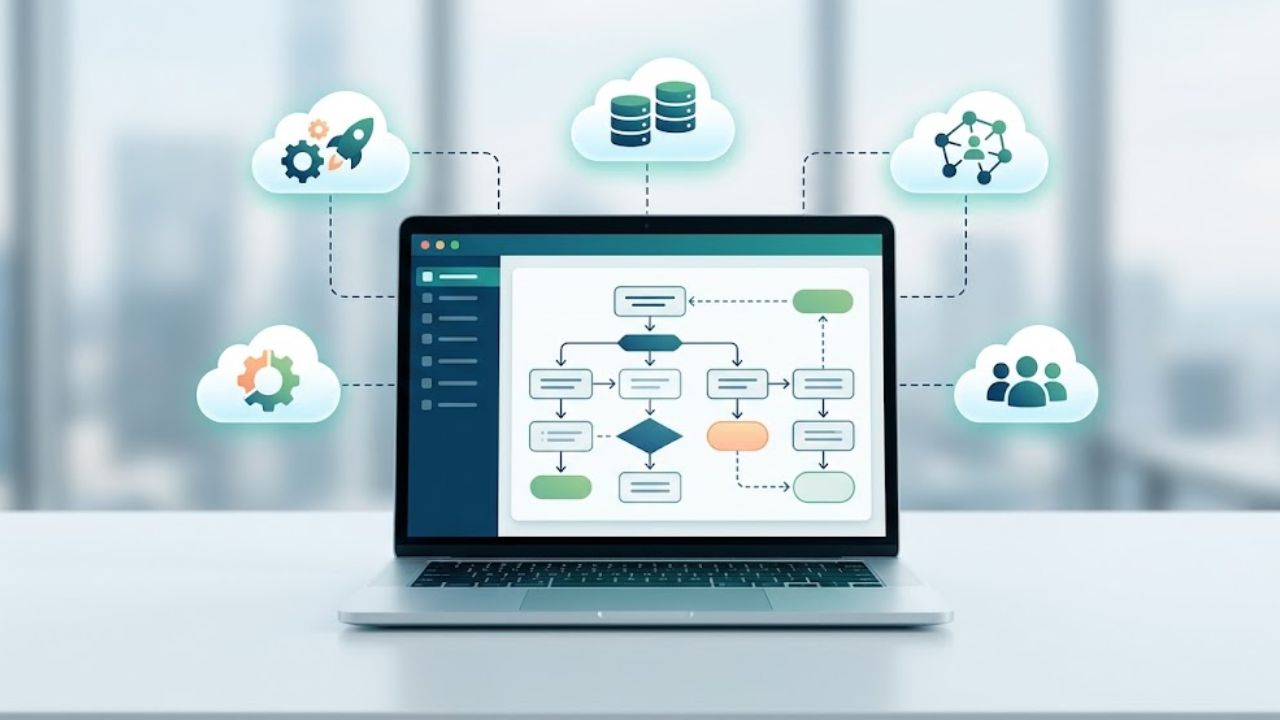
An AI task automation architecture is the software framework that connects artificial intelligence models with traditional enterprise software to execute end-to-end workflows safely.
While AI models excel at natural language understanding, intent classification, and flexible decision-making, conventional code handles calculations, credentials, database writes, and business rules.
Treating the language model as a component rather than the entire system prevents operational fragility. By placing strict validation checks, permission boundaries, and state logging between model recommendations and real-world execution, a dependable automation architecture ensures scalable, secure, and repeatable business operations.
What AI Task Automation Architecture Means

AI task automation architecture is the technical structure that allows a system to receive a task, collect relevant information, decide what should happen next, use approved tools, and return or execute a result.
The design may use a fixed workflow, an agentic loop, or a combination of both.
A fixed workflow follows steps chosen in advance by developers. An agentic system has more freedom to select tools and determine the next action from the information it receives. Most production systems work better somewhere between those extremes: code controls the broad process, while the model handles a few decisions that would be difficult to express through rigid rules.
Consider an expense-review system. Ordinary code can confirm that a receipt exists, check whether the amount exceeds a policy threshold, validate the currency, and verify that required fields are present. A model may classify an unclear expense description or explain why an unusual request appears to conflict with policy. A manager can review genuine exceptions.
There is little reason to ask a language model to perform a calculation, database lookup, or permission rule that normal software can execute more cheaply and consistently.
The Pieces Behind the Automation
Most AI-enabled workflows contain the same broad layers, even when the products and platforms differ.
The trigger and intake layer receives the original event: a form submission, uploaded document, support message, scheduled job, webhook, or database update.
An orchestrator controls the sequence. It decides which step runs next, how long the workflow may continue, what happens after a failure, and when the system should stop.
The model layer handles tasks such as intent classification, information extraction, drafting, summarisation, or selecting a possible next action.
A retrieval and context layer supplies the information the model needs, including policies, account records, documents, conversation history, or earlier workflow results.
The tool gateway exposes approved APIs and functions. It acts as the boundary between generated output and real systems.
The execution layer performs the actual operation: querying a database, updating a record, creating an event, running code, or sending a request to another service.
Finally, the system needs durable state, validation, approval controls, and observability. Without those pieces, it becomes difficult to recover from failure or explain why an action occurred.
These layers solve different problems. Prompt editing will not fix weak access controls. A more capable model will not stop a duplicate payment caused by unsafe retry logic.
How a Task Moves Through the System
A customer refund request shows how the architecture works because it combines natural language, account data, company policy, calculations, and a potentially consequential action.
The Request Becomes a Trackable Job
A customer submits a message saying that a recent purchase did not work and asks for a refund.
The intake service records the message, assigns a job identifier, and checks that the request contains enough information to continue. It may validate the account reference, inspect attached files, normalize dates, and reject unsupported formats.
The identifier is more important than it appears. Webhooks can be delivered twice. Users can press a submit button again. A network timeout may cause another service to repeat the same request.
Without a way to recognize that these events belong to one logical task, the system may process the same refund twice.
Predictable Rules Run Before the Model
The architecture should handle obvious checks through normal code.
The system can confirm that the order exists, retrieve its purchase date, identify the account region, and check whether a refund request is already open. A missing order number should trigger a request for clarification rather than an AI-generated guess.
This reduces cost and narrows the work given to the model. It also keeps basic business rules out of a component that can produce inconsistent output.
Using AI for every step may sound sophisticated, but it usually creates more failure points than value.
The Context Is Assembled Carefully
The model may receive:
- The customer’s message
- The verified order record
- The applicable regional policy
- Relevant earlier support interactions
- The user’s role and permissions
- A description of available tools
- A required response format
The system should retrieve only what the task requires. Loading an entire customer history or a complete policy library can bury the relevant information, increase processing time, and expose data that the workflow does not need.
MCP is one way for applications to connect models with external resources and tools through a shared protocol. It can standardize how those capabilities are exposed, but it does not decide whether a source is trustworthy or whether a user should have access. The host application remains responsible for authentication, permissions, and context selection.
The Model Proposes What Should Happen
The model might conclude that the workflow needs to:
- Confirm the order status.
- Retrieve the current refund policy.
- Calculate the number of days since purchase.
- Determine whether the request follows the normal route.
- Draft a customer response.
- Submit the proposed refund for approval.
The important word is proposed.
The model does not gain direct authority over a payment system merely because it generates a tool request. It returns structured output that the surrounding application must inspect before anything happens.
Current agent runtimes often manage this as a loop. The model requests a tool, receives the result, and decides whether another step is needed. The loop ends when the system reaches a valid final output, asks for human input, or hits a stopping condition.
The Tool Gateway Applies Real Rules
The tool gateway sits between the model and external systems. It should treat every model-generated action as untrusted until it passes validation.
Before executing a request, the gateway may check:
- Is this tool allowed in the current workflow?
- Does the user have permission to use it?
- Do the arguments match the required schema?
- Does the account belong to the current customer?
- Does the region permit the requested action?
- Has the operation already been completed?
- Does it require approval?
A broad function such as manage_customer_account gives the model too much room to interpret what it may do.
Smaller tools create clearer limits:
- read_order_status
- retrieve_refund_policy
- draft_refund_request
- submit_refund_for_approval
Good tool design reduces ambiguity before any prompt tuning begins.
Ordinary Software Performs the Action
Once a request passes validation, conventional software calls the database, payment provider, calendar, task platform, or another service.
The result might be successful, rejected by a business rule, denied by permissions, rate-limited, or partially completed.
Known infrastructure problems belong in code. Authentication failures, network timeouts, and invalid schemas should follow explicit handling rules. Asking a model to interpret every technical error adds cost and unpredictability to problems the system already understands.
The model becomes useful again when the result is genuinely ambiguous. Two similar orders may match the request. A retrieved policy may conflict with an archived document. The customer may have omitted a critical detail.
At that point, the workflow can search again, ask for clarification, route the case to an exception queue, or stop.
Validation Comes Before Completion
A generated answer or proposed action should pass technical and business checks before the workflow accepts it.
Validation may include:
- Required fields and data types
- Calculation checks
- Source and policy matching
- Account and regional restrictions
- Duplicate-operation checks
- Content and security controls
- Approval requirements
A model-generated invoice record, for example, should not enter an accounting system until the supplier ID, currency, tax fields, amount, and totals pass normal validation.
Agent frameworks may provide guardrails around model input, output, or tool calls. These are useful control points, but they do not replace secure APIs, independent authorization, or domain-specific rules.
A second model checking the first model is also not a guarantee. It may repeat the same misunderstanding.
Fixed Workflows Are Often the Better Design
Not every AI automation needs an autonomous agent.
A fixed workflow is usually better when the steps are known:
- Extract fields from an invoice.
- Validate the totals.
- Match the supplier.
- Route mismatches for review.
- Save the approved record.
An agentic loop becomes more useful when the outcome is clear but the route changes from case to case. Investigating a complicated support complaint may require different searches, policies, account records, and follow-up questions each time.
Several lighter patterns sit between rigid automation and open-ended agency.
Routing lets a model classify a request and send it to a predefined workflow. This is one of the most useful patterns because the model makes a limited decision while the actual work remains controlled.
Prompt chaining divides a task into stages. One call extracts information, another checks it, and a later step drafts the response. The structure helps evaluation, though each extra call adds latency and cost.
Parallel processing runs independent searches or checks at the same time.
Manager-and-worker systems use one model to divide a broad task among specialized agents or tools. They can help with large research or software tasks, but they also add coordination overhead.
Multi-agent architecture is frequently overused. One agent with a small set of clear tools is usually easier to test, trace, and operate than several agents passing partial interpretations to one another.
State and Recovery Cannot Live Only in the Prompt
A demonstration may keep the entire workflow inside one model conversation. Production systems need durable state outside the model.
The system may need to record:
- Which steps have finished
- Which tools were called
- What each call returned
- Which records changed
- Whether approval is pending
- How many retries have occurred
- When the workflow should expire
- Which prompt, model, policy, and tool versions were used
Platforms such as Temporal, Azure Durable Functions, and AWS Step Functions can support stateful or durable orchestration, but their execution models differ. They are examples of infrastructure choices, not mandatory parts of every AI system.
The underlying requirement is simpler: the workflow must survive a crashed worker, temporary outage, or delayed approval without losing its place or repeating an unsafe action.
Retries Create Their Own Risks
Retry logic sounds routine until the failed step changes the outside world.
Repeating a read operation is usually harmless. Repeating “send payment,” “create order,” “delete record,” or “email customer” can produce duplicate effects.
Some workflow systems provide at-least-once execution for certain activities, which means a step may run again after a failure even if the first attempt partially succeeded. Others provide different guarantees depending on the workflow type.
The architecture should never assume that retries are harmless.
Write operations may need:
- Idempotency keys
- Checks for an existing result
- Upserts rather than blind inserts
- Transactional boundaries
- Deduplication records
- A reconciliation process for partial completion
A retry should repeat the logical request safely, not repeat the side effect without checking.
Security Changes When the Model Can Act
A system that only drafts text has a limited reach. A system connected to email, customer records, cloud storage, code execution, or financial tools can create much larger problems.
The architecture should use least-privilege access, scoped credentials, separate read and write tools, and independent authorization for every consequential action.
It may also need:
- Sandboxed code execution
- Limits on loops, spending, recipients, or record counts
- Approval for destructive operations
- Secret filtering in prompts and logs
- Audit records for external changes
- Clear revocation and timeout rules
External content introduces another threat. A webpage, email, or document may contain instructions aimed at the model rather than the human reader. This is known as indirect prompt injection or agent hijacking.
The system should treat retrieved content as data, not authority. Text inside an email should never be able to grant the agent new permissions, redefine its tools, or override application-level rules.
Telling the model to ignore malicious instructions is useful, but it is not a security boundary.
Logging the Final Answer Is Not Enough
Traditional monitoring records service errors, latency, and availability. AI automation needs a fuller execution trace.
A useful record may include:
- The original trigger
- Retrieved source identifiers
- Prompt and model versions
- Structured model output
- Tool requests and validated arguments
- Tool responses
- Approval decisions
- Retries and exceptions
- External state changes
- Token use, latency, and cost
This makes it possible to reconstruct why the system behaved as it did.
Tracing creates its own privacy problem. Recording complete prompts, customer emails, internal documents, and database results can quietly produce another sensitive-data store.
Teams should define access controls, masking, retention periods, and deletion rules before logs accumulate—not after an incident reveals how much information they contain.
Evaluation Must Cover the Full Run
A polished final answer does not prove that the automation succeeded.
The system may have retrieved the wrong customer record, called an unnecessary tool, crossed a permission boundary, or recovered incorrectly from a failed API while still producing fluent text.
Evaluation should examine:
- Workflow selection
- Retrieved records and documents
- Tool choice and arguments
- Permissions and approval handling
- Calculations and policy decisions
- Retry behavior
- External state changes
- Human intervention
- Cost and completion time
The test set also needs difficult cases: missing records, outdated policies, duplicate triggers, failed services, unclear instructions, denied permissions, and hostile content.
Clean demonstration prompts are useful for showing the happy path. They reveal very little about whether the architecture can survive real operations.
When AI Does Not Belong in the Workflow
AI is probably unnecessary when the task follows stable rules, the input is already structured, or a short script can produce the result.
It is also a poor fit when reliable evidence is unavailable, the completion condition cannot be measured, or an incorrect action would be difficult to detect and reverse.
The strongest AI task automation architecture does not maximize model usage. It gives the model a narrow responsibility and keeps predictable work inside predictable software.
A database query should remain a database query. A calculation should remain a calculation. A permission check should never depend on persuasive language generated by a model.
Final Thoughts
AI task automation architecture is not simply a chatbot connected to several APIs. It is the system of controls that determines how data, decisions, and authority move from one step to the next.
The model may interpret a request, classify an exception, or suggest a route. Retrieval supplies evidence. The orchestrator tracks progress. Tools perform actions. Durable state supports recovery. Validation and permissions limit what happens when the model is wrong.
Start with one narrow workflow. Keep deterministic rules in code, expose only clearly defined tools, design write operations for safe retries, and trace every consequential action. Test duplicate events, missing data, failed services, and hostile content before expanding the system’s authority.
A restrained architecture may look less impressive than a fully autonomous demonstration. It is far more likely to survive real users, real data, and real consequences.