

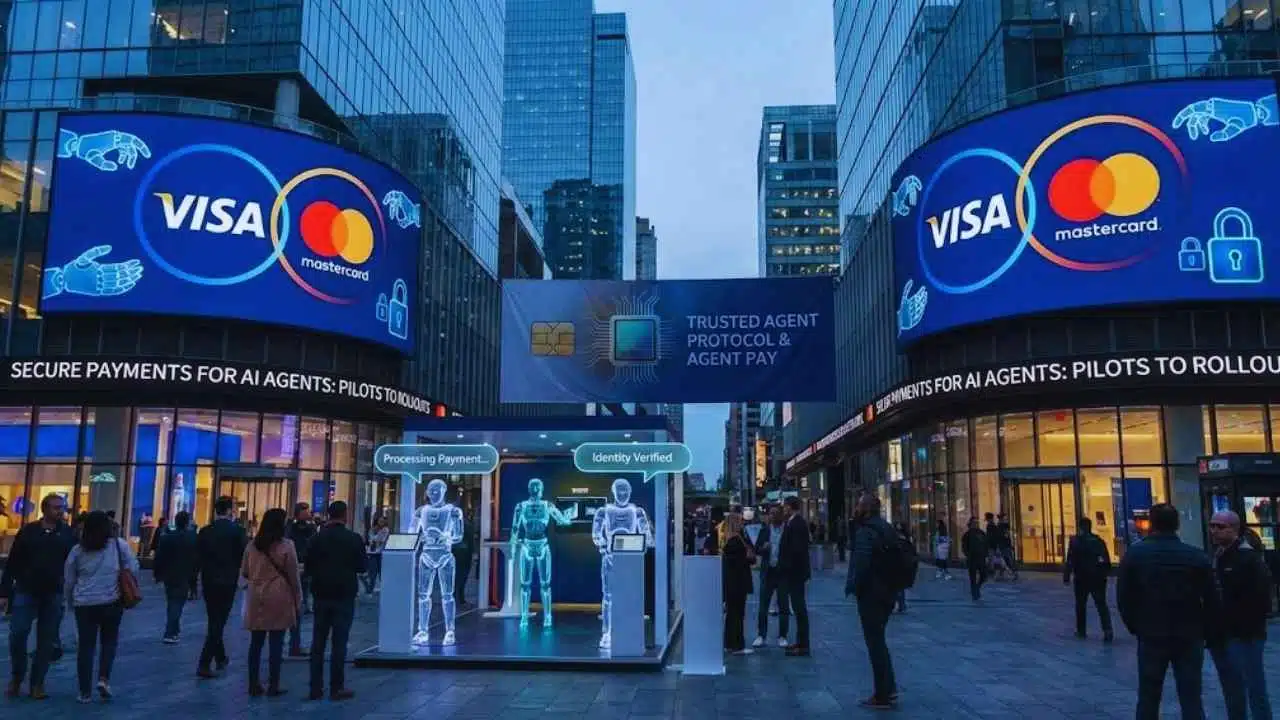
Visa and Mastercard payment systems for AI agents are moving from pilots to rollouts as chatbots begin shopping and paying inside conversations—raising new questions about security, disputes, and who is responsible when an AI gets it wrong.
What’s changing in payments as AI agents start buying
AI is shifting from “help me research” to “buy it for me.” Payment networks now want to ensure that when an AI agent checks out on a shopper’s behalf, the transaction is authenticated, permissioned, and traceable—without forcing merchants to redesign checkout from scratch.
Visa and Mastercard are positioning themselves as the trust layer for this next phase of digital commerce. In late 2025, both companies advanced specialized payment frameworks aimed at “agentic commerce,” where an AI agent can search, compare, decide, and pay—often without the user leaving the chat interface.
Visa said it completed “hundreds” of secure, agent-initiated test transactions with ecosystem partners and framed 2026 as the moment agent-driven checkout goes mainstream.
Mastercard, meanwhile, has been building on its tokenization and authentication stack—introducing agent-focused credentials and acceptance rules intended to let banks, merchants, and platforms recognize that “an approved agent” (not an unknown bot) is initiating the payment.
Why Visa And Mastercard Are Racing Into Agentic Commerce
The push is partly defensive: AI-driven traffic to retail sites has surged sharply, and the more commerce begins in AI assistants, the more payment networks risk being abstracted away into the background.
Adobe data cited by Visa points to a steep jump in AI-driven retail referrals, suggesting consumer shopping journeys are increasingly influenced by AI tools.
At the same time, AI companies are embedding checkout directly into chat. OpenAI introduced “Instant Checkout” in late September 2025 for U.S. users, starting with Etsy listings and planning expansion to Shopify merchants, with payments powered by Stripe and an “Agentic Commerce Protocol.”
That combination—AI discovery + in-chat checkout—creates a new reality for fraud prevention, customer consent, and dispute handling.
Competing Frameworks: Visa Trusted Agent Protocol vs Mastercard Agent Pay
Visa and Mastercard are taking parallel approaches: authenticate the agent, scope what it’s allowed to do, and secure the payment credential so the shopper’s real card details aren’t repeatedly exposed.
Key Differences At A Glance
| Area | Visa Trusted Agent Protocol | Mastercard Agent Pay |
| Core goal | Verify trusted agents and secure agent-to-merchant communication | Enable trusted agent payments using evolved token credentials |
| Security approach | Web-oriented cryptographic verification and authenticated agent signals | “Agentic tokens” built on network tokenization + authentication |
| Notable partners mentioned | Cloudflare collaboration for protocol development | Integrations positioned around issuers, merchants, and AI platforms |
| Status | Announced October 14, 2025; expanded pilots and partner testing in 2025 | Announced April 2025; Agent Pay acceptance framework highlighted for 2025–2026 adoption |
Visa introduced the Trusted Agent Protocol on October 14, 2025, describing it as an ecosystem-led framework for agentic commerce. Visa said the approach helps merchants distinguish legitimate AI agents from malicious bots and enables secure communication throughout the transaction.
Mastercard’s Agent Pay initiative, announced earlier in 2025, focuses on enabling payments that are “securely authorized and identified,” and it emphasizes consumer control plus protections against fraud and support for disputes.
How Visa’s Trusted Agent Protocol Works
Visa’s design centers on one core need: merchants must know whether they’re interacting with a real shopper, a legitimate AI agent acting for that shopper, or a malicious bot.
In its October 2025 announcement, Visa positioned the Trusted Agent Protocol as an “open framework” built on existing web infrastructure so merchants can verify agents with minimal checkout disruption.
Cloudflare said it worked with Visa to integrate bot-authentication capabilities into the protocol, allowing merchants to securely and transparently engage AI shopping agents at the edge—where automated abuse is often detected.
Visa has also linked this protocol work to its broader initiative, “Visa Intelligent Commerce,” which aims to let consumers use AI agents for shopping while retaining user-defined controls.
How Mastercard Agent Pay Uses “Agentic Tokens”
Mastercard’s framing centers on tokenization: rather than letting an agent handle raw card credentials, the network issues tokenized payment credentials designed for secure digital commerce.
In its press materials, Mastercard describes Agent Pay as a program that integrates with agentic AI and introduces “Mastercard Agentic Tokens,” extending tokenization capabilities already used for contactless, secure card-on-file, and other digital payments.
In December 2025, Mastercard also highlighted regional readiness where tokenization is already widely enabled, arguing that markets with high issuer tokenization coverage are primed for adoption of Agent Pay’s security and authentication model.
What “Agentic Commerce” Means For Shoppers
For consumers, the pitch is convenience with guardrails:
- The agent handles repetitive steps (searching, comparing, checkout).
- The consumer sets permissions (spend limits, merchant categories, rules).
- The payment credential is secured via authentication and tokenization.
Visa’s materials emphasize that consumers can define limits and rules while the system supports safe payment execution via verified agent flows.
Mastercard similarly stresses “complete control” over what an agent can purchase and positions its authentication stack as a way to keep transactions clearly authorized and identifiable.
The Big Unresolved Issue: Errors, Disputes, And Liability
Even if fraud is reduced, mistakes will happen—wrong item, wrong date, wrong shipping address, duplicates, or misunderstood preferences.
Traditional card disputes typically involve four main parties: the cardholder, the issuing bank, the merchant, and the acquiring bank/payment processor. Agentic commerce can add at least one more actor: the AI platform or agent provider that executed the action.
Mastercard’s public statements explicitly mention supporting consumer disputes as part of its Agent Pay design goals, underscoring that dispute flows need to work even when an agent is involved.
Visa’s approach—verifying agents and structuring authenticated intent—also appears aimed at improving traceability: if a transaction is agent-initiated, systems need clear signals about who initiated it and under what permissions.
Industry analysts and merchant-payment providers have warned that agentic checkout could reshape chargebacks and post-purchase workflows, because “intent” becomes harder to interpret when it is delegated to software.
Timeline: How Fast This Is Moving
Below is a simplified timeline of key milestones that show how quickly agentic commerce is moving from concept to commercial deployment.
| Date | Milestone | Company |
| Apr 29, 2025 | Agent Pay announced; agentic tokens + consumer control highlighted | Mastercard |
| Aug 21, 2025 | Adobe reports AI-driven retail traffic up sharply year over year | Adobe |
| Sep 29, 2025 | Instant Checkout launched in ChatGPT for U.S. users (Etsy first; Shopify planned) | OpenAI |
| Oct 14, 2025 | Trusted Agent Protocol announced; Cloudflare collaboration | Visa |
| Dec 2025 | Visa reports hundreds of secure agent-initiated pilot transactions | Visa |
| Early 2026 (planned/positioned) | Broader commercial expansion and cross-market rollouts | Visa/Mastercard |
What Merchants And Platforms Should Watch Next
Three practical signals will indicate whether agentic commerce becomes a default checkout path in 2026:
- Interoperability: Merchants will resist rebuilding checkout for every AI assistant. Protocols that reuse web standards and existing payment rails will be easier to adopt. Visa explicitly framed Trusted Agent Protocol around existing web infrastructure.
- Fraud And Bot Filtering: If agent traffic looks like bot traffic, it will be blocked. Cloudflare’s involvement signals that bot authentication and edge enforcement are central to making “good automation” acceptable to merchants.
- Dispute Clarity: The winning model will make it easier—rather than harder—to resolve “I didn’t mean to buy this” cases when a user delegated actions to an agent. Mastercard has publicly included dispute support in its Agent Pay positioning.
Visa and Mastercard are treating agentic commerce as a structural change, not a feature—building systems that can verify AI agents, enforce permissions, and secure credentials as purchases move into chat interfaces. The next phase will test whether these frameworks reduce fraud and friction without creating new confusion around disputes and responsibility. With Instant Checkout already live in ChatGPT for U.S. users, 2026 is shaping up as the year merchants, banks, and AI platforms decide what “trusted” AI-driven checkout should look like at scale.






















