Homeschooling gets overwhelming fast when every decision leads to another decision. Parents need curriculum support, records, lesson ideas, social opportunities, online classes, printables, planning tools, books, and real-world learning outside the house.
That is why the best homeschooling resources for parents are not just random links to save. They solve specific problems. A good resource helps a parent answer one of the big questions: What should we study? How do I plan the week? Where can my child learn with others? How do I track progress? What do I do when I feel completely new to this?
This guide organizes 25 practical homeschool resources into the areas most parents actually need: community, online classes, educational YouTube channels, planning apps, beginner books, free printables, and field trip ideas. It works as a broad parents homeschool guide for families that want a clearer starting point without building a messy folder of unused resources.
One important note: homeschooling rules vary by country, state, province, and local authority. Resources can help with teaching, planning, and confidence, but parents should still check current local requirements for registration, attendance, testing, portfolio records, curriculum documentation, or reporting.
Our Selection Criteria
A long list is not useful if parents cannot tell what each resource is for. This article prioritizes resources that help with real homeschool problems rather than tools that only look impressive.
The selection focused on practical usefulness, parent control, age flexibility, planning value, learning quality, community support, cost awareness, and real-world learning. A strong homeschool resource should make the week easier to manage, not add more admin.
The most useful resources usually do one of four jobs: they help parents plan, help children learn, help families connect, or help lessons move beyond screens and worksheets.
What Most Homeschool Resource Lists Get Wrong
Many homeschool resource lists mix apps, worksheets, books, curriculum platforms, Facebook groups, and YouTube channels without explaining how parents should use them. That creates more tabs, not more clarity.
A better approach is to match the resource to the problem.
If a parent feels isolated, the answer is probably community support, not another worksheet site. If the week keeps falling apart, a planning tool may help more than a new curriculum. If a child struggles with a subject, an online class or strong video channel may be better than forcing the same workbook again. If a parent is new and anxious, the right book can be more useful than another product comparison.
The best homeschooling tools fit into a real family rhythm. They should support the parent’s judgment, not replace it.
Homeschool Community Resources
Community is often the missing piece parents notice after the first few weeks. Homeschooling can be flexible and rewarding, but it can also feel lonely without other families, mentors, and local learning opportunities.
1. Local Homeschool Co-ops and Weekly Learning Groups
A local homeschool co-op can give children regular learning time with other kids and give parents a support system outside the home. Some co-ops are academic and meet for structured classes. Others are relaxed and focus on park days, science labs, art, nature walks, book clubs, or project-based learning.
The real value is shared effort. One parent may lead science experiments, another may organize writing, and another may plan field trips. That can reduce the pressure on one parent to do everything alone.
Parents should check the fit before joining. Ask about cost, parent responsibilities, class structure, religious or secular expectations, discipline policies, attendance rules, and age grouping. A co-op can be excellent and still be wrong for a family’s schedule or homeschool style.
2. State, Provincial, or Regional Homeschool Associations
Regional homeschool associations are useful because they often understand local rules, support networks, events, conventions, testing expectations, graduation questions, and record-keeping concerns better than general online forums.
These groups can be especially helpful when parents are new. They may point families toward local co-ops, legal guidance, sports groups, curriculum fairs, parent meetups, or special-interest communities.
Parents should still verify legal requirements with the latest official education authority in their area. Homeschool laws and reporting rules are too important to rely only on old blog posts, social media replies, or secondhand advice.
This is one of the first homeschool resources parents should check when they are trying to understand what homeschooling looks like locally.
3. Library Programs and Local Learning Networks
Public libraries are underrated homeschool hubs. Many offer reading programs, STEM clubs, maker activities, book clubs, research databases, language resources, museum passes, study spaces, and daytime events that homeschool families can attend.
The practical advantage is flexibility. A library can support several ages at once. A younger child may join story time while an older child uses research databases, checks out books for a unit study, or attends a coding workshop.
Parents should ask about educator cards, interlibrary loans, event calendars, meeting rooms, homeschool-specific programs, and database access. Some useful services are not obvious unless you ask.
Libraries also help keep homeschooling affordable. A parent who knows how to use the library well can build literature studies, science reading lists, history units, and project-based learning without buying every resource.
4. Nature-Based Homeschool Communities
Nature-based homeschool communities are useful for families that want more outdoor time, seasonal learning, movement, observation, and hands-on exploration. These groups may organize nature walks, outdoor play days, field trips, book clubs, forest-school-style meetups, or informal parent gatherings.
This kind of community works especially well for younger children, active learners, and families that do not want every homeschool day to happen at a desk. Outdoor learning can support science, journaling, sketching, poetry, weather observation, ecology, geography, and physical education.
The limitation is that nature groups do not replace academic planning. Parents may still need math practice, reading progression, writing instruction, and records.
For families that feel stuck in worksheets and screens, nature-based community can make homeschooling feel alive again.
Online Class Platforms for Homeschoolers
Parents do not have to teach every subject alone. Online classes can help with advanced subjects, group discussion, enrichment, writing, languages, STEM, and areas where outside instruction is simply better.
5. Outschool for Flexible Live and Self-Paced Classes
Outschool is useful when parents want flexible online classes without enrolling in a full online school. It offers live and self-paced classes for children and teens across academic subjects, creative interests, coding, languages, life skills, and enrichment topics.
For homeschoolers, Outschool works best as targeted support. A parent might use it for a writing workshop, conversational Spanish class, book club, coding class, debate group, or one-time science lesson.
Parents should check teacher profiles, class reviews, refund policies, age ranges, time zones, class size, and whether the class is live or self-paced. A class with an exciting title may still be too light, too advanced, or too discussion-heavy for a particular child.
Outschool is strongest as a flexible supplement, especially when outside instruction or peer discussion improves the subject.
6. Khan Academy for Free Core Subject Support
Khan Academy is one of the most useful free online learning resources for homeschool families. It offers structured lessons and practice across major subjects, with strong value in math, science, computing, economics, humanities, and test preparation.
For many families, Khan Academy works best for math support. Parents can use it to review a skill, assign practice, identify gaps, or give a child another explanation when the first one does not work.
The mistake is treating Khan Academy as the entire homeschool plan. Some students need books, writing, discussion, projects, hands-on work, and direct parent instruction alongside videos and exercises.
As a free support tool, it belongs near the top of any homeschooling resources for parents list.
7. Time4Learning for Structured Online Curriculum
Time4Learning is a better fit for parents who want a more organized online curriculum instead of separate videos and worksheets. It offers online lessons, activities, quizzes, printable worksheets, parent tools, and progress tracking.
This can help families that need structure. Working parents, new homeschoolers, and parents teaching several children may appreciate having lessons already arranged.
The limitation is that online curriculum can become passive if parents stop checking understanding. A child can click through lessons without fully mastering the material. Parents should still review progress, discuss lessons, add reading or writing where needed, and watch for gaps.
Time4Learning is useful when structure is the problem. It is less useful if the family already has a strong curriculum and only needs occasional help.
8. Miacademy and MiaPrep for Interactive Online Learning
Miacademy is designed for K–8 online homeschool learning, while MiaPrep supports older students. These platforms include interactive lessons, flexible pacing, parent tools, progress tracking, attendance tracking, and reporting features.
This type of platform may appeal to children who like independent digital learning and a more interactive interface. It can also help parents who want tracking built into the learning system.
Parents should trial the platform before relying on it for the year. Some children enjoy game-like learning. Others rush through it or need more paper work, reading, discussion, and hands-on reinforcement.
Miacademy and MiaPrep can be useful for families that want structure and independence, but parents still need to supervise learning quality.
Educational YouTube Channels for Homeschool
YouTube can support homeschooling when parents choose videos intentionally. It becomes a problem when recommendations take over the lesson.
9. Crash Course and Crash Course Kids
Crash Course is useful for older students who need clear overviews in subjects such as history, science, literature, economics, government, and study skills. Crash Course Kids is better suited for younger learners, especially around science and inquiry-based topics.
The main Crash Course style is fast and information-dense. That works well for teens who need a strong introduction before reading, writing, or discussion. It may be too quick for younger students or children who need slower explanations.
Parents can make it more useful with a notebook prompt, timeline, vocabulary list, discussion question, or short written summary. Passive watching is the weakest version. Active viewing turns the video into a lesson.
Crash Course works best as a supplement, not as a full curriculum.
10. SciShow Kids for Elementary Science Curiosity
SciShow Kids is a strong fit for younger learners who constantly ask “why” questions. The channel explains animals, weather, the human body, engineering ideas, nature, and basic science topics in a child-friendly way.
Parents can use it as a short science starter. A video can lead into a nature walk, drawing activity, simple experiment, read-aloud, or library book search.
The follow-up matters. Ask the child to explain the idea back, draw what happened, find an example outside, or build a small model. That keeps the video from becoming background entertainment.
SciShow Kids is not a complete science program, but it is excellent for keeping curiosity alive.
11. NASA Learning Resources and Video Content
NASA is a strong resource for homeschool families because it offers videos, STEM activities, student materials, interactive resources, and lesson support connected to real science and space exploration.
Parents can use NASA resources for astronomy, Earth science, weather, robotics, engineering, space missions, and STEM career discussions. The material connects lessons to real-world research instead of abstract textbook examples.
Some NASA resources are advanced, so parents should filter by age, grade, or topic. Younger students may enjoy simple space activities, while older students can handle engineering design, mission data, and deeper science content.
For STEM-focused homeschool families, NASA belongs in the resource stack.
12. PBS LearningMedia and NOVA for Structured Educational Video
PBS LearningMedia offers free teaching resources, including videos, lesson plans, games, and classroom materials. NOVA’s education resources are especially useful for science topics because they bring documentary-style explanation into learning activities.
This is helpful for parents who want video content with more educational structure than random search results. PBS materials can support science, history, social studies, civics, media literacy, and language arts.
The best use is selective. Search by topic, choose one resource, and add a question, worksheet, discussion, notebook entry, or project.
PBS and NOVA are useful when parents want quality media without turning the homeschool day into a playlist.
Homeschool Tracking and Planning Apps
Planning tools help parents manage lessons, records, attendance, schedules, and progress. The best tool is the one a parent can actually maintain.
13. Homeschool Planet for Full Digital Planning and Records
Homeschool Planet is a full-featured online homeschool planner for families that want lesson plans, assignments, schedules, grading, attendance, transcripts, and calendars in one place. Its automatic rescheduling can help when real life disrupts the week.
This is best for parents who want a serious planning system and are willing to set it up properly. Families with multiple children, outside classes, co-op days, several curricula, and record-keeping requirements may get more value from it than families with a very simple routine.
The risk is overplanning. A digital planner can make parents feel behind even when the child is learning well. The tool should support the homeschool, not punish the family for every schedule change.
Homeschool Planet is a strong choice when parents need structure, records, and visibility across the week.
14. Homeschool Panda for Planning, Portfolio, and Collaboration
Homeschool Panda supports lesson planning, record keeping, collaboration, access across devices, and portfolio-style documentation. It can help parents track assignments, upload images, manage tasks, organize records, and document student work.
This makes it useful for families that want more than a paper planner but do not want to build a system from scratch. It can also help when parents need to save evidence of learning through photos, activities, and work samples.
The practical concern is consistency. A beautiful system that is not updated becomes another abandoned tool.
Homeschool Panda is worth considering for parents who want planning and documentation in one digital space.
15. Syllabird for a Simpler Modern Planner
Syllabird is a digital homeschool planner built for organizing curriculum, tracking progress, and managing a family’s educational journey. It may appeal to parents who want a cleaner, simpler planning experience.
A simpler tool can be better if it gets used consistently. Not every family needs transcripts, advanced reports, complex scheduling, or detailed grading.
Parents should compare features before switching from another system. Some families need detailed compliance records. Others only need a clear weekly map.
Syllabird is useful for parents who want digital planning without turning planning into a second job.
Books for New Homeschool Parents
Tools help with logistics, but books help parents think better. New homeschool parents often need confidence, perspective, and a clearer philosophy before they need more products.
16. The Brave Learner by Julie Bogart
The Brave Learner is useful for parents who want homeschooling to feel less like recreating school at home and more like building a rich learning life. Julie Bogart focuses on curiosity, family rhythm, enchantment, and everyday learning.
This book is especially helpful for parents who feel homeschooling has become too tense, rigid, or worksheet-driven. It does not argue for chaos. It reminds parents that attention, delight, conversation, and discovery matter.
Parents who want a strict checklist may find it less direct than a methods manual. For families struggling with pressure, perfectionism, or burnout, it can reset the tone.
It is a strong book for parents who need courage and imagination, not another complicated schedule.
17. The Well-Trained Mind by Susan Wise Bauer and Jessie Wise
The Well-Trained Mind is a major resource for parents interested in classical education at home. It offers a structured approach to reading, writing, history, science, language study, and academic progression across stages.
Its value is the long view. Instead of only asking what to do this week, parents can think about how skills build over years.
The limitation is size and intensity. New homeschool parents may feel overwhelmed if they try to implement everything at once. The better approach is to read it for structure, take what fits, and avoid turning it into a pressure machine.
For parents who want academic rigor and a clear educational model, it is worth reading carefully.
18. Teach Your Own by John Holt and Pat Farenga
Teach Your Own represents a different homeschool tradition: trust in children as learners, respect for informal learning, and skepticism toward simply copying school at home.
This book is especially useful for parents exploring unschooling, relaxed homeschooling, child-led learning, or a less institution-shaped view of education. It challenges the idea that every meaningful lesson must look like a classroom lesson.
That does not mean every family should adopt a fully child-led approach. Some children need structure. Some parents need records. Some legal contexts require documentation.
Teach Your Own is best read as a perspective-shaping book, not a daily planning manual.
Free Printable Resources for Homeschool
Printables are helpful when they support a lesson. They become a problem when they replace teaching. The strongest printable resources give parents quick practice, organizers, activity sheets, maps, reading supports, or project materials without constant spending.
19. PBS LearningMedia Printable and Lesson Resources
PBS LearningMedia is useful because it offers free teaching resources beyond worksheets. Parents can find videos, games, lesson plans, and supporting materials across subjects.
For homeschool families, PBS works well when building a unit study. A parent might pair a short video with a note catcher, discussion prompt, reading activity, or mini-project.
PBS is especially useful for science, social studies, history, civics, media literacy, and current-topic learning. It also helps parents find more structured educational media than random search results.
Choose one strong resource for the lesson. Do not turn one topic into ten downloads.
20. NASA STEM Activities and Printable Resources
NASA’s STEM resources include hands-on activities, educator guides, videos, interactive features, lesson plans, posters, games, and student materials. For homeschool parents, that makes NASA more than a space-video site.
This is one of the best free options for science units because it connects printable work with real-world exploration. Parents can use NASA materials for astronomy, engineering, weather, Earth science, robotics, and STEM careers.
The caution is level matching. Some NASA materials are designed for classrooms or older students, so parents should filter by age, grade, or activity type.
NASA resources are especially valuable when a lesson should end with building, observing, testing, or discussing instead of only filling in blanks.
21. Teachers Pay Teachers Free Resources
Teachers Pay Teachers has a large free-resource section where parents can find teacher-created worksheets, lesson plans, task cards, reading passages, assessments, and activity sheets across many grade levels and subjects.
The strength is variety. If a child needs fractions practice, reading response pages, seasonal writing prompts, science notebook pages, or grammar review, there may be something useful.
The weakness is consistency. Resources come from many creators, so quality varies. Parents should preview the file, check whether an answer key is included, look at the grade level carefully, and avoid downloading a pile of printables just because they are free.
TPT works best as a targeted support tool. Search for the exact skill or activity, choose carefully, and move on.
22. Education.com Worksheets and Activities
Education.com offers worksheets, games, activities, lesson plans, and learning resources organized by subject and grade level. It is especially useful for early elementary practice and skill reinforcement.
Parents can use it for math drills, handwriting, phonics, reading comprehension, science activities, grammar, and seasonal learning. The resources are easier to search than a general web search.
The practical limitation is access. Some resources may require an account or paid plan depending on current policies and usage limits. Parents should check what is free before relying on it heavily.
Education.com is best for extra practice and quick printable support, not as the entire homeschool curriculum.
Field Trip Ideas for Homeschool Families
A strong homeschool does not need to stay inside. Field trips help children connect lessons to places, people, objects, work, history, nature, and community life.
23. Children’s Museums, Science Centers, and Hands-On Museums
Children’s museums and science centers are excellent homeschool field trip options because they are designed for active learning. Exhibits often support early science, engineering, art, movement, sensory exploration, storytelling, and problem solving.
Many museums run homeschool days, workshops, membership discounts, or reciprocal admission programs. Parents should check age range, exhibit style, quiet hours, membership rules, parking, food policies, and group options.
To make the trip educational, give the child a simple mission. Ask them to choose one exhibit to explain, draw, compare, or describe afterward.
Museums work best when parents avoid over-scheduling the visit. Let children explore, then use a notebook entry, conversation, or small project to turn the experience into learning.
24. National Parks, Nature Centers, and Outdoor Learning Sites
National parks, state parks, nature centers, botanical gardens, wildlife refuges, and conservation areas can support science, geography, history, ecology, art, writing, and physical education at the same time.
Outdoor trips work best with a clear focus. Instead of “learn nature,” choose one observation: animal tracks, tree types, erosion, pond life, rocks, maps, weather, or human impact.
Families outside the United States can use the same idea locally by checking national park systems, municipal parks, conservation centers, botanical gardens, and environmental education programs.
A simple park visit with a field notebook can become one of the most memorable homeschool lessons of the month.
25. Local History, Civics, and Community Field Trips
Not every field trip needs a major museum. Local community sites can teach children how the real world works.
Good options include courthouses, town halls, fire stations, post offices, farms, local businesses, historical homes, cultural centers, community theaters, recycling centers, markets, and local newspapers. These trips connect learning to the child’s own community.
Parents can turn them into lessons about civics, economics, geography, careers, communication, public service, local history, and practical life skills. A bakery visit can become math, chemistry, business, and writing. A courthouse visit can become civics and history. A farm visit can become biology, weather, food systems, and economics.
Call ahead, ask whether homeschool visits are allowed, prepare questions, and follow up with a short reflection, drawing, timeline, map, or written summary.
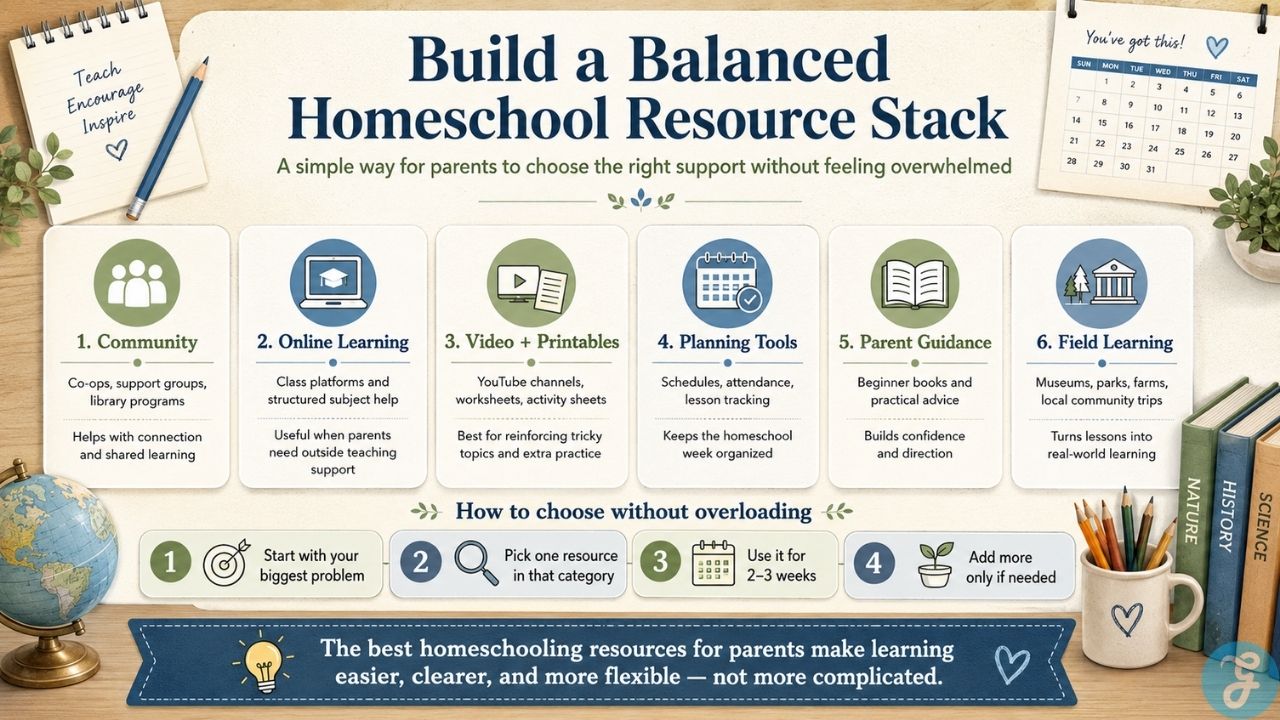
How to Build a Homeschool Resource Stack Without Getting Overwhelmed
The temptation is to save everything. That usually creates more stress.
Start with the problem bothering the family most right now.
If the child is lonely, start with community resources. If planning is chaotic, choose one planning system. If the parent feels unsure about teaching, read one beginner book. If lessons feel dry, add one YouTube channel or field trip idea. If money is tight, use free printables carefully instead of buying another curriculum package.
A balanced homeschool resource stack might include one local community, one core curriculum or class platform, one planning system, one free printable library, one video resource for hard topics, one book for parent confidence, and one monthly field trip habit.
That is enough for most families to start. More resources can be added when a real need appears.
What Parents Should Check Before Using Any Homeschool Resource
Every resource should pass a basic parent check before becoming part of the week.
Check the child’s age and level first. A resource can be excellent and still wrong for the student right now. Check the time cost too. A simple platform can still require setup, supervision, printing, accounts, subscriptions, and troubleshooting.
Parents should also check whether the resource supports their homeschool goals or distracts from them. A video channel may help with science but cause problems if it turns into open-ended screen time. A printable site may support practice but become busywork if the parent prints too much.
Local requirements matter as well. Planning apps, portfolios, attendance logs, assessments, and reports matter more in some places than others.
The best homeschooling resources for parents fit the child, the parent, the law, the budget, and the actual rhythm of the home.
The Practical Takeaway
The best homeschooling resources for parents are the ones that make learning more manageable without turning the home into a stressed-out school office.
Community resources help families feel less alone. Online classes and videos support subjects parents do not want to teach alone. Planning apps keep records and schedules clearer. Books help parents think better. Printables add practice without constant spending. Field trips remind children that learning is not limited to a desk.
Start with one resource category that solves today’s problem. Use it well. Then build slowly from there. Homeschooling works better when the resource stack supports the family, not when the family spends every week trying to manage the resource stack.
Frequently Asked Questions (FAQs) on Homeschooling Resources for Parents
What are the best homeschooling resources for parents who are just starting?
New homeschool parents should start with local legal guidance, a simple planning system, a beginner-friendly book, one curriculum or online class option, and a local community group. It is better to start small than to collect too many resources before understanding the child’s learning style.
Are free homeschool resources enough?
Free homeschool resources can support a strong homeschool plan, especially for printables, videos, library books, STEM activities, and supplemental practice. Most families still need structure, parent involvement, and a clear plan. Free resources work best when they are chosen for a specific lesson or skill.
What homeschooling tools help with record keeping?
Homeschool Planet, Homeschool Panda, and Syllabird are examples of digital planning tools that can help with schedules, assignments, progress tracking, attendance, and records. Parents should choose based on local documentation needs and how much planning detail they can realistically maintain.
Can YouTube be used for homeschooling?
YouTube can support homeschooling when parents choose channels intentionally and add discussion, writing, practice, or hands-on work. Channels like Crash Course, SciShow Kids, NASA, and PBS resources can help explain topics, but they should not replace a full learning plan.
Local co-ops, homeschool associations, library programs, sports groups, nature groups, museum classes, faith-based or secular homeschool groups, and field trip networks can all help. The best option depends on the child’s age, personality, schedule, and the family’s homeschool style.