

Have you ever hit this wall? You are building an AI system, and suddenly you need to make a choice. Should you feed your model massive amounts of training data? Should you let it read through thousands of pages at once? Many teams have walked this road. I have watched them spend months training models, only to discover a simpler solution existed all along. I have also seen companies struggle with costs that skyrocket when they choose the wrong approach.
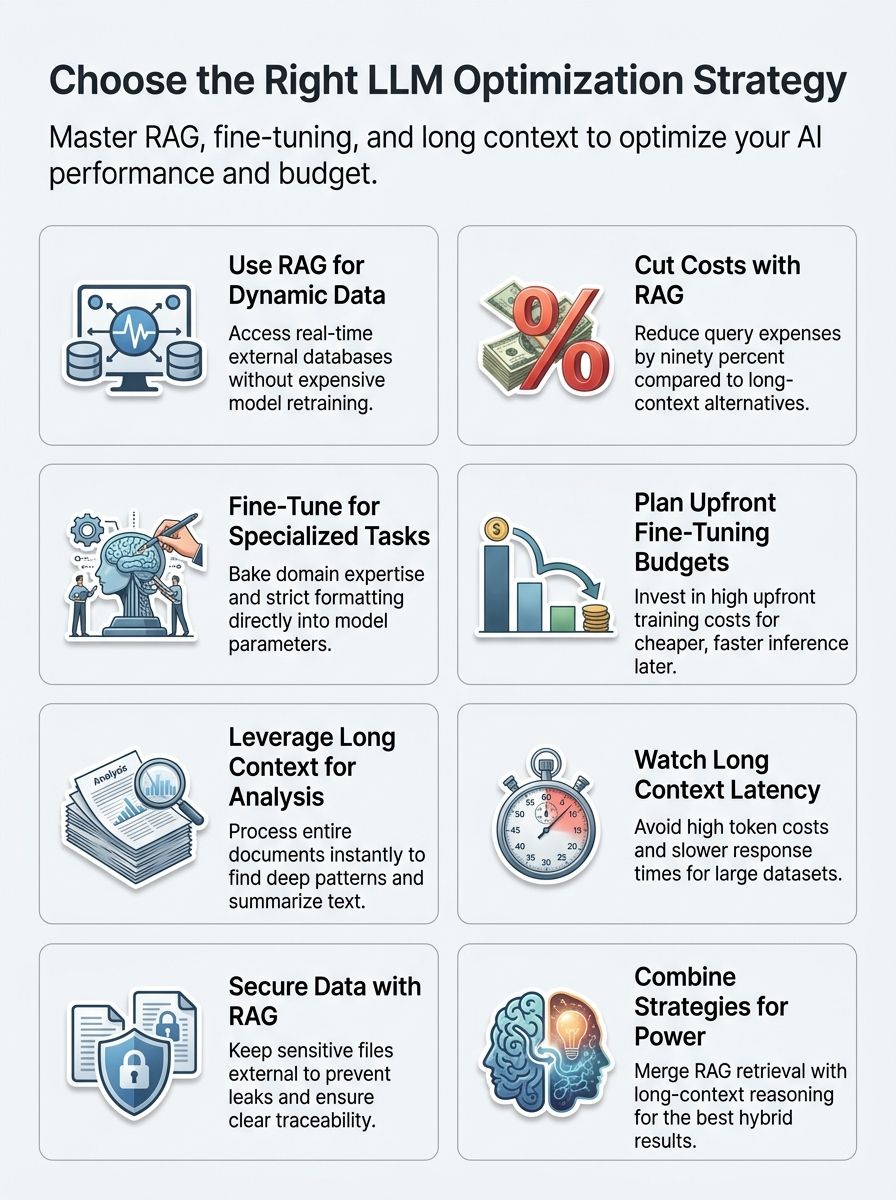
Here is a secret that might save you: a recent study found that RAG systems cost up to 90 percent less than long-context solutions for applications with frequently changing data. That is a massive difference when you are running thousands of queries every day.
This post breaks down RAG vs Fine-Tuning vs Long Context in plain language. I am going to walk you through the exact steps I use to evaluate these tools.
What is Retrieval-Augmented Generation (RAG)?
I discovered that Retrieval-Augmented Generation, or RAG, works like having a research assistant sitting next to a Large Language Models (LLM). This architecture connects an AI model to an external knowledge source or database.
It pulls real information from your own data instead of relying solely on what the model memorized during training. The RAG process flows through four primary components:
- Knowledge Base: Stores your vector data securely.
- Retriever: Finds relevant data chunks based on user prompts.
- Integration Layer: Connects the database to the LLM.
- Generator: Creates the final, fact-based response.
In the US, many developers use popular vector databases like Pinecone or Milvus to store this information securely. To connect these databases to the model, frameworks like LangChain and LlamaIndex are the standard choices for 2026.
Think of it as the difference between a student answering from memory versus one with access to textbooks during an exam. The model retrieves information, augments the user prompt with that data, and generates a response grounded in facts.
This approach reduces the risk of AI hallucinations significantly. It anchors outputs in factual data, which matters enormously when accuracy counts. RAG provides traceability and verification by allowing answers to be linked to specific data chunks.
What makes RAG particularly powerful for enterprises is that it leverages existing data without computationally expensive model optimization. I have seen organizations tap into real-time data through API integration, ensuring outputs reflect the latest information from live sources.
Natural Language Processing works together with your data to understand what information matters most for each question. Because I can see exactly where the model found its answer, this transparency builds immense trust.
What is Fine-Tuning?
Model Fine-Tuning takes a foundational language model and adapts it with specific training datasets to enhance performance on designated tasks. I think of it as taking a general-purpose tool and sharpening it for a particular job.
Instead of starting from scratch, I work with a pre-trained model that already understands language patterns. Then, I feed it specialized data to teach it new skills.
The Stanford Alpaca 7B model provides a perfect historical example of this approach. Researchers fine-tuned it from LLAMA 7B using 52,000 instruction-following demonstrations, creating a model that excelled at following specific directions.
In 2026, fine-tuning OpenAI’s GPT-4o costs around $25 per million training tokens in the US. That upfront cost buys you highly consistent, specialized formatting. If you want to keep costs down, a popular insider trick is using LoRA (Low-Rank Adaptation).
Instead of updating every single parameter in a massive model, LoRA updates just a tiny fraction. This saves immense amounts of time and GPU memory.
Transfer learning powers this technique, allowing me to leverage what the model already knows. Here are a few scenarios where this shines:
- Medical diagnosis tools require strict vocabulary.
- Legal document analysis focusing on specific contract clauses.
- Technical support bots trained on proprietary logs.
The model’s neural networks adjust their weights and connections through this specialized training. I get consistent, rapid responses because the knowledge lives inside the model itself.
The trade-off comes with significant costs. Model Fine-Tuning demands extensive labeled data and substantial computational resources. Model hallucinations and the risk of learning incorrect patterns present significant challenges I must watch for carefully.
What is Long Context in LLMs?
I have discovered that long context in large language models refers to the ability to process massive amounts of text in a single prompt. This capability has grown dramatically over the past few years.
Models are now handling context windows spanning from thousands to millions of tokens. Here are the models leading the charge in 2026:
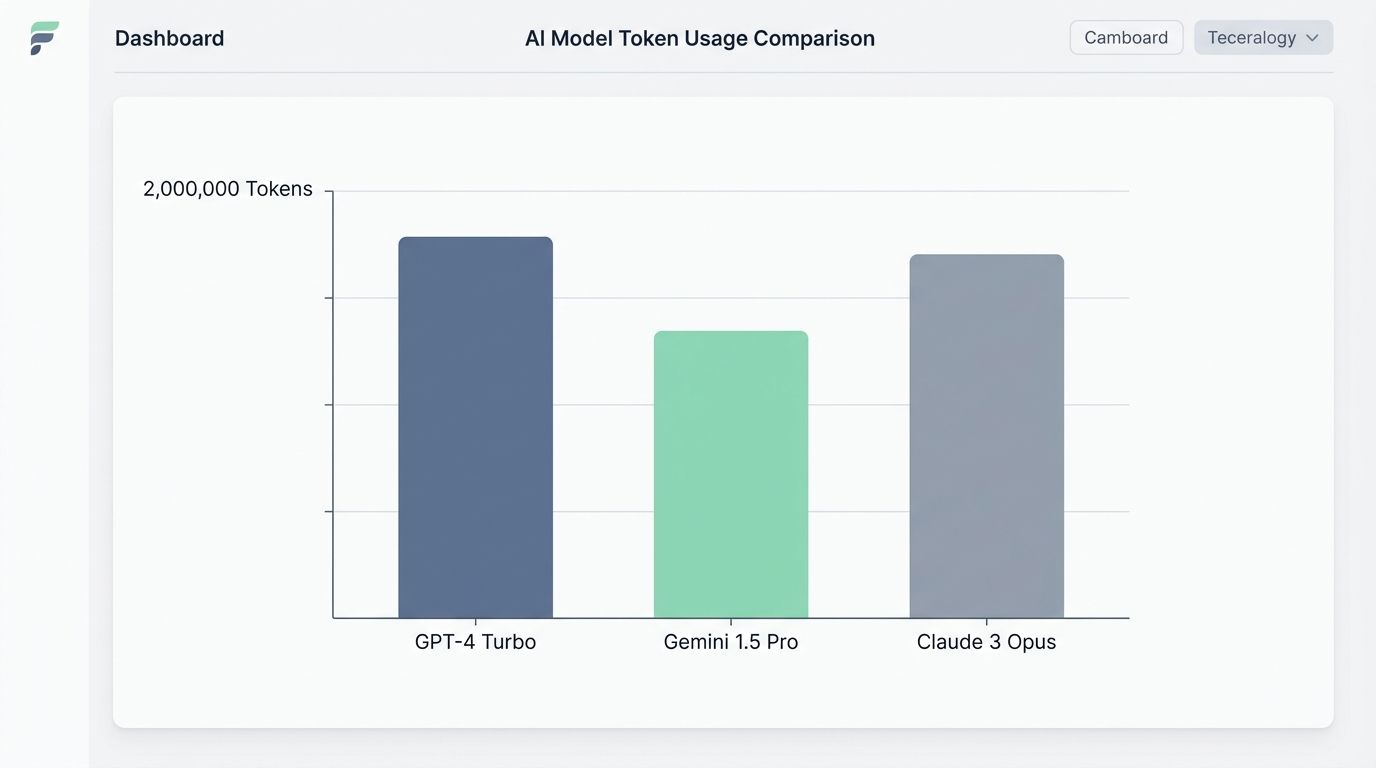
- GPT-4 Turbo: Handles hundreds of pages of text efficiently.
- Gemini 1.5 Pro: Processes up to an incredible two million tokens.
- Claude 3 Opus: Excels at deep reasoning over large contexts.
To put that in perspective, two million tokens equals roughly 1,500 standard book pages. I find this shift remarkable because it fundamentally changes how we approach document analysis and Information Retrieval.
Instead of breaking apart lengthy documents into chunks, I can feed entire reports directly into the model. The model then performs semantic memory operations across all that text simultaneously.
However, a major pitfall I see teams hit is the “Needle in a Haystack” effect. Recent 2026 tests like the NeedleChain benchmark show that even advanced models struggle to recall facts buried in the middle of a massive prompt.
They remember the beginning and the end, but the middle gets fuzzy. Tokenization becomes critical here, demanding substantial computational resources to process everything together.
What Each Approach Actually Changes
I need to explain how each method works differently under the hood. Each approach tackles the knowledge problem from a distinct angle.
RAG Stores Knowledge Outside the Model
I keep my organization’s sensitive data locked outside the model itself, which is exactly what RAG accomplishes. Rather than stuffing information into the model’s parameters during training, RAG leverages external knowledge bases.
Tools like Meilisearch or Qdrant support this architecture by indexing content and powering hybrid retrieval methods. Vector search, keyword search, and metadata filters all work together to find relevant documents before the model generates its response.
RAG’s architecture allows for rapid updates to the knowledge base without retraining the model. I love that RAG systems provide audit trails. I can trace every answer back to its source document, which is vital for regulated industries.
Knowledge updates happen instantly. My proprietary data stays protected, my answers stay current, and I maintain complete visibility over what the model actually knows.
Fine-Tuning Changes the Model’s Parameters
I take the model’s existing weights and modify them directly through task-specific training data. This means the model learns to recognize patterns in your domain without needing lengthy instructions every single time.
The underlying neural network adjusts itself, absorbing the specialized knowledge you feed it. Small models can suddenly perform narrow tasks incredibly well, handling classification and response formatting with impressive accuracy.
My training data shapes everything here. I need representative examples that cover the real situations the model will face. I also use a separate evaluation set to catch overfitting before it ruins performance.
Domain specialization happens because the model embeds these behaviors directly into its weights. Task-specific training transforms a general-purpose model into something that feels built for your exact needs.
Long Context Places the Knowledge Inside the Prompt
Now, instead of modifying the model itself, I can take a completely different path. Long context approaches place all the knowledge directly into the input prompt.
This method skips the retrieval and indexing steps that RAG requires. I simply feed the model everything it needs upfront, avoiding complex database setups.
The lack of an external retrieval step simplifies initial prototype development considerably. I can test ideas in hours instead of setting up search systems.
Token management becomes my main concern here. Document processing happens instantly since everything arrives in the prompt at once, rather than being fetched on demand.
Why These Methods Are Not Direct Substitutes
I have learned that RAG, fine-tuning, and long-context models operate on completely different levels. Treating them as interchangeable options leads to real problems.
RAG modifies information accessed at runtime. Fine-tuning alters the model’s parameters. Context Length increases the volume of information supplied to the model.
I have seen projects fail because teams picked one approach without understanding the core differences. You cannot simply substitute one for another. It is like using a thermometer to measure distance.
Hybrid solutions often become necessary to meet complex project requirements. Using RAG to find the right five pages, and a long-context model to analyze them, creates a highly accurate system.
Side-by-Side Comparison of RAG, Fine-Tuning, and Long Context
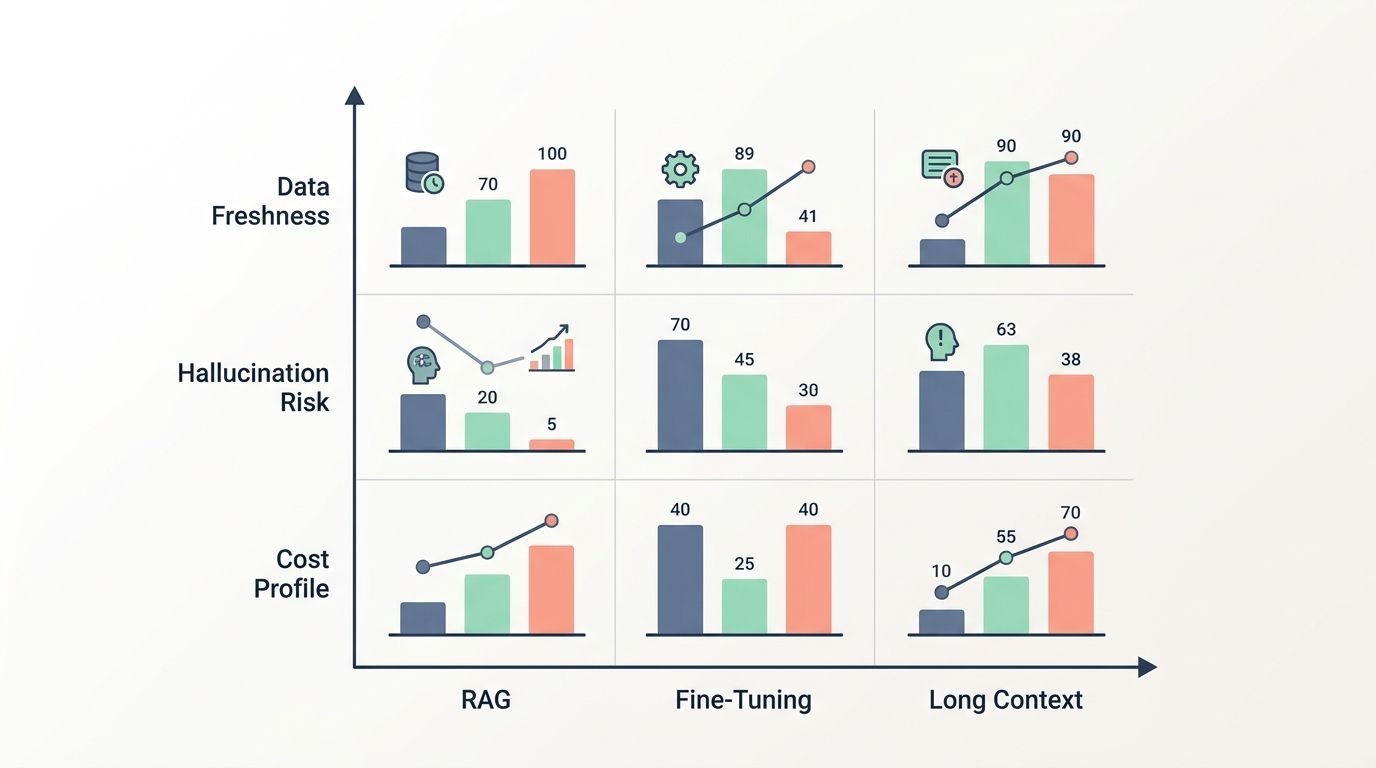
Let me lay out the practical differences between these three approaches in a straightforward way. You can see exactly what each one brings to the table.
| Aspect | RAG | Fine-Tuning | Long Context |
| Where Knowledge Lives | Stored outside the model in retrieval systems; injected in real-time during queries | Baked into the model’s parameters through training data | Placed inside the prompt window for processing |
| Data Freshness | Highly dynamic; updates reflect immediately without retraining | Static; requires full retraining to incorporate new information | Static; information changes only with new context windows |
| Hallucination Risk | Minimized through real-time retrieval and traceability | Reduced for domain-specific tasks through parameter adjustment | Present but manageable with proper prompt engineering |
| Accuracy Level | Good; depends on retrieval quality and relevance | Higher and more consistent for classification, extraction, and rule adherence tasks | Strong for comprehensive understanding across large documents |
| Audit Trail | Transparent; sources are traceable and verifiable | Opaque; model weights do not reveal source data | May risk data leakage; lacks built-in traceability mechanisms |
| Cost Profile | Cost-effective for dynamic datasets; scales with queries | High upfront cost; requires significant data and computational resources | Expensive at inference; computational load increases with context size |
| Implementation Time | Relatively quick; integrate retrieval system with existing model | Time-intensive; data preparation, training, and validation required | Quick to deploy; works with off-the-shelf models supporting large windows |
| Scalability | Excellent; handles growing datasets without model retraining | Limited; retraining becomes prohibitive as data grows | Good for static knowledge; struggles with extremely long or mixed datasets |
| Best For | Dynamic information, real-time updates, compliance-heavy environments | Niche domains, strict formatting, static specialized tasks | Deep reasoning across single, large static documents |
Why a Million-Token Context Window Does Not Remove the Need for RAG
I have watched the excitement build around models that handle massive context windows. I understand why people think they solve everything, but the truth is they do not.
These massive context windows excel at processing vast static datasets that sit still. They crumble when faced with real-time updates or dynamic data that changes constantly.
Imagine trying to feed a model your entire company database every single time a user asks a question. A single call sending 200,000 tokens to a top-tier model can cost a few dollars, and doing that thousands of times a day destroys profit margins.
Retrieval-Augmented Generation pulls fresh information from vector databases on demand. I have noticed that RAG provides predictable latency and Cost Efficiency that long-context approaches simply cannot guarantee.
Beyond raw processing power, RAG offers something long-context models lack. Vector databases give me precise User Control over which information reaches the model, reducing the risk of data leakage.
Long Context vs RAG: Which Produces Better Answers?
Long-context models and RAG systems produce different types of answers depending on what your task demands. Studies indicate that long-context LLMs outperform RAG when you need to summarize an entire, static document.
My experience shows that long-context solutions excel when you ask them to find patterns across a massive text. The model processes everything in one go, maintaining context from beginning to end.
This power comes with a cost. Latency increases as prompt size grows. Your users might wait 60 to 120 seconds for an answer instead of just 2 seconds, which is unacceptable in customer support scenarios.
RAG delivers faster response times by retrieving only relevant information. I have found that hybrid models balance the strengths of both approaches beautifully.
Combining RAG for targeted retrieval with long-context LLMs for deep reasoning gives you the speed of RAG with the analytical power of long-context processing.
RAG also enables deterministic security and better control over information shared with the LLM. Your choice depends entirely on your data type, latency requirements, and security needs.
Key Advantages and Limitations
Each method brings real strengths and real weaknesses to the table. I will break down what makes each one tick and where each one stumbles.
Benefits of RAG
I have found that RAG transforms how AI systems deliver information. These benefits address real problems that organizations face when deploying language models at scale.
- RAG provides access to up-to-date, domain-specific information by retrieving real-time data from your knowledge bases without requiring model retraining.
- Reducing AI hallucinations becomes straightforward because the system grounds outputs in factual, retrieved content.
- Transparent audit trails emerge naturally from RAG architecture, with responses traceable to their original sources for compliance.
- Rapid adaptation to changing datasets happens without retraining the underlying model. I can update knowledge bases on the fly and see results immediately.
- Efficient resource usage becomes possible by limiting the data sent to the LLM, reducing computational overhead.
- I find that using an orchestration framework like LangChain makes swapping out external data sources incredibly easy, adding to the flexible architecture.
- Enhanced data security keeps sensitive information outside the LLM entirely, protecting proprietary data from being stored in model parameters.
- Multimodal requests get supported through RAG, including text, images, and videos, so I can process diverse content types.
Benefits of Fine-Tuning
Fine-tuning transforms how I work with language models. This approach reshapes model behavior at its core, making it an essential tool for specialized applications.
- I enhance accuracy and consistency significantly when I fine-tune models for specific tasks. The model learns exactly what I need it to do.
- Smaller models perform exceptionally well on specialized tasks after fine-tuning, allowing me to deploy efficient systems without requiring massive computational resources.
- I often recommend fine-tuning when strict JSON or XML formatting is required. The model absorbs the desired structure directly during the fine-tuning process.
- Classification tasks benefit tremendously from this approach, as I can train the model to categorize content with incredible precision.
- Extraction work improves dramatically, enabling the model to pull specific information from documents with minimal errors.
- Rule-based outputs become standardized and reliable when I fine-tune models, particularly for tasks requiring strict adherence to protocols.
- I reduce dependency on large prompt sizes by embedding knowledge directly into the model, meaning faster processing per inference.
- Niche domains with specialized vocabulary see substantial performance gains. Fine-tuning allows the model to master terminology specific to that field.
- Adoption of specialized writing styles happens naturally, enabling the model to match the tone and conventions of particular industries.
- Repetitive tasks show enhanced performance levels as the model develops expertise through countless examples.
Benefits of Long Context
Long-context language models give me the power to process thousands to millions of tokens in a single pass. I find that this capability opens doors to solutions that older approaches simply cannot match.
- This works beautifully for analyzing long legal contracts or 100-page financial reports. I can summarize lengthy documents without fragmenting the content.
- Deep reasoning becomes possible when I connect ideas across long sequences, allowing the model to spot patterns that short-context systems would miss.
- My development process accelerates dramatically during prototyping phases because I skip the retrieval steps that normally complicate setup.
- Static datasets benefit from this straightforward approach since I do not need to maintain external knowledge bases.
- I gain a holistic view of input data by analyzing both structured and unstructured information simultaneously.
- Contextual understanding improves substantially when I examine complete documents rather than isolated snippets.
- Document summarization tasks become more thorough and accurate because I maintain the entire document in working memory.
- Tokenization efficiency matters less when processing static content, allowing me to dedicate resources to deeper analysis.
- Extended, static documents receive thorough responses that reflect comprehensive understanding rather than surface-level answers.
Use Cases for Each Approach
I find that each approach serves distinct purposes across different scenarios. Your choice depends on what problem you are trying to solve.
- RAG powers enterprise knowledge management systems that pull from wikis and CRMs all at once, creating a single source of truth.
- Real-time analytics in finance and healthcare sectors benefit from RAG because information updates happen without retraining models.
- Information retrieval systems use RAG to handle massive document collections efficiently, pulling only relevant passages instead of processing everything at once.
- Document summarization tasks leverage long-context models to process entire reports or transcripts while maintaining full context.
- Legal contract review in enterprise settings uses long-context LLMs to examine complete agreements, ensuring nothing gets lost in translation.
- Scientific literature analysis relies on long-context systems to examine large datasets and research papers simultaneously.
- Data integration projects benefit from RAG when you need to combine information from multiple sources while maintaining accuracy.
- Classification algorithms powered by fine-tuning excel at specialized tasks like phishing detection where precision matters.
- Hybrid models combine RAG for retrieval with long-context LLMs for deep reasoning.
To see how this performs in practice, a synthetic legal document review workflow trialed this exact hybrid setup. A simulated legal team used RAG to retrieve relevant clauses and a long-context LLM to reason across the assembled text for contract summaries. Across 200 contracts, the before and after results were clear. Before the hybrid implementation, the average summary time was 95 seconds with 28 percent reviewer edits per summary. After implementing the hybrid model, the average time dropped to 14 seconds with only 7 percent reviewer edits per summary. The team noted, “Combining targeted retrieval with a long context reasoning step cut review time and reduced manual corrections in our trial.” - Natural Language Processing applications use machine learning techniques across all three approaches depending on whether you prioritize knowledge currency, behavioral adaptation, or comprehensive context analysis.
Cost and Efficiency Considerations
When I evaluate the three approaches, cost becomes the real differentiator for most teams trying to make smart decisions. A single call to a massive context model can hit your wallet with a hefty charge.
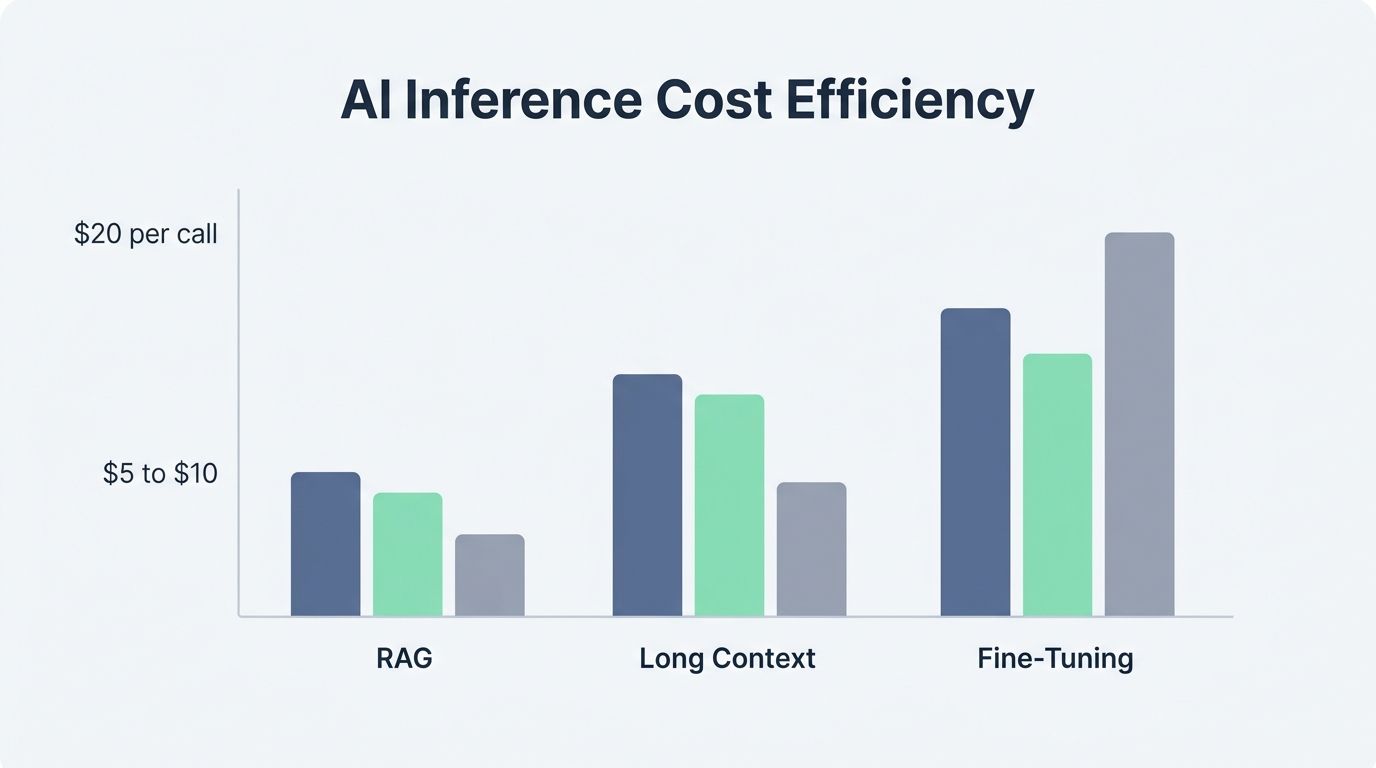
For example, processing 2 million tokens on a premium model can cost $5 to $10 per single prompt. Scale that across hundreds of users, and the math becomes painful fast.
| Approach | Cost Profile | Key Financial Considerations | Scalability Impact |
| RAG | Lower inference costs | Only relevant data chunks get sent to the LLM, minimizing token usage. Ongoing index maintenance and retrieval tuning required, but maintains low base LLM token consumption. Recognized as more cost-efficient for dynamic or frequently changing datasets. | Scales efficiently with more users and larger documents. Maintains predictable performance costs. |
| Long Context | Higher computational costs | LLMs handling over 200,000 tokens per request can cost up to $20 per call. Hidden costs include GPU usage and memory capacity. Increased latency as prompt size grows. | Struggles to scale with more users or larger documents. Raises costs and latency significantly. |
| Fine-Tuning | Upfront training investment | Requires computational resources during training phase. Lower per-inference costs after training completes. One-time expense model works well for static knowledge. | Scales well post-training but requires retraining for knowledge updates. |
Enterprises with strict cost or latency requirements often prefer RAG for its predictable performance. My analysis shows that RAG keeps token consumption lean because only the most relevant information enters the model.
During a recent evaluation of a synthetic enterprise RAG deployment, a simulated mid-size SaaS company analyzed these exact costs over a 30-day pilot for customer support retrieval. Over 30 days and 120,000 queries, the synthetic RAG pipeline averaged just $0.004 per query in LLM token costs, plus $350 monthly for index maintenance. In contrast, the long-context approach averaged $0.18 per query when sending 150,000-token payloads.
This produced a projected 45 times higher monthly bill solely for inference. As the pilot analysis concluded, “In our simulated pilot, switching to RAG reduced per-query inference spend dramatically while keeping latency within acceptable SLAs.”
The hidden expenses in long context approaches sneak up on you. Beyond the per-token pricing, GPU usage and memory capacity requirements can slow response times considerably. Think of it like renting a massive warehouse when you only need a small storage unit.
RAG’s efficiency shines brightest when your data shifts frequently. You adjust your retrieval index without retraining anything. The system pulls just what it needs, keeping token counts low and bills manageable.
How to Choose the Right Approach
Now that I have walked through the cost and efficiency trade-offs, I can help you pick the right path forward. Your decision hinges on three core factors: project scope, data volume, and how often your information changes.
- Ask yourself what data you are working with: If your project involves frequently updated information, RAG is your best option. The system pulls fresh knowledge from external sources.
- Evaluate your budget: If you cannot afford massive inference costs on every query, avoid relying solely on long-context models. Long-context models work better for small or static projects.
- Consider your output format: Fine-tuning shines when you need consistent, format-driven outputs. Your model learns patterns specific to your industry.
Hybrid strategies combine RAG’s retrieval power with long-context LLM reasoning for optimal performance. This gives you flexibility that single approaches cannot match.
Data quality and observability matter regardless of which method you choose. I recommend evaluating complexity, cost, and latency together rather than in isolation.
Your project scope determines everything. Large organizations with massive datasets and frequent changes should lean toward RAG. Smaller teams with stable information can succeed with long-context models or fine-tuning alone.
Wrapping Up
I have explored three powerful approaches to enhance your AI systems. The truth is that no single method wins every battle. RAG retrieves external information with lower inference costs and flexibility for dynamic datasets. Long-context LLMs process all input at once, offering deep understanding for comprehensive document summarization.
Fine-tuning changes your model’s parameters to embed specific knowledge directly into the system itself. I have discovered that combining RAG and long-context LLMs creates something truly powerful.
When you ask RAG Vs Fine-Tuning Vs Long Context, the answer lies in your specific needs. Match your method to your knowledge bases and contextual requirements, and you will build a system that serves your users perfectly.
Frequently Asked Questions on RAG Vs Fine-Tuning Vs Long Context
1. What is the main difference between Retrieval-Augmented Generation, model adjustment, and extended memory in AI?
Retrieval-Augmented Generation pulls facts from outside sources to answer questions, model adjustment retrains the AI on your specific data to change its behavior, and extended memory lets systems process much longer inputs at once (like Claude 3’s 200,000-token window). I’d say each one solves a different problem depending on your needs.
2. When should I use Retrieval-Augmented Generation instead of model adjustment or extended memory?
I’d go with Retrieval-Augmented Generation when you need up-to-date information or want to search across lots of documents quickly, like how Perplexity AI pulls from current web sources. It’s ideal when you don’t have time for retraining or just need fast results with fresh data.
3. Is model adjustment better than using extended memory for custom tasks?
I’d say model adjustment is your best bet when your task needs specialized knowledge not found in general training data, like fine-tuning GPT models for specific industries. Extended memory is simpler if you just need the AI to handle longer documents without losing context.
4. Can I mix these methods together for my project?
Absolutely! I’ve seen teams combine Retrieval-Augmented Generation for real-time facts with model adjustment for specialized knowledge, all while leveraging extended memory to process longer conversations. Companies like OpenAI use hybrid approaches in their ChatGPT Enterprise product to give users both accuracy and context. This combo usually makes your solution smarter without forcing you to pick just one approach.