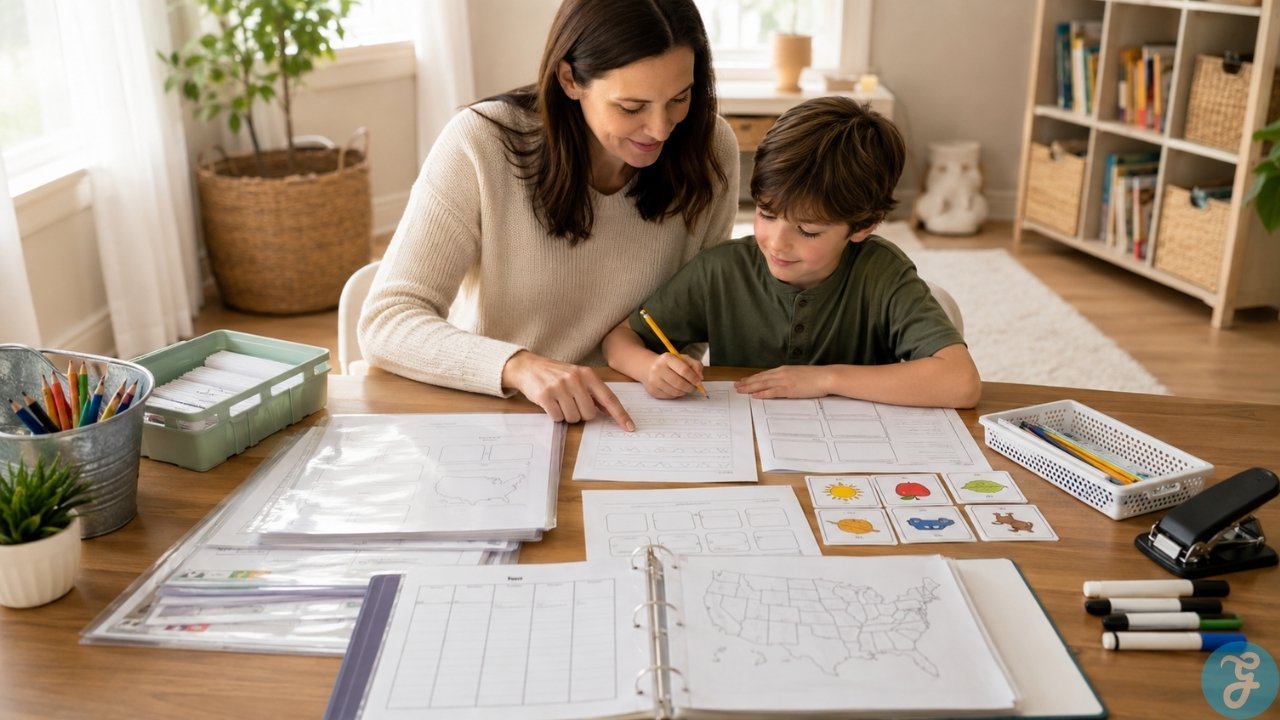
Building a comprehensive home curriculum can quickly become an expensive endeavor. Between buying textbooks, tracking down lab kits, and sourcing specialized reading materials, the costs accumulate rapidly for a growing family. Fortunately, high-quality digital templates can offset a significant portion of these operational expenses.
True efficiency in home education comes from utilizing digital resources as targeted structural support rather than just printing random worksheets to fill time. Finding the right templates allows parents to customize their lesson plans without acquiring high financial debt before the academic year even begins.
The Hidden Friction of Digital Downloads
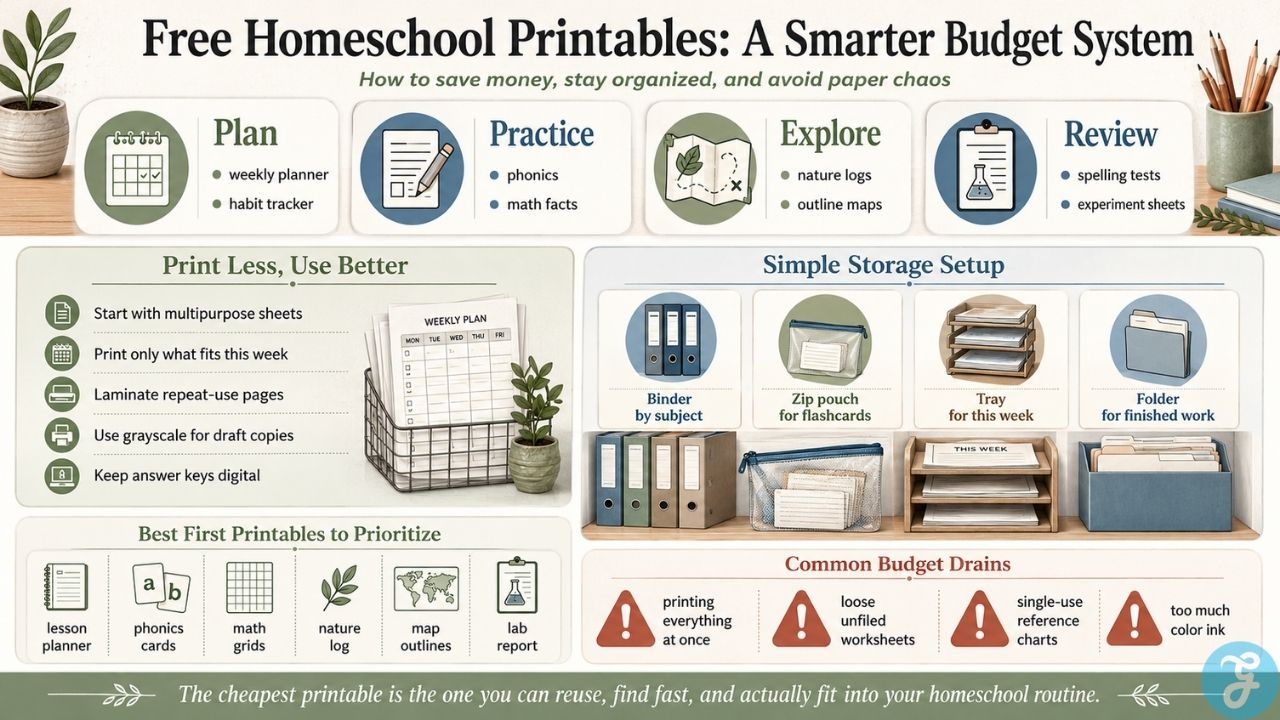
While tracking down free homeschool worksheets helps protect your bank account, physical paper management introduces its own set of logistical challenges. New educators frequently fall into the trap of printing thousands of unorganized sheets, resulting in cluttered workspaces, lost assignments, and wasted printer ink.
To keep your educational space efficient, prioritize resources that serve multiple purposes or can be laminated for repeated use with dry-erase markers. Finding targeted free printables for homeschool is most effective when you have a clear storage and organization system established before you ever click print.
The 11 Best Free Printables for Homeschool
The following collection of homeschool downloads covers structural planning, daily logistics, core academic practice, and observational logs.
1. Primary Reading Phonics Flashcards
Early literacy requires repetitive recognition practice. Printable phonics cards allow parents to build customized blending decks without purchasing commercial flashcard sets.
Storage Warning: Cut these cards out cleanly and store them in small plastic cases or index boxes. If left loose in standard work binders, individual letter sounds will inevitably go missing before the end of the school term.
2. Weekly Curriculum Lesson Planners
Managing multiple subjects across different age levels requires strict scheduling infrastructure. A blank master planner sheet gives you a physical dashboard for the week ahead.
-
It includes specific daily rows for core mathematics and language arts tracking.
-
It provides vertical blocks for shared group activities like history readings or science experiments.
-
It leaves an empty margin area dedicated entirely to weekly library book checklists.
3. Interactive Math Fact Sheets
Rote memorization of addition and multiplication tables becomes less tedious when presented via visual grids. These printable lessons turn raw number crunching into pattern recognition.
Unlike standard linear worksheets, grid-style math sheets help children visualize the numerical relationships between factors, allowing them to spot mathematical patterns along diagonals and columns independently.
4. Nature Study Observation Logs
Moving science instruction outdoors requires a structured way for kids to record their findings. An observation sheet serves as a guided field journal page.
These downloads usually feature designated spaces for sketching local flora, recording daily weather metrics, and writing short narrative descriptions of wildlife encounters, combining early biology instruction with descriptive writing practice.
5. Timeline History Grid Templates
Keeping historical events in chronological order is difficult without a visual anchor. Linear timeline grids allow students to plot major historical epochs as they read through library books.
| Layout Type | Best Use Case | Operational Friction |
| Accordion Style | Mapping out centuries across multiple generations | Requires massive wall space when fully extended |
| Binder Layout | Keeping regional histories separated by distinct tabs | Makes it harder to visualize overlapping global events |
6. Daily Habit Trackers for Kids
A significant portion of starting homeschool involves building daily personal responsibility. Simple checklist charts help children manage their morning routines without constant parental prompting.
These sheets focus on basic household integration, such as making the bed, packing away school supplies, and completing independent reading blocks before afternoon activities begin.
7. Science Experiment Report Blanks
Introducing the scientific method early helps train logical reasoning skills. A blank lab report template prompts students to think through the steps of a physical experiment systematically.
The page layout requires the student to write out a clear hypothesis, list the physical tools utilized, document the actual testing steps, and summarize the observable outcome.
8. Handwriting Practice Guidelines
Purchasing specialized penmanship notebooks is unnecessary when you can print targeted line variations on demand. These templates provide appropriate spacing boundaries for different developmental levels.
You can download wide-ruled dotted lines for toddlers mastering basic shapes, medium guidelines for print alphabet mastery, and tighter slanted paths specifically designed for early cursive instruction.
9. Geography Outline Maps
Memorizing political borders and major waterways requires active physical labeling practice rather than passive looking. Blank continent maps force students to engage with the geography text.
Instead of purchasing expensive map workbooks, parents can print out plain outline maps of specific regions, allowing students to color in mountain ranges, draw trade routes, and label capital cities manually.
10. Spelling Test Custom Grids
A simple but necessary tool for weekly language arts testing. These clear columns keep spelling assessments neat and organized for portfolio reviews.
The sheet provides numbered blank lines alongside a secondary column where students can rewrite corrected words immediately if they make a mistake during the initial auditory test.
11. Art Appreciation Response Sheets
Exposing children to classical fine art does not require complex textbook sets. You can project a painting on a screen and have the student fill out a structured response sheet.
The prompt layout guides the student to look for specific focal elements, identify the dominant color choices, note the apparent emotional tone, and write a brief critique of the artist’s composition style.
A Strategy for Managing Physical Paper
Deploying free printables for homeschool works best when you establish a definitive system for the physical sheets before starting production. Avoid the temptation to build an unorganized stack of loose sheets on your desk. Use a heavy-duty three-hole punch and assign distinct binders for separate academic subjects, or laminate core reference charts so they can be reused multiple times across the school year. By controlling the physical volume of your downloads, you protect both your home environment and your overall educational budget.