Does it feel like your service business does great work, but local seo still is not bringing in enough calls? You are not dealing with a traffic problem alone, you are dealing with a visibility problem.
When people cannot find you in Google Search or Google Maps, your phone stays quiet, your website gets thin organic traffic, and paid advertising starts to feel expensive fast.
This guide walks you through seven SEO tactics for service businesses in a simple way. We will cover your google business profile, keyword research, location pages, online reviews, mobile optimization, schema markup, and the local backlinks that help you show up where customers actually look.
I will also show you where tools like BrightLocal and ChatGPT can save time without turning your content strategy into bland copy. Grab what fits your business, skip what does not, and build from there.
What Is Local SEO and Why Does It Matter for Service Businesses?
Search engine optimization (SEO) is the work of making your website and business listings easier for search engines and customers to understand. For a service-based business, local seo matters most because people usually search with buying intent, things like “emergency plumber near me” or “roof repair in Miami.”
Google says local rankings mainly come down to relevance, distance, and prominence. That gives you a clear plan: match the search, show the area you serve, and build enough trust signals that Google feels comfortable showing you in the map pack.
- Relevance: your google business profile, service pages, categories, and keywords need to match what customers want.
- Distance: your location or service area affects how often you appear for nearby searches.
- Prominence: reviews, local citations, backlinks, and brand mentions help prove you are a real local business.
That is why small business seo can keep paying off long after an ad campaign ends. A strong local presence drives organic search visits, better conversion rates, and a smoother user experience for people who just want a phone number, a service area, and a fast way to book.
Your website still has to do its part, so it helps to speed up your WordPress website and keep a responsive design that works on every phone. You also need technical seo basics and clear calls-to-action so visitors do not stall after they land.
Content matters, too. Smart teams use Generative AI tools like ChatGPT and Copilot to speed up drafts, FAQs, and content optimization, but the best results still come from adding real local knowledge, real reviews, and real service details.
Optimize Your Google Business Profile
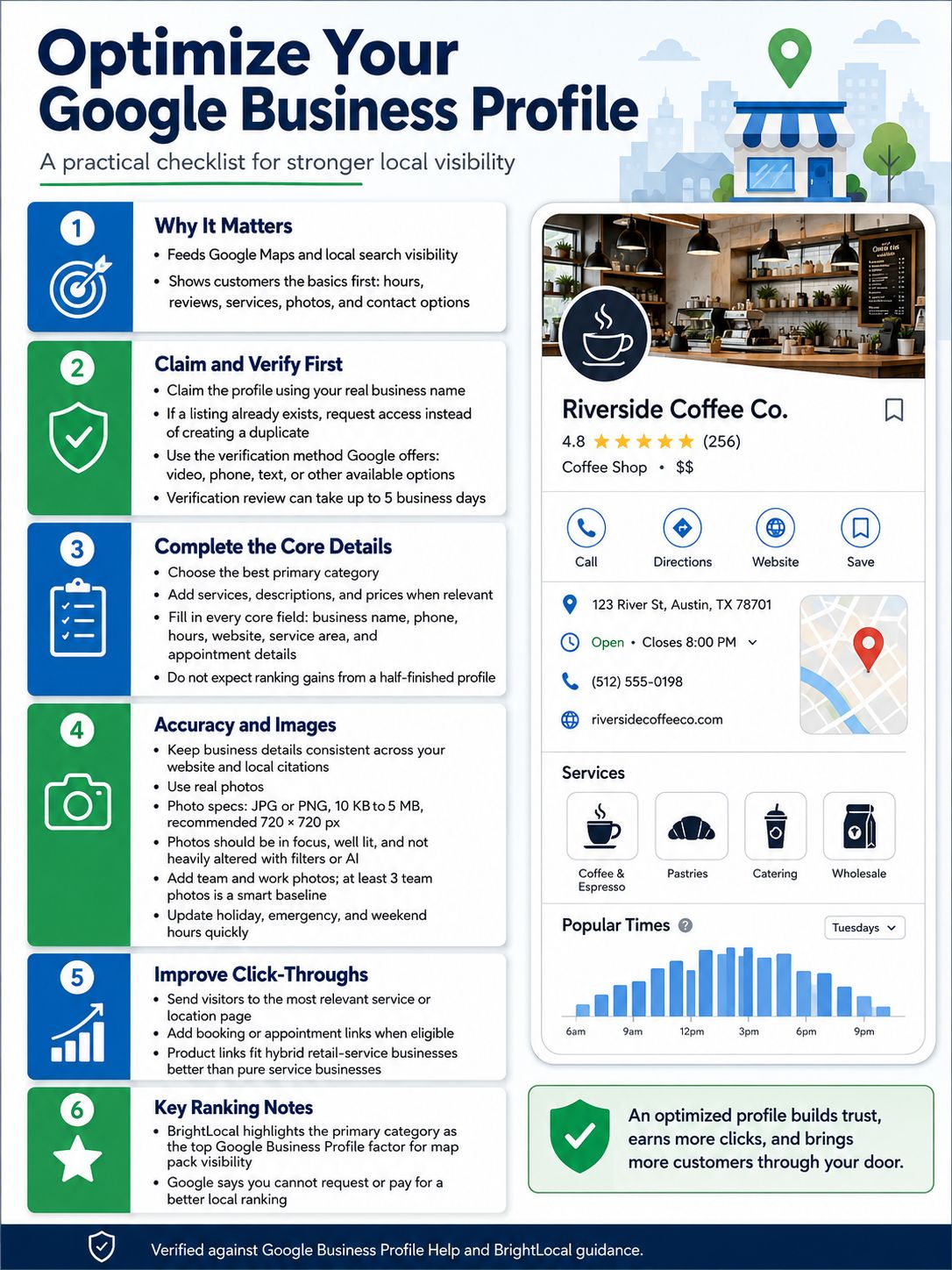
Your google business profile is the fastest win for many service providers. It feeds Google Maps, shapes local search visibility, and gives customers the basics they care about first: hours, reviews, services, photos, and a way to contact you.
Claim and verify your profile
If you have not claimed and verified your profile yet, start there before you do anything fancy. In Google’s current help docs, verification review can take up to 5 business days, so this step deserves your first slot on the checklist.
- Claim the profile tied to your real business name. If an old listing already exists, request access instead of creating a duplicate.
- Choose the best primary category. The 2026 Local Search Ranking Factors survey highlighted by BrightLocal says the primary category is the top Google Business Profile factor for map pack visibility.
- Add your services. Google lets service businesses group services, add descriptions, and in many cases add prices, which helps your profile match more specific searches.
- Fill in every core field: business name, phone, hours, website, service area, and appointment details. Complete profiles are more likely to show for relevant local searches.
- Use the verification option Google gives you. Methods can include video, phone, text, or other options chosen automatically by Google.
A good rule is simple: do not expect ranking gains from a half-finished profile. Google also makes it clear that there is no way to pay for a better local ranking, so skip any pitch that promises a shortcut inside the map pack.
Add accurate business details and high-quality images
Once the profile is live, accuracy beats creativity. Keep the same business name, address, and phone details across your website, google business profile, Bing Places, Yelp, and other local citations so search engines do not have to guess which version is right.
- Use real photos. Google’s photo guidelines recommend JPG or PNG files between 10 KB and 5 MB, with 720 by 720 pixels as the recommended resolution.
- Show your team and your work. Google suggests category-specific photos, and for team photos it recommends adding at least three images to help humanize the business.
- Keep images honest. Google says photos should be in focus, well lit, and not heavily altered with filters or AI.
- Update hours quickly. Holiday hours, emergency schedules, and weekend availability directly affect calls and customer engagement.
- Use the right landing page. If someone clicks through from your profile, send them to the service or location page that matches the intent, not a vague home page.
- Add retail product links only if they fit your model. Hybrid businesses that also sell in-store products can benefit from Google Merchant Center style product visibility, but pure service businesses usually get more value from services, reviews, and appointment paths.
Target the Right Keywords
Good keyword research is really customer-language research. You are trying to match the words people use when they need help now, not the words you use in an internal meeting.
Focus on long-tail and conversational keywords
Long-tail keywords usually bring better leads because they are more specific. Someone searching “water heater replacement cost in Phoenix” is much closer to booking than someone searching “plumbing.”
- Use service plus city: “AC repair Dallas.”
- Use problem-based searches: “why is my furnace blowing cold air.”
- Use urgent intent: “same day locksmith near me.”
- Use question phrases: “how much does drain cleaning cost in Miami.”
- Use neighborhood-level targeting where it is real: “roof repair in Lincoln Park” works only if you truly serve that area.
Write your pages the way customers speak into their phones. That helps with voice search, improves content marketing ideas, and gives your service business more chances to rank for searches with strong buying intent.
Do not stop at headings. Google Search Central says it may use your meta descriptions for the snippet when they describe the page well, so write them like short sales copy: clear service, clear location, clear next step.
Incorporate location-based keywords
Location keywords belong in the right places, not everywhere. Use them in title tags, headings, image alt text, internal links, and page copy only where they help the reader understand what you do and where you do it.
- Put your core keyword in the page title and H1.
- Add city or neighborhood terms in the intro, subheads, and FAQ copy where it feels natural.
- Build separate location pages only for places you actually serve.
- Use Google Search Console to spot queries that already get impressions, then strengthen those pages first.
- Match keyword choice to intent: “emergency electrician” and “licensed electrician” are related, but they do not signal the exact same need.
Build Dedicated Service and Location Pages
If you want more organic traffic from more towns, you need pages built for those searches. A home page cannot do all the work by itself.
Create pages tailored to specific services
Start with one page for each core service. Then add location pages for the cities or neighborhoods that actually matter to your lead generation plan.
- Give every core service its own page. “Drain cleaning,” “water heater repair,” and “sewer line replacement” should not be buried on one generic plumbing page.
- Show proof on the page. Add local photos, service details, timing expectations, price guidance, and the towns you serve.
- Use schema markup. Google’s LocalBusiness guidance lets you mark up hours, departments, and business details, and the most specific subtype helps search engines understand the page better.
- Keep pages fast. Google Search Central’s “good” Core Web Vitals targets are LCP within 2.5 seconds, INP under 200 milliseconds, and CLS below 0.1.
- Choose a system you can actually manage. A clean responsive CMS makes updates, internal links, and content optimization much easier.
Google has warned against doorway pages for years, so avoid creating twenty thin city pages that all say the same thing with a different place name swapped in. One strong service page plus a smaller set of real location pages usually beats a pile of low-value pages.
| Page type | What it should include | Main goal |
|---|---|---|
| Service page | Clear service description, price or estimate guidance, FAQs, photos, call-to-action | Rank for the service itself and convert the visit |
| Location page | City-specific copy, local testimonials, service area details, local examples, booking path | Rank in nearby markets outside your home city |
| Contact or booking page | Phone, form, hours, service area, response times, trust signals | Turn search interest into a lead |
Include local testimonials and clear calls-to-action
Location pages work best when they reduce doubt. The visitor should feel, “Yes, these people really work here, and yes, I can contact them right now.”
- Add testimonials with names and towns, with permission, so the page feels local and believable.
- Place the CTA near the top: Call Now, Book Online, or Get a Free Quote are all stronger than a vague “Learn More.”
- Use matching landing pages in your listings. Google’s business links rules say local business links should lead to a dedicated landing page for that business, not a generic page or a social profile.
- Show service areas honestly. Do not imply you have an office in a town if you only travel there.
- Support the copy with trust signals: badges, case studies, review excerpts, before-and-after photos, and financing or warranty details if they apply.
Gather and Leverage Customer Reviews
Online reviews do more than make you look credible. They influence local search visibility, they shape click-through rates, and they answer the trust question before a prospect ever calls.
Encourage satisfied customers to leave online reviews
BrightLocal’s February 2026 survey found that 31% of consumers will only use a business with 4.5 stars or higher. That makes review generation a revenue task, not a side project.
- Ask right after the job. The best time is when the customer is still happy and the result is still fresh.
- Use Google’s review link or QR code. Google now lets you create both, and the QR code is generated from a desktop browser, which saves time for field teams.
- Never offer incentives. Google says discounted services, gifts, or any reward in exchange for reviews count as fake engagement.
- Ask for specifics. A review that mentions the service and city is more persuasive than “Great company.”
- Train your team to ask. A simple script at job close keeps review requests consistent.
- Reply to every review you can. Short, personal replies show you are paying attention and help customer engagement.
One useful detail for service businesses: Google can ask reviewers to choose the specific service they received from your service list. That means your services section and your reviews can reinforce each other.
Do not let your best reviews live in one place only. Bring them onto your website, your social media, and the service pages that need more trust.
- Create a testimonials section on each high-value page, grouped by service where possible.
- Use short quotes with real context, such as the city, the service, and the result.
- Turn top reviews into social posts for Facebook, LinkedIn, and Instagram.
- Pair reviews with photos or short video clips so the praise feels more human and less generic.
- Keep fresh reviews coming. Recency matters because older reviews lose persuasive power faster than many owners expect.
Invest in Local Backlinks
Backlinks still matter, especially when they come from local sources that make sense for your business. A few strong local links can do more for prominence than a random batch of weak directory links.
Partner with local businesses and organizations
Think about the businesses and groups that already serve the same neighborhoods you do. Those are often your best local link opportunities.
- Partner with complementary businesses, such as real estate agents, property managers, interior designers, or local contractors.
- Co-create helpful resources, like seasonal checklists or maintenance guides, and publish them on both sites.
- Sponsor community involvement projects, school events, charity runs, or neighborhood cleanups that list sponsors online.
- Join your local chamber and trade groups for citations, referral traffic, and trust.
- Pitch local media or neighborhood blogs with real stories, not sales copy, such as storm prep, seasonal safety, or pricing trends in your service niche.
Join community directories and sponsor events
Citations still help search engines verify who you are. Keep them accurate, but do not confuse citation volume with authority.
- Claim and update Bing Places. Microsoft support points businesses to Bing Places for claiming or updating listings that appear in Bing Maps results.
- Keep major profiles consistent on Yelp, Angi, Avvo, LinkedIn, and trusted local directories that fit your industry.
- Favor quality over quantity. One respected city directory is more useful than ten junk listings.
- Track referral traffic in Analytics and branded queries in Search Console so you know which citations and backlinks actually send leads.
- Link event mentions to the right page, usually a relevant service page or city page, not always the home page.
Create High-Quality and Engaging Content
Helpful content turns your website into more than an online brochure. It gives you more chances to rank, more ways to answer objections, and more proof that you know the work.
Publish how-to guides and service-specific blogs
The best service-business content solves problems before the phone rings. That makes it strong for organic traffic and strong for lead generation.
- Write how-to posts around common problems, like leaks, strange noises, maintenance timing, or cost questions.
- Build short case studies that show the problem, the fix, the area served, and the outcome.
- Answer seasonal questions, such as winter HVAC prep or hurricane roof checks in coastal markets.
- Turn customer questions into content. If your staff hears the same question every week, that question belongs on the site.
- Link blog posts to money pages, including service pages, location pages, and booking pages, so content supports conversions.
As of July 2026, BrightLocal starts at $41 per month for one location, while ChatGPT Plus is $20 per month. That makes them useful for different jobs, not interchangeable ones.
| Tool | Best use | Starting price | Smart way to use it |
|---|---|---|---|
| BrightLocal | Rank tracking, citation work, review monitoring, local reporting | $41 per month for one location | Use it to measure local search visibility and keep local listings organized |
| ChatGPT | Drafting outlines, FAQs, review reply ideas, headline testing, content planning | $20 per month for Plus | Use it to speed up writing, then add your local proof, pricing context, and expert edits |
If you want faster publishing, use artificial intelligence as an assistant, not a substitute for expertise. That is where Generative AI tools help most, especially for first drafts, alt text, content strategy ideas, and content optimization workflows.
Utilize video and visual content for better engagement
Video is great for service businesses because people want to see the team, the process, and the result. A 30-second clip of a job well explained can do more than a long paragraph.
- Create short service videos for Google Business Profile posts, YouTube, Instagram, and the matching service page.
- Add captions and local context so people understand the clip with the sound off.
- Show before-and-after visuals, team intros, truck arrival, or simple safety tips.
- Keep pages quick. Visual content works only if the page still feels fast, so work to improve Core Web Vitals for a faster website.
Optimize for Voice Search
Voice search is less about gadgets and more about phrasing. People speak in full questions, and your pages should make it easy for search engines and assistants to find a clean answer.
Incorporate question-based keywords
As of May 7, 2026, Google Search Console says FAQ rich results no longer appear in Google Search. So keep FAQ content because it helps users and voice-style searches, not because you expect an extra search feature.
- Use real customer questions as headings on service pages.
- Start with cost questions, because those often signal strong buying intent.
- Add timing questions, such as “How long does AC repair take?”
- Include service-area questions, such as “Do you serve Coral Gables?”
- Cover urgency, such as “Can you come out today?”
This works especially well when you pull wording from calls, chat logs, emails, and online reviews. Those phrases tend to sound more natural than anything from a keyword planner alone.
Provide concise answers to common queries
For voice-style searches, clear wins. Put the answer first, then add detail below it.
- Answer the question in the first sentence, ideally in plain English.
- Keep the first answer short, then follow with price factors, service limits, or next steps.
- Repeat important contact details near the top of the page for mobile users.
- Use schema markup where it fits, especially LocalBusiness details that help search engines understand hours and business information.
- Link to the right follow-up page, so a user can move from a quick answer to booking without hunting around the site.
Final Thoughts
You do not need a huge digital marketing budget to get better results from local seo. You need the basics done well, in the right order.
Start with your google business profile, then tighten your keyword research, build stronger service and location pages, and ask for reviews in a steady way. After that, improve site speed, keep mobile optimization sharp, and earn local backlinks that make sense for your market.
Track what happens in Google Search Console and your calls, then keep improving the pages that already show signs of life. That is how service businesses turn search engine optimization into steady leads, month after month.
FAQs About Essential SEO Tactics For Service Businesses
1. What are the top SEO tactics for service businesses?
Use local SEO, keyword research, on-page SEO, content marketing, get backlinks, optimize for phones, and speed up your site.
2. How do I do keyword research for my service business?
Find the words customers use, pick long-tail phrases, and check competitors; use simple tools to spot intent.
3. Why is local SEO and a business profile important?
Local searches send people to your door, fast. A clear business profile shows hours, photos, and customer reviews, so people choose you.
4. How do I get backlinks and customer reviews?
Work with partners, join local groups, and write helpful guides, these attract external links. Ask happy clients for reviews, politely, right after service, like asking for a small favor. Reply to reviews, it builds trust.