

Publishers cannot afford lazy content marketing anymore. The old playbook was simple: publish articles, chase search traffic, post links on social media, collect pageviews, and hope the revenue model works. That playbook still produces activity. It does not always produce audience loyalty, direct relationships, or sustainable income.
That is why Content Marketing Strategies for Publishers need to be broader than “write more content.” A publisher needs curation, newsletters, headline writing, pillar planning, article repurposing, reader engagement, and monetization working together. These are not separate side projects. They are connected parts of the same editorial system.
The goal is not just to attract readers once. The goal is to help readers discover useful content, trust the editorial voice, return often, subscribe when the value is clear, and support the business model in ways that do not damage credibility.
A publisher that only thinks in articles will keep filling an archive. A publisher that thinks in strategy builds a content ecosystem.
Our Selection Criteria
We selected these strategies based on how useful they are for modern publishers, niche sites, digital media brands, newsletter-led businesses, and editorial teams.
| Criteria | What We Looked For |
|---|---|
| Audience value | Does the strategy help readers understand, decide, save time, or return? |
| Editorial fit | Can it work without weakening trust or turning content into generic marketing? |
| Search value | Does it support topical authority, useful structure, and internal discovery? |
| Direct audience growth | Can it help build newsletters, returning visitors, community, or reader loyalty? |
| Revenue support | Can it help ads, memberships, sponsorships, affiliate income, products, or services? |
| Repeatability | Can a small editorial or content team use it without creating chaos? |
Who This Is For
These strategies are useful for publishers, niche blogs, media startups, newsletter operators, affiliate publishers, B2B editorial brands, local newsrooms, education sites, and content teams that need stronger audience relationships.
They are especially useful if your site has scattered articles, weak repeat readership, low newsletter conversion, shallow engagement, unclear revenue paths, or too much dependence on search and social traffic.
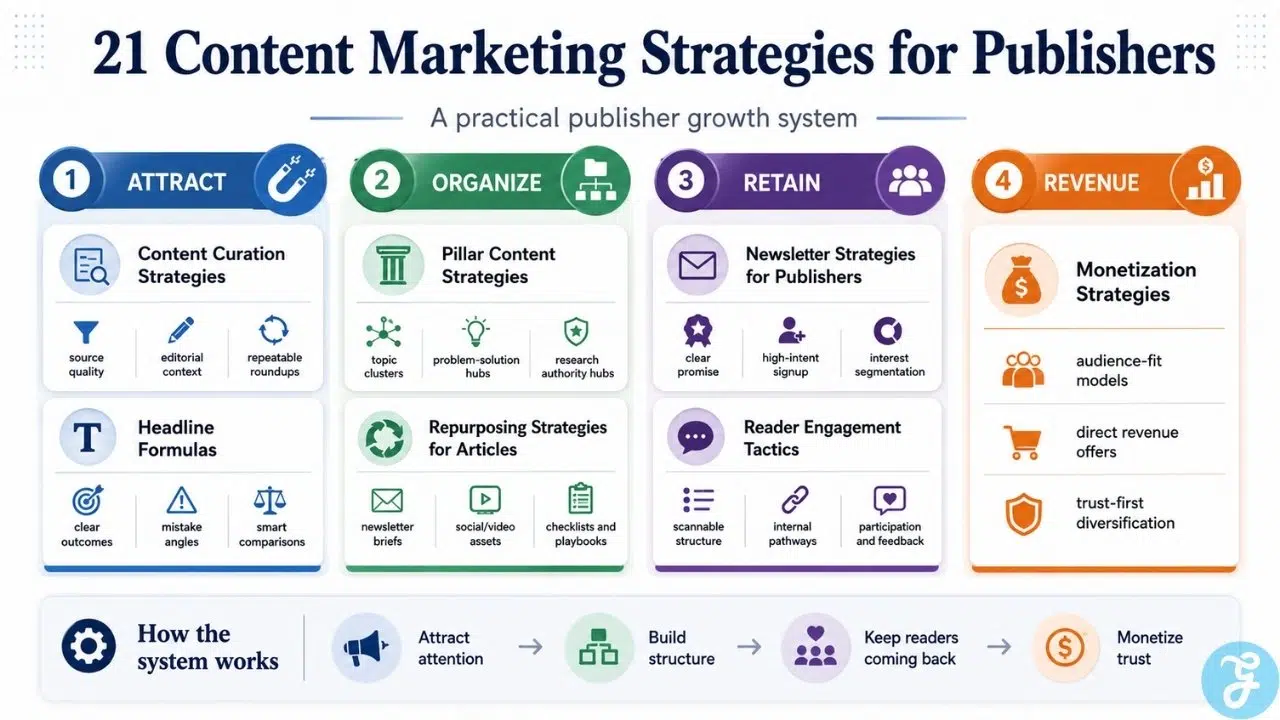
21 Content Marketing Strategies for Publishers
A strong publisher content system does not rely on one tactic. It uses multiple editorial strategies that support each other. The following 21 content marketing tactics are organized around seven core areas: curation, newsletters, headline writing, pillar content, repurposing, engagement, and monetization.
Content Curation Strategies
Curation matters because niche readers do not need more noise. They need a trusted filter. Strong content curation helps a publisher become the place readers visit when they want the useful version, the clearer version, or the “what actually matters” version of a topic.
1. Build a Source Map for Your Niche
A publisher should know where the best information in its space comes from before publishing another roundup. Build a source map that includes primary sources, expert blogs, newsletters, reports, podcasts, forums, social accounts, communities, and competitor coverage.
This makes curation more consistent. Instead of scrambling for links every week, your team has a living map of trusted sources. It also helps editors notice source gaps, overused voices, and emerging experts before everyone else repeats the same references.
Best Practical Use Case:
- Niche publishers that want a repeatable curation system
- Newsletters, topic hubs, industry blogs, and expert roundups
Why it works:
- Improves source quality
- Reduces random link collection
- Helps editors build authority through better selection
Things to consider:
- Review the source map regularly
- Do not rely only on loud social voices or recycled commentary
2. Add Editorial Context to Every Curated Item
A link is not curation. A link with judgment is.
Every curated item should explain why it matters, who should read it, what changed, what is missing, or how it connects to the reader’s problem. This turns a simple list into editorial service.
Readers should leave with a sharper view than they had before. If they still need to open ten tabs to understand the point, the curation did not do enough work.
Best Practical Use Case:
- Adding original value to third-party content
- Expert newsletters, niche sites, and professional audiences
Why it works:
- Builds trust in the publisher’s judgment
- Saves readers time
- Makes curated content feel useful rather than copied
Things to consider:
- Avoid summarizing too much from the original source
- Credit sources clearly and fairly
3. Turn Roundups Into Recognizable Editorial Products
A recurring roundup should have a clear angle. “Weekly links” is forgettable. “This week’s most useful AI policy updates for publishers” is a product.
Give each recurring format a purpose, rhythm, and editorial promise. Readers should know what they will get and why it is worth opening again.
Good roundups also create internal linking opportunities. Older editions can connect to pillar pages, trend explainers, evergreen guides, and related resources.
Best Practical Use Case:
- Building audience habit through repeatable curation
- Fast-moving niches, newsletters, and editorial series
Why it works:
- Creates consistency
- Gives readers a reason to return
- Turns curation into a recognizable brand asset
Things to consider:
- Do not include weak items just to fill space
- Keep the format tight enough to maintain quality
Newsletter Strategies for Publishers
Email is one of the few channels where publishers can build a direct relationship that does not fully depend on platforms. But newsletters only work when they have a clear promise, useful rhythm, and enough editorial value to justify space in the inbox.
4. Give Every Newsletter a Clear Reader Promise
A newsletter should not exist because “we need email marketing.” It should exist because it gives a specific reader a specific reason to subscribe.
That promise might be a daily briefing, weekly analysis, local update, industry scan, expert curation, premium insight, or practical checklist. The clearer the promise, the easier it becomes to write subject lines, choose stories, design sections, and promote signups.
Best Practical Use Case:
- Newsletter positioning
- Publishers launching or fixing email products
Why it works:
- Makes the signup offer easier to understand
- Gives the newsletter an editorial identity
- Prevents inbox fatigue caused by vague updates
Things to consider:
- Avoid launching multiple newsletters with the same promise
- Keep the promise narrow enough to remember
5. Place Signup Offers Near High-Intent Content
The best signup moments usually happen when readers have already shown interest. A reader finishing a detailed guide, tool comparison, local explainer, or niche analysis is more likely to subscribe than someone interrupted by a generic popup.
Place newsletter prompts near strong articles, topic hubs, author pages, resource pages, and high-returning visitor paths. Match the signup message to the topic. A reader on a media monetization article should not see the same newsletter offer as a reader on a headline writing guide.
Best Practical Use Case:
- Growing more relevant subscribers
- Publishers with topic verticals or evergreen traffic
Why it works:
- Converts readers when intent is already high
- Makes signup prompts feel helpful
- Supports better segmentation from the start
Things to consider:
- Ask for only what you need at first
- Do not damage the reading experience with aggressive forms
6. Segment by Interest and Frequency
Not every reader wants the same topic or the same cadence. Some want daily updates. Some want a weekly digest. Some want alerts only for one beat. Others want analysis, not news volume.
Start simple. Let readers choose topics, frequency, or newsletter type. Then use behavior to improve recommendations over time.
Segmentation helps publishers reduce unsubscribes, improve relevance, and build stronger relationships with different audience groups.
Best Practical Use Case:
- Improving retention and relevance
- Multi-topic publishers, local sites, and B2B brands
Why it works:
- Reduces inbox fatigue
- Makes email feel more personal
- Helps sponsorship and paid offer targeting
Things to consider:
- Do not create segments your team cannot maintain
- Offer preference options before readers unsubscribe
Strategies for Headline Formulas
Headlines are not decoration. They are editorial packaging. A strong headline helps the right reader understand the value quickly, while a weak one hides good work behind vague wording.
7. Use Clear Outcome Headlines for Practical Content
When an article teaches something, the headline should make the result obvious. Readers should know what they will be able to understand, choose, fix, or improve after clicking.
This works especially well for guides, checklists, workflows, and tutorials. It also keeps the article focused because the headline forces the writer to define the outcome before drafting.
Best Practical Use Case:
- Guides and educational content
- SEO articles, explainers, and evergreen resources
Why it works:
- Makes value clear immediately
- Attracts readers with specific intent
- Reduces mismatch between headline and article
Things to consider:
- Do not promise an easy result if the topic is complex
- Make sure the body delivers the promised outcome
8. Use Risk or Mistake Headlines When the Stakes Are Real
Mistake-based headlines work because readers want to avoid wasted time, lost money, public embarrassment, or poor decisions. For publishers, this format works well when the article genuinely identifies common errors and explains how to fix them.
The key is specificity. “Mistakes that hurt your newsletter” is weaker than “newsletter mistakes that make loyal readers unsubscribe.”
Best Practical Use Case:
- Warning and improvement content
- Expert columns, B2B content, and practical editorial advice
Why it works:
- Creates urgency without fake drama
- Helps readers self-diagnose
- Makes expert guidance easier to package
Things to consider:
- Do not shame the reader
- Always include the fix, not just the failure
9. Use Comparison Headlines for Decision-Stage Readers
Many readers are not looking for a definition. They are choosing between options.
Comparison headlines work well when the audience needs help deciding between tools, formats, strategies, platforms, or approaches. A good comparison headline should signal that the article will explain trade-offs, not force a fake winner.
Best Practical Use Case:
- Decision-support content
- Buyer guides, strategy comparisons, and tool articles
Why it works:
- Matches high-intent search behavior
- Creates natural article structure
- Helps readers move from research to action
Things to consider:
- Be honest when the answer depends on context
- Include “choose this if” guidance whenever possible
Pillar Content Strategies
Pillar content helps publishers turn scattered articles into organized authority. The point is not to create one huge page and call it a strategy. The point is to help readers move from broad understanding to specific answers through a clear internal structure.
10. Build Classic Topic Clusters Around Core Editorial Areas
A topic cluster uses a broad central page supported by deeper subtopic pages. For publishers, this works well around recurring subject areas: newsletter growth, content monetization, technical SEO, audience development, or local policy coverage.
The pillar gives the big picture. The cluster pages answer narrower questions. Internal links connect the system.
Best Practical Use Case:
- Organizing broad editorial topics
- SEO teams, publishers, SaaS blogs, and niche sites
Why it works:
- Builds topical depth
- Improves internal navigation
- Makes content planning less random
Things to consider:
- Cluster pages must be genuinely useful
- Do not create thin articles just to fill the hub
11. Use Problem-Solution Hubs for Practical Reader Needs
A problem-solution hub organizes content around what the reader is trying to fix, not just what the publisher calls the category.
Instead of a broad “Email Marketing” hub, a publisher might build around “how to grow newsletter subscribers” or “how to improve reader retention.” This format works because it starts with reader intent.
Best Practical Use Case:
- Practical and conversion-friendly hubs
- B2B publishers, SaaS content, and editorial brands with service offers
Why it works:
- Connects content to reader pain
- Supports stronger calls to action
- Makes hubs feel useful instead of academic
Things to consider:
- Keep the problem specific
- Make sure each supporting page solves a real subproblem
12. Create Data, Research, or Expert Hubs to Build Authority
Not every pillar needs to be a basic guide. Some of the strongest publisher pillars are built around research, benchmarks, expert commentary, curated resources, or original analysis.
These hubs can earn trust because they offer something harder to copy. They can also support newsletters, reports, sponsorships, and recurring editorial series.
Best Practical Use Case:
- Authority building
- Research-led publishers, B2B sites, industry media, and expert communities
Why it works:
- Creates original value
- Gives other sites a reason to cite or reference your work
- Strengthens editorial credibility
Things to consider:
- Explain methodology when using data
- Keep expert hubs updated so they do not become stale libraries
Repurposing Strategies for Articles
A strong article should not disappear after one publish date. Repurposing helps publishers turn research, structure, examples, and insights into multiple useful formats without creating thin duplicate content.
13. Turn Strong Articles Into Newsletter Briefings
A published article can become a concise email edition with a fresh editor’s note, key takeaways, and a link to the full piece. This gives the article a second life and helps email subscribers get value without needing to search the site.
The newsletter version should not paste the article. It should reframe the idea for inbox reading.
Best Practical Use Case:
- Extending article distribution
- Publishers, blogs, and editorial newsletters
Why it works:
- Gives strong content another audience touchpoint
- Builds direct relationships
- Makes newsletter production easier
Things to consider:
- Add fresh context
- Keep the email version focused and useful
14. Break Long Articles Into Social and Video Assets
Most strong articles contain several standalone ideas. A framework can become a carousel. A warning can become a short video. A checklist can become a social post. A strong opinion can become a discussion prompt.
This works best when each repurposed asset has one clear idea. Do not drag the whole article into every platform.
Best Practical Use Case:
- Multi-channel distribution
- LinkedIn, YouTube Shorts, Instagram, X, and community posts
Why it works:
- Extends the reach of one article
- Helps test which ideas resonate
- Makes social publishing less dependent on new ideas
Things to consider:
- Rewrite for the platform
- Avoid posting identical excerpts everywhere
15. Turn Evergreen Articles Into Checklists, Hubs, or Playbooks
Some articles contain repeatable processes. Those can become downloadable checklists, internal editorial playbooks, resource pages, or pillar hub sections.
This is one of the highest-value content marketing tactics because it turns information into action. A reader who saves a checklist or returns to a hub is more engaged than someone who skims once.
Best Practical Use Case:
- Practical article reuse
- Guides, tutorials, B2B content, and publishing workflows
Why it works:
- Creates reusable assets
- Supports lead generation or reader retention
- Makes old articles useful again
Things to consider:
- Refresh the original article before repurposing if it is outdated
- Do not turn weak content into downloadable clutter
Reader Engagement Tactics
Engagement is not just comments or likes. For publishers, real engagement means readers stay, explore, respond, save, subscribe, and return. The best engagement tactics respect the reader’s time instead of trying to trap attention.
16. Structure Articles for Scanning and Depth
Readers often scan before they commit. That does not mean they dislike depth. It means they need orientation.
Use clear headings, short paragraphs, useful labels, strong transitions, and internal navigation. This helps readers find value quickly and decide where to spend more attention.
Best Practical Use Case:
- Improving article usability
- Long-form guides, listicles, explainers, and comparisons
Why it works:
- Makes depth easier to navigate
- Improves mobile readability
- Keeps readers from abandoning dense pages
Things to consider:
- Do not reduce everything to shallow bullets
- Use structure to clarify, not decorate
17. Build Internal Pathways for the Next Best Click
Every article should give interested readers somewhere useful to go next. That might be a deeper guide, a beginner page, a comparison, a newsletter signup, a resource hub, or a related opinion piece.
The goal is not to add random links. The goal is to guide readers based on intent.
Best Practical Use Case:
- Improving reader retention and site exploration
- Publishers with large archives or content hubs
Why it works:
- Reduces dead-end articles
- Increases useful internal clicks
- Helps readers build a relationship with the site
Things to consider:
- Link to the next best resource, not every related page
- Use descriptive anchor text when adding internal links
18. Invite Participation With Questions, Polls, and Community Moments
Readers engage more when they feel there is room to participate. A good prompt asks for something specific: experience, disagreement, examples, questions, or preferences.
This can happen in articles, newsletters, comments, polls, live chats, or recurring community formats. The key is to make participation easy and meaningful.
Best Practical Use Case:
- Building audience feedback loops
- Niche publishers, newsletters, communities, and expert sites
Why it works:
- Helps readers feel involved
- Gives editors insight into audience needs
- Creates ideas for future content
Things to consider:
- Moderate participation carefully
- Show readers when their feedback shapes future coverage
Content Monetization Strategies
Content marketing should support the business model without damaging editorial trust. A publisher does not need every revenue stream. It needs the right mix for its traffic, audience loyalty, buying intent, expertise, and direct channels.
19. Match Revenue Models to Audience Assets
Different content sites have different monetization strengths. High-traffic sites may support display ads. Buyer-intent sites may support affiliate content. Loyal editorial brands may support memberships. Expert sites may sell products, services, or events.
Start with the asset, not the trend. A revenue model that works for one publisher may fail on another because the audience relationship is different.
Best Practical Use Case:
- Choosing monetization models realistically
- Publishers, niche sites, blogs, and editorial startups
Why it works:
- Prevents random monetization experiments
- Aligns revenue with audience behavior
- Protects editorial trust
Things to consider:
- Measure profit, not just revenue
- Avoid models that hurt the reader experience
20. Build Direct Revenue Through Email, Memberships, and Products
Direct channels give publishers more control than platform-dependent traffic. A focused newsletter can support sponsorships, premium editions, product launches, events, or subscriptions.
Digital products can also work when the site has practical expertise. Templates, reports, checklists, courses, toolkits, and research packages can monetize trust without needing massive traffic.
Best Practical Use Case:
- Building revenue beyond pageviews
- Expert publishers, B2B sites, niche blogs, and newsletters
Why it works:
- Reduces dependence on ads alone
- Rewards audience loyalty
- Turns editorial expertise into tangible value
Things to consider:
- Paid offers need a clear promise
- Weak products can damage trust faster than weak articles
21. Protect Trust While Diversifying Income
Revenue diversification matters, but reader trust matters more. Ads, sponsorships, affiliate links, subscriptions, sponsored content, and events can all work when they are relevant and transparent.
The best monetization strategy does not treat readers like inventory. It treats attention as something earned. That means clear disclosure, good user experience, honest recommendations, and editorial standards that do not bend for every sponsor.
Best Practical Use Case:
- Long-term publisher revenue
- Any content site trying to grow sustainably
Why it works:
- Reduces dependence on one income stream
- Protects credibility
- Helps revenue grow without weakening the brand
Things to consider:
- Do not monetize faster than the audience relationship can handle
- Review revenue models regularly as traffic and trust change
A Quick Overview
These strategies work best as a connected system. Curation helps discovery. Newsletters build direct relationships. Headlines improve entry points. Pillars organize authority. Repurposing extends reach. Engagement strengthens loyalty. Monetization turns trust into sustainable revenue.
| Area | Strategies Covered | Main Benefit | Best Fit |
| Curation | 1–3 | Better discovery and editorial trust | Niche publishers, newsletters |
| 4–6 | Direct audience growth | Publishers, local media, B2B brands | |
| Headlines | 7–9 | Stronger clicks without clickbait | Blogs, editorial teams |
| Pillars | 10–12 | Topic authority and internal structure | SEO teams, content hubs |
| Repurposing | 13–15 | More value from each article | Small teams, publishers |
| Engagement | 16–18 | Reader retention and participation | Media brands, communities |
| Monetization | 19–21 | Sustainable revenue models | Content sites, niche businesses |
Content Marketing Strategies for Publishers
1. Build Internal Pathways
This is one of the fastest ways to improve a publisher’s existing archive. If related articles are not connected clearly, readers leave before discovering the depth your site already has.
2. Give Every Newsletter a Clear Promise
Email becomes stronger when readers know exactly why it belongs in their inbox. A vague newsletter is easy to ignore. A focused one becomes a habit.
3. Build Topic Clusters Around Core Editorial Areas
This turns random publishing into structured authority. It also makes editorial planning easier because every new article has a purpose inside a larger system.
4. Repurpose Strong Articles Into Multiple Formats
A good article should not die after publication day. Repurposing helps teams extend reach without constantly starting from zero.
5. Match Revenue Models to Audience Assets
Monetization works better when it fits the audience relationship. Traffic, trust, buyer intent, email loyalty, and expertise each support different income models.
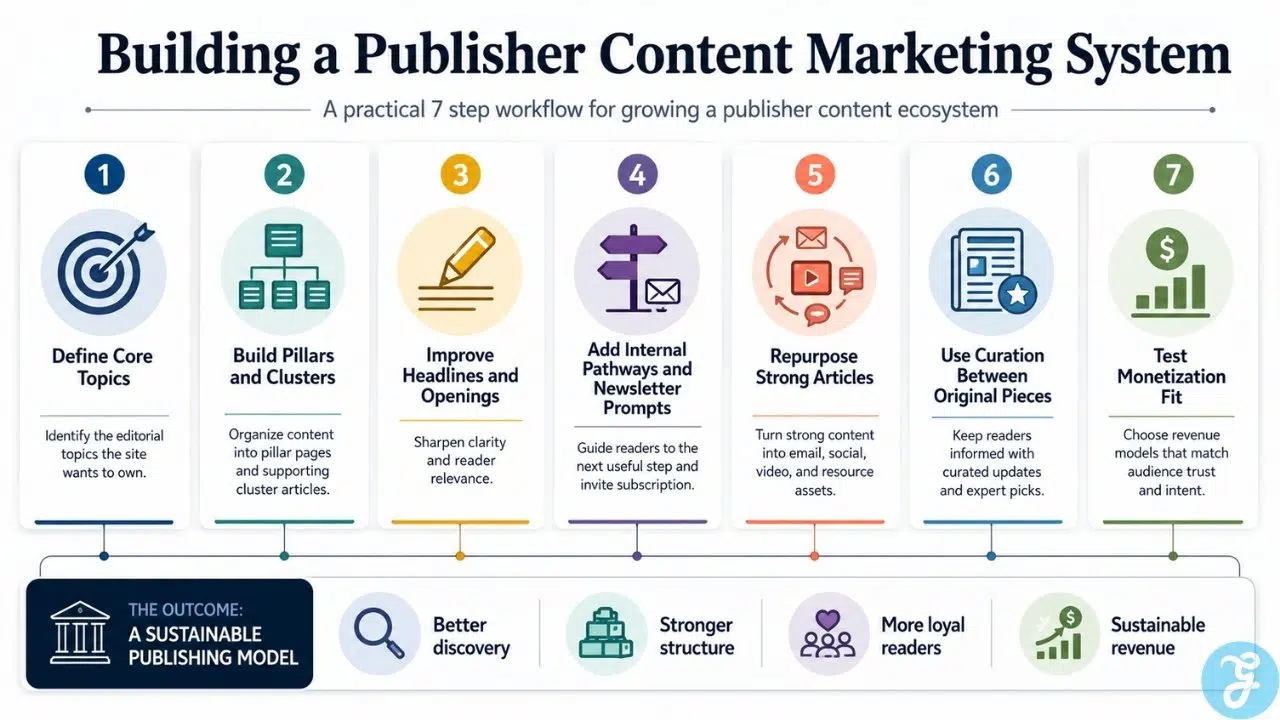
How to Build a Publisher Content Marketing System
Do not try to implement all 21 strategies at once. Start by diagnosing the weakest part of your current system.
If discovery is weak, improve curation, headlines, and pillar structure. If return visits are weak, improve newsletters, internal pathways, and saveable assets. If the archive is messy, build hubs and refresh older content. If revenue is weak, identify the audience asset you actually have before adding new monetization offers.
A practical rollout might look like this:
- Define the core editorial topics your site wants to own.
- Build or clean up the pillar and cluster structure.
- Improve headlines and article openings for clarity.
- Add internal pathways and newsletter prompts to high-value content.
- Repurpose strong articles into email, social, video, and resources.
- Use curation to keep readers informed between original pieces.
- Test monetization models that match audience trust and intent.
Final Checklist Before Publishing More Content
Before adding another article to the calendar, ask:
- Does this support a larger topic, hub, or reader journey?
- Can readers understand the value from the headline?
- Is there a clear next step after reading?
- Can this article feed a newsletter, social post, checklist, or future hub?
- Does it help attract, retain, or monetize the right audience?
- Are we adding original value or just filling the archive?
- Will this still be useful after the publish date passes?
Publishing More Is Not the Same as Building More Value
The best Content Marketing Strategies for Publishers do not reward volume for its own sake. They reward structure, usefulness, consistency, and trust.
A publisher’s real advantage is not simply having articles. It is knowing how those articles work together. One piece should attract the reader. Another should deepen the topic. Another should invite the subscription. Another should build trust. Another should support revenue.
That is how content marketing becomes more than promotion.
It becomes the operating system for audience growth, editorial authority, and sustainable publishing.
Frequently Asked Questions (FAQs) on Content Marketing Strategies for Publishers
What are Content Marketing Strategies for Publishers?
Content Marketing Strategies for Publishers are repeatable editorial and audience-growth methods that help publishers attract readers, build trust, improve retention, organize content, grow direct channels, and generate revenue.
Why do publishers need content marketing?
Publishers need content marketing because publishing alone does not guarantee discovery, loyalty, or income. A strategy helps connect articles, newsletters, curation, engagement, and monetization into one coherent system.
What are the best publisher content strategies?
The strongest publisher content strategies include topic clusters, newsletters, content curation, strong headlines, article repurposing, reader engagement tactics, and trust-based monetization.
How can publishers improve reader retention?
Publishers can improve reader retention by building internal pathways, offering newsletters, using recurring formats, creating saveable assets, inviting participation, and giving readers a clear reason to return.
How do content marketing tactics support publisher revenue?
Content marketing tactics support revenue by increasing trust, improving repeat visits, building email audiences, strengthening authority, supporting sponsorships, improving affiliate content, and creating opportunities for memberships, products, or services.