

Getting someone to click once is not the hard part anymore. Keeping them interested after the click is where most publishers, blogs, and content teams struggle.
Readers are busy. Feeds move fast. Search results answer more questions directly. Social platforms train people to skim, swipe, and leave. If your content does not give readers a reason to stay, respond, save, subscribe, or return, it becomes another disposable page in a crowded web.
That is why reader engagement tactics matter.
Real engagement is not just comments, likes, or time on page. Those can help, but they do not tell the whole story. Strong engagement means readers feel understood, find value quickly, trust the experience, and see a reason to come back.
The best tactics are not gimmicks. They are editorial, structural, and community-driven choices that make the reader feel less like traffic and more like an audience.
Our Selection Criteria
We selected these tactics based on practical usefulness for publishers, bloggers, niche sites, newsletters, media brands, and content teams.
| Criteria | What We Looked For |
|---|---|
| Reader value | Does the tactic make the content more useful or easier to engage with? |
| Retention potential | Can it help readers return, subscribe, save, or continue reading? |
| Editorial fit | Does it improve the content experience without cheap tricks? |
| Community value | Does it help readers feel heard, involved, or connected? |
| SEO support | Can it improve content usefulness, internal navigation, and topical depth? |
| Repeatability | Can a small team use it consistently without overcomplicating production? |
Who This Is For
These reader engagement tactics are useful for publishers, bloggers, newsletter editors, content marketers, media startups, niche site owners, SaaS content teams, educators, and community managers.
They are especially useful if readers visit once and disappear, comments are weak, newsletter signups are low, internal clicks are poor, or your content feels useful but not memorable.
11 Reader Engagement Tactics That Actually Work
Before applying any tactic, remember this: engagement starts with relevance. If the content does not match the reader’s problem, no widget, poll, CTA, or comment box will save it.
1. Open With the Reader’s Real Problem
Many articles lose readers because the opening is too generic. It explains the topic before proving that the writer understands the reader’s situation.
A stronger opening names the problem clearly. It shows the reader why the topic matters now, what is at stake, and what the article will help them understand or solve. This is one of the simplest audience engagement methods because it improves the first few seconds of attention.
Where it works best:
- Best for improving early reader attention
- Great for blogs, explainers, guides, newsletters, and opinion pieces
Why we chose it:
- Makes readers feel understood quickly
- Reduces early bounce caused by vague introductions
- Gives the article a clearer emotional and practical reason to exist
- Helps the content feel written for people, not just keywords
Things to consider:
- Do not exaggerate the pain point
- Get to the useful part quickly after setting the problem
2. Use Scannable Structure Without Dumbing Things Down
Readers often scan before they commit. That does not mean they hate depth. It means they want proof that the page is worth their time.
Use clear headings, short paragraphs, bold labels, useful bullets, tables where they genuinely help, and section transitions that guide the reader. Scannability is not about making content shallow. It is about helping readers find their way through the depth.
Where it works best:
- Best for keeping busy readers oriented
- Great for long-form content, listicles, guides, and comparison articles
Why we chose it:
- Helps readers decide where to focus
- Improves the reading experience on mobile
- Makes complex topics easier to navigate
- Supports engaging readers who may not read in a straight line
Things to consider:
- Do not turn every paragraph into a bullet
- Use structure to clarify, not decorate
3. Add Reader Questions Inside the Content
A good article should not only answer questions. It should anticipate the next question before the reader has to ask it.
Add short question-led sections or prompts inside the content. For example: “What does this mean for a small publisher?” or “When should you avoid this tactic?” These moments make the article feel more conversational and help readers continue naturally.
Where it works best:
- Best for making content feel interactive without heavy tools
- Great for explainers, tutorials, B2B content, and educational articles
Why we chose it:
- Mirrors how readers think while learning
- Keeps the article from feeling like a lecture
- Helps surface objections and uncertainties
- Improves flow between sections
Things to consider:
- Use real reader questions, not filler questions
- Answer each question directly and practically
4. Build Internal Pathways for the Next Click
Reader retention improves when people know where to go next. Too many sites publish isolated articles and expect readers to figure out the journey alone.
Add relevant internal links, “read next” blocks, topic hubs, related guides, comparison pages, and beginner-to-advanced pathways. The goal is not to dump links everywhere. The goal is to help readers continue based on their intent.
Where it works best:
- Best for increasing return value from existing content
- Great for publishers, SEO teams, niche blogs, and learning centers
Why we chose it:
- Keeps interested readers moving through the site
- Helps organize related content around topics
- Supports topical authority and better content discovery
- Reduces dead-end articles
Things to consider:
- Link contextually, not randomly
- Prioritize the next best article, not every related article
5. Use Polls and Micro-Questions Carefully
Polls can increase engagement when they ask something readers actually care about. A lazy poll feels like decoration. A useful poll helps readers compare their view with others or gives the publisher insight into audience needs.
Micro-questions can work inside newsletters, articles, and social posts. Ask readers what they struggle with, which option they prefer, what they want explained next, or whether a recommendation fits their situation.
Where it works best:
- Best for lightweight audience participation
- Great for newsletters, communities, social posts, and editorial sites
Why we chose it:
- Invites readers to participate without a big commitment
- Helps teams understand reader preferences
- Can generate future content ideas
- Makes the audience feel less passive
Things to consider:
- Do not add polls just to make a page look interactive
- Share results or act on feedback when possible
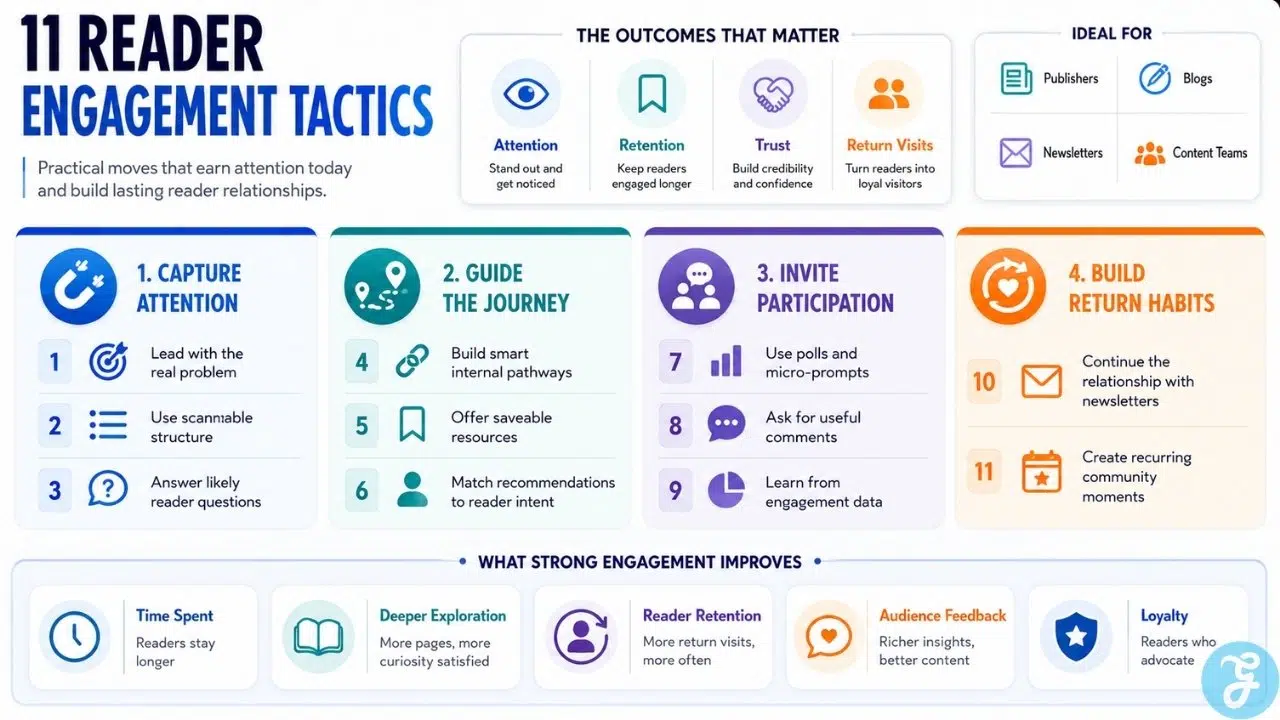
6. Create Comment Prompts That Invite Useful Responses
“Leave a comment below” is weak because it asks for effort without giving direction. Better comment prompts are specific.
Ask readers to share their experience, disagreement, example, question, or use case. For example: “Which tactic has helped your newsletter retain readers?” is stronger than “What do you think?” Good prompts give people a reason to respond.
Where it works best:
- Best for improving comment quality
- Great for blogs, communities, newsletters, and expert articles
Why we chose it:
- Encourages more thoughtful responses
- Gives readers permission to contribute something specific
- Helps reveal audience pain points
- Can turn comments into future article ideas
Things to consider:
- Moderate comments to protect quality
- Reply to strong comments so readers know participation matters
7. Offer Saveable Assets Inside the Article
Readers engage more deeply when an article gives them something they can reuse. That might be a checklist, cheat sheet, template, scorecard, worksheet, decision matrix, or short framework.
Saveable assets turn passive reading into action. They also increase the chance that readers bookmark the page, share it, subscribe, or come back when they need the resource again.
Where it works best:
- Best for turning content into a practical resource
- Great for guides, tutorials, B2B content, education, and SaaS blogs
Why we chose it:
- Gives readers a reason to save or return
- Makes advice easier to apply
- Supports newsletter growth or lead generation
- Increases the perceived value of the article
Things to consider:
- The asset should be genuinely useful, not a thin PDF
- Keep it simple enough to use immediately
8. Personalize Recommendations by Reader Intent
Personalization does not always require complex software. Sometimes it starts with simple segmentation.
Create pathways like “If you are a beginner, start here,” “If you manage a team, read this,” or “If you already have traffic, focus on retention.” This helps different readers find the advice that fits them instead of forcing everyone through the same content path.
Where it works best:
- Best for mixed audiences with different needs
- Great for newsletters, resource hubs, SaaS blogs, and educational sites
Why we chose it:
- Makes content feel more relevant
- Helps readers avoid advice that does not fit them
- Improves reader retention by reducing frustration
- Supports better internal linking and content journeys
Things to consider:
- Do not over-segment until the audience becomes hard to manage
- Keep pathways simple and visible
9. Use Newsletters to Continue the Relationship
A reader may not return to your site on their own. A newsletter gives them a reason to come back.
Use newsletters to extend the article, not just promote it. Send key takeaways, editor’s notes, reader questions, related resources, short briefings, or practical follow-ups. This turns a single article into an ongoing relationship.
Where it works best:
- Best for building repeat readership
- Great for publishers, niche sites, creators, and content brands
Why we Chose It:
- Moves the relationship beyond one pageview
- Helps build a direct audience channel
- Supports reader retention through habit
- Gives content more than one distribution moment
Things to consider:
- Do not send generic article dumps
- Make the newsletter promise clear and useful
10. Use Data to Find Drop-Off Points
Reader engagement should not depend only on instinct. Analytics can show where readers leave, what they click, which pages lead to more sessions, and which topics build return visits.
Look beyond surface metrics. Time on page can mislead. Instead, examine scroll depth, internal clicks, newsletter signups, return visitors, comments, shares, conversion paths, and content-assisted outcomes. The goal is to understand what keeps readers involved.
Where it works best:
- Best for improving engagement based on behavior
- Great for publishers, content teams, ecommerce blogs, and SaaS sites
Why we chose it:
- Shows where content loses attention
- Helps identify articles with strong retention potential
- Improves internal linking and CTA placement
- Turns engagement from guesswork into editorial improvement
Things to consider:
- Do not chase one metric blindly
- Pair data with qualitative feedback from readers
11. Build Community Around Recurring Content
Recurring formats build habits. Community builds belonging. Combine the two and reader engagement becomes much stronger.
This could be a weekly Q&A, monthly reader challenge, expert roundup, comment thread, live discussion, newsletter response section, or recurring “reader picks” feature. When readers know they can participate again, they are more likely to return.
Where it works best:
- Best for long-term audience engagement
- Great for publishers, newsletters, communities, creators, and niche sites
Why we chose it:
- Builds habit and participation
- Makes readers feel part of the content ecosystem
- Creates repeatable editorial moments
- Can generate ideas, quotes, questions, and community insight
Things to consider:
- Start small before launching a full community
- Keep participation easy and clearly moderated
A Quick Overview
These reader engagement tactics work best when they support the reader’s journey instead of interrupting it. Some tactics help people stay on the page, some help them continue to another article, and others turn a one-time visit into a longer relationship through email, comments, or community.
| Tactic | Best Use | Main Benefit | Best Fit |
| Reader-problem opening | Early attention | Stronger relevance | Blogs, guides, newsletters |
| Scannable structure | Better reading flow | Easier navigation | Long-form content |
| Reader questions | Conversational depth | More natural flow | Explainers, tutorials |
| Internal pathways | Next-click retention | More site exploration | Publishers, SEO sites |
| Polls and micro-questions | Lightweight interaction | Audience feedback | Newsletters, communities |
| Comment prompts | Better discussion | More useful responses | Blogs, expert content |
| Saveable assets | Practical engagement | More saves and returns | Guides, B2B content |
| Intent-based recommendations | Personalization | Better relevance | Resource hubs, SaaS blogs |
| Newsletters | Relationship building | Repeat readership | Publishers, creators |
| Engagement analytics | Performance improvement | Smarter optimization | Content teams |
| Recurring community content | Habit and belonging | Long-term loyalty | Niche sites, publishers |
Our Top 3 Picks and Why
1. Build Internal Pathways for the Next Click
This is one of the most practical tactics because many websites already have related content but fail to connect it well. Better internal pathways help readers keep learning without getting lost.
2. Offer Saveable Assets Inside the Article
Saveable assets make content more useful. A reader who downloads, bookmarks, or returns to a checklist is more engaged than someone who simply skims and leaves.
3. Use Newsletters to Continue the Relationship
Newsletters turn casual readers into reachable readers. For publishers and content teams, that direct relationship is too valuable to ignore.
How to Choose the Right Reader Engagement Tactic
Choose the tactic based on where readers drop off.
If readers leave quickly, improve the opening and structure. If they finish articles but do not continue, build better internal pathways. If they read but do not subscribe, offer stronger saveable assets or newsletter promises. If you already have loyal readers, community features and recurring formats can deepen the relationship.
A simple selection framework:
- Pick reader-problem openings if intros feel generic.
- Pick scannable structure if articles are long or dense.
- Pick internal pathways if readers do not click to related content.
- Pick saveable assets if the article teaches a process.
- Pick newsletters if you want repeat readership.
- Pick polls or comment prompts if audience participation is weak.
- Pick analytics reviews if you are unsure where engagement drops.
Final Checklist Before Publishing for Engagement
Before publishing, ask:
- Does the opening speak to a real reader problem?
- Can readers scan the article and understand the structure quickly?
- Are there useful internal links for the next step?
- Is there a clear reason to save, share, comment, or subscribe?
- Does the content invite participation without feeling forced?
- Are CTAs relevant to the reader’s stage?
- Will this piece help readers return, not just arrive?
Engagement Starts With Respect
The best reader engagement tactics do not manipulate attention. They respect it.
Readers come to content with limited time, specific problems, and many distractions. If your article helps them quickly, guides them clearly, and gives them a reason to continue the relationship, engagement becomes more natural.
Clicks are temporary. Reader trust lasts longer.
Build for that, and engagement stops being a metric you chase. It becomes the result of content that people actually want to use, remember, and return to.
Frequently Asked Questions (FAQs) on Reader Engagement Tactics
What are reader engagement tactics?
Reader engagement tactics are methods used to keep readers interested, involved, and connected with content. They include better openings, scannable structure, internal links, polls, comments, newsletters, saveable assets, and community formats.
How do you keep readers engaged in an article?
Start with a real reader problem, use clear structure, add useful examples, answer likely questions, and guide readers to the next helpful step. Avoid long generic introductions and unsupported advice.
What is the difference between reader engagement and reader retention?
Reader engagement is how actively readers interact with or use your content. Reader retention is whether they come back over time. Strong engagement often supports better retention.
Which audience engagement methods work best for publishers?
Publishers often benefit from newsletters, internal content pathways, comment prompts, recurring formats, polls, and saveable resources. The best choice depends on audience behavior and editorial goals.
Can reader engagement tactics help SEO?
Yes, indirectly. Useful structure, relevant internal links, strong content quality, and better reader satisfaction can improve the overall content experience. Engagement tactics should support usefulness first, not manipulate metrics.