In advanced manufacturing, many critical decisions are made long before a product reaches the production line. Materials are selected, finishes are approved, lighting conditions are evaluated and suppliers are chosen while the project is still in development. Yet, in products where light, color, transparency or reflection affect performance, traditional validation often depends on physical prototypes that arrive late, cost money and leave little room for correction.
This is one of the reasons why predictive virtual prototyping is gaining strategic value in Industry 4.0. Companies are no longer looking only for faster design cycles; they need reliable data that helps engineering teams anticipate how a product will behave in real conditions. When optical performance is part of the equation, simulation must go beyond visual approximation and become a scientific decision making tool.
From physical trials to physics-based confidence
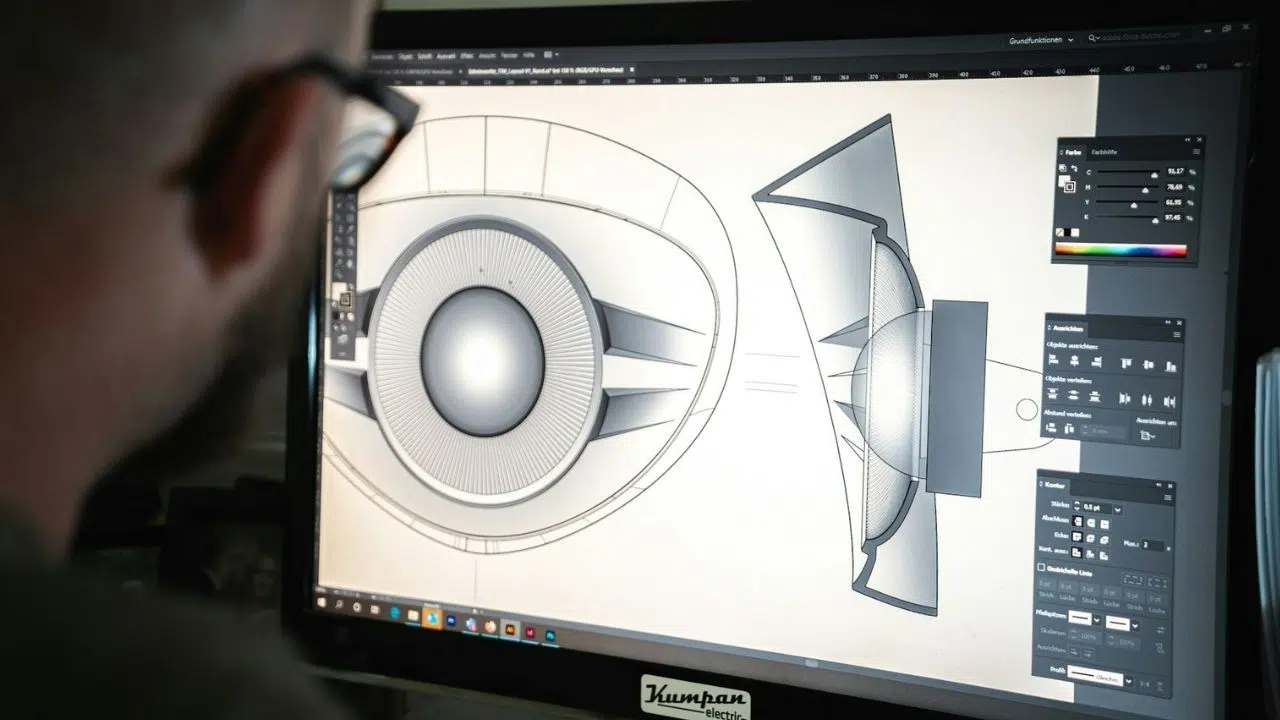
This is the context in which Eclat Digital has positioned its work: the company develops Ocean™, a physics based optical simulation software created for industrial teams that need to validate both appearance and technical performance before manufacturing. Its value lies in helping engineers build highly accurate virtual prototypes where lighting, reflections, colorimetry and material behavior can be assessed with measurable criteria.
In practice, this type of solution allows companies to detect potential issues earlier in the development process. A surface may behave differently depending on the angle of observation. A transparent material may generate unwanted reflections. A finish may meet expectations under one illuminant but fail under another. These are not minor details; in many sectors, they influence perceived quality, safety, usability and customer acceptance.
Why optical simulation belongs in CAE
Computer-aided engineering (CAE) has long helped companies test structural, thermal or aerodynamic performance virtually. The same logic now applies to optical simulation. When a product’s perceived quality and functional performance depend on light, engineers need data-rich tools that can model those interactions with scientific precision.
Ocean™ supports virtual prototyping by helping teams assess appearance and performance through physically grounded calculations. This allows engineering, design, R&D and manufacturing teams to work from a shared evidence base rather than separate interpretations. The result is not just faster review, but better alignment between technical feasibility and market expectations.
In Industry 4.0 environments, that alignment is critical. Digital workflows only create value when the data they generate is dependable. A virtual prototype that cannot predict real behavior may accelerate discussion, but it will not reduce risk. A predictive model, by contrast, can help companies compare options, identify weak points and make investment decisions with more confidence.
Reducing I+D costs without lowering standards
Physical prototyping will always have a place in industrial development. The goal is not to eliminate testing, but to reserve it for the most mature and promising options. By using optical simulation earlier, companies can reduce the number of iterations that reach the workshop, supplier or production line. That has a direct impact on I+D budgets.
Fewer physical samples mean lower material waste, fewer tooling adjustments and less time spent correcting issues that could have been detected digitally. For high-value products, regulated applications or components with complex optical behavior, the savings can be substantial.
There is also a strategic advantage: speed. Product teams that validate more scenarios virtually can explore alternatives without waiting for every physical batch. They can test different lighting conditions, surface properties or material combinations in a controlled environment. This shortens decision cycles and supports a faster route to market without forcing teams to rely on intuition alone.
Spectral rendering and the value of reliable data
One of the most important factors in predictive optical simulation is spectral rendering. Instead of simplifying light and color into a basic visual approximation, spectral methods consider how different wavelengths interact with materials. This is especially relevant when colorimetry, translucency, gloss, reflection or absorption affect the final product.
For B2B manufacturers, this level of detail is not a luxury. It can influence supplier selection, quality control, customer approval and compliance with technical specifications. A decision based on incomplete visual information can lead to mismatched expectations across departments or between a manufacturer and its client. With spectral representation and photometric analysis, engineering teams can move beyond “it looks right” and work with measurable parameters. That shift is central to modern digital transformation: replacing subjective interpretation with traceable, repeatable and auditable data.
The digital twin as a decision platform
The value of a digital twin increases when it reflects not only geometry, but also behavior. For products where optical performance matters, integrating simulation data into the digital twin gives teams a richer model of how the product will perform in realistic conditions. This improves collaboration across the product lifecycle. Designers can evaluate material choices earlier. Engineers can assess risks before production.
Marketing and customer-facing teams can explain product behavior with greater clarity. Procurement teams can compare suppliers using technical evidence instead of relying only on samples and specifications. In that sense, predictive virtual prototyping becomes more than a technical tool. It becomes a decision platform that connects departments around a common version of the product.
A more reliable path to industrial innovation
Industry 4.0 is often associated with automation, connected factories and real-time analytics. Yet one of its most valuable contributions is more fundamental: improving the quality of decisions before resources are committed. Physics-based optical simulation fits naturally into that vision. For companies developing products where light, color and visual performance are business-critical, the ability to validate virtually is becoming a competitive advantage.
It reduces uncertainty, accelerates development and helps teams defend decisions with reliable data. The manufacturers that adopt this mindset are not simply digitizing an old process. They are building a smarter engineering culture, one in which prototypes are not only faster to create, but more predictive, more measurable and more useful.