The phrase carbon neutral claims lies sounds aggressive until you spend enough time reading sustainability pages, airline ads, ESG reports, product labels, and “climate positive” landing pages.
The company emits. The product still has a footprint. The flight still burns fuel. The factory still uses energy. The supply chain still depends on transport, packaging, materials, servers, farms, chemicals, warehouses, and waste. Then, somewhere near the bottom of the page, after the soft green color palette has done its emotional work, the brand explains the magic trick: offsets. That is usually where the honesty starts leaking.
“Carbon neutral” is one of the most convenient phrases ever handed to corporate marketing teams. It sounds clean without forcing the product to be clean. It sounds scientific without making the average buyer understand carbon accounting. It sounds like a result, when in many cases it is really a purchase, an estimate, a certificate, a model, and a generous interpretation of what “neutral” means.
I am not saying every company using the phrase is committing legal fraud. That would be too broad and too careless. Some companies measure emissions properly. Some reduce what they can. Some buy higher-quality credits only for residual emissions. Some are trying to communicate a complicated transition in a market that rewards simple labels.
But as a public-facing claim, “carbon neutral” is often misleading in the way ordinary people understand it. People hear neutral and think the climate harm has been cancelled. Most of the time, it has merely been rebranded.
Why “Carbon Neutral Claims Lies” Is Fairer Than It Sounds
The problem begins with the word “neutral.” Neutral suggests balance. It suggests no net harm. It suggests that whatever emissions were created have been matched, cancelled, or erased somewhere else. In consumer language, it feels like permission: buy this, fly this, wear this, ship this, stream this, and you are not making the climate problem worse. That is a huge impression to create.
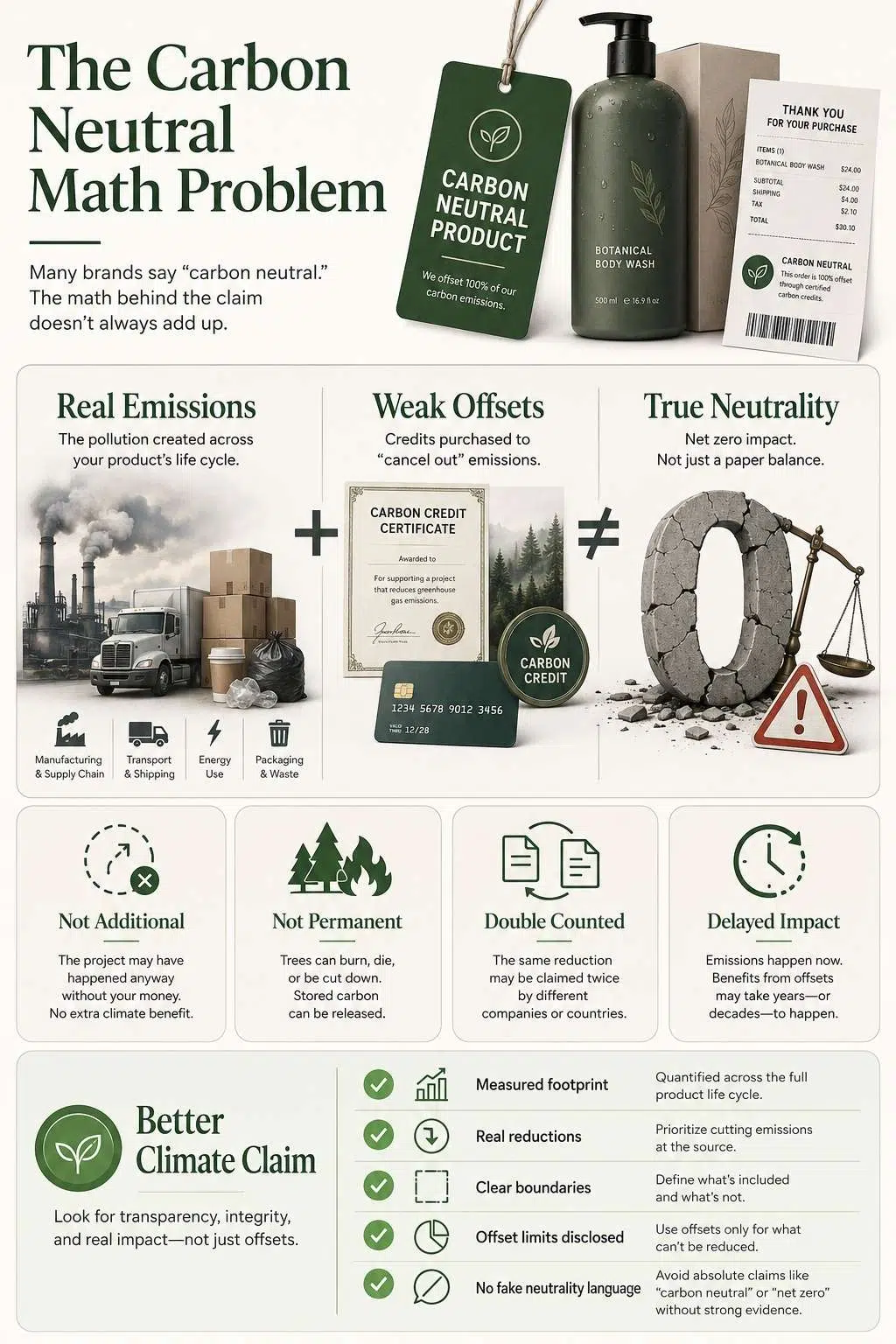
To make that claim honestly, a company would need to show more than a tidy badge. It would need to measure the full footprint, define the boundaries clearly, reduce emissions at the source, explain what cannot yet be reduced, disclose what remains, use high-integrity credits only for genuinely residual emissions, avoid double counting, and stop pretending an outside project makes a high-emitting product harmless.
Most carbon neutral marketing does not do that. It gives the consumer a mood, not an account.
That is why the phrase is so useful and so dangerous. It compresses a complicated emissions story into a feel-good label. It blurs the difference between reducing emissions and compensating for them. It blurs the difference between avoiding emissions, reducing emissions, and removing carbon dioxide from the atmosphere. It blurs the difference between permanent carbon removal and a forest project that may burn, die, be cut down, or never have been at serious risk in the first place.
This is not a small wording problem. It is the whole deception. “Carbon neutral” turns uncertainty into confidence. It turns accounting into absolution. It lets brands sell the emotional relief of climate responsibility without always doing the physical work that climate responsibility requires.
Carbon Neutral Lies Usually Start With Offset Math
Most carbon neutral lies are not built from nothing. They are built from offset math that looks clean on paper and messy in the real world.
The basic idea is simple. A company emits one tonne of carbon dioxide equivalent. It buys a credit from a project that supposedly avoids, reduces, or removes one tonne somewhere else. On a spreadsheet, the balance becomes zero. Paper is patient with nonsense. The atmosphere is not.
Offset projects depend on assumptions that are often hard to prove. Would that forest really have been cut down without the project? Would that renewable energy project really not have been built without carbon-credit money? Will those trees store carbon for decades or centuries? Did emissions simply move somewhere else? Did two buyers claim the same reduction? Was the baseline inflated so the project could issue more credits than it deserved?
These are not boring technical details. They are the claim. If the offset is not additional, it did not create a new climate benefit. If it is not permanent, it cannot truly balance fossil carbon released today. If emissions leak somewhere else, the benefit shrinks. If the same reduction is counted twice, the accounting becomes fantasy. If the baseline is exaggerated, the credit is inflated from the start.
That is why carbon neutral claims are so often weaker than they look. The company may have bought a real certificate from a real registry tied to a real project. But if the climate benefit does not match the public-facing claim, the marketing message becomes false in effect.
Not false because nothing happened. False because not enough happened to justify the word neutral.
Offset Claims Fake: The Problems Hidden Behind the Badge
The phrase offset claims fake sounds blunt, but it captures what many consumers feel when they learn how these labels actually work. They thought the company had cleaned up the product.
Instead, they discover the company paid for a separate climate project and called the product neutral. That gap matters.
The FTC’s Green Guides in the United States have long warned that carbon offset claims require competent and reliable evidence, proper accounting, no double-selling of the same reduction, and disclosure when the claimed reduction will not happen for at least two years. That is not activist nitpicking. That is basic consumer protection.
The UK’s advertising watchdog has also warned brands to avoid unqualified carbon neutral and net zero claims. It has pushed advertisers to explain whether they are actively reducing emissions or relying on offsetting, because consumers may otherwise assume the product or its manufacture produces no or few emissions.
That warning exists because ordinary people do not read climate claims like carbon accountants. They read them like shoppers, travelers, parents, employees, and voters. They see “carbon neutral” and assume something meaningful has changed in the product or service itself. Often, the thing that changed was the marketing page.
The offset market has also faced serious quality questions. A 2024 Nature Communications study looking at major corporate offset buyers found that companies had largely sourced low-quality, cheap offsets, with 87 percent carrying a high risk of not providing real and additional emissions reductions.
That number should make every “carbon neutral” label feel less like reassurance and more like a warning sticker. If most credits used by major buyers are at high risk of not delivering real and additional reductions, then the public claim built on those credits deserves hard skepticism.
Carbon Neutral Debunked: Reduction and Compensation Are Not the Same
Here is the distinction every brand wants to soften: Cutting emissions and offsetting emissions are not the same thing. Cutting emissions means the company changes the product, process, power source, logistics, materials, operations, or supply chain so less pollution enters the atmosphere.
Offsetting means the company continues emitting and pays for a claimed climate benefit somewhere else. Both may appear in a climate strategy. They do not deserve the same moral status.
A company that switches factories to renewable power has changed its own footprint. A company that redesigns packaging, reduces waste, electrifies delivery, extends product life, or cleans up supplier emissions has changed the thing being sold.
A company that buys offsets has bought a claim about another activity. That does not make every offset worthless. High-quality climate finance can support useful work. Some durable carbon removal will matter for hard-to-abate residual emissions. There are sectors where eliminating every tonne immediately is not realistic.
But the honest hierarchy is clear: Reduce first. Remove what truly remains. Use credits carefully, transparently, and without pretending they erase the product’s actual impact.
Most carbon neutral claims reverse that order. They lead with the badge. They bury the method. They make the customer feel better before explaining what actually changed. That is not transparency. That is emotional accounting.
Regulators Are Finally Catching Up
The legal mood around carbon neutral claims is changing because regulators can see the consumer problem.
People do not interpret “carbon neutral” as a spreadsheet footnote. They interpret it as a climate result. When they discover the claim depends heavily on offsets, the trust collapse is not surprising. It is rational.
The European Union has moved especially hard on this issue. EU countries were required to transpose the Empowering Consumers for the Green Transition Directive into national law by March 27, 2026, and the rules are due to apply from September 27, 2026. The European Commission’s 2026 guidance explains that claims such as carbon neutral, climate neutral, carbon compensated, and carbon positive can be prohibited in certain product contexts when they are based on offsetting rather than the product’s actual lifecycle impact.
That is a big deal. The logic is simple: if a product still causes emissions, a company should not imply the product itself has a neutral, reduced, or positive climate impact simply because the company paid for compensation outside the product’s value chain.
This does not mean companies can never talk about climate investments. They can. But they must stop presenting offset purchases as if they make the product itself clean. That is the correction the market badly needs.
Climate communication should tell consumers what happened, not soothe them with words that hide the difference between internal reductions and external compensation.
The Certificate Problem: Verified Does Not Mean Harmless
One reason carbon neutral marketing survives is that it often comes wrapped in comforting third-party language. Certified. Verified. Audited. Registry-backed. Standard-aligned. These words create trust. They make the claim feel settled. But verification is not the same as truth in the way consumers understand truth.
A credit can be verified under a methodology that later proves too generous. A project can follow a standard and still face questions about additionality, permanence, leakage, over-crediting, or community impact. A certification can confirm that a process was followed without proving that the public-facing message is fair.
That is where consumers get trapped. They assume a certification means the climate claim is true in the simple way the headline implies. In reality, many certifications still involve estimates, baselines, models, assumptions, future benefits, project risks, and boundaries that the average shopper never sees.
A certificate can support a claim. It cannot rescue an exaggerated one. If a company emits today and funds a project that may reduce emissions over many years, calling the product carbon neutral today is already a stretch. If the project would have happened anyway, the stretch becomes fiction. If the carbon storage later reverses, the fiction gets a timestamp.
This is why serious climate communication needs plain language. Say what was measured, reduced, what remains, what was financed, what kind of credits were used, what the limits are. But do not slap “neutral” on the front and ask people to admire the leaf icon.
The Biggest Lie Is the Moral Permission Slip
The worst part of carbon neutral claims is not the accounting problem. It is the permission slip they hand to consumers and executives. Consumers are told they can keep buying as usual. Executives are told they can keep delaying harder operational decisions.
Marketing teams are told they can turn climate anxiety into brand preference. Investors are told the company has a plan. Everyone gets comfort. The atmosphere gets the invoice.
That is the real harm. Weak carbon neutral claims shift attention away from absolute emissions reductions. They let brands turn climate responsibility into a checkout option, a label, a campaign, a badge, or a line in a sustainability report. They suggest climate harm can be tidied up after the fact. But the climate system does not respond to brand positioning.
A tonne of fossil carbon does not care about your landing page. A supply chain does not become cleaner because the product label has a green seal. A flight does not burn less fuel because a customer clicked the offset box. A fast-fashion item does not become low impact because a brand funded a tree-planting project and uploaded a soft-focus video.
This is where “carbon neutral” becomes more than sloppy language. It becomes strategic delay.

Carbon Neutral Claims Make Dirty Products Look Cleaner Than They Are
The claim becomes especially dangerous in high-emission sectors. A carbon neutral flight is still a flight. A carbon neutral fossil-fuel product is still tied to fossil fuel. A carbon neutral fast-fashion item is still part of a resource-heavy model. A carbon neutral shipping option still depends on a transport system. A carbon neutral event still has travel, food, waste, materials, power, and infrastructure behind it.
The label can make a high-impact activity feel cleaner without forcing the business model to change.
That is why these claims often feel less like climate communication and more like reputation laundering. The company does not have to say, “This still creates emissions, but we reduced them in these specific ways and funded a separate climate project for the remaining estimated footprint.”
That would be clearer. It would also be less magical. Instead, the public sees “carbon neutral.” Short. Smooth. Convenient. Dangerous. A better claim would say: “We reduced lifecycle emissions by this amount and funded separate climate projects for remaining estimated emissions.”
That is less marketable because it leaves the complexity visible. Good. The complexity belongs there.
Why “Almost Always Lies” Is a Defensible Criticism
Some people will object to the word lies. They will say carbon accounting is complex. They will say companies need transition tools. They will say offsets can finance climate projects that would otherwise struggle. They will say perfectionism can discourage action.
Some of that is fair. But the problem is not every use of climate finance. The problem is the public claim. “Carbon neutral” is a clean phrase placed on a messy reality. It suggests a level of certainty and equivalence that most offset-heavy claims cannot honestly carry.
A company can truthfully say it measured emissions. It can truthfully say it reduced some emissions, purchased carbon credits, funded reforestation, clean cooking, methane capture, carbon removal, or renewable energy projects, working toward a lower-carbon product.
But “carbon neutral” goes further. It tells the public the harm has been balanced. That is the part that usually breaks under scrutiny.
So yes, “almost always lies” is a fair criticism when we are talking about the ordinary consumer impression. Not always a legal lie. Not always a deliberate lie. Not always a boardroom conspiracy carried out by villains in recycled-fiber suits.
But often a marketing lie. Because the consumer hears: “This has no net climate impact.” The reality is often: “We emitted, estimated, averaged, modelled, purchased credits, and hope the system works.” Those are not the same sentence.
Stop Selling Clean Guilt
The carbon neutral era has trained consumers to look for guilt relief instead of real climate progress. That needs to end.
A good climate claim should make a company more accountable, not less. It should expose the work, not hide it. It should help people understand the real footprint, not sedate them with a badge. It should reward businesses that cut emissions at the source, not businesses that buy the cheapest moral vocabulary available.
The phrase carbon neutral claims lies is uncomfortable because it removes the polite cover. But polite language is part of the problem. “Neutral” has allowed too many brands to sound cleaner than they are, braver than they are, and further along than they are.
Carbon neutral debunked does not mean climate action is impossible. It means the claim should stop pretending the atmosphere accepts branding. Companies should reduce emissions first, explain the rest clearly, and treat offsets as limited climate finance rather than a public absolution machine.
Anything less is not leadership. It is greenwashing with better typography.