Good nature science activities do not need a perfect forest, a fancy kit, or a parent who secretly remembers every biology lesson from school. A backyard works. A balcony works. A sidewalk tree works. A park bench near some ants works. Kids can learn real science almost anywhere nature is doing what nature does: growing, decomposing, moving water, changing weather, feeding insects, spreading seeds, and quietly ignoring our schedules.
That is the best part of outdoor science. It does not feel like a worksheet pretending to be fun. Children can touch soil, watch clouds, compare leaves, count pollinators, test how water moves, track small changes, and ask the kind of questions adults sometimes forget to ask.
Why is this soil sticky? Why do some seeds fly? Why are bugs under this log and not that one? Why did the puddle disappear? Why do leaves look different on the same plant? Those questions are science.
This list covers 8 nature-based science activities for kids that are easy to set up, low-cost, and useful for parents, teachers, homeschoolers, camps, and after-school programs. They teach observation, ecosystems, weather, soil science, plant biology, decomposition, water movement, and environmental STEM without making the outdoors feel like another classroom with grass.
What Makes Nature Science Activities More Than Outdoor Play?
Outdoor play is valuable on its own, but nature science activities add one extra layer: children investigate something.
They do not just run around. They observe, compare, predict, measure, record, test, and explain. That turns a walk in the park into a small field study. It turns a pile of leaves into a lesson about decomposition. It turns a puddle into a question about evaporation and water flow.
The best outdoor science activities usually include four parts:
- A clear question
- A simple method
- Something to observe or measure
- A short reflection afterward
For example, “Which area has more insects?” is better than “Go look for bugs.” “Which soil holds water longer?” is better than “Play with dirt.” “How does seed shape affect movement?” is better than “Throw seeds in the air.”
Kids still get movement, curiosity, and fresh air. They also learn how science works in the real world, where answers are often messy, local, and interesting.
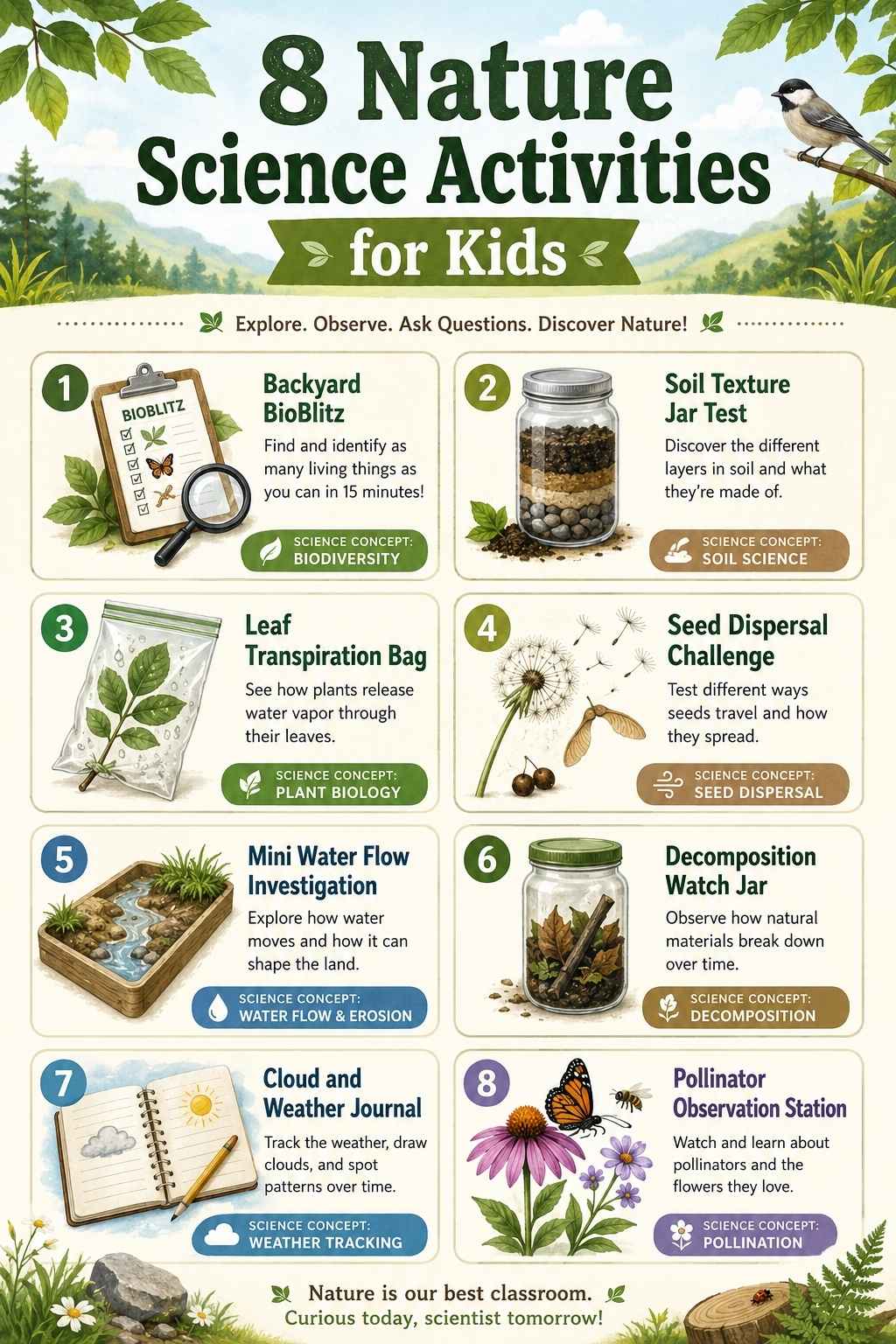
8 Nature Science Activities Kids Can Try Outdoors
These nature experiments work best when children make a prediction first. Ask what they think will happen, let them investigate, then ask what they noticed. That small habit turns a simple activity into real environmental STEM.
1. Backyard BioBlitz
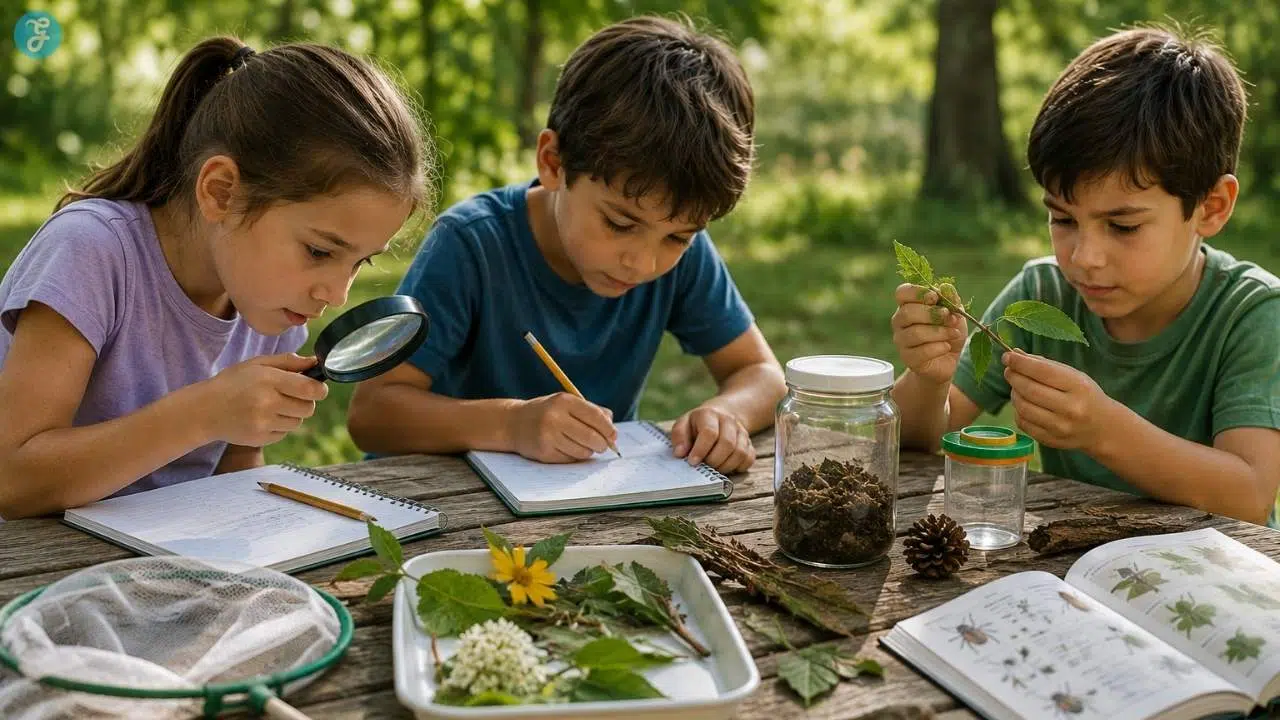
A BioBlitz is a short, focused search for living things in one area. Kids choose a small outdoor space, such as a backyard, garden, schoolyard, park corner, or sidewalk tree area, and try to record as many living things as they can find.
They can look for plants, insects, birds, fungi, moss, worms, spiders, seeds, feathers, flowers, and signs of animals. Younger kids can draw what they see. Older kids can group findings into categories or use a field guide with adult help.
The goal is not to identify everything perfectly. The goal is to notice how much life exists in a small area.
What kids learn: Biodiversity, observation, classification, habitats, and ecosystem awareness.
You’ll need: Notebook, pencil, magnifying glass, camera if allowed, and a safe outdoor space.
Try this: Set a timer for 15 minutes and count how many different living things children can observe without disturbing them.
Make it stronger: Repeat the BioBlitz in the same place during another season and compare results.
2. Soil Texture Jar Test
Soil is not just “dirt.” It is a mix of minerals, organic matter, water, air, and tiny living things.
For this activity, kids collect a small soil sample, remove big sticks or leaves, place the soil in a clear jar with water, shake it well, and let it settle. Over time, heavier sand settles near the bottom, silt forms another layer, clay settles more slowly, and organic matter may float.
This activity helps kids see that different soils behave differently. Garden soil, sandy soil, clay-heavy soil, and compost-rich soil may all create different layers.
What kids learn: Soil texture, sedimentation, observation, layers, and environmental comparison.
You’ll need: Clear jar with lid, soil sample, water, spoon, paper towel, and notebook.
Try this: Compare soil from two places, such as a garden bed and a walking path.
Safety note: Use soil from safe areas only. Avoid soil near roads, chemical-treated lawns, construction sites, or pet waste.
3. Leaf Transpiration Bag
Plants move water through their roots, stems, and leaves. This simple experiment helps kids see that process.
Choose a healthy leafy branch on a plant or small tree. Place a clear plastic bag around a cluster of leaves and gently secure it with a twist tie or string. Leave it for a few hours in daylight. Tiny water droplets should appear inside the bag.
Those droplets come from transpiration, the process where plants release water vapor through their leaves.
This is a quiet experiment, but it is powerful because it makes an invisible plant process visible.
What kids learn: Plant biology, transpiration, water movement, and observation over time.
You’ll need: Clear plastic bag, twist tie or string, leafy plant, and notebook.
Try this: Compare one bag on a sunny leaf cluster and one on a shaded leaf cluster.
Important note: Do not tie the bag too tightly or leave it on too long. Remove it after the observation.
4. Seed Dispersal Challenge
Seeds move in clever ways. Some float. Some fly. Some stick to fur or clothes. Some drop near the parent plant. Some get eaten and carried by animals.
For this activity, kids collect safe fallen seeds or look at seed examples, then design their own “seed” from paper, cotton balls, tape, string, or natural materials. The challenge is to make a seed model that travels by wind, water, or sticking.
They can test paper helicopters, fluffy cotton seeds, floating cork seeds, or sticky sock seeds. This blends nature science with engineering because children design, test, fail, and improve.
What kids learn: Seed dispersal, plant adaptation, engineering design, wind movement, and testing variables.
You’ll need: Paper, tape, cotton balls, string, leaves, cork pieces, small bowl of water, and open space.
Try this: Ask kids to design a seed that travels the farthest in the wind.
Make it smarter: Test one change at a time, such as wing size, weight, or shape.
5. Mini Water Flow Investigation
Water teaches environmental science quickly because kids can see it move. Find three outdoor surfaces: grass, soil, pavement, gravel, mulch, or sand. Pour the same amount of water slowly onto each surface and observe what happens. Does the water soak in, run off, spread, form a puddle, or carry soil with it?
This activity introduces runoff, erosion, permeability, and why surfaces matter in neighborhoods and ecosystems.
It is also a good way to talk about flooding, storm drains, gardens, trees, and why too much pavement can change how water behaves.
What kids learn: Runoff, erosion, permeability, water movement, and environmental design.
You’ll need: Measuring cup, water, notebook, and different outdoor surfaces.
Try this: Use the same amount of water on each surface and time how long it takes to disappear.
Safety note: Do not pour water where it could create slippery steps, mud hazards, or damage plants.
6. Decomposition Watch Jar
Decomposition is one of nature’s recycling systems.
For this activity, kids collect small natural materials such as dry leaves, grass clippings, tiny twigs, and a little soil. Place them in a clear jar with small air holes in the lid, lightly mist the contents, and observe changes over several days or weeks.
Children can watch materials darken, shrink, soften, and break down. They can compare what decomposes faster: leaf pieces, fruit peel, paper, or small natural materials.
This activity should stay simple and safe. Avoid meat, dairy, oily foods, or anything that may smell terrible or attract pests.
What kids learn: Decomposition, organic matter, microbes, soil formation, and ecosystem cycles.
You’ll need: Clear jar, small natural materials, soil, spray bottle, paper towel, and notebook.
Try this: Compare a jar with dry leaves only and one with leaves plus a little soil.
Cleanup note: Empty the jar into compost or soil when finished, if materials are safe and untreated.
7. Cloud and Weather Journal
Weather science becomes more meaningful when kids track it over time.
For one week, children observe the sky at the same time each day. They draw the clouds, note the temperature if they have a thermometer, record wind direction with a ribbon or windsock, and describe whether the day feels sunny, cloudy, humid, windy, rainy, or dry.
This activity teaches kids that weather is not random noise. It has patterns, changes, and clues.
Older kids can compare their observations with a local forecast and see where predictions matched or missed.
What kids learn: Weather patterns, clouds, data recording, prediction, and observation.
You’ll need: Notebook, pencil, thermometer if available, ribbon or homemade windsock, and outdoor view.
Try this: Ask kids to predict tomorrow’s weather based on today’s sky and wind.
Make it stronger: Track weather for two weeks and create a simple chart.
8. Pollinator Observation Station
Pollinators are easy to overlook until kids slow down and watch flowers carefully. Choose a flowering plant in a safe place. Sit nearby for 10 minutes and record what visits: bees, butterflies, flies, beetles, ants, or other insects. Kids should observe from a respectful distance and avoid touching insects.
This activity teaches pollination, plant-animal relationships, habitat, and patience. It also helps children see that not all “bugs” are pests. Many are doing important work.
If no pollinators appear, that is still useful data. Children can ask why. Is it too cold? Too windy? Are there few flowers? Is it the wrong time of day?
What kids learn: Pollination, insect behavior, habitat, observation, and ecosystem relationships.
You’ll need: Notebook, pencil, flowering plant, timer, and safe observation spot.
Try this: Compare two flower types and see which one attracts more visitors.
Safety note: Keep distance from bees and wasps, especially if anyone has allergies.
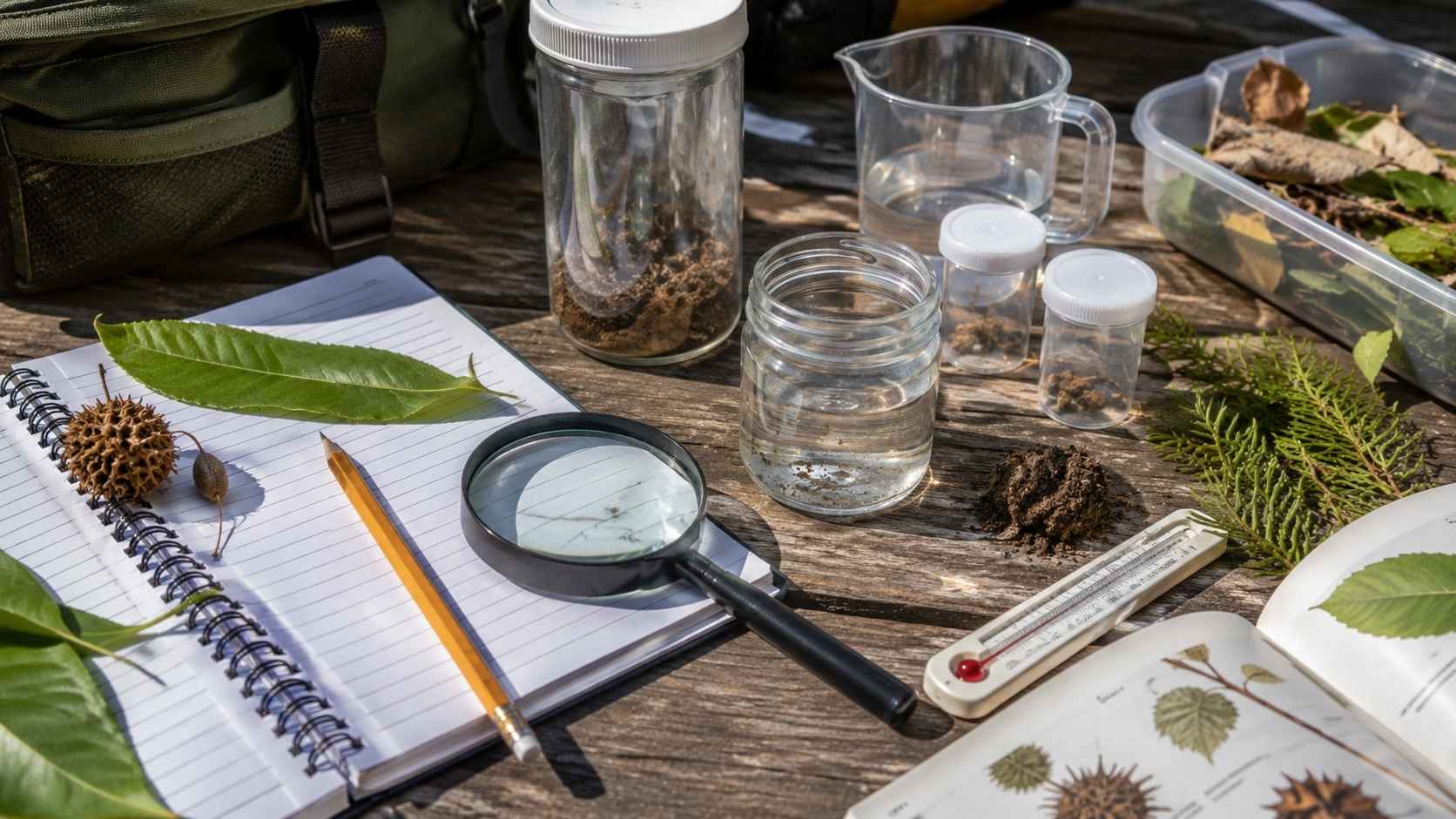
Quick Overview: 8 Nature Science Activities
| Activity | Main Science Concept | Best For |
| Backyard BioBlitz | Biodiversity and observation | Ages 5+ |
| Soil Texture Jar Test | Soil science and sediment layers | Ages 7+ |
| Leaf Transpiration Bag | Plant biology and water movement | Ages 6+ |
| Seed Dispersal Challenge | Plant adaptation and engineering | Ages 6+ |
| Mini Water Flow Investigation | Erosion, runoff, and surfaces | Ages 7+ |
| Decomposition Watch Jar | Decomposition and ecosystems | Ages 6+ |
| Cloud and Weather Journal | Weather patterns and data tracking | Ages 5+ |
| Pollinator Observation Station | Pollination and habitat awareness | Ages 6+ |
Best Nature Science Activities by Age
| Age Group | Best Activities |
| Ages 4-5 | Backyard BioBlitz, Cloud Journal, Pollinator Watching |
| Ages 6-7 | Leaf Transpiration Bag, Seed Dispersal Challenge, Decomposition Jar |
| Ages 8-10 | Soil Texture Jar Test, Water Flow Investigation, Weather Tracking |
| Ages 11+ | Repeated BioBlitz, erosion comparisons, pollinator counts, soil comparisons |
Age ranges are flexible. Younger children can join harder activities with help, and older kids can make simple activities more advanced by measuring, graphing, repeating trials, and comparing data.
Simple Supplies for Outdoor Science Kids Can Use
You do not need expensive equipment to start environmental STEM outdoors.
Helpful supplies include:
- Notebook
- Pencil
- Clipboard
- Magnifying glass
- Clear jars
- Measuring cup
- Spoon
- String
- Paper bags
- Field guide
- Thermometer
- Ruler
- Timer
- Camera or phone with adult supervision
- Reused containers
- Small tray
- Plastic bags for short experiments only
A simple outdoor science kit should be easy to carry and easy to clean.
Safety Tips for Nature Experiments
Nature science should be hands-on, but it still needs boundaries.
Do not let kids touch unknown mushrooms, animal droppings, dead animals, stinging insects, sharp plants, or unfamiliar berries. Check for allergies, poison ivy or similar plants, ticks, mosquitoes, heat, slippery surfaces, and weather changes. Wash your hands after outdoor activities, especially after touching soil or plants.
Avoid collecting from protected parks, wildlife areas, or private property without permission. Teach children to observe living things gently and return rocks, logs, and leaves where they found them when possible.
The best rule is simple: observe first, disturb as little as possible.
How to Make Nature-Based Science More Educational
The activity becomes more powerful when kids explain their thinking.
- Before the activity, ask: “What do you think we will find?”
- During the activity, ask: “What do you notice?”
- After the activity, ask: “What changed, and why do you think it changed?”
- Then ask one more question: “What should we test next?”
That final question matters. It teaches kids that science is not only about getting an answer. It is about asking better questions.
A child who compares soil, tracks clouds, counts pollinators, or watches leaves release water is practicing real scientific thinking. They are learning to slow down, notice evidence, and connect small observations to bigger environmental systems.
Common Mistakes to Avoid
- Turning every outdoor activity into a lecture. Kids need time to notice before adults explain.
- Trying to identify every species perfectly. Identification is useful, but observation matters too.
- Collecting too much. Outdoor STEM should teach respect for living systems, not turn nature into a supply closet.
- Rushing. Many nature experiments work slowly. Plants transpire over hours. Decomposition takes days or weeks. Weather patterns need repeated observation.
- Expecting clean results. Real outdoor science is messy because nature has variables. That is part of the learning.
Wrapping Up
Nature science activities help kids see that science is not locked inside a classroom. It is in the soil under their shoes, the water running across pavement, the clouds changing shape, the insects visiting flowers, the seeds floating in the wind, and the leaves releasing water into the air.
The best outdoor science kids activities are simple but meaningful. Start with a small place. Ask a clear question. Observe carefully. Record what happens. Try again another day.
That is how children begin to understand nature as a living system, not just a background for play.
Frequently Asked Questions About Nature Science Activities
1. What are nature science activities?
Nature science activities are hands-on outdoor learning activities that help kids investigate plants, animals, soil, weather, water, habitats, and ecosystems. They often involve observation, measuring, comparing, recording, and asking questions about the natural world.
2. What are easy outdoor science activities for kids?
Easy outdoor science activities include a backyard BioBlitz, cloud journal, pollinator observation, leaf transpiration bag, soil jar test, seed dispersal challenge, water flow test, and decomposition jar.
3. Can kids do nature experiments without a backyard?
Yes. Kids can do nature experiments at a park, schoolyard, balcony, sidewalk tree, community garden, or even near a window. The key is choosing activities that fit the space, such as cloud watching, seed observation, pollinator counting, or water flow comparisons.
4. What do kids learn from environmental STEM activities?
Kids learn observation, classification, data tracking, ecosystems, plant biology, soil science, weather, water movement, biodiversity, decomposition, and human impact on the environment. They also practice asking questions and testing ideas.
5. Are nature science activities safe for young children?
They can be safe with adult supervision and clear rules. Children should avoid unknown plants, mushrooms, animal waste, dead animals, sharp objects, stinging insects, and unsafe water. Handwashing and weather awareness are important.
6. How can parents make outdoor science more interesting?
Parents can make outdoor science more interesting by asking prediction questions, using a notebook, repeating activities over time, comparing two locations, letting kids draw observations, and turning walks into small investigations instead of lectures.