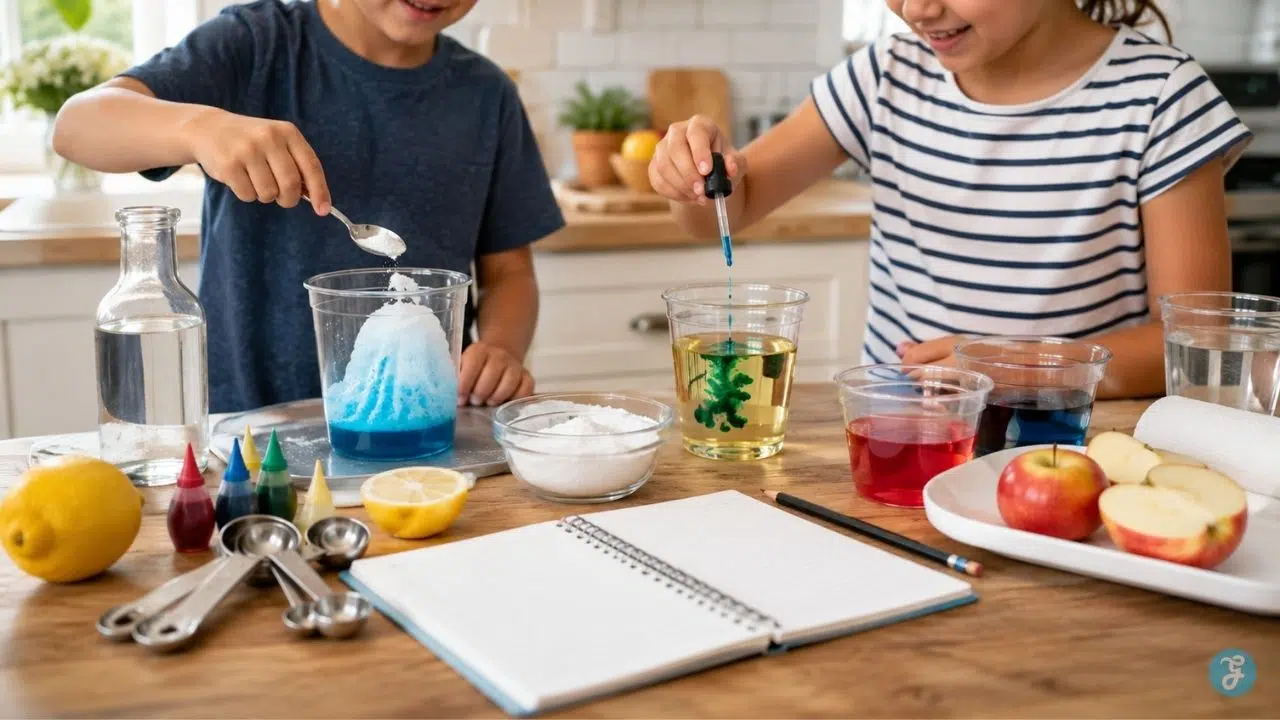
Finding kitchen science experiments that are actually useful can be harder than it looks. Some activities are fun but teach almost nothing. Some are too messy for a normal home. Some require ingredients you do not have. And some look exciting online until you realize you are one spill away from regretting your entire parenting or teaching career.
The good news is that a kitchen already has plenty of science hiding in plain sight. Baking soda, vinegar, cabbage, oil, water, sugar, yeast, apples, raisins, paper towels, and food coloring can teach real concepts: chemical reactions, gas production, density, capillary action, pH, oxidation, fermentation, buoyancy, and emulsions. Kids do not need a lab coat to notice patterns. They need safe materials, clear steps, and an adult who lets them ask “why?” five times in a row.
This list focuses on easy science experiments kids can do at home or in a classroom kitchen setup. They are hands-on, low-cost, and simple enough for families, teachers, homeschoolers, and after-school programs.
My Perspective Behind Choosing These Kitchen Science Experiments
These experiments were chosen because they teach real science with common home materials. I avoided activities that need harsh chemicals, open flames, risky pressure buildup, expensive kits, or complicated cleanup.
Each experiment had to meet at least one of these standards:
- It teaches a clear science concept.
- It uses ordinary kitchen or grocery materials.
- It works well for kids with adult supervision.
- It encourages prediction, observation, testing, and explanation.
- It can be repeated with small changes so kids learn variables.
- It feels fun without turning the kitchen into a disaster zone.
The goal is not just to entertain kids for 15 minutes. The goal is to help them see that science is already happening in food, water, air, bubbles, color, and everyday reactions.
Quick Safety Notes Before You Start
Kitchen science is still science. Keep it safe and simple. Use adult supervision, especially with glass jars, hot water, knives, food coloring, balloons, and small objects. Do not let kids taste experiment materials unless the activity is clearly meant to be eaten, and everything has stayed clean. Never mix household cleaners, bleach, ammonia, or unknown chemicals. Keep experiments away from pets and very young children who may put materials in their mouths.
For best results, cover the table, use trays or baking sheets, keep towels nearby, and explain that cleanup is part of the experiment.
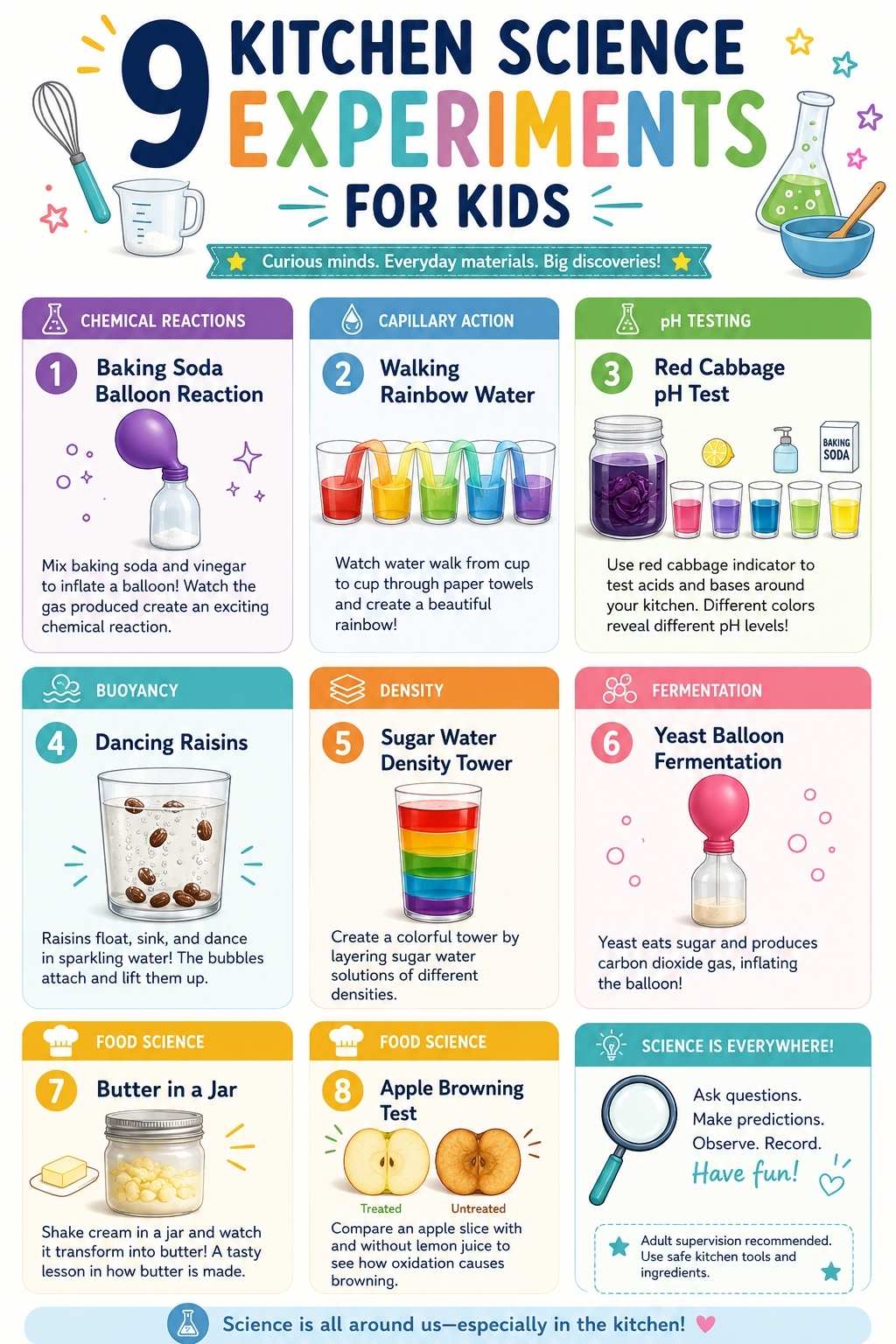
9 Kitchen Science Experiments for Kids
These home experiments work best when kids predict first, observe carefully, and then explain what changed. The experiment is not only the “wow” moment. The real learning happens when they compare what they expected with what actually happened.
1. Baking Soda Balloon Reaction
This is one of the classic kitchen science experiments because kids can see a gas form right in front of them.
Put vinegar in a bottle. Add baking soda into a balloon using a funnel. Stretch the balloon over the bottle opening without letting the baking soda fall in yet. Then lift the balloon so the baking soda drops into the vinegar. The mixture fizzes, and the balloon starts to inflate.
The science is simple but powerful. Baking soda and vinegar react to produce carbon dioxide gas. That gas takes up space, so it fills the balloon. This experiment is better than a basic volcano because the balloon makes the invisible gas visible.
What kids learn: Chemical reactions, gas production, observation, and cause and effect.
You’ll need: Baking soda, vinegar, an empty bottle, a balloon, a funnel, and a tray.
Try this: Test different amounts of baking soda or vinegar and compare balloon size.
Parent note: Do not seal the bottle tightly with anything other than the balloon. Keep the setup on a tray because fizz can overflow.
2. Walking Rainbow Water
This is a quiet experiment, but kids love watching colors move. Line up several clear cups. Fill every other cup with colored water, then place folded paper towels between the cups so each towel touches the water in one cup and reaches into the next. Over time, the colored water travels up and across the paper towel into the empty cups.
This happens because of capillary action. Water can move through tiny spaces in the paper towel fibers. When two colors meet, kids also get to watch color mixing happen slowly. This is a strong activity for younger children because it is visual, gentle, and easy to set up.
What kids learn: Capillary action, absorption, color mixing, and patience.
You’ll need: Clear cups, water, food coloring, paper towels, and a tray.
Try this: Ask kids to predict which colors will appear in the empty cups.
Make it smarter: Use different paper towel brands and compare which one moves water fastest.
3. Red Cabbage pH Test
Red cabbage looks ordinary until you turn it into a natural pH indicator.
Chop red cabbage, soak it in hot water with adult help, and collect the purple liquid. Then add small amounts of safe household liquids to separate cups of cabbage water. Lemon juice, vinegar, baking soda solution, plain water, and soapy water can create different color changes.
The color changes because red cabbage contains pigments that react differently in acidic and basic solutions. Kids can see that not all clear liquids are chemically the same.
This is one of the best food science kids’ activities because it feels like magic but teaches real chemistry.
What kids learn: Acids, bases, pH, indicators, and comparison.
You’ll need: Red cabbage, hot water, clear cups, vinegar, lemon juice, baking soda solution, and spoon.
Try this: Make a simple chart showing which liquids turned pink, purple, blue, or green.
Safety note: Use kitchen-safe materials only. Do not test cleaners, bleach, or unknown liquids.
4. Dancing Raisins
This experiment turns a glass of fizzy water into a tiny science show. Drop raisins into a clear glass of carbonated water or clear soda. At first, the raisins sink. Then bubbles attach to their wrinkly surfaces and lift them upward. When the bubbles pop at the surface, the raisins sink again. The up-and-down motion makes them look like they are dancing.
This teaches kids about gas bubbles and buoyancy in a very simple way. It also gives them a chance to compare materials. Do raisins work better than grapes? What about rice? What about small pasta pieces?
What kids learn: Buoyancy, gas bubbles, density, and observation.
You’ll need: Clear carbonated water or clear soda, raisins, a glass, and optional test objects.
Try this: Compare raisins, dry pasta, small grapes, and popcorn kernels.
Practical note: Use a tall, clear glass so kids can see the movement clearly.
5. Oil and Water Color Burst
Oil and water do not mix easily, and this experiment makes that difference beautiful. Fill a clear glass mostly with water. In a separate small cup, mix a little cooking oil with drops of food coloring. Pour the oil mixture into the water. The oil floats on top, and the food coloring slowly drops from the oil into the water, creating colorful bursts.
This experiment teaches density, miscibility, and diffusion. Oil floats because it is less dense than water, and food coloring behaves differently in oil and water.
Kids usually remember this one because it looks like underwater fireworks.
What kids learn: Density, miscibility, diffusion, and liquid behavior.
You’ll need: Clear glass, water, cooking oil, food coloring, a spoon, and a tray.
Try this: Test warm water versus cold water and observe whether the color spreads differently.
Cleanup tip: Pour oily water into a waste container if needed and wipe residue with paper towels before washing.
6. Sugar Water Density Tower
This experiment shows that liquids can layer when they have different densities. Make several cups of water with different amounts of sugar. Add a different food color to each cup. The more sugar dissolved in the water, the denser the liquid becomes. Carefully layer the liquids in a clear glass using a spoon or dropper, starting with the densest sugar water.
If done slowly, the colors form layers instead of mixing right away. This activity is excellent for older kids because it requires careful measuring and patience. It also introduces the idea that density is not only about solid objects. Liquids have density, too.
What kids learn: Density, measurement, layering, and variables.
You’ll need: Sugar, water, food coloring, clear cups, a spoon, a dropper or turkey baster, and clear glass.
Try this: Use different sugar amounts in each cup and ask kids to predict the layer order.
Make it easier: Start with only three colors before trying five or six layers.
7. Yeast Balloon Fermentation
Yeast is alive, and this experiment helps kids see it in action. Add warm water, yeast, and sugar to a bottle. Stretch a balloon over the top. As the yeast feeds on sugar, it produces carbon dioxide gas. The balloon slowly inflates as gas collects inside.
This is a great kitchen science activity for older kids because it connects biology, chemistry, and food. Yeast is used in bread-making, and this experiment shows why dough rises.
Kids can compare bottles with sugar, no sugar, warm water, cold water, or too much salt to see what yeast needs to work well.
What kids learn: Fermentation, microorganisms, carbon dioxide, and variables.
You’ll need: Active dry yeast, sugar, warm water, a bottle, a balloon, a funnel, and a tray.
Try this: Compare one bottle with sugar and one without sugar.
Parent note: Use warm water, not hot water. Very hot water can stop yeast from working.
8. Butter in a Jar
This experiment lets kids make food while learning science. Pour heavy cream into a clean jar, close the lid tightly, and shake. At first, the cream becomes whipped cream. Keep shaking, and the fat globules clump together until butter separates from buttermilk. Strain the liquid, rinse the butter gently, and add a pinch of salt if you want.
This teaches kids that food has structure. Cream is not just “white liquid.” It contains fat, water, and proteins. Shaking changes how those parts are arranged.
This activity is especially good because kids can connect science to something they eat.
What kids learn: Food science, emulsions, fat separation, physical change, and states of matter.
You’ll need: Heavy cream, a clean jar with a lid, a strainer, a bowl, spoon, and optional salt.
Try this: Compare shaking by hand with rolling the jar gently back and forth.
Food note: Only taste it if everything was clean, food-safe, and supervised from the beginning.
9. Apple Browning Test
Cut apples turn brown because of oxidation. This experiment helps kids test which kitchen liquids slow that process.
Place apple slices on a plate. Dip each slice in a different liquid: lemon juice, water, salt water, vinegar, or nothing. Label the plate or keep a simple chart. Watch what happens over 30 minutes to a few hours.
Lemon juice often slows browning because it is acidic and contains vitamin C. Salt water may also slow browning. The untreated slice usually browns more quickly.
This experiment is easy, but it teaches a serious science skill: controlling variables. Each apple slice should be similar in size, observed for the same amount of time, and compared fairly.
What kids learn: Oxidation, variables, comparison, and food preservation.
You’ll need: Apple slices, lemon juice, water, salt water, vinegar, a plate, and paper labels.
Try this: Take photos every 15 minutes and compare the results.
Good science question: Which liquid slowed browning the most, and how do you know?
A Quick Overview of the Best Kitchen Science Experiments
| Experiment | Main Concept | Best For |
| Baking Soda Balloon Reaction | Chemical reaction and gas production | Ages 5+ |
| Walking Rainbow Water | Capillary action and color mixing | Ages 4+ |
| Red Cabbage pH Test | Acids, bases, and indicators | Ages 7+ |
| Dancing Raisins | Bubbles, buoyancy, and gas | Ages 5+ |
| Oil and Water Color Burst | Density, miscibility, and diffusion | Ages 5+ |
| Sugar Water Density Tower | Density and layering | Ages 7+ |
| Yeast Balloon Fermentation | Microbiology and carbon dioxide | Ages 8+ |
| Butter in a Jar | Food science and emulsions | Ages 5+ |
| Apple Browning Test | Oxidation and variables | Ages 6+ |
Best Kitchen Science Experiments by Age
| Age Group | Best Experiments |
| Ages 4-5 | Walking Rainbow Water, Dancing Raisins, Butter in a Jar |
| Ages 6-7 | Baking Soda Balloon, Apple Browning Test, Oil and Water Color Burst |
| Ages 8-10 | Red Cabbage pH Test, Sugar Water Density Tower, Yeast Balloon Fermentation |
| Ages 11+ | Density comparisons, pH charts, yeast variable testing, oxidation timing |
Younger kids can still join harder activities with adult help. Older kids can make simple activities more advanced by measuring, timing, graphing, and changing one variable at a time.
Common Mistakes to Avoid
- Doing the experiment for the child. Let kids pour, count, stir, shake, predict, and observe where it is safe.
- Rushing the explanation. Let the surprise happen first. Then talk about the science.
- Using too many materials. Simple experiments are often better because kids can focus on what changed.
- Ignoring safety because the materials are “just from the kitchen.” Vinegar, hot water, glass, balloons, and food coloring still need adult supervision.
- Expecting perfect results. Sometimes layers mix. Balloons do not inflate much. Colors look muddy. That is not failure. That is a chance to ask what changed and try again.
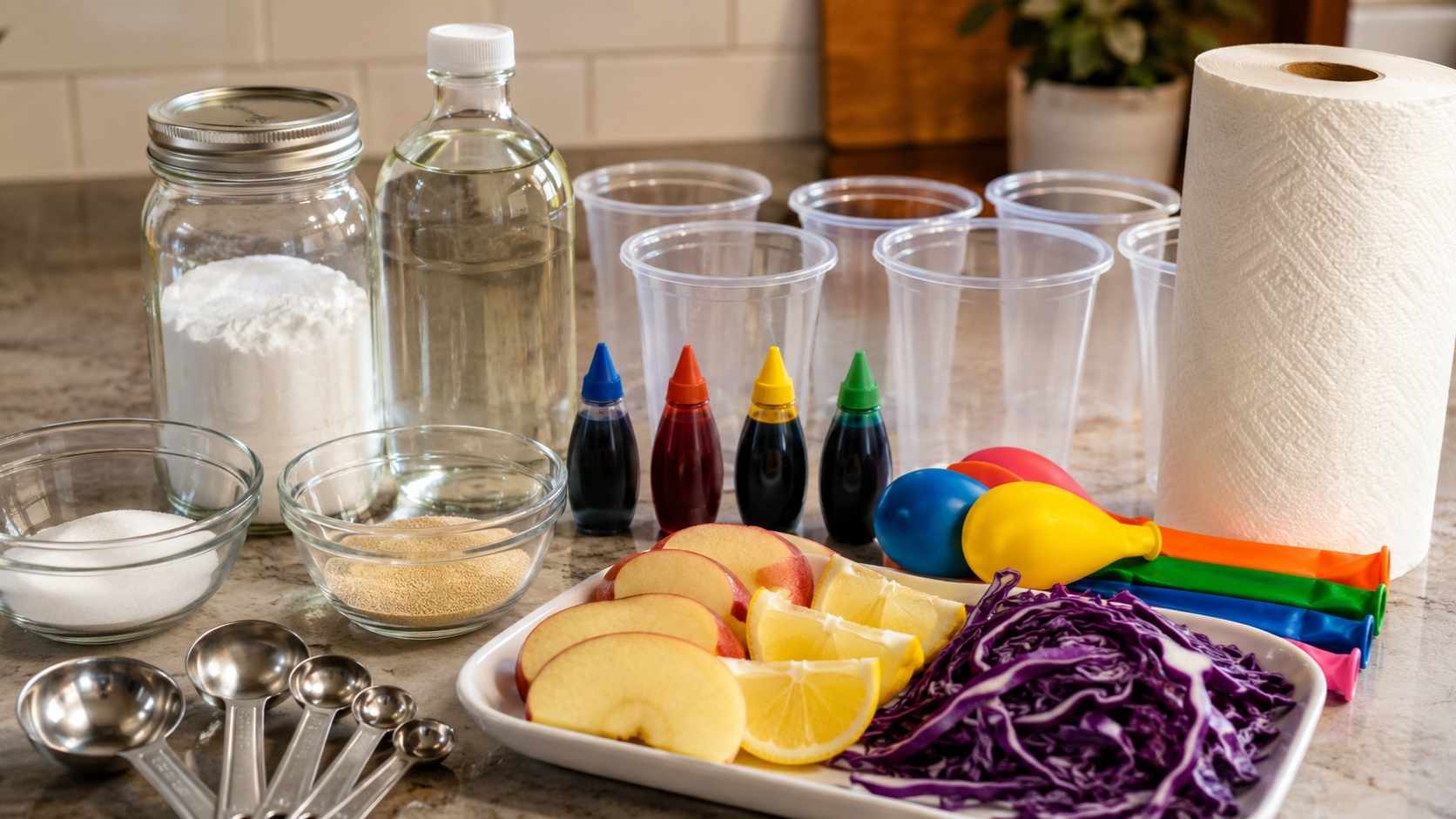
Simple Kitchen Science Supplies to Keep Ready
You can do many home experiments with a small supply basket.
Useful items include:
- Baking soda
- Vinegar
- Food coloring
- Clear cups
- Measuring spoons
- Balloons
- Paper towels
- Sugar
- Salt
- Cooking oil
- Yeast
- Lemons
- Apples
- Red cabbage
- Droppers or pipettes
- Graph paper
- Labels
- Trays or baking sheets
A simple setup makes it easier to say yes when kids ask, “Can we try an experiment?”
Wrapping Up
Kitchen science experiments work because they make science visible. Kids can watch gas inflate a balloon, see water climb through paper towels, test acids and bases with cabbage juice, make raisins dance, stack colorful liquids, grow yeast bubbles, shake cream into butter, and slow apple browning with lemon juice.
These are not just cute home experiments. They teach real ideas: reactions, density, pH, fermentation, oxidation, food structure, and variables. The kitchen is already full of science. You just have to let kids investigate it.
Frequently Asked Questions About Kitchen Science Experiments
1. What are the easiest kitchen science experiments for kids?
The easiest kitchen science experiments include walking rainbow water, dancing raisins, baking soda and vinegar reactions, oil and water color bursts, and butter in a jar. These use simple materials and show visible results quickly.
2. Are kitchen science experiments safe for kids?
Most kitchen science experiments are safe with adult supervision and common-sense rules. Avoid harsh cleaners, unknown chemicals, open flames, sharp tools, and sealed pressure containers. Use trays, protect surfaces, and do not let kids taste experiment materials unless the activity is clearly food-safe.
3. What science can kids learn in the kitchen?
Kids can learn chemistry, biology, physics, and food science in the kitchen. Common concepts include chemical reactions, carbon dioxide, density, capillary action, pH, oxidation, fermentation, mixtures, emulsions, and variables.
4. What kitchen items are good for science experiments?
Good kitchen science items include baking soda, vinegar, food coloring, water, oil, sugar, salt, yeast, red cabbage, lemons, apples, paper towels, clear cups, balloons, and measuring spoons.
5. What is a good food science experiment for kids?
Butter in a jar is a great food science experiment because kids can see cream change into butter through shaking. Yeast balloon fermentation is another strong food science activity because it shows how yeast produces carbon dioxide, which connects directly to bread-making.
6. How can I make easy science experiments more educational?
Ask kids to predict what will happen, observe carefully, explain what changed, and test one new variable. A simple notebook or drawing sheet can also help kids record results and think like young scientists.