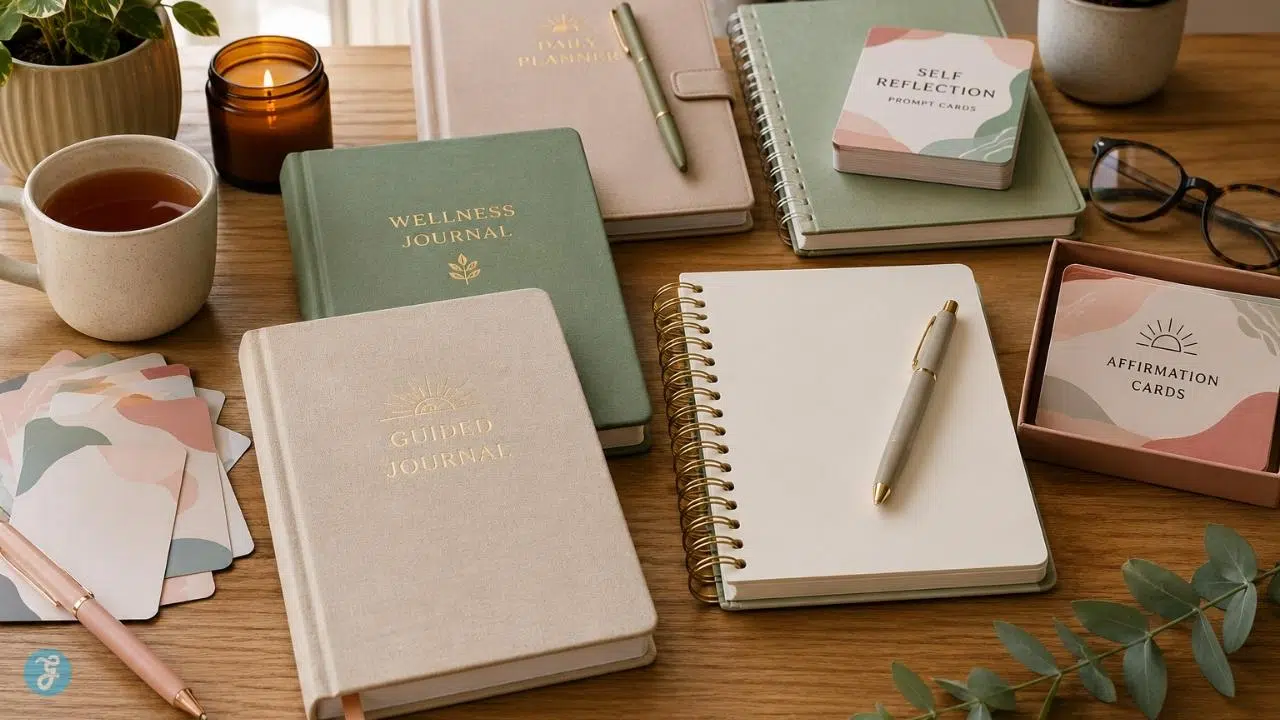
Most journaling mindset tools look peaceful on a desk. A linen notebook. A soft-colored pen. A gratitude prompt. A cup of tea placed suspiciously well beside a candle. Very calming. Very Instagram. Also very easy to abandon after four days when real life walks in wearing shoes.
That is the problem with journaling tools. People do not fail because they are lazy. They fail because they buy the wrong format for the way their brain actually works.
Some people need structure. Some need blank space. Some need prompts because an empty page feels rude. Some need a five-minute ritual. Some need a digital journal because they think better on their phone. Some need a card deck because sitting down to “process feelings” sounds dramatic, but answering one question feels doable.
The right tool should lower the barrier to reflection. It should help you notice patterns, name what you feel, plan the next step, and return to yourself without turning self-care into homework.
This list compares 11 journaling and mindset tools for different types of users, from gratitude journals and wellness planners to prompt cards, digital apps, bullet journals, and mindset gear.
How to Choose the Right Journaling Mindset Tool
Before buying a journal or mindset tool, ask one question: what kind of reflection do you actually need?
If you want a quick daily ritual, choose a gratitude journal. If your life feels scattered, choose a planner-journal hybrid. If your thoughts are heavy or complex, choose deeper prompts. If you want habit support, choose a wellness journal. If you hate carrying notebooks, choose a digital app. If you resist anything too “self-help,” choose something playful.
A good journaling tool should match your friction point:
- No time: Choose a short guided journal.
- No idea what to write: Choose prompt cards or structured pages.
- Too many goals: Choose a goal planner.
- Low consistency: Choose a simple daily or weekly format.
- Need privacy and search: Choose a digital journal.
- Want creative freedom: Choose a bullet journal.
- Want wellness tracking: Choose a wellness planner.
- Need a lighter mood reset: Choose affirmation cards.
The best tool is not the prettiest one. It is the one you will actually open.
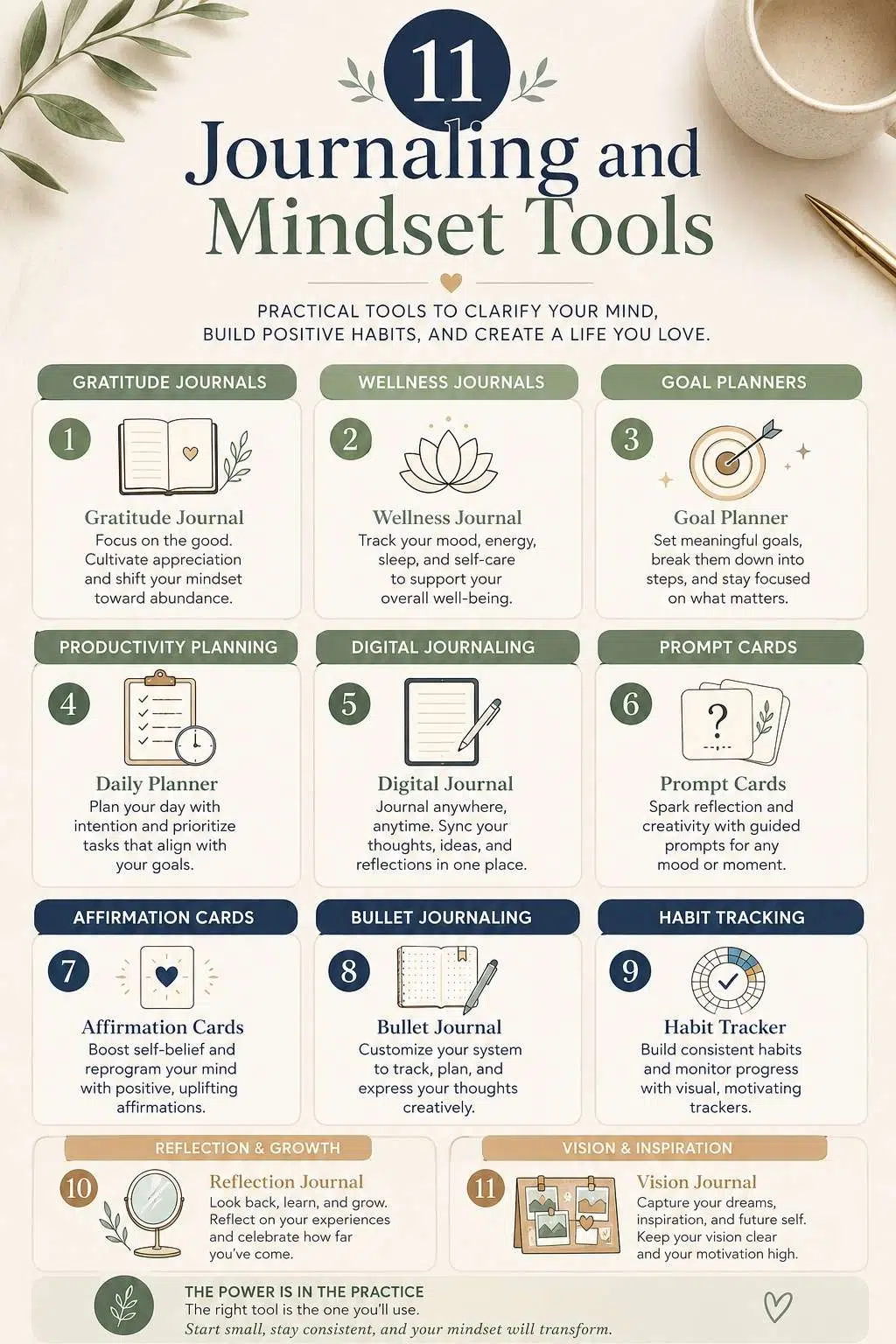
11 Journaling and Mindset Tools Worth Trying
The tools below are not ranked from “best” to “worst.” They serve different needs. The smartest choice depends on whether you want gratitude, structure, habit tracking, emotional reflection, goal planning, or creative freedom.
1. The Five Minute Journal by Intelligent Change
The Five Minute Journal is one of the easiest gratitude journals to recommend because it does not ask for much. That is its biggest strength.
Instead of giving you a blank page and expecting deep emotional poetry before breakfast, it uses short morning and evening prompts. The format is designed around a simple daily gratitude practice: notice what is good, set an intention, and reflect on the day.
This works well for people who want the benefits of journaling but do not want to write long entries. It also helps beginners avoid the classic “I don’t know what to say” problem.
The limitation is depth. If you want long-form reflection, emotional processing, or complex goal planning, this may feel too simple. But for a five-minute ritual, that simplicity is exactly the point.
A strong match for: Beginners, busy professionals, students, and anyone who wants a low-pressure gratitude habit.
Best feature: Short guided prompts that make daily reflection easy to repeat.
Worth considering: It may feel too light if you want deep journaling or therapy-style prompts.
2. Papier Wellness Journal
Papier’s Wellness Journal is a good fit for people who want journaling to connect with daily self-care habits.
Its pages are built around wellness check-ins such as intentions, sleep, water intake, meals, self-care ideas, thoughts, feelings, and gratitude. That makes it more practical than a pure gratitude journal and less intense than a goal-performance planner.
This is useful for people who want to notice how their routines affect their mood and energy. If you are trying to sleep better, eat more consistently, remember water, or create a gentler daily rhythm, this type of wellness journal gives you a place to track those patterns.
It also has the aesthetic advantage Papier is known for. That may sound shallow, but design matters. A journal you like looking at is more likely to stay on your desk.
Ideal for: People who want a pretty but practical wellness journal.
Notable strength: Combines reflection with simple lifestyle tracking.
Before buying: If you dislike structured pages, a blank notebook may feel more freeing.
3. BestSelf Self Journal
The BestSelf Self Journal is built for people who want journaling to lead somewhere.
It uses a 13-week structure with goal setting, planning, time-blocking, reflection, and progress tracking. This makes it more focused on execution than emotional journaling. It is less “How do I feel today?” and more “What matters, what am I doing, and how do I stay accountable?”
That makes it especially useful for entrepreneurs, freelancers, students, creators, and professionals who have a clear goal but keep losing focus. The 13-week timeframe is also smart because it is long enough to make progress but short enough to feel urgent.
The downside is that it requires more commitment than a simple gratitude journal. If your main need is emotional reflection or gentle self-care, it may feel too productivity-heavy.
Works well for: Goal-setters, business owners, students, and people who like structured planning.
Best feature: A 13-week roadmap that connects goals to daily action.
Practical note: Use it for one or two serious goals. Trying to track your entire life in it can become overwhelming.
4. Panda Planner Classic
Panda Planner Classic sits between productivity planning and mindset journaling.
It includes sections for gratitude, priorities, scheduling, tasks, and reflection. That balance is useful because many people do not need a separate gratitude journal, planner, and habit tracker. They need one place to reset their mind and organize the day.
This tool works well for people who wake up scattered. The daily format helps you choose what matters, plan the schedule, and start from a more intentional place. It can also help people who like the emotional benefit of journaling but still need practical task management.
The limitation is that daily planners only work if you return to them consistently. If you prefer weekly planning, a day-by-day format may feel too demanding.
Great match for: People who want gratitude, planning, and productivity in one journal.
Top advantage: Combines mindset prompts with daily priorities and scheduling.
Small drawback: It can feel repetitive if you do not enjoy daily check-ins.
5. Silk + Sonder Monthly Journal
Silk + Sonder is different because it works more like a monthly journaling subscription than a one-time notebook.
Each month brings a fresh guided journal with planning pages, self-care prompts, trackers, reflection sections, and themed exercises. That monthly reset can be helpful for people who get bored using the same journal layout for months.
This is a good option for someone who wants journaling to feel guided and seasonal. It can create momentum because each month feels like a fresh start. The subscription model also adds a sense of continuity, which some users may enjoy.
The trade-off is cost and commitment. A subscription journal is not the best fit if you want a one-time purchase or dislike accumulating paper products.
Most useful for: People who like fresh prompts, monthly themes, and guided self-care structure.
Best feature: New guided journal experience each month.
Check before ordering: Make sure the subscription format fits your budget and storage habits.
6. Day One Journal App
Day One is one of the strongest digital journaling tools for people who want reflection without paper.
It works across phone, computer, tablet, and web, and it supports features like prompts, search, photos, media, multiple journals on paid plans, and end-to-end encryption. That makes it especially useful for people who want a private, searchable record of their life.
Digital journaling has a few advantages. You can write anywhere, add photos, search old entries, use reminders, and keep everything synced. If your phone is already where your thoughts land, Day One may be easier than forcing a paper habit.
The downside is obvious: it is still a screen. If your goal is to disconnect, a physical journal may be better.
A smart pick for: Digital-first users, travelers, photo journalers, and people who want searchable entries.
Best feature: Secure, searchable journaling with prompts and multimedia options.
Worth knowing: Some advanced features require paid plans, so check what the free version includes before committing.
7. The School of Life Know Yourself Prompt Cards
The School of Life Know Yourself Cards are not a journal, but they are one of the better mindset tools for people who want deeper reflection.
The deck includes 60 prompt cards designed around self-knowledge. That makes it useful when you want to journal but do not know where to begin. Instead of staring at a blank page, you pull a card and respond to one question.
This format can help people move beyond surface-level gratitude into values, emotions, relationships, identity, memories, and patterns. It is also good for couples, friends, coaching sessions, therapy-adjacent reflection, or solo journaling.
The only caution is that deeper prompts can bring up uncomfortable material. That is not automatically bad, but it means this tool should be used gently.
Especially useful for: Deep thinkers, reflective writers, coaches, and people who want better self-awareness.
Best feature: Thoughtful prompts that create richer journal entries.
A quick reminder: If a prompt feels too heavy, skip it. Journaling should not become emotional self-punishment.
8. Knock Knock Affirmators!
Affirmators! by Knock Knock is the least serious tool on this list, and that is exactly why it belongs here.
A lot of affirmation products feel painfully earnest. Affirmators! takes a lighter route with funny, whimsical, non-cheesy affirmation cards. It is good for people who want a small mindset reset without feeling like they have joined a self-help seminar against their will.
This is not a deep journaling system. It is more of a mood cue, desk tool, gift, or daily prompt. You can pull one card in the morning, use it as a journal starter, or keep it nearby when your brain is being dramatic.
The best use is pairing the card with one written response: “Where does this apply today?”
Recommended for: People who like humor with their positivity.
Best feature: Affirmation cards that feel playful instead of preachy.
Final buying note: Do not expect a card deck to replace actual reflection. Use it as a starting point.
9. The Positive Planner
The Positive Planner is a good option for people who want a self-care journal with a gentle, supportive structure.
It focuses on gratitude, reflections, daily positivity, and mindfulness activities. The 12-week format makes it feel contained, which can be useful for people who get overwhelmed by year-long journals. You are not committing to a life transformation. You are trying a 12-week rhythm.
This tool is especially useful for people who want journaling to feel warm and encouraging rather than productivity-driven. It is closer to self-care than goal management.
The limitation is that it may feel too guided for people who want total freedom. But for someone who needs prompts and a softer tone, that structure is a benefit.
Best suited to: People who want gentle daily reflection and gratitude prompts.
Best feature: A supportive 12-week self-care format.
Worth considering: It leans more emotional and reflective than productivity-focused.
10. Leuchtturm1917 Bullet Journal Edition 2
The Leuchtturm1917 Bullet Journal Edition 2 is best for people who do not want a pre-filled wellness journal at all.
This is a flexible dot-grid notebook built for the Bullet Journal method. It includes features like numbered pages, dot grid paper, an index, future log support, and Bullet Journal-specific extras. That makes it useful for people who want to build their own system for tasks, habits, moods, gratitude, ideas, and reflection.
The appeal is freedom. You can create a gratitude log, mood tracker, habit tracker, weekly review, reading list, goal map, or brain dump page exactly how you want it.
The downside is also freedom. If you need prompts, this may feel too open. Bullet journaling works best for people who enjoy designing or adapting systems.
Perfect if you want: A flexible journal system you can customize.
Best feature: Dot-grid structure for trackers, logs, planning, and reflection.
Before you buy: Do not over-decorate it at the start. A functional bullet journal beats a beautiful abandoned one.
11. Clever Fox Wellness Planner
Clever Fox Wellness Planner is best for people who want journaling tied closely to health and lifestyle goals.
It includes space to track activities, food, water, habits, priorities, and wellness goals. That makes it more specific than a general gratitude journal and more practical than a blank notebook. It can be useful for people trying to understand how daily choices affect energy, mood, focus, and routines.
This is a strong option if your mindset work is connected to health habits. Maybe you want to move more, eat more consistently, improve hydration, plan meals, or notice stress patterns. A wellness planner gives those habits a place to live.
The caution is that wellness tracking can become obsessive for some people. If tracking food, body measurements, or routines makes you anxious, choose a gentler gratitude or reflection journal instead.
A good choice for: Wellness goal tracking, habit building, and lifestyle reflection.
Best feature: Combines daily planning with health and wellness tracking.
One thing to note: Use it for awareness, not self-criticism.

Quick Comparison: 11 Journaling and Mindset Tools
| Tool | Best For | Format | Main Strength |
| The Five Minute Journal | Quick gratitude practice | Guided journal | Short morning and evening reflection |
| Papier Wellness Journal | Wellness tracking and self-care | Guided wellness journal | Sleep, water, meals, intentions, feelings |
| BestSelf Self Journal | Goal setting and execution | 13-week planner journal | Structured planning and reflection |
| Panda Planner Classic | Productivity plus mindset | Daily planner | Gratitude, priorities, and focus |
| Silk + Sonder Monthly Journal | Monthly guided self-care | Subscription journal | Fresh prompts and planning structure |
| Day One Journal App | Digital journaling | App | Photos, prompts, search, encryption |
| The School of Life Know Yourself Cards | Deeper self-reflection | Prompt cards | Self-knowledge questions |
| Knock Knock Affirmators! | Lighthearted mindset reset | Affirmation card deck | Funny, non-cheesy positive prompts |
| The Positive Planner | Daily gratitude and positivity | Self-care journal | 12-week reflection and mood support |
| Leuchtturm1917 Bullet Journal Edition 2 | Custom planning and reflection | Dot-grid notebook | Flexible bullet journal system |
| Clever Fox Wellness Planner | Health and wellness goals | Wellness planner | Activity, food, habits, and priorities |
What Makes a Journaling Tool Actually Useful?
A useful journaling tool does not need to be fancy. It needs to reduce friction.
The best tools usually do one or more of these things:
- Give you a simple place to start
- Ask better questions than you would ask yourself
- Help you notice patterns over time
- Make reflection feel repeatable
- Support a specific goal or habit
- Keep the process private and low-pressure
- Fit naturally into your morning, evening, or weekly routine
A tool becomes useless when it asks too much too soon. If the first page feels like a personal development exam, most people quit.
Start smaller than you think. One honest sentence is better than a perfect spread you never finish.
Common Mistakes People Make With Wellness Journals
- Buying a journal because it looks calming, not because the format fits your life.
- Starting too big. If you try to track mood, meals, sleep, workouts, gratitude, goals, affirmations, water, spending, and ten habits from day one, the journal becomes another job.
- Confusing journaling with forced positivity. Gratitude is useful, but it should not become a way to deny hard feelings.
- Treating missed days like failure. A journal is not ruined because you skipped Tuesday. Just continue.
- Expecting a tool to do emotional work for you. A journal can guide reflection, but you still need honesty, patience, and sometimes professional support.
How to Build a Simple Journaling Routine
The easiest routine is the one you can repeat when life is busy.
Try this:
- Choose one tool.
- Pick one time of day.
- Write for five minutes.
- Use one prompt or one question.
- Stop before it feels exhausting.
- Review once a week.
A simple morning routine might be: one gratitude, one intention, one priority.
A simple evening routine might be: one thing that happened, one thing you felt, one thing you learned.
A weekly routine might be: what drained me, what restored me, what needs to change?
The point is not to write beautifully. The point is to build a small record of your inner life so you can stop carrying everything in your head.
Wrapping Up
The best journaling mindset tools are not magic. They are containers.
The Five Minute Journal gives gratitude a short daily rhythm. Papier makes wellness tracking feel approachable. BestSelf turns goals into a 13-week plan. Panda Planner blends productivity with reflection. Silk + Sonder keeps self-care fresh each month. Day One makes digital journaling private and searchable. The School of Life cards help with deeper self-knowledge. Affirmators! adds humor to mindset work. The Positive Planner keeps reflection gentle. Leuchtturm1917 Bullet Journal Edition 2 gives you full creative control. Clever Fox Wellness Planner connects mindset to daily health habits.
The right tool is the one that helps you return to yourself without making the process feel heavy.
Start small. Write honestly. Keep going imperfectly.
Frequently Asked Questions About Journaling Mindset Tools
1. What are journaling mindset tools?
Journaling mindset tools are notebooks, guided journals, planners, prompt cards, apps, and reflection systems that help people write, process thoughts, track habits, practice gratitude, set intentions, and build self-awareness.
2. Are gratitude journals actually useful?
Gratitude journals can be useful when they help people notice positive moments, relationships, and small wins they might otherwise overlook. They work best when the practice feels honest, specific, and repeatable rather than forced or fake.
3. What is the best journaling tool for beginners?
The Five Minute Journal is one of the easiest beginner tools because it uses short daily prompts. Day One is a good beginner option for digital users, while Papier Wellness Journal is useful for people who want a guided but gentle paper format.
4. What should I write in a wellness journal?
You can write about sleep, mood, meals, movement, water intake, gratitude, stress, energy, intentions, habits, and reflections. The best wellness journals help you notice patterns rather than judge yourself.
5. Are digital journals better than paper journals?
Digital journals are better for search, photos, privacy settings, reminders, and writing anywhere. Paper journals are better for screen-free reflection, slower thinking, and tactile focus. The better choice depends on your habits.
6. Can journaling replace therapy?
No. Journaling can support reflection and self-awareness, but it should not replace therapy or professional mental health care. If journaling brings up distress, trauma, or overwhelming emotions, it is wise to pause and seek qualified support.