
Angel investors explained simply: they are individuals who invest their own money into early-stage startups, usually in exchange for equity or future equity. That sounds simple until you are the founder sitting across the table.
You may need money to build the product, hire your first teammate, test a market, or survive long enough to reach revenue. An angel investor can help with that. But angel money is not just cash. It can change your ownership, your decision-making, your fundraising path, and sometimes the pressure around your startup.
Some angels are deeply helpful. They open doors, challenge your thinking, introduce customers, and help you avoid rookie mistakes. Others only write a check and disappear. A few can create more confusion than value. That is why founders need to understand angel investing before they start chasing introductions.
This guide explains what angel investors do, how angel funding rounds work, where to find angels, what they look for, how to pitch them, and what mistakes founders should avoid.
What Is an Angel Investor?
An angel investor is an individual who provides early funding to a startup, usually in exchange for ownership equity, convertible debt, or a SAFE.
Unlike venture capital firms, angels usually invest their own money. They may invest alone, through an angel group, through a syndicate, or alongside other early-stage investors. Angel investors often support startups before larger institutional investors are ready to invest.
They may invest when:
- The product is still early.
- The team is small.
- Revenue is limited or just starting.
- The market is promising but not fully proven.
- The founder needs capital to reach the next milestone.
For founders, angels can be useful because they are often more flexible than venture funds. A good angel can move faster, write a smaller check, and make decisions based on founder quality, market insight, and early traction.
How Angel Investors Are Different From Venture Capitalists
Angel investors and venture capitalists both invest in startups, but they are not the same.
| Factor | Angel Investor | Venture Capital Firm |
| Money source | Personal money | Pooled capital from limited partners |
| Stage | Very early, pre-seed, seed | Seed, Series A, and later |
| Check size | Usually smaller | Usually larger |
| Decision process | Often faster and more personal | More structured and committee-driven |
| Support style | Advice, intros, mentorship | Board support, hiring help, follow-on capital |
| Ownership target | Usually a smaller stake | Often, a larger ownership target |
| Best fit | Early validation and first capital | Scale, hiring, expansion, major growth |
An angel investor may invest because they believe in the founder, know the industry, or want to support early innovation.
A VC fund usually needs the company to have potential for a much larger return because the fund must return capital to its own investors.
That difference matters. Not every startup needs VC. Some only need a few strategic angels to reach revenue, prove demand, or build the first product version.
When Angel Funding Makes Sense
Angel funding can make sense when your startup has moved beyond an idea but is still too early for larger funding.
It may be useful when you need capital to:
- Build the first serious version of the product.
- Hire a technical or growth team member.
- Run early customer acquisition tests.
- Validate a market.
- Complete beta testing.
- Reach your first revenue milestone.
- Prepare for a seed round.
- Extend the runway while providing traction.
For SaaS founders, angel funding often fits between bootstrapping and seed funding. For example, a founder may build a rough MVP with personal savings, get 20 beta users, and then raise a small angel round to improve onboarding, ship core features, and test pricing. That is a healthy use of angel capital.
But angel funding is not a fix for unclear thinking. If you do not know who the product is for, why customers care, or what milestone the money will unlock, raising money may only delay hard decisions.
When Angel Funding May Not Be Right
Angel investors are not the right answer for every startup.
You may not need angel funding if you can reach revenue through bootstrapping, or your product has a low build cost, or you want full control, or you do not want to sell equity, or you are building a small profitable business, or you do not have a clear use for the money, or you are not ready for investor updates and expectations.
Angel funding may also be a poor fit if your business is unlikely to produce investor-level returns. That does not mean the business is bad. A local service business, agency, small software tool, or niche lifestyle business can be excellent for the founder but unattractive to equity investors.
Investors need a return. Founders need the right kind of capital. Those are not always the same thing.
How Angel Funding Rounds Work
Angel funding rounds are usually early rounds where one or more individual investors put money into the startup.
These rounds may be called:
- Pre-seed round
- Angel round
- Friends and family round
- Seed extension
- Bridge round
- Syndicate round
The structure can vary.
Common angel funding instruments include:
| Funding Type | How It Works | Founder Note |
| Equity round | Investors buy shares at a set valuation | More formal and legally heavier |
| SAFE | An investor gets future equity when a priced round happens | Common for early startups |
| Convertible note | Debt that may convert into equity later | Often includes interest and maturity date |
| Revenue-based deal | Investor gets repayment from future revenue | Less common for classic angel investing |
| Simple loan | The founder borrows money and repays it | Does not usually fit high-risk startup investing |
Many early startups use SAFEs because they are simpler than a priced equity round. But “simple” does not mean “risk-free.” Founders still need to understand valuation caps, discounts, pro rata rights, and how ownership may change later. Always work with a startup lawyer before signing investment documents.
What Angels Usually Look For
Angel investors know early startups are risky. They usually invest before everything is proven. That means they often look for signals, not perfection.
Common angel investor signals include:
- A strong founder-market fit
- A clear customer problem
- A large or valuable market
- Early user interest
- Early revenue or pilots
- A believable product plan
- Fast learning speed
- Strong storytelling
- Clear use of funds
- A realistic next milestone
- Potential for follow-on funding
- Trustworthy founder behavior
For SaaS startups, angels may also look at:
- Activation
- Retention
- Trial conversion
- Early customer feedback
- Churn signals
- Usage frequency
- Pricing tests
- Product-led growth potential
- Sales pipeline
- Customer acquisition path
A founder does not need every metric early. But they should show that the business is moving from assumption to evidence.
Strategic Angels vs Passive Angels
Not all angels are equal. A passive angel mainly writes a check. That can still be helpful if the terms are clean and the founder needs capital. A strategic angel brings more than money.
They may offer:
- Customer introductions
- Industry knowledge
- Hiring referrals
- Fundraising introductions
- Product feedback
- Go-to-market advice
- Credibility
- Partnership opportunities
- Experience from building or exiting companies
For example, if you are building a SaaS product for finance teams, an angel who has sold software to CFOs may be more useful than a random investor with a bigger check. The best angel is not always the richest one. It is often the person whose experience matches your next hard problem.
Finding Angels: Where Founders Should Look
Finding angels is easier when you stop thinking like a fundraiser and start thinking like a network builder.
Good places to find angel investors include:
- Angel groups
- Startup accelerators
- Founder communities
- Operator networks
- LinkedIn
- Industry events
- Demo days
- University entrepreneurship centers
- Startup lawyers and accountants
- Existing founders
- Past executives in your market
- Customer networks
- Angel syndicates
- Warm introductions from advisors
Warm introductions usually work better than cold messages. Angels see many pitches, so trust matters. But cold outreach can still work if it is short, specific, and relevant. Do not send a vague pitch to hundreds of people. Build a focused list of angels who understand your market, stage, and business model.
How to Build an Angel Investor List
A good angel list is not just a spreadsheet of rich people. Build it around fit.
Useful columns include:
- Investor name
- Industry fit
- Startup stage preference
- Typical check size
- Relevant portfolio companies
- Location
- Intro path
- Strategic value
- Last known activity
- Notes from public posts or interviews
- Priority level
Look for angels who have experience with your category.
For SaaS, that might mean:
- Former SaaS founders
- Product leaders
- Sales leaders
- Growth marketers
- Exited founders
- Operators from your target industry
- Early-stage angel syndicates
- B2B software investors
A smaller list of 30 relevant angels is better than a random list of 300 names.
How to Pitch Angel Investors
Your pitch should be clear, short, and grounded. An angel does not need a 40-slide deck in the first message.
They need to quickly understand:
- What you are building
- Who it is for
- Why the problem matters
- What proof do you have
- Why now is the right time
- What do you need the money for
- Why you are the right founder
A strong first message may include:
- One-sentence company summary
- The customer problem
- Early traction
- Why the angel is relevant
- The round size or funding goal
- A simple ask for a short conversation
Keep it human. Angels invest in people as much as ideas. Avoid hype-heavy language. “Revolutionary,” “game-changing,” and “massive disruption” mean little without evidence.
Angel Round Terms Founders Should Understand
Founders should know the basic terms before negotiating.
Common terms include:
Valuation Cap
A valuation cap sets the maximum valuation at which a SAFE or note converts into equity.
For investors, it rewards early risk. For founders, it affects future ownership.
Discount
A discount gives early investors a better price than later investors when the investment converts.
Pro Rata Rights
Pro rata rights let investors maintain their ownership percentage in future rounds by investing more.
Most Favored Nation Clause
An MFN clause may give an investor the right to receive better terms if later investors get better terms.
Convertible Note Interest
Convertible notes may carry interest before converting into equity.
Maturity Date
Convertible notes may have a date when repayment or conversion needs to be addressed.
Board Seat
Most small angel investors do not get board seats, but large angels or lead investors may ask for more involvement.
Founders do not need to become lawyers. But they should understand enough to avoid signing terms they cannot explain.
How Much Should Founders Raise From Angels?
Raise enough to reach a meaningful milestone, not just a random number.
That milestone may be:
- Launching the MVP
- Getting first 10 paying customers
- Reaching a revenue target
- Completing beta testing
- Hiring one key role
- Proving retention
- Testing a sales motion
- Preparing for a seed round
A simple fundraising question helps:
What will be true about the business after this money is spent?
If the answer is vague, the round is not well planned.
A founder might say:
“We are raising enough to give us 12 months to launch the product, convert 20 beta users into paying customers, and prove our first repeatable acquisition channel.”
That is clearer than: “We are raising money to grow.”
How Much Equity Should Founders Give Angels?
There is no universal answer. It depends on the amount raised, valuation, stage, traction, market, and terms. But founders should be careful about giving away too much too early. Early ownership decisions affect later rounds, employee option pools, founder motivation, and control. Before accepting angel money, model your cap table.
Ask:
- How much ownership will this round convert into?
- What happens if we raise a seed round later?
- What happens after an option pool is created?
- How much founder ownership remains after future rounds?
- Will the company still be attractive to future investors?
- Will the founding team still feel motivated?
The number on the check matters. The ownership cost matters too.
How to Evaluate an Angel Investor
Founders should do due diligence on investors, too.
Before accepting money, ask:
- Have they invested in startups before?
- Do they understand the risk?
- Can they help beyond capital?
- Are they respectful of founders?
- Do they have relevant experience?
- Do other founders recommend them?
- Are their expectations realistic?
- Will they create pressure or confusion?
- Do they understand the instrument being used?
- Can they follow up later if needed?
Talk to the founders they have backed. A bad investor can slow you down, create drama, or make future fundraising harder. You are not only choosing money. You are choosing a long-term stakeholder.
Red Flags in Angel Investors
Watch for warning signs. Be careful if an angel:
- Wants too much equity for a small check
- Asks for unusual control rights
- Pushes you to sign without legal review
- Does not understand startup risk
- Promises introductions but gives no specifics
- Acts disrespectfully during the process
- Wants operational control too early
- Cannot explain their own expectations
- Adds complicated terms for a small round
- Has poor founder references
A small check with bad terms can become expensive later. Clean money from a trusted angel is usually better than messy money from someone with an ego or confusion.

Common Mistakes Founders Make With Angel Investors
Mistake 01: Raising Before the Problem Is Clear
Angel money cannot fix a vague problem.
Before fundraising, know who the customer is and why the problem matters.
Mistake 02: Talking to Random Investors
Not every angel is right for your startup.
Target angels who understand your market, business model, and stage.
Mistake 03: Giving Away Too Much Too Early
Early dilution can hurt future fundraising and founder motivation.
Model your cap table before closing a round.
Mistake 04: Treating Angel Money as Validation
Funding is not proof that customers care.
Customer usage, revenue, retention, and feedback matter more.
Mistake 05: Ignoring Legal Details
SAFEs, notes, and equity rounds all have consequences.
Use a startup lawyer before signing.
Mistake 06: Accepting Money From the Wrong Person
A difficult investor can create long-term problems.
Check references before saying yes.
Mistake 07: Raising Without a Milestone
Money should buy progress.
If you cannot explain the milestone, you may not be ready to raise.
How Angel Investors Fit Into SaaS Growth
Angel investors can be especially helpful for SaaS startups when the money supports a clear growth milestone.
For example:
- Building the MVP
- Improving onboarding
- Running beta testing
- Hiring a first engineer
- Testing a SaaS content marketing channel
- Creating a product-led growth motion
- Improving activation
- Reaching first paid customers
- Preparing for seed fundraising
This is where angel funding connects with the broader SaaS growth marketing system. The money should help you learn faster, build better, or reach proof sooner. It should not replace customer discovery, product quality, or disciplined growth.
Final Thoughts
Angel investors explained well comes down to one practical idea: angel money is early belief, but it should still be tied to clear progress.
A good angel investor can help you move faster, think more sharply, meet the right people, and reach the next stage of the company. But angel funding also comes with ownership trade-offs, legal terms, expectations, and long-term consequences.
Do not raise just because startup culture makes fundraising look glamorous. Raise because the business has a real opportunity, and capital will help you reach a meaningful milestone.
The best founders treat angel investing with respect. They prepare clearly, target relevant investors, understand the terms, protect the cap table, and choose people who can help the company beyond the check.
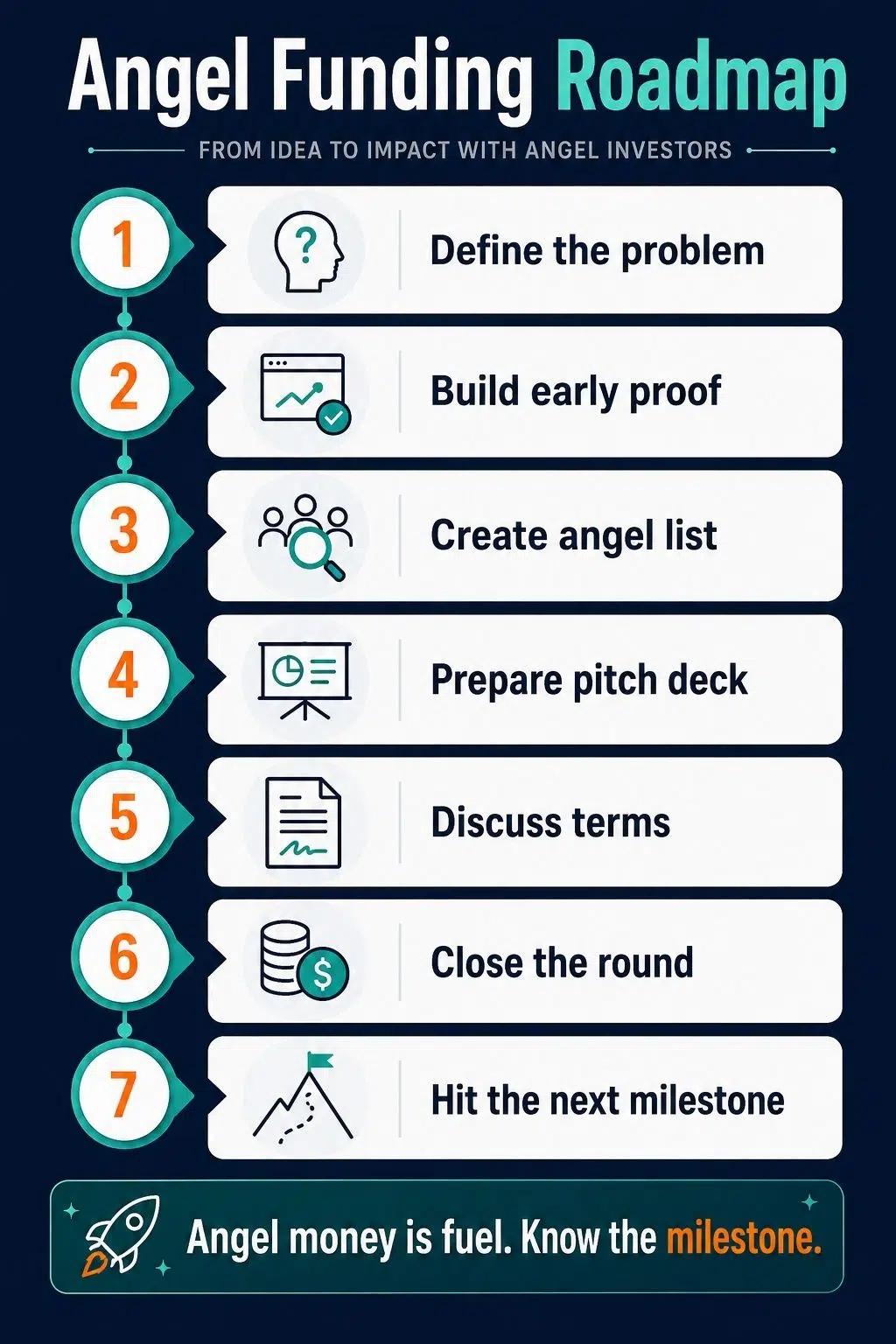
Angel funding is not the finish line. It is fuel. Use it only when you know where you are trying to go.
Frequently Asked Questions About Angel Investors
1. What is an angel investor?
An angel investor is an individual who invests personal money into an early-stage startup, usually in exchange for equity, convertible debt, or future equity through a SAFE.
2. How do angel investors make money?
Angel investors make money when the startup grows in value and creates a return through an acquisition, IPO, secondary sale, or later liquidity event. Angel investing is risky, and many startups fail.
3. How do founders find angel investors?
Founders can find angel investors through warm introductions, angel groups, startup accelerators, founder communities, LinkedIn, demo days, industry events, startup lawyers, and operator networks.
4. What do angel investors look for?
Angel investors usually look for strong founders, a clear customer problem, market potential, early traction, founder-market fit, a believable product plan, and a clear use of funds.
5. What is an angel funding round?
An angel funding round is an early startup fundraising round where one or more angel investors invest capital into the company, often through equity, SAFEs, or convertible notes.
6. Are angel investors better than venture capital?
Angel investors are often better for very early-stage startups that need smaller checks, flexible support, and strategic advice. Venture capital may be better when the company needs larger capital and is ready to scale aggressively.
7. Should every founder raise angel funding?
No. Some founders are better off bootstrapping, using customer revenue, or choosing non-dilutive funding. Angel funding makes sense when outside capital clearly helps the startup reach a valuable milestone.