
Partner marketing SaaS sounds attractive because it promises something every software company wants: growth without relying only on paid ads, cold outbound, or founder-led selling. But partnerships are not magic. A partner program will not fix weak positioning. It will not rescue a product that customers do not understand. It will not turn random agencies, affiliates, influencers, consultants, or integration partners into revenue just because you added a “Partner with us” page to your website.
That is where many SaaS companies get disappointed. They recruit partners too early. They choose partners who have an audience but no buyer trust. They offer commissions but no enablement. They build integrations but never co-market them. They launch a channel program without clear rules, ownership, tracking, or partner support. Then they wonder why the pipeline is thin.
Good SaaS partnerships work differently. They are built around shared customers, shared value, and a clear reason for both sides to care. The best partner marketing programs help SaaS companies reach trusted audiences, solve adjacent customer problems, strengthen product adoption, expand use cases, improve retention, and create revenue channels that compound over time.
For a broader look at how partnerships fit into acquisition, activation, retention, and expansion, read our complete SaaS Growth Marketing Guide.
What Is Partner Marketing in SaaS?
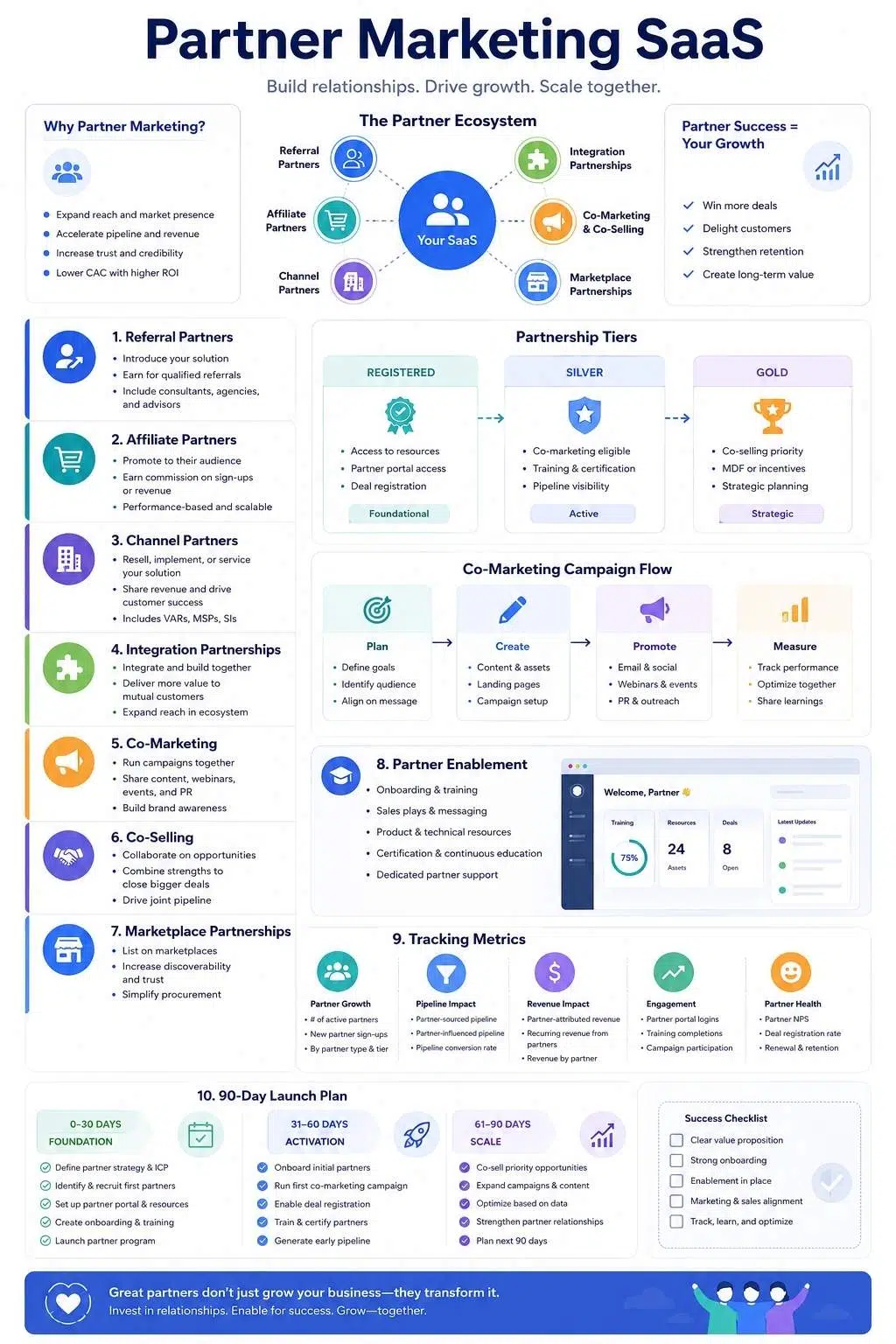
Partner marketing SaaS is the process of growing a software company through strategic relationships with other businesses, platforms, consultants, agencies, creators, resellers, marketplaces, or technology providers. The goal is not simply to “get referrals.” A strong SaaS partner marketing strategy helps two companies create more value together than they could create alone.
That may happen through:
- Co-marketing campaigns
- Referral partnerships
- Affiliate programs
- Channel partner programs
- Reseller partnerships
- Agency partnerships
- Integration partnerships
- Marketplace listings
- Co-selling motions
- Strategic alliances
- Customer success partnerships
- Implementation partnerships
- Technology ecosystem partnerships
For example, a CRM SaaS company may partner with sales consultants, onboarding agencies, email marketing platforms, data enrichment tools, and workflow automation providers.
Each partner type serves a different role. Some bring leads. Some close deals. Some improve implementation. Some make the product more useful. Some reduce churn. Some help customers adopt the software faster. That is why SaaS partnerships should be designed around the customer journey, not just revenue attribution.
Why Partner Marketing Matters for SaaS Companies
SaaS growth has become more expensive and more competitive. Paid acquisition costs can rise quickly. Organic search can take time. Outbound email gets ignored. Social reach changes. Buyers trust peer recommendations, consultants, communities, existing tools, and familiar platforms more than brand claims from a vendor they just discovered.
Partner marketing helps because it uses existing trust. A buyer may not know your SaaS company yet, but they may trust:
- Their agency
- Their consultant
- Their tech stack
- Their community
- Their integration marketplace
- Their CRM platform
- Their accountant
- Their IT provider
- Their implementation partner
- Their favorite industry expert
A good partner gives your product a warmer path into the buyer’s world.
For SaaS companies, partnerships can support:
- Demand generation
- Lead qualification
- Product adoption
- Implementation
- Customer education
- Retention
- Expansion
- Marketplace visibility
- Category credibility
- Competitive differentiation
- Regional growth
- Enterprise sales support
The important point is this: partner marketing is not only a top-of-funnel tactic. A partner can influence the whole SaaS lifecycle.
Partner Marketing vs Affiliate Marketing vs Channel Sales
These terms often get mixed together, but they are not the same.
| Model | Main Purpose | Typical Partner Role |
| Partner marketing | Create joint awareness, demand, trust, and adoption | Co-market, refer, educate, integrate, or influence |
| Affiliate marketing | Drive tracked traffic or signups for commission | Promote links, content, offers, or product mentions |
| Channel sales | Sell through or with third-party partners | Resell, distribute, co-sell, or manage deals |
| Integration partnerships | Connect products to improve customer workflows | Build technical integrations and co-market use cases |
| Strategic alliances | Create broader business value between companies | Joint GTM, product alignment, market expansion |
Affiliate marketing can be part of partner marketing, but it is usually narrower. Channel sales can be part of partner marketing, but it requires deeper enablement, deal rules, incentives, and sales operations.
Integration partnerships can create marketing value, but they also require product, engineering, support, and customer success alignment.
A mature SaaS partner program may include all of these. An early-stage SaaS company should usually start with one or two partner motions that match its product and market.
When Should a SaaS Company Start Partner Marketing?
Do not start partner marketing too early just because it sounds scalable. Partners need something solid to promote, sell, integrate with, or recommend. If your product positioning is unclear, onboarding is weak, pricing keeps changing, or customer fit is still uncertain, partners will struggle.
Before building a serious partner program, you should usually have:
- Clear ideal customer profile
- Proven product-market fit signals
- Working onboarding process
- Strong product value proposition
- Clear pricing and packaging
- Basic sales process
- Customer proof or use cases
- Reliable tracking and attribution
- Partner owner or clear internal responsibility
- Enablement materials
- Support process for partners and referred customers
This does not mean you need to be enterprise-scale. Early SaaS companies can still test lightweight partnerships. But they should not build a complicated channel program before they understand who buys, why they buy, and what makes customers stay.
A simple rule helps: If your own team cannot sell and onboard the customer clearly, partners will not magically do it better.
Types of SaaS Partnerships That Drive Growth
Different SaaS partnerships solve different problems. Choose the model based on your product, market, and growth goal.
1. Referral Partnerships
Referral partnerships are one of the simplest ways to start.
A referral partner introduces potential customers to your SaaS company. If the lead becomes a customer, the partner may receive a commission, reward, revenue share, or reciprocal value.
Referral partners may include:
- Consultants
- Agencies
- Customers
- Industry experts
- Service providers
- Accountants
- Coaches
- Technology advisors
- Community owners
- Complementary SaaS vendors
Referral partnerships work best when the partner already has trust with the buyer. For example, a marketing consultant may refer clients to a landing page optimization SaaS because it helps them deliver better campaign results.
The key is alignment. A referral partner should not just have an audience. They should have access to buyers who actually need the product.
2. Affiliate Partnerships
Affiliate partnerships are performance-based. Partners promote the product using tracked links and earn a commission when users sign up, start trials, or become paying customers.
Affiliate partners may include:
- Bloggers
- Newsletter creators
- YouTubers
- Review sites
- Course creators
- Influencers
- Niche media sites
- Comparison websites
- Community owners
Affiliate programs can help SaaS companies scale content-driven demand. But they also create risk if quality control is weak. Some affiliates may overpromise, use poor content, target the wrong audience, or chase commission rather than customer fit. That can increase churn later.
A strong affiliate program needs:
- Clear partner terms
- Approved messaging
- Brand guidelines
- Tracking links
- Attribution rules
- Commission structure
- Content examples
- Compliance expectations
- Quality monitoring
- Fraud prevention
- Payout process
Affiliate marketing is useful, but it should not become a race for cheap signups. For SaaS, customer quality matters more than raw lead volume.
3. Channel Partners SaaS Programs
Channel partners SaaS programs involve third parties helping sell, distribute, implement, or support the product.
Common channel partner types include:
- Resellers
- Value-added resellers
- Managed service providers
- Systems integrators
- Consultants
- Agencies
- Implementation partners
- Regional distributors
- Technology advisors
Channel partners are especially useful when:
- Buyers need guidance before purchasing
- Implementation is complex
- Local market knowledge matters
- The product serves mid-market or enterprise customers
- Customers need training or migration help
- Existing trusted advisors influence buying decisions
- Direct sales cannot reach every segment efficiently
But channel programs need structure.
You need to define:
- Who owns the deal
- How leads are registered
- How commissions work
- What happens when two partners touch one deal
- What support partners receive
- What certification or training is required
- How partners are evaluated
- What happens if a partner misrepresents the product
- How renewals and expansions are handled
A channel program without rules creates conflict.
A channel program with strong enablement can extend your sales reach without weakening the customer experience.
4. Integration Partnerships
Integration partnerships connect your SaaS product with another tool that your customers already use.
These partnerships can be powerful because they make the product more useful inside a real workflow.
Examples:
- CRM plus email marketing platform
- Project management tool plus Slack
- Accounting software plus payment platform
- Help desk plus customer success platform
- Analytics tool plus data warehouse
- HR software plus payroll system
- Scheduling tool plus calendar app
- AI writing tool plus CMS
Integration partnerships help SaaS companies by:
- Increasing product stickiness
- Improving adoption
- Reducing workflow friction
- Expanding marketplace visibility
- Creating co-marketing opportunities
- Supporting product-led growth
- Helping customers connect their existing stack
- Making the product harder to replace
But not every integration deserves a partnership. Some integrations are table stakes. Others can become growth channels.
A strong integration partnership should answer:
- Do our customers already use this tool?
- Does the integration solve a real workflow problem?
- Can both companies co-market the use case?
- Is there a shared buyer or user persona?
- Will the integration improve activation or retention?
- Is the technical experience reliable?
- Can support teams handle integration questions?
- Is there marketplace visibility available?
Integration partnerships work best when product value and marketing value support each other.
5. Co-Marketing Partnerships
Co-marketing partnerships happen when two companies promote a shared message, resource, campaign, or event.
Examples include:
- Webinars
- Joint reports
- Podcast episodes
- Email swaps
- Guest articles
- LinkedIn Live sessions
- Co-branded templates
- Research studies
- Online workshops
- Community events
- Product demo sessions
- Benchmark reports
- Industry guides
Co-marketing works when both audiences care about the same problem. For example, a customer support SaaS and a customer feedback SaaS might create a guide on improving customer experience. Each company brings its own audience, expertise, and product angle.
Good co-marketing is not just audience swapping. It should create something useful enough that both brands look smarter after publishing it.
6. Co-Selling Partnerships
Co-selling happens when two companies work together to win a customer.
This is common when products complement each other and solve a larger business problem together.
For example:
- A CRM vendor co-sells with a sales enablement platform.
- A cloud provider co-sells with a security SaaS vendor.
- A customer data platform co-sells with an analytics tool.
- A systems integrator co-sells a SaaS platform with implementation services.
Co-selling can work well for larger deals because it helps the buyer see a fuller solution. But it requires trust and coordination.
Teams need to agree on:
- Target accounts
- Account mapping
- Sales roles
- Joint messaging
- Deal ownership
- Customer handoff
- Data sharing rules
- Incentives
- Follow-up process
- Success criteria
Co-selling fails when partners compete for control or confuse the buyer. It works when the customer sees one stronger solution, not two vendors pushing separate agendas.
7. Marketplace Partnerships
Many SaaS companies grow through marketplaces attached to larger platforms. Examples include app marketplaces, cloud marketplaces, CRM ecosystems, automation platforms, and collaboration tools.
Marketplace partnerships can help with:
- Product discovery
- Buyer trust
- Integration visibility
- Customer adoption
- Enterprise procurement
- Reviews and ratings
- Co-marketing opportunities
- Partner ecosystem credibility
But a marketplace listing alone is not a strategy. A weak listing with unclear positioning, poor screenshots, no reviews, vague use cases, and no promotion will not drive much.
A strong marketplace strategy includes:
- Clear category positioning
- Strong listing copy
- Screenshots or demos
- Use-case examples
- Security and compliance details
- Customer reviews
- Integration documentation
- Support instructions
- Co-marketing plan
- Tracking and attribution
- Regular optimization
The marketplace can open the door. You still need to earn attention.
8. Agency and Consultant Partnerships
Agency and consultant partnerships are especially useful in SaaS because many customers need help turning software into results.
An agency may help clients with:
- Strategy
- Implementation
- Migration
- Training
- Campaign execution
- Reporting
- Workflow design
- Revenue operations
- CRM setup
- Automation
- Content production
- Customer support operations
This creates a natural opportunity for SaaS companies. The software helps the agency deliver results. The agency helps customers adopt the software. The customer gets better outcomes. This is why many SaaS ecosystems build partner programs around agencies, consultancies, and service providers.
To make these partnerships work, SaaS companies need to give partners:
- Training
- Certification
- Demo accounts
- Sales materials
- Use-case guides
- Client onboarding resources
- Partner support
- Revenue share or referral fees
- Directory visibility
- Co-marketing opportunities
- Product roadmap communication
Agencies can be powerful partners, but they need trust, clarity, and ongoing support.
How to Build a Partner Marketing SaaS Strategy
A partner strategy should be built in steps. Do not recruit everyone at once.
1. Start With the Customer Problem
The best SaaS partnerships start with the customer, not the partner.
Ask:
- What problem does our customer need to solve before or after using our product?
- What tools do they already use?
- Which experts do they trust?
- Which services help them succeed?
- Which workflows surround our product?
- Which platforms are we naturally connected to?
- Which companies serve the same ICP without directly competing?
- Which partners could improve customer outcomes?
For example, if you sell customer onboarding software, your customers may also need CRM tools, product analytics, customer success platforms, documentation tools, and implementation consultants.
Those are possible partner categories. The point is not to build partnerships because they look impressive. The point is to help customers move faster toward value.
2. Define the Partner Type You Need
Different goals require different partners.
| Goal | Best Partner Type |
| More top-of-funnel awareness | Affiliates, creators, media partners, co-marketing partners |
| More qualified pipeline | Referral partners, consultants, agencies, co-sell partners |
| Better implementation | Agencies, systems integrators, service partners |
| Higher product adoption | Integration partners, customer success partners |
| Regional growth | Local resellers, distributors, service providers |
| Enterprise credibility | Cloud marketplaces, strategic alliances, consultants |
| Better retention | Implementation partners, integration partners, customer success partners |
| More product stickiness | Integration partnerships and ecosystem partnerships |
If your goal is awareness, do not build a complex reseller program first. If your goal is enterprise adoption, do not rely only on affiliates. Match the partner motion to the business problem.
3. Build a Clear Partner Value Proposition
Partners will ask one question, even if they do not say it directly: “What is in this for us?”
A strong partner value proposition may include:
- Revenue share
- Referral commission
- New service opportunities
- Better client outcomes
- Access to a growing customer base
- Co-marketing exposure
- Directory listing
- Certification
- Training
- Sales support
- Product expertise
- Deal protection
- Marketplace visibility
- Joint content
- Implementation opportunities
- Exclusive partner resources
The value proposition should be specific.
Weak partner pitch: “Partner with us and grow together.”
Stronger partner pitch: “We help revenue operations consultants deliver faster CRM cleanup projects. Partners receive 20% recurring commission, implementation templates, co-branded webinars, and listing in our consultant directory.”
Specificity builds trust.
4. Create Partner Selection Criteria
Not every interested partner should be accepted. Bad-fit partners can damage your brand, mislead customers, create support problems, or generate low-retention users.
Evaluate partners based on:
- Audience fit
- Customer trust
- Industry expertise
- Product knowledge
- Sales ability
- Service quality
- Reputation
- Content quality
- Geographic fit
- Technical capability
- Existing customer base
- Alignment with your ICP
- Support expectations
- Commitment level
- Ethical selling behavior
A smaller group of strong partners usually beats a large list of inactive partners. Partner quantity looks good in a dashboard. Partner quality drives revenue.
5. Create Partner Tiers
As your program grows, partner tiers help organize benefits and expectations.
Example:
| Tier | Best For | Benefits |
| Referral Partner | Light-touch recommenders | Tracking links, referral fees, basic resources |
| Certified Partner | Trained consultants or agencies | Certification, directory listing, sales materials |
| Premier Partner | High-performing strategic partners | Co-marketing, priority support, deal collaboration |
| Integration Partner | Technology partners | Technical support, marketplace listing, joint launch |
| Strategic Partner | Major ecosystem or enterprise partner | Executive alignment, joint GTM, co-selling |
Tiers should not be decorative. Each tier should reflect partner commitment, capability, performance, and customer impact.
6. Build Partner Enablement Before Recruiting Too Many Partners
Partner enablement is the material, training, and support that helps partners succeed. Without enablement, partners may misunderstand the product, pitch the wrong use case, or disappear after the first call.
Useful partner enablement assets include:
- Partner onboarding guide
- Product positioning guide
- Ideal customer profile
- Competitor comparison
- Demo script
- Sales deck
- Email templates
- Discovery questions
- Use-case one-pagers
- Case studies
- Pricing explanation
- FAQ document
- Objection handling guide
- Integration documentation
- Implementation checklist
- Co-marketing guidelines
- Brand guidelines
- Tracking instructions
Enablement should make it easy for partners to explain, sell, and support the product correctly. If partners have to guess, they will either stop promoting or say the wrong thing.
7. Set Clear Incentives and Commission Rules
Partner incentives need to be fair, simple, and sustainable.
Common incentive models include:
- One-time referral fee
- Recurring commission
- Revenue share
- Tiered commission
- Deal registration protection
- Service revenue opportunity
- Marketplace revenue share
- Co-marketing support
- Performance bonuses
- Certification benefits
- Directory visibility
- MDF or marketing development funds
Be careful with overly generous commissions that damage unit economics. Also, be careful with incentives that reward low-quality deals. For SaaS, it is often better to reward qualified revenue than raw signup volume.
Clarify:
- What counts as a qualified referral
- When commission is paid
- How long commission lasts
- Whether upgrades are included
- What happens with refunds
- What happens with churned customers
- How attribution works
- What happens when multiple partners influence one deal
- Whether self-referrals are allowed
- Whether partners can bid on brand keywords
- What promotional claims are restricted
Clear terms prevent future conflict.
8. Create a Partner Onboarding Process
Partner onboarding should help partners understand the product, customer, and program.
A practical onboarding flow may include:
| Step | Purpose |
| Application | Qualify partner fit |
| Approval | Confirm program rules and expectations |
| Welcome email | Share first resources and next steps |
| Training | Teach product, ICP, positioning, and use cases |
| Certification | Validate knowledge for deeper partner tiers |
| Demo access | Let partners experience the product |
| Resource hub | Give sales and marketing materials |
| Tracking setup | Provide links, codes, or deal registration process |
| First campaign plan | Choose the first partner activity |
| Check-in | Review early performance and questions |
Do not assume partners will read a 40-page PDF. Make onboarding simple, guided, and practical.
Co-marketing should not feel like two logos pasted onto a generic webinar. Start with a real shared problem.
Examples:
- “How RevOps Teams Can Clean CRM Data Before Scaling Outbound”
- “How Agencies Can Report Client ROI Without Manual Spreadsheets”
- “How Customer Success Teams Can Reduce Onboarding Drop-Off”
- “How SaaS Finance Teams Can Forecast Revenue More Accurately”
- “How Remote Teams Can Automate Support Handoffs”
Good co-marketing content should:
- Solve a real customer problem
- Use both companies’ expertise
- Introduce the integration or partnership naturally
- Give practical examples
- Include a clear next step
- Feed leads into a tracked follow-up process
Common co-marketing formats include:
- Webinar
- Checklist
- Template
- Research report
- Blog post
- LinkedIn event
- Newsletter feature
- Podcast episode
- Case study
- Joint demo
- Customer workshop
A co-marketing campaign should have a follow-up plan before it launches. Otherwise, it becomes content with no pipeline.

10. Build Integration Partnerships With Go-to-Market in Mind
Many SaaS teams treat integrations as product work only. That is a missed opportunity. If an integration solves a real customer problem, it deserves a go-to-market plan.
An integration launch should include:
- Clear use case
- Joint landing page
- Marketplace listing
- Help documentation
- Email announcement
- Product announcement
- Co-branded demo
- Sales enablement
- Support training
- Customer success playbook
- Partner social posts
- Integration setup guide
- Case study if possible
- Usage tracking
The marketing message should not be: “We now integrate with X.”
The better message is: “Now your sales team can sync lead activity from X into Y without manual updates.”
Customers care about the workflow, not the integration badge.
11. Track Partner Performance Properly
Partner marketing needs clean measurement. Without tracking, partners lose trust, and your team cannot see what works.
Track metrics such as:
| Metric | Why It Matters |
| Partner-sourced leads | Shows lead generation from partners |
| Partner-influenced pipeline | Shows partner impact on deals |
| Referral conversion rate | Shows lead quality |
| Partner-sourced revenue | Shows direct revenue contribution |
| Partner-influenced revenue | Shows broader ecosystem impact |
| Activation rate | Shows whether partner leads become real users |
| Churn rate by partner source | Shows customer quality |
| Time to close | Shows sales efficiency |
| Average deal size | Shows partner segment value |
| Expansion revenue | Shows long-term account growth |
| Partner engagement | Shows whether partners remain active |
| Co-marketing performance | Shows campaign results |
| Integration usage | Shows product adoption from partnerships |
| Marketplace traffic | Shows discovery impact |
Do not measure only signups. A partner that sends fewer leads but stronger customers may be more valuable than a partner that sends a large volume of poor-fit traffic.
12. Avoid Partner Conflict
Partner conflict can damage a program quickly.
Common conflict areas include:
- Multiple partners claiming one deal
- Direct sales competing with partners
- Unclear territory rules
- Confusing commission terms
- Poor deal registration process
- Partners overpromising features
- Customer ownership disputes
- Renewal and expansion commission confusion
- Lack of transparency around attribution
Prevent this early.
Set rules for:
- Deal registration
- Lead ownership
- Commission eligibility
- Partner responsibilities
- Sales team responsibilities
- Customer communication
- Territory or segment rules
- Renewal ownership
- Dispute resolution
Partners need to trust the system. If they feel your direct sales team takes their deals, they will stop bringing opportunities.
13. Keep Partner Marketing Aligned With Customer Success
The best SaaS partnerships do not stop after a deal closes. A partner may help customers implement, adopt, and expand the product. This matters because partner-sourced customers can churn if expectations are wrong or onboarding is weak.
Customer success should know:
- Which partner sourced the customer
- What was promised
- What use case was discussed
- Whether the partner is helping with implementation
- What success criteria were set
- What integrations are involved
- What risks may exist
Partners can also help with:
- Training
- Implementation
- Workflow setup
- Customer education
- Data migration
- Integration configuration
- Change management
- Ongoing consulting
If partner marketing only cares about the pipeline, it may create retention problems. If partner marketing, sales, product, and customer success work together, partnerships can improve long-term customer outcomes.
14. Build Partner Content That Helps Partners Sell
Partner content should not be generic brand material. Partners need content that helps them explain the product to their audience.
Useful partner content includes:
- “Who this is for” guide
- Use-case explainers
- Comparison guides
- Buyer pain point content
- Email swipe copy
- Social post examples
- Landing page copy
- Demo video
- Sales one-pager
- Customer story
- ROI calculator
- Implementation checklist
- Industry-specific guide
- Integration setup tutorial
Do not force every partner to create messaging from scratch. Give them strong material, but allow enough flexibility to speak in their own voice. The best partner content feels native to the partner’s audience.
15. Use Partner Marketing for Retention, Not Just Acquisition
This is where many SaaS companies miss value. Partners can help customers stay.
For example:
- An implementation partner helps customers set up correctly.
- An integration partner makes the product part of a daily workflow.
- A consultant helps the customer prove ROI.
- An agency uses the product repeatedly with clients.
- A customer success partner helps train teams.
- A marketplace partner improves product discovery and trust.
- A channel partner provides local support and relationship continuity.
Partnerships can improve retention when they help customers get value faster and keep using the product in meaningful ways. That is why partner-sourced revenue should be measured beyond the first sale.
Look at:
- Activation rate
- Product adoption
- Support burden
- Renewal rate
- Expansion revenue
- Customer satisfaction
- Churn rate by partner source
A partner who brings sticky customers is worth protecting.
16. Create a Partner Program Operating Rhythm
Partner marketing needs ongoing management.
A good operating rhythm may include:
Weekly
- Review new partner leads
- Check active campaigns
- Follow up on partner questions
- Review deal registration
- Fix tracking issues
- Support active co-selling opportunities
Monthly
- Review partner performance
- Identify top-performing partners
- Update enablement materials
- Launch or plan co-marketing campaigns
- Review partner-sourced pipeline
- Discuss partner feedback with product and sales
Quarterly
- Review partner tiers
- Audit inactive partners
- Analyze churn by partner source
- Plan strategic campaigns
- Refresh partner training
- Review incentives
- Collect partner feedback
- Identify new partner categories
A partner program that is not managed becomes a list. A partner program that is managed becomes a growth channel.
Common Partner Marketing SaaS Mistakes
Recruiting Partners Before Product-Market Fit
Partners need a clear product, a clear customer, and a clear value proposition. Without that, they cannot help much.
Treating Partners Like Free Salespeople
Partners need value, too. If they do not benefit, they will not stay active.
Focusing Only on Commissions
Money matters, but enablement, trust, customer fit, and mutual value matter just as much.
Accepting Every Partner
A bad-fit partner can create poor leads, wrong expectations, and brand risk.
Building Integrations Without Marketing Them
An integration without positioning, documentation, and promotion may sit unused.
Ignoring Partner Enablement
If partners do not understand the product, they cannot promote or sell it well.
Measuring Only Lead Volume
Partner quality matters. Track activation, revenue, retention, and expansion.
Creating Channel Conflict
Unclear ownership and attribution rules can damage trust with partners and sales teams.
Forgetting Customer Success
Partner-sourced customers still need onboarding, support, and adoption help.
Letting Partners Go Cold
Partners need communication, updates, resources, and reasons to stay engaged.
Best Metrics for Partner Marketing SaaS Programs
A healthy partner program needs both activity metrics and outcome metrics.
| Metric Type | Examples |
| Partner recruitment | Applications, approved partners, active partners |
| Partner engagement | Portal logins, training completion, campaign participation |
| Pipeline | Partner-sourced leads, partner-influenced pipeline, deal registration |
| Revenue | Partner-sourced revenue, partner-influenced revenue, average deal size |
| Conversion | Referral-to-demo rate, demo-to-close rate, trial-to-paid rate |
| Retention | Churn by partner source, renewal rate, expansion rate |
| Integration | Integration installs, active integration users, marketplace traffic |
| Enablement | Certification completion, content downloads, partner feedback |
| Co-marketing | Registrations, attendance, content downloads, qualified leads |
| Customer success | Activation rate, onboarding completion, product adoption |
Choose metrics based on the partner type.
- An affiliate program may focus on traffic, signups, and paid conversions.
- A reseller program may focus on registered deals, close rate, and partner-sourced revenue.
- An integration partnership may focus on installs, usage, retention, and marketplace visibility.
- A partner metric is useful only if it helps you make better decisions.
The Bottom Line on Partner Marketing SaaS
Partner marketing SaaS works when the partnership creates real customer value. It fails when companies treat partners as shortcuts.
A strong SaaS partner program starts with the customer problem, chooses the right partner type, gives partners a clear reason to care, supports them with enablement, tracks performance honestly, and connects partner activity to revenue, retention, and product adoption.
The best partnerships do not feel forced. They make sense to the customer. The agency already helps with implementation. The integration already fits the workflow. The consultant already advises the buyer. The marketplace already earns trust. The co-marketing partner already speaks to the same audience. That is where partnerships become powerful.
Not because they are trendy. Because they help the right customers discover, understand, adopt, and stay with your SaaS product. And when that happens, partner marketing becomes more than a campaign. It becomes a growth system.
Frequently Asked Questions About Partner Marketing SaaS
1. What is partner marketing SaaS?
Partner marketing SaaS is a growth strategy where a software company works with partners such as agencies, affiliates, consultants, resellers, integration providers, marketplaces, or complementary SaaS companies to reach customers, generate demand, improve adoption, and drive revenue.
2. What are the best SaaS partnerships for growth?
The best SaaS partnerships depend on the product and customer. Common high-value partnerships include referral partners, channel partners, agency partners, integration partnerships, co-marketing partners, marketplace partners, and co-selling partners.
3. How do channel partners SaaS programs work?
Channel partners SaaS programs allow third parties to sell, refer, implement, or support a SaaS product. These partners may earn commissions, revenue share, service opportunities, or other benefits in exchange for helping the SaaS company reach and serve customers.
4. Why are integration partnerships important for SaaS?
Integration partnerships are important because customers want software tools that work together. A strong integration can improve product adoption, reduce workflow friction, increase retention, create marketplace visibility, and support co-marketing opportunities.
5. How do you start a SaaS partner program?
Start by defining your customer problem, choosing the right partner type, creating a partner value proposition, setting qualification criteria, building enablement materials, setting tracking and commission rules, and recruiting a small group of high-fit partners before scaling.
6. How do you measure SaaS partner marketing success?
Measure SaaS partner marketing by tracking partner-sourced leads, partner-influenced pipeline, partner-sourced revenue, referral conversion rate, average deal size, integration usage, co-marketing performance, activation rate, retention, churn by partner source, and expansion revenue.