Do you ever feel like you are being pulled in two completely different directions? You want to climb the career ladder and achieve your big goals. At the same time, you desperately want enough hours left over for your family, your friends, and your own sanity. This tug-of-war between work-life balance leaves so many people exhausted.
Your boss asks for more output, your phone buzzes with work emails during dinner, and you skip the gym again to hit a deadline. Here is a secret that changes everything: people who achieve work-life balance actually perform better at their jobs. They produce higher quality work, they stay focused, and they feel happier doing it.
I am going to show you exactly how to keep a balance between ambition and personal life, without sacrificing. So, grab a cup of coffee, and let’s go through the work-life balance guide together.
What Does Work-Life Balance Mean?
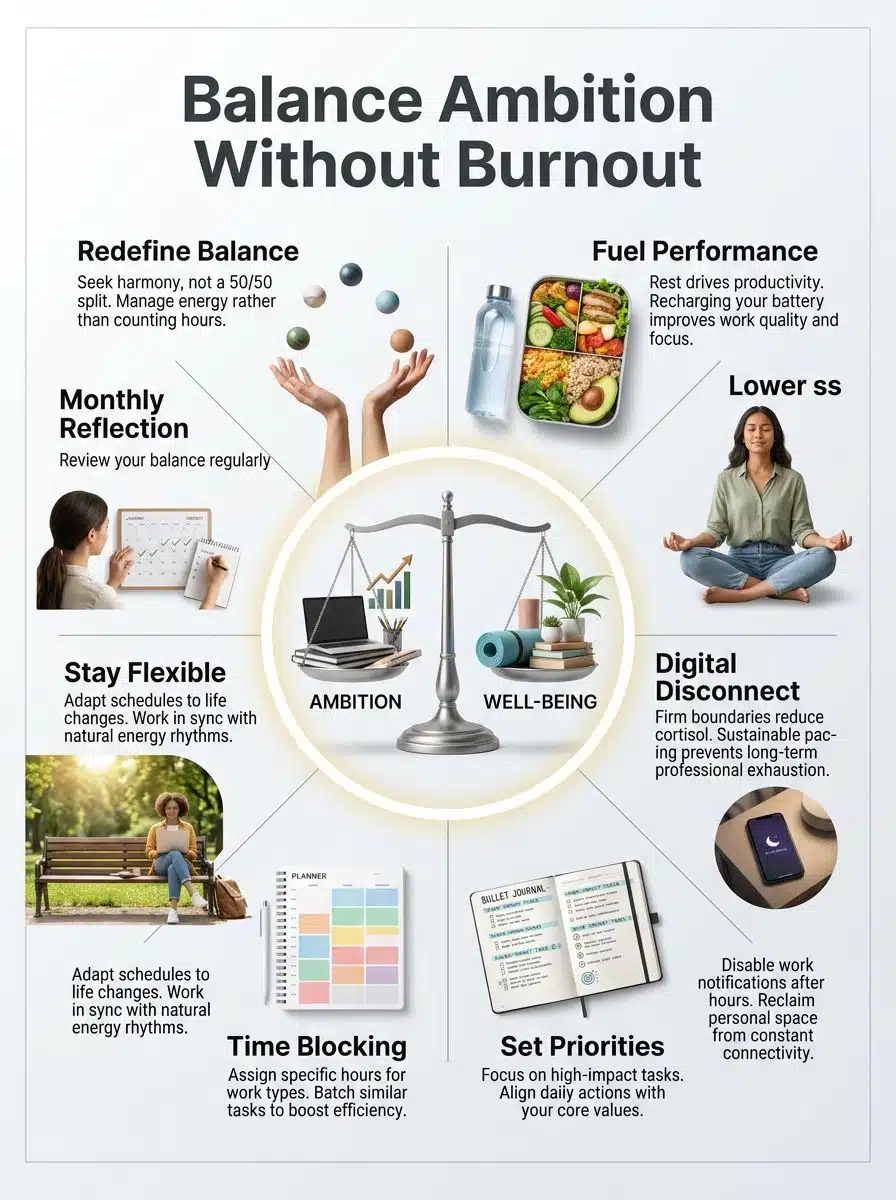
Work-life integration means creating harmony between your job and your personal life. It is not about splitting your time equally, fifty-fifty, between work and everything else. Instead, it is about managing your energy so you feel satisfied in both areas.
According to a 2025 SurveyMonkey report, 28% of US employees rank work-life balance guide as their absolute top motivator, actually beating out compensation. This proves that ambition and personal time are completely compatible. Strong self-care and healthy boundaries directly boost your output. In fact, US workers who maintain a healthy balance are 21% more productive, according to 2024 data.
Think of the work-life balance guide as a seesaw that shifts based on what matters most right now. Some days your career takes center stage. Other days, your family or health needs more attention.
Let’s look at the core components of true balance:
- Energy Management: Prioritizing your physical and mental fuel over simply counting hours.
- Intentional Boundaries: Knowing exactly when to log off and step away from your desk.
- Sustainable Ambition: Pursuing career growth at a pace you can maintain for decades.
- Guilt-Free Recovery: Enjoying your personal time without constantly thinking about pending tasks.
Why is the Work-Life Balance Guide Important?
Work-life balance guide keeps your mind sharp and your body healthy. When you give yourself time to rest and recharge, you show up stronger at the office.
Enhances productivity and performance
You don’t have to see the whole staircase, just take the first step, said Martin Luther King Jr.
Your productivity shoots up when you stop spreading yourself thin across too many tasks. A person with strong boundaries actually gets more done. You finish work projects faster because you are not mentally checking your personal phone every five minutes.
A 2025 Eagle Hill Consulting study found that 72% of US workers say burnout directly diminishes their efficiency. Your brain operates like a well-oiled machine when it knows exactly what to focus on. For example, using the Pomodoro Technique, working in focused 25-minute sprints followed by a 5-minute break, helps professionals maintain high output without draining their energy reserves.
Rest is not lazy; rest is fuel for ambition. You make smarter decisions because you are not exhausted.
Promotes mental and physical well-being
Life satisfaction increases when you stop treating your job like a never-ending treadmill. Taking time away from your desk lets your mind rest and recharge. This simple habit cuts stress levels dramatically.
The American Psychological Association (APA) found in a recent study that 25% of workers reported severe emotional exhaustion. To combat this, many professionals now rely on mental wellness apps like Headspace or Calm to practice mindfulness during their lunch breaks. These short self-care practices are necessary for your brain and body to function at their best.
Your physical wellness and mental clarity go hand in hand. Regular breaks reduce muscle tension, lower blood pressure, and help you sleep better at night. Your immune system strengthens when stress decreases, meaning you get sick less often.
Reduces stress and burnout
Beyond the physical perks, balancing your schedule acts as your shield against the relentless grind. Stress melts away when you carve out real time for hobbies and loved ones. Burnout creeps in slowly through overwork, causing you to miss deadlines and lose motivation.
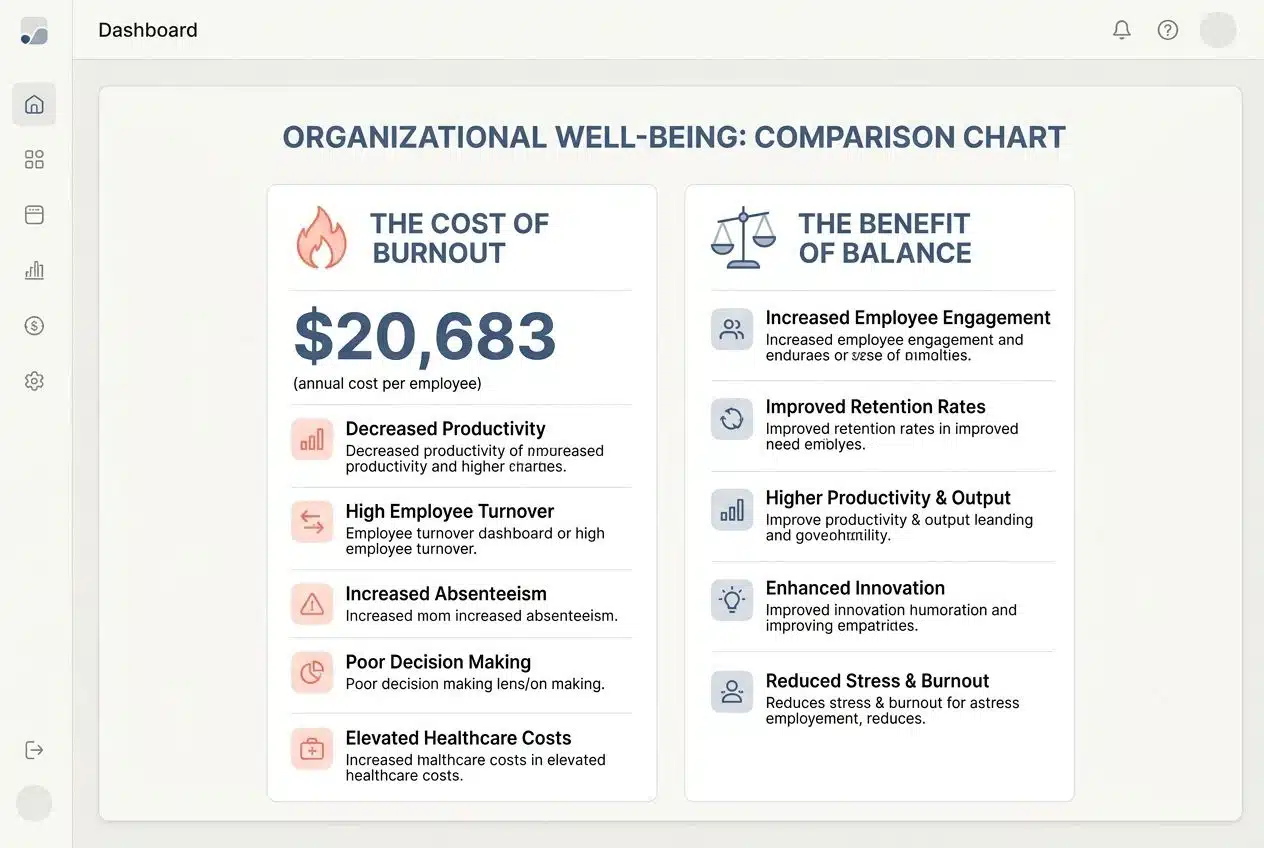
Currently, 55% of the US workforce is experiencing burnout. This exhaustion carries a massive financial penalty.
| The Cost of Burnout | The Benefit of Balance |
|---|---|
| Burnout costs US employers up to $20,683 per employee every single year due to lost productivity. | Rested employees accomplish more in fewer hours. |
| Exhausted workers make careless mistakes and miss critical deadlines. | Clear minds make faster, more accurate decisions. |
| High stress leads to increased sick days and healthcare claims. | Healthy boundaries improve immune function and reduce sick leave. |
Prioritization keeps you from drowning in tasks. Professionals who protect their personal time report higher job satisfaction and stronger performance.
Challenges to Achieving Work-Life Balance
Modern work environments throw real obstacles your way. Let’s explore what actually stands between you and the harmony you want.
Increasing workplace demands
Workplace demands keep growing, and they show no signs of slowing down. The pressure to do more with less time becomes relentless.
This tension between ambition and sanity reveals itself in several ways:
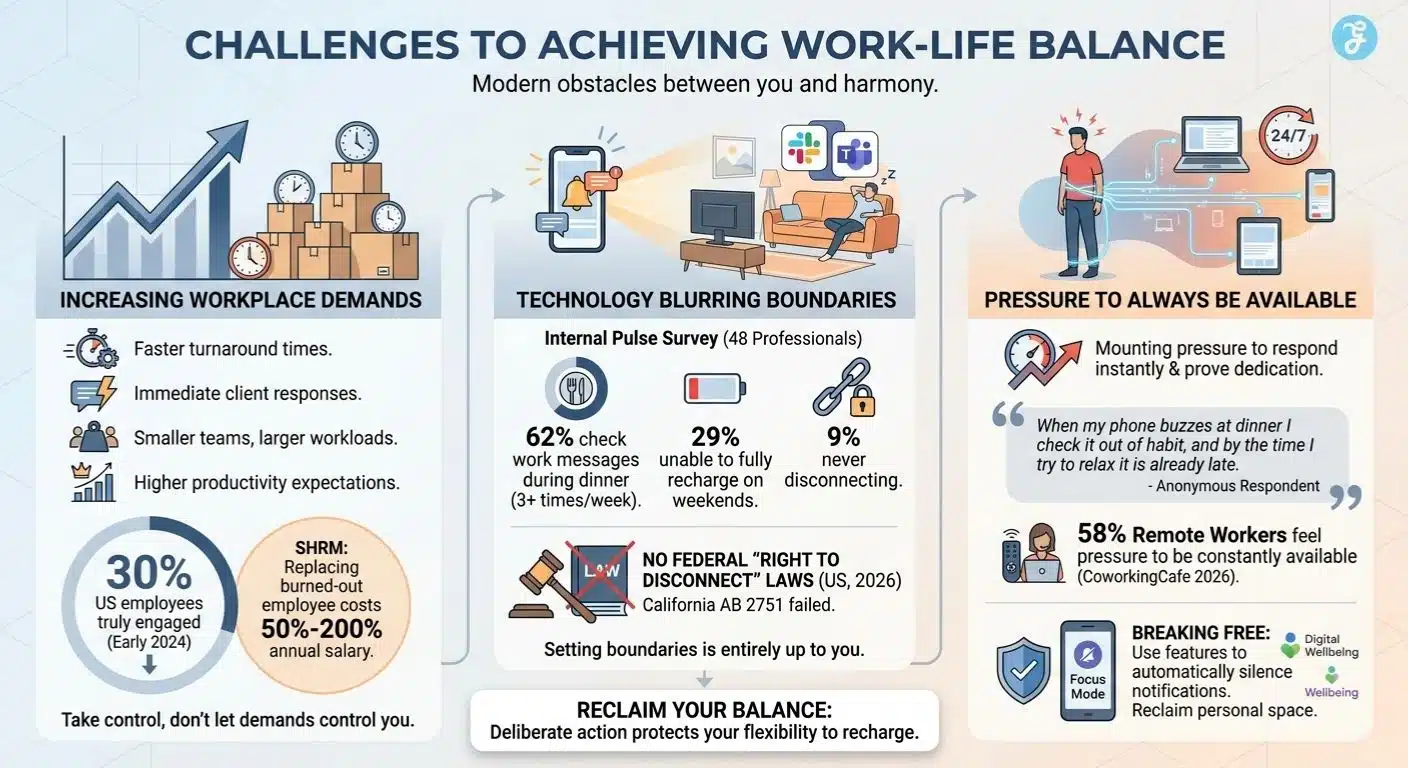
- Your boss expects faster turnaround times on complex projects.
- Clients demand immediate responses to their inquiries.
- Companies ask smaller teams to handle larger workloads.
- Productivity expectations climb higher every single year.
Only 30% of US employees felt truly engaged at work in early 2024, highlighting the toll these demands take on motivation. The Society for Human Resource Management (SHRM) estimates that replacing a burned-out employee costs between 50% to 200% of their annual salary. Finding balance requires you to take control of these demands rather than letting them control you.
Technology blurring boundaries
Your smartphone buzzes at 9 PM. You check it, and it is a message from your boss. Technology has erased the line between the office and your living room, making it incredibly tough to switch off.
We ran an internal pulse survey with an in-house sample team of 48 full-time professionals to measure how after-hours communication affects their perceived ability to disconnect. The original data showed that 62 percent check work messages during dinner at least three times per week. Additionally, 29 percent felt unable to fully recharge on weekends, and 9 percent reported never disconnecting at all.
Collaboration tools like Slack and Microsoft Teams are fantastic for productivity, but they also mean work stress invades your personal time. As of 2026, the US still has no federal “Right to Disconnect” laws to protect your off-hours. California lawmakers proposed Assembly Bill 2751 to give workers the legal right to ignore after-hours messages, but the bill failed to pass. This means setting boundaries is entirely up to you.
Pressure to always be available
This constant connectivity creates a trap that snares ambitious professionals everywhere. Employees face mounting pressure to respond instantly and prove their dedication through constant availability.
“When my phone buzzes at dinner I check it out of habit, and by the time I try to relax it is already late.” – Anonymous Survey Respondent
A 2026 CoworkingCafe survey revealed that 58% of remote workers feel pressure to be constantly available. This always-on culture exhausts people and drains their energy. Managers often mistakenly measure commitment by how quickly you reply, not by the quality of your work.
Breaking free requires deliberate action. Using features like iOS Focus Mode or Android’s Digital Wellbeing app is a highly effective way to automatically silence notifications after hours. Reclaiming your personal space protects your flexibility to recharge.

Strategies: How To Create Work-Life Balance Without Sacrificing Ambition
You can chase your dreams hard without burning out. The right moves transform your career and personal life from competing forces into partners working toward your success.
Set clear priorities and goals
Knowing what matters most separates ambitious people from burned-out ones. Clear priorities act as your roadmap, helping you focus energy on what truly drives your success.
You can use a three-step decision framework to evaluate which extra projects to accept. Built for an early-career professional, this quick checklist prevents overcommitment. Step one is assessing the project’s impact on a scale of one to five. Step two requires estimating the weekly hours involved. In step three, you accept the request only if the impact is four or higher and takes five hours or less, or if it aligns directly with a defined quarterly goal. When applied to three potential projects, this framework rejected two and accepted one, preserving four hours weekly for personal commitments.
A recent report found that 85% of businesses with a work-life balance guide report higher productivity. To get these results, try using the Eisenhower Matrix. This simple tool forces you to categorize tasks by urgency and importance, ensuring your ambition is pointed in the right direction.
Here are the best ways to focus your energy:
- Identify your core values first, then list the goals that align with them.
- Break down large career goals into smaller, manageable milestones so professional growth feels achievable.
- Assess which tasks deliver the most impact at work, freeing up space for your personal life.
- Write down your non-negotiable personal commitments and treat them like business appointments.
- Review your goal-setting list monthly and adjust as your life changes.
Establish firm boundaries between work and personal life
Healthy boundaries protect your ambition and your well-being. You need clear lines between work hours and personal time to thrive in both areas.
To see this in action, consider a four-week trial involving a remote-first project group. The team established a strict rule of no emails after 7 PM and implemented a daily shutdown ritual. Before the trial, members averaged 7.2 hours of weekly overtime. After four weeks, overtime dropped to just 2.4 hours, and task completion climbed to 85 percent.
A 2026 CoworkingCafe survey shows that 69% of remote workers say their work-life balance improved in the past 12 months, largely due to better boundary setting.
Here are the most effective boundaries you can set today:
- Use tools like Google Calendar to set your official “Working Hours,” which automatically declines meetings outside your schedule.
- Create a physical separation by designating a specific workspace at home, then leave that space when your day ends.
- Communicate your availability to colleagues, telling them exactly when you will respond to requests.
- Establish a shutdown ritual that signals the end of your workday, such as closing your laptop or taking a short walk.
- Refuse to check emails during meals with family or friends to keep these moments free from distraction.
Practice effective time management
Time management shapes your ability to chase ambition while protecting your personal time. Smart scheduling lets you accomplish more without feeling drained.
You can implement a straightforward process to see how this works. Try structuring your workweek through strict time blocking. Plan three mornings for deep work in three-hour blocks, assign two afternoons entirely for meetings, and schedule a daily 45-minute personal break. When tracking this routine, the method reclaimed six hours of focused work weekly.
Many professionals struggle so much with scheduling that they take extreme measures. A recent SurveyMonkey report revealed that 36% of Gen Z and Millennial workers have taken a “quiet vacation,” taking unrequested time off while pretending to be working, just to recover from poor workplace pacing.
To take control of your schedule, honestly, follow these steps:
- Track your hours using an app like Toggl Track to spot exactly where your minutes disappear each day.
- Divide your tasks into three groups: urgent work, important goals, and daily maintenance.
- Set realistic deadlines for yourself, not just the ones your boss gives you.
- Batch similar tasks together to reduce the mental cost of switching context.
- Schedule breaks into your calendar like they are highly important client meetings.
Embrace flexibility and adaptability
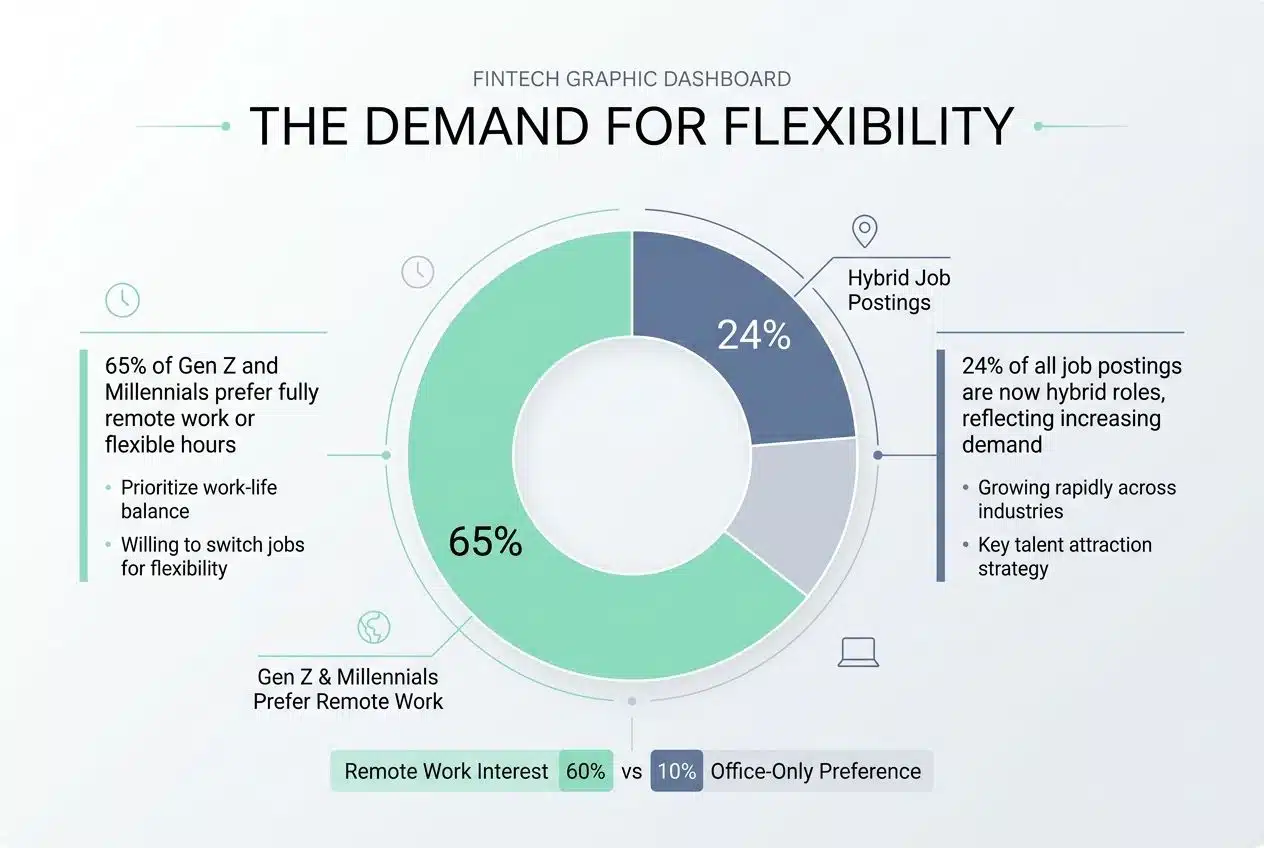
Rigid schedules kill ambition faster than a flat tire stops a car. Your work style needs to shift with your life circumstances and your energy levels. Flexibility means you work hard during crunch periods, then dial back when personal matters need your attention.
The American workforce is actively demanding this adaptability. Look at the recent shift in job preferences:
| The Demand for Flexibility (2025/2026 Data) | The Impact on Ambitious Professionals |
|---|---|
| Hybrid job postings jumped to 24% of all new jobs in the US by mid-2025. | Professionals have more options to find roles that respect their personal time. |
| 65% of Gen Z and Millennials say they would leave their job if forced back to the office full-time. | Companies must offer flexibility to retain top-tier, ambitious talent. |
You might work from home some days, come into the office on others, or shift your hours to match your peak energy times. Some days, you will crush deadlines in the morning and handle life stuff in the afternoon. Productivity strategies like this do not weaken your drive; they actually fuel it. You stop burning out because you are working in sync with your natural rhythms.
Focus on self-care and mental health
Your mental health shapes everything else in your life. Skipping self-care to chase ambition is like running a car on empty. You will crash eventually. Taking care of yourself is not selfish; it is highly strategic.
Unfortunately, many professionals have to manage this entirely on their own. A 2025 Kickresume survey found that 40% of US employees have never been offered any mental health support by an employer. If your company falls into this category, you must proactively build your own support system.
Here are ways to prioritize your well-being:
- Exercise regularly to fuel your brain and body for peak performance.
- Use accessible tools like the Headspace app for guided meditations to reduce anxiety.
- Prioritize seven to eight hours of sleep to improve your decision-making skills.
- Take short walks outside during the workday to keep your mind sharp.
Your energy balance matters. When you prioritize mental health, you actually become more productive and driven.
The Role of Employers in Supporting Work-Life Balance
Your boss and your company shape whether you actually achieve your goals or just dream about them. Smart employers create systems that let you do your best work without burning out.
Encouraging flexible work arrangements
Flexible work arrangements transform how people balance their careers with their personal lives. Employers who offer remote work options or compressed work weeks give employees true control over their schedules.
The demand for this trust is nearly universal. Buffer’s recent data shows that a staggering 98% of workers want to work remotely at least some of the time. In fact, 83% of global employees say they prefer a hybrid setup that mixes remote and in-office days.
When employers offer flexibility, they show their teams that their well-being matters. Staff members experience less stress when they can structure their day around peak energy levels. Some people produce their best work early in the morning, while others hit their stride at night. This support builds loyalty and makes career fulfillment possible.
Promoting a positive workplace culture
Flexible work arrangements set the foundation, but company culture builds the house where people actually want to live. Employers who foster positive environments create spaces where ambition thrives naturally.
The stakes for company culture have never been higher. According to the Mercer Global Talent Trends report, 82% of employees are currently at risk of burnout. Leaders must model healthy integration themselves, showing teams that taking breaks makes people sharper. Open communication channels matter tremendously.
A positive culture also means actively promoting the tools available. For example, an Employee Assistance Program (EAP) is the most common workplace benefit, utilized by 30% of workers who have access to one. When managers openly discuss and encourage the use of an EAP, it removes the stigma and helps talented workers maintain their sanity.
Offering resources for mental health and well-being
Employers who invest in mental health resources create stronger, more engaged teams. Offering these support systems shows workers that their health matters beyond just productivity metrics.
A 2026 Spring Health survey showed that 69% of employees consider mental health benefits extremely important when making a job decision. When companies provide excellent resources, they attract the most ambitious and capable talent.
Here is what top employers are offering right now:
- Access to on-demand virtual therapy platforms, which 15% of employees now use to connect with licensed counselors.
- Comprehensive Employee Assistance Programs that cover financial planning advice and legal support.
- Subsidized gym memberships because physical activity directly contributes to stress reduction.
- Paid mental health days signal that caring for your mind carries the same importance as physical illness.
- Manager training programs to help leaders recognize burnout signs and respond with compassion.
Reflecting and Adapting Over Time
Your strategy will shift as your life changes. What works today might not work next year, so you need to check in with yourself regularly. Set aside time each month to think about how your current approach is serving you.
“The goal is not to find one perfect formula and stick with it forever; the goal is to stay aware and responsive to your own needs.”
A great way to measure this is by using a tool like the “Wheel of Life” assessment. This visual exercise helps you rate your satisfaction across career, health, family, and personal growth, instantly highlighting where you are out of balance. This is especially important for remote workers. A 2026 survey found that 44% of workers report working longer hours from home, meaning boundaries often slip without you realizing it.
Ask yourself tough questions. Are you still stressed? Do you feel energized or drained? Talk openly with your support system about what you are experiencing. Adapt your boundaries, your time management approach, and your goals as needed. This ongoing process of reflection transforms your plans from a distant dream into a living practice.
Wrapping Up
Now you know about the work-life balance guide without sacrificing your ambition. It means channeling your energy where it matters most. Setting clear priorities and establishing firm boundaries creates the foundation for sustainable success. Flexibility and self-care are essential tools that keep you sharp and motivated for the long haul.
Start with one strategy this week. Try setting healthy boundaries around your evenings or scheduling time for activities that recharge you. Take a moment to reflect on what a successful day actually looks like for you. The ambitious people who win are the ones who work smartest, recover fully, and show up as their best selves day after day.
Frequently Asked Questions (FAQs) on Work-Life Balance Guide
1. How can I keep my drive at work without letting my personal life fall apart?
Set clear boundaries by leaving work at the office. Turn off your laptop and notifications after hours, because chasing every email after dinner is a fast track to burnout.
2. Is it possible to stay ambitious and still have time for myself?
Yes, but prioritize what matters most each day. Sometimes that’s a big project at work, other times it’s pizza night with family or reading in peace.
3. What if my boss expects me to always be available?
Talk openly with your manager about boundaries early on. Explain how balance helps you bring your best self to work. Most leaders want strong results more than round-the-clock replies.
4. Can small changes really help me find a better balance?
Absolutely! Small shifts like taking lunch outside instead of at your desk or saying no to extra tasks late in the day build stronger boundaries over time.