


Have you ever heard a friend mention they go to therapy and felt a little uncomfortable? Maybe you worried about what others might think. These feelings are completely normal, and you are definitely not alone. Many people carry incorrect ideas about mental health support in their heads. These false beliefs actually stop millions of people from getting the help they need.
Modern therapy misconceptions keep people stuck in their daily struggles. In fact, 2026 data from the National Institute of Mental Health shows that about 1 in 4 adults in the US deal with mental health issues each year. Yet, less than half of them actually reach out for professional support.
The gap between needing help and getting it usually comes down to misunderstanding what counseling is really about. I want to help you figure out modern therapy misconceptions and how to find the right help. We will break down the biggest myths and show you how to find a therapist who fits your needs perfectly.
Why Therapy Is Still Misunderstood And How To Find The Right Help
Many people picture therapy as something reserved for folks in crisis. This false image stops millions from getting the care they actually need. Movies and TV shows paint therapists as mind-reading wizards or judgmental figures. This creates completely false ideas about what really happens in a counseling room.
Common stereotypes about therapy
Therapy gets wrapped up in a bunch of false ideas that keep people away from getting help. Some folks think therapy is only for people who are falling apart. Others picture a therapist as someone who sits silently while you spill your guts on a couch.
These misconceptions stick around because the media often gets it wrong. They show therapy as dramatic, weird, or something only for the wealthy. Here are the most common stereotypes we see every day:
- The “Crazy” Myth: Believing you must have a severe illness to qualify for support.
- The Silent Observer: Thinking therapists just nod and take notes without offering real feedback.
- The Quick Fix: Assuming one session will magically solve years of deep emotional struggles.
- The Wealthy Luxury: Viewing counseling as a spa treatment only rich people can afford.
The truth is that counseling serves everyday people facing everyday challenges. Your coworker might use therapy to handle a tough breakup. Your neighbor might try psychotherapy to manage anxiety before public speaking. These real-world situations show that emotional well-being matters for everyone.
Cultural and societal stigmas around mental health
Many people still view mental health struggles as personal failures. Society has long painted seeking psychological support as a sign of weakness. Families sometimes discourage open conversations about emotional well-being. They treat mental health issues like shameful secrets. Men face intense pressure to “tough it out” rather than pursue emotional support.
Schools rarely teach students that mental health matters just as much as physical health. Workplaces often ignore the importance of psychological support for their employees. These stigmas create very real barriers. People avoid getting help because they fear judgment from loved ones or coworkers.
Stigma keeps people isolated, but breaking the silence breaks the stigma. By simply talking about our mental health, we take away the power of shame.
The good news is that attitudes are shifting. More public figures openly discuss their mental health journeys. Younger generations increasingly recognize that seeking professional help shows great strength. Companies now invest in employee wellness programs that include access to therapists. Social media campaigns spread awareness about the healing process. This cultural shift makes it easier to pursue treatment options without shame holding you back.
Lack of awareness about the benefits of therapy
Most people do not know what therapy can actually do for them. They see a therapist as a last resort. Therapy offers real tools for everyday struggles. It helps with stress, relationship problems, work challenges, and personal growth.
Counseling gives you coping strategies that stick with you for life. Emotional support from a trained professional changes how you handle tough situations. Many folks miss out on these benefits simply because nobody told them therapy was an option. Psychological support actually works best when you start early. Healing happens faster when you get help before problems get huge.
Let’s look at a simple comparison of what people think therapy is versus what it actually does:
| What People Assume | The Actual Reality |
|---|---|
| It is just venting about your week. | It involves learning specific, actionable coping strategies. |
| You only go when you hit rock bottom. | It acts as preventive care to keep you mentally strong. |
| The therapist solves your problems. | The therapist gives you tools to solve problems yourself. |
Breaking through this lack of awareness means sharing real stories about how therapy helped real people succeed.
Debunking Common Therapy Myths
Many people hold onto false ideas about therapy. Let’s clear up the biggest myths that keep folks away from counseling.
Myth 01: Therapy is only for people with severe mental illness
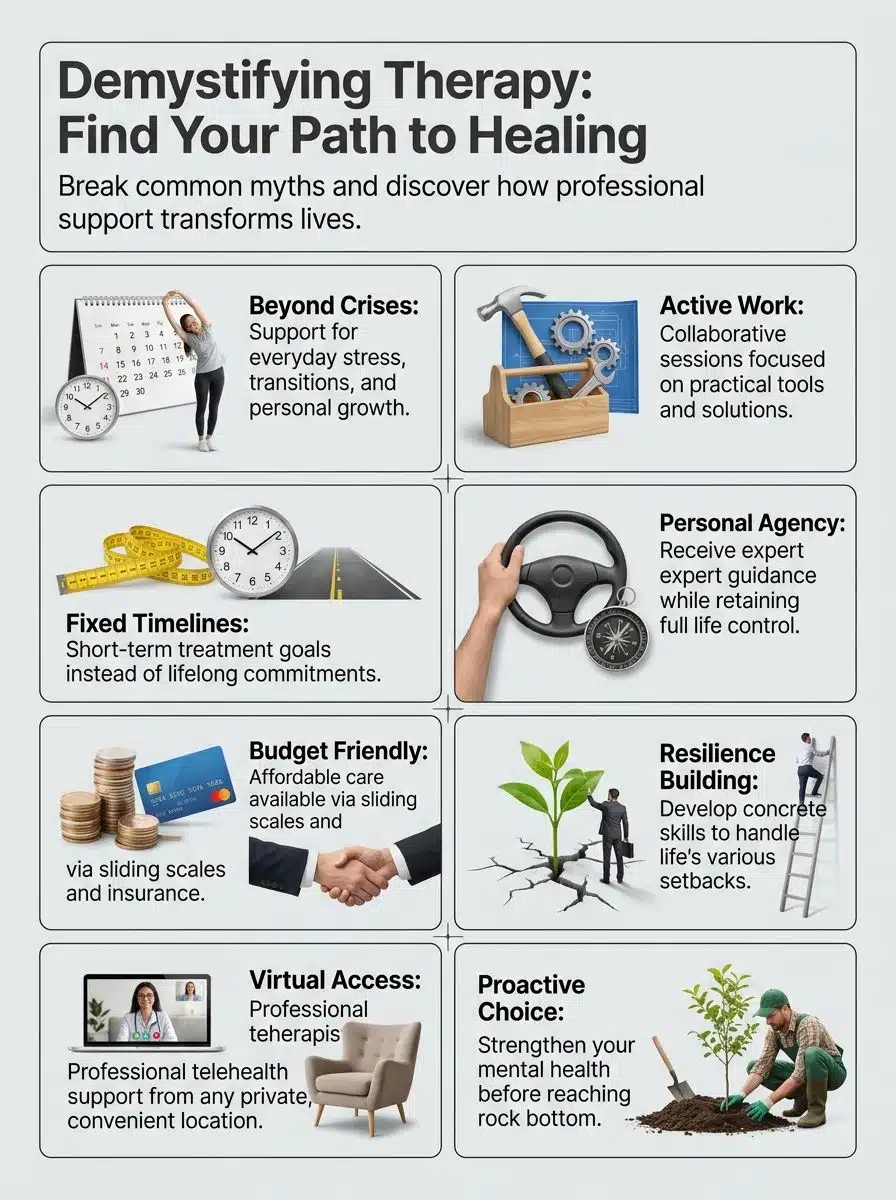
Here is the truth: therapy is not just for people in crisis. You do not need to hit rock bottom to benefit from counseling. Therapy works for anyone facing stress, relationship problems, work anxiety, or life transitions. Think of it like going to the gym. You do not wait until you are completely out of shape to start exercising. People seek psychotherapy for all sorts of reasons.
Your emotional well-being matters whether you are dealing with something major or something small. Therapy serves as a wonderful form of preventive care. Getting professional support early helps you develop healthy habits before small issues become big ones.
You might visit a therapist to improve your relationships or simply understand yourself better. Counseling provides tools that strengthen your emotional resilience. Seeking psychological support shows self-awareness. Everyone deserves access to healing and support.
Myth 02: Therapy is just about talking or venting
Now that we have cleared up who therapy helps, let’s tackle another big misconception. Many people think therapy is just sitting around and venting about their problems. That is simply not true. Therapy goes far beyond casual conversation.
A skilled therapist uses specific coping strategies to help you work through challenges. For example, Cognitive Behavioral Therapy (CBT) is a highly structured approach. Recent 2025 data show CBT has a 50 to 75 percent success rate for treating anxiety and depression. A great therapist will actively help you build emotional well-being. They might do this by:
- Teaching you proven breathing techniques for immediate anxiety relief.
- Helping you reframe negative thought patterns into positive ones.
- Working with you on clear, effective communication skills for your relationships.
- Providing worksheets to practice new habits between your sessions.
You are not just talking to feel better in the moment. You are learning lasting psychological support strategies. Counseling sessions focus on specific issues and move you toward real solutions.
Myth 03: Therapy lasts forever
Therapy does not trap you in an endless cycle. Many people think they will sit in a therapist’s office for decades. Your counseling journey has a real endpoint.
Most therapy lasts anywhere from a few weeks to several months. Some folks tackle specific issues in just ten to twenty sessions. You control the timeline. Your therapist will not keep you coming back forever just to fill appointment slots. The therapeutic relationship is built on progress. Once you develop solid coping strategies, therapy naturally winds down.
Your mental health support does not end when sessions stop. The tools and healing you gain stick with you for life. Many people return for a few sessions later if they hit rough patches, and that is perfectly normal. Therapy is a tool you use when you need it.
Myth 04: Therapists will tell you what to do
Here is a common misconception. People think therapists act like puppet masters who tell you exactly what moves to make. Your therapist actually serves as a guide, not a director. They ask questions, help you explore your thoughts, and support you in discovering your own answers. You hold the power to make decisions about your life. Your counselor simply helps you see things more clearly.
Many people fear losing control in a therapeutic relationship. The truth is that you are in the driver’s seat the entire time. Professional help means getting expert guidance while you stay in charge.
Your therapist will not tell you to leave your job or end your relationship. Instead, they develop coping strategies with you. This collaborative approach means you grow stronger through your own choices.
Myth 05: Therapy is too expensive
Many people think therapy costs too much money, so they skip it entirely. Cost should not stop you from getting help. The truth is that therapy comes in many price ranges. Depending on where you live in the US, average out-of-pocket costs in 2026 range from $100 to $250 per hour. However, you have many more affordable options available.
Many therapists offer sliding scale fees based on what you earn. Others work with insurance plans that cover most of the cost. Community mental health centers provide very affordable counseling services. Here is a quick look at how different options compare in price:
| Therapy Format | Estimated Cost (US 2026) | Best For |
|---|---|---|
| Private Practice (Out-of-Pocket) | $100 – $250 per session | Highly specialized, face-to-face care. |
| Online Platforms (e.g., Talkspace) | $60 – $100 per week | Convenient, budget-friendly text/video access. |
| Therapist-Led Group Therapy | $40 – $50 per session | Building peer support at a lower cost. |
| Insurance Copay | $20 – $60 per session | Those with good employer health benefits. |
Your investment in psychological support now saves you money later by preventing bigger health problems. Think of therapy as spending money on your well-being. Financial barriers are real, but options exist for every budget.
The Benefits of Therapy
Therapy gives you real tools to handle life’s tough moments. You will build stronger emotional strength and learn ways to bounce back when things get hard.

Addressing both past and present challenges
Therapy works like a bridge between your past and present. Your therapist helps you understand old wounds that still hurt today. Maybe you struggle with trust because someone let you down years ago.
Your counselor helps you see how that old pain shapes your choices now. This self-discovery process takes time, but it matters. You learn why you react in certain ways and find out what triggers your stress. Understanding these patterns gives you real power to change them. Your current struggles often have roots in your history. A therapist digs into both areas with you.
They help you untangle messy feelings from childhood while working on what is happening right now. Maybe you feel stuck at work today. Your counselor helps you handle these problems while healing old wounds. This two-part approach creates lasting change.
Developing coping mechanisms and tools
Your therapist helps you build real skills that stay with you long after sessions end. You learn concrete coping strategies customized to your specific struggles. These tools become your personal toolkit.
You grab them whenever life throws curveballs at you. The therapeutic relationship gives you a safe space to practice these strategies and get feedback. Some of the most valuable tools you might learn include:
- Grounding Techniques: Using your five senses to calm a racing heart during a panic attack.
- Journaling Prompts: Writing down complex emotions to process them clearly before reacting.
- Boundary Setting: Learning how to say “no” politely but firmly to protect your time.
- Cognitive Restructuring: Catching a negative thought and actively replacing it with a realistic one.
Over time, these coping mechanisms become automatic. You handle challenges with much more confidence. Psychological support transforms how you handle life’s obstacles.
Improving emotional and mental resilience
These coping tools become the foundation for something even more powerful. They help you build emotional and mental resilience. Resilience is your ability to bounce back from hard times. Therapy teaches you how to strengthen this ability. You learn to handle stress better and recover from setbacks more quickly.
Resilience is not about avoiding the storm. It is about learning how to steer your ship through the rough waters. Therapy gives you the compass.
Psychological support through counseling helps you develop inner strength that lasts. Your therapist works with you to identify what makes you tough. You discover patterns in how you respond to problems. This mental resilience becomes like a shield, protecting your emotional well-being. The therapeutic relationship models healthy communication and support. You leave therapy sessions with a stronger sense of self.
How to Find the Right Therapist for You
Finding the right therapist takes work, but it opens doors to real healing and growth. Let’s break down the exact steps.
Identify your goals for therapy
Knowing what you want from therapy sets the direction for your entire journey. Before you schedule that first appointment, sit down and think about what brought you to seek counseling.
Are you dealing with anxiety that keeps you up at night? Do you struggle with relationship conflicts that drain your emotional well-being? Write down these goals, no matter how big or small they seem. This clarity helps you and your therapist build a strong therapeutic relationship focused on what matters most. Your goals shape which type of psychotherapy works best for your situation.
Talk honestly with potential therapists about what you hope to achieve. Some people want short-term help with a specific problem. Others pursue long-term self-discovery and healing. Sharing your goals upfront means they can offer the right psychological support from day one.
Research different types of therapy
Therapy comes in many different forms. Finding the right fit matters more than you might think. Different approaches work for different personalities. Here are a few common types of therapy you will encounter:
- Cognitive Behavioral Therapy (CBT): Helps you change negative thought patterns and behaviors. Great for anxiety and depression.
- Psychodynamic Therapy: Digs into your past to understand how old experiences shape your current life.
- Humanistic Therapy: Focuses heavily on your personal growth, self-acceptance, and self-discovery.
- Acceptance and Commitment Therapy (ACT): Teaches you to accept difficult feelings while taking action toward your values.
Your therapist can help you figure out which psychological support style works best for you. Talk to potential counselors about their methods. There is no shame in exploring different options until you find your perfect match.
Consider logistics like affordability and scheduling
Cost and timing matter immensely. You need a setup that fits seamlessly into your actual life. Check what your insurance covers before you start making calls. Many private practices charge between $100 and $250 per session. If money is tight, ask directly about sliding scale fees based on your income. To keep your search organized, consider tracking these logistics for each therapist:
| Logistical Factor | Questions to Ask the Therapist |
|---|---|
| Pricing & Insurance | Do you accept my specific health insurance plan, or do you provide superbills? |
| Session Format | Do you offer exclusively in-person sessions, or can we meet via video call? |
| Availability | Do you have evening or weekend appointment slots available for working professionals? |
| Cancellation Policy | What happens if I get sick and need to reschedule my session at the last minute? |
Scheduling fits better into your life when you pick the right time slot. Online therapy removes travel time, so you can attend sessions from home. Your therapist will work with you to find times that stick.
Look for a licensed and experienced professional
Now that you have thought about what you can afford, it is time to find the right person. Your therapist’s credentials matter greatly. A licensed professional has completed years of training and passed strict state exams.
Look for therapists who hold specific, verifiable licenses. You will often see letters like LCSW (Licensed Clinical Social Worker), LPC (Licensed Professional Counselor), or LMFT (Licensed Marriage and Family Therapist). You can verify a therapist’s license quickly through your state’s licensing board website or national databases like the Association of Social Work Boards (ASWB).
Experience counts just as much as education. A therapist who has worked with people facing challenges exactly like yours brings valuable knowledge to the table. Ask potential therapists about their background and the specific issues they treat.
Finding the right fit goes beyond checking credentials. You need someone you feel comfortable talking to. You might need to meet with a few different therapists before you find the one who clicks, and that is completely okay. Trust your gut feeling.
How Do You Know If Your Therapist Is Actually Helping You?
Evaluating the effectiveness of therapy requires looking beyond the immediate relief or exhaustion following a session, and examining structural changes in your daily life. Progress is rarely linear, but there are distinct markers of clinical success.
Tracking Nervous System Regulation
One of the most reliable indicators of progress is a shift in physical and emotional reactivity. You will begin to notice a larger buffer between a trigger and your response. The intensity of anxiety spikes decreases, and the recovery time after a stressful event significantly shortens, demonstrating actual neural rewiring and improved emotional regulation.
Measuring Behavioral Shifts Outside the Clinic
True therapeutic success ultimately manifests in your external environments and relationships. To better evaluate these shifts, tracking tangible behavioral changes can provide objective evidence of your growth.
The following table breaks down common baseline behaviors and the corresponding markers of therapeutic progress:
| Baseline Behavior | Marker of Therapeutic Progress |
| People-pleasing and chronic inability to say “no.” | Setting clear boundaries without experiencing lingering guilt |
| Spiraling into catastrophic thinking | Recognizing cognitive distortions in real-time and self-soothing |
| Avoiding emotional intimacy or conflict | Communicating needs clearly and tolerating vulnerability |
What Actually Happens in Therapy? A Real Patient’s Guide
Understanding the day-to-day reality of therapy strips away the intimidation factor and sets clear expectations before you even walk in the door. Modern sessions are collaborative workspaces rather than passive medical examinations.
The Initial Intake and Goal Setting
The first few sessions are rarely about diving into deep trauma immediately. Instead, this phase acts as a structural foundation. Practitioners will gather a comprehensive personal history, assess current coping mechanisms, and work collaboratively with you to establish measurable objectives. The focus shifts from vague goals like “feeling better” to specific, actionable milestones like “reducing panic responses during workplace conflict.”
The Core Work: Somatic and Cognitive Processing
Once the baseline is established, the actual work involves active processing. Depending on the modality, this might mean identifying cognitive distortions using CBT frameworks, processing traumatic memories through EMDR, or using somatic experiencing to release trapped physical tension. The therapist acts as a guide to manage the pacing, ensuring you remain within your “window of tolerance” without becoming psychologically overwhelmed.
The Role of Online Therapy
Therapy through screens brings mental health support straight to your home. It makes appointments fit your schedule instead of the other way around. Video sessions work incredibly well and open doors for folks who struggle with transportation.
Effectiveness of telehealth therapy
Telehealth therapy works just as well as in-person sessions for many people. In fact, a 2024 study by the American Psychological Association found that online CBT led to improvements in depression symptoms that were completely comparable to traditional in-person care.
Patients love the format. Online therapy delivers real results right from your couch. Your therapist still listens, guides you, and helps you build emotional well-being. The therapeutic relationship forms just fine over video calls. Here is why online therapy is so effective:
- Higher Attendance: People are much less likely to skip sessions when they do not have to drive in traffic.
- Comfortable Environment: Sharing vulnerable feelings is often easier when you are wrapped in your favorite blanket at home.
- Reduced Stigma: You do not have to worry about running into anyone in a public waiting room.
- Better Access: You can choose from a wider pool of specialists across your entire state.
By 2025, over 35% of all outpatient mental health visits in the US will be conducted via teletherapy. It is a proven, reliable method for delivering psychological support.
Accessibility and convenience for modern lifestyles
Online therapy fits into busy lives like a puzzle piece. You skip the drive to an office, the waiting room small talk, and the time off work. You log in from home, your car, or anywhere with internet access. Sessions happen at times that work for you. This flexibility means therapy becomes a natural part of your routine. Parents juggling kids and professionals with packed schedules all benefit from this setup.
Your therapist brings professional help right to your screen. Convenience also breaks down barriers for rural communities that lack local therapists. Cost often drops, too, since many platforms offer affordable options. Modern lifestyles move fast, and online psychotherapy moves right along with you.
Removing the Stigma of Seeking Help
Therapy is a clear sign of strength, not a weakness. You take powerful action to improve your life when you talk to a professional. Let’s work together to change how society views mental health support.

Viewing therapy as a proactive choice
Most people see therapy as something they do after hitting a breaking point. You can flip that script entirely. Seeking professional help before things fall apart makes real sense. You build emotional well-being and coping strategies while life feels manageable.
Think of therapy like a regular dental check-up. You do not wait for a tooth to fall out before you see a dentist. You go for cleanings to prevent the pain in the first place.
This proactive approach helps you spot problems early. Regular check-ups with a therapist keep you sharp, grounded, and ready for whatever comes next. You do not wait for a crisis to knock on your door. Building psychological support into your life works like preventative medicine. This mindset transforms therapy into something you do for yourself, on your own terms.
Encouraging open conversations about mental health
Talking openly about mental health changes everything. You break the silence when you share your struggles with friends or family. Society gets stronger when people stop hiding their pain. Open conversations make therapy feel normal. A coworker mentions seeing a therapist, and suddenly, others feel brave enough to seek counseling too. This ripple effect spreads hope.
Starting these talks takes courage, but it gets much easier over time. You might simply say, “I have been working with a therapist, and it is really helping me.” That simple statement gives others permission to seek psychological support without fear.
Communities thrive when mental health becomes part of regular conversation. The stigma fades when enough people refuse to stay quiet. Removing shame means more people get the support they desperately need.
Finally Securing Your Therapeutic Foundation
Therapy opens doors that many people never knew existed. You get to work with a trained professional who listens without judgment. They help you understand yourself better and give you real tools for emotional well-being.
The therapeutic relationship you build becomes a safe space where healing happens naturally. Your goals matter, your struggles matter, and your progress matters. Finding the right counselor takes effort, but that effort pays off in ways that touch every part of your life. Seeking professional help is pure wisdom.
You take your car to a mechanic when something breaks, so why not take your mind to someone trained to help it thrive? The path to better mental health starts with one simple choice. Decide that you deserve support.
Understanding Why Therapy Is Still Misunderstood And How To Find The Right Help is your first big step forward. Peer support groups, online therapy options, and traditional counseling all serve different people in different ways. That choice to seek support, all by itself, changes everything.
Frequently Asked Questions (FAQs) on Modern Therapy Misconceptions
1. Why do people still misunderstand therapy?
Old movies and TV shows painted therapy as only for people with serious mental illness, and that image stuck. Research by the American Psychological Association shows that stigma still keeps many Americans from seeking help. The reality is that therapy helps with everyday challenges like stress, relationships, and personal growth, not just major crises.
2. How can I tell if I need counseling?
If you’ve been feeling sad, worried, or stuck for more than a couple of weeks, or if everyday tasks feel harder than usual, that’s a sign to reach out. You don’t need to be in crisis to benefit.
3. What should I look for when choosing the right helper?
Look for someone licensed, like an LCSW or LPC, who has experience with what you’re going through, and don’t hesitate to ask questions in a first call to see if their approach feels right for you.
4. Is it normal to try different counselors before finding one that clicks?
Absolutely, and it happens more often than you’d think. Trust your gut and keep searching until you find someone where talking feels natural, and you feel safe being yourself.
5. Why Do I Feel Misunderstood by My Therapist?
Feeling misunderstood typically stems from a mismatch in clinical approaches or a lack of shared treatment goals. You might be seeking actionable, solution-focused advice while your therapist utilizes a more passive, exploratory method, or they may simply be missing crucial cultural context regarding your lived experience.
In psychology, this disconnect is known as a “therapeutic rupture.” The most effective next step is to voice your frustration directly during your session. A skilled therapist will use this feedback to adjust their approach—a process called a “repair” that actually strengthens your working relationship. If they become defensive or refuse to adapt, it is a clear sign that you may need to seek a practitioner whose style better aligns with your needs.





















