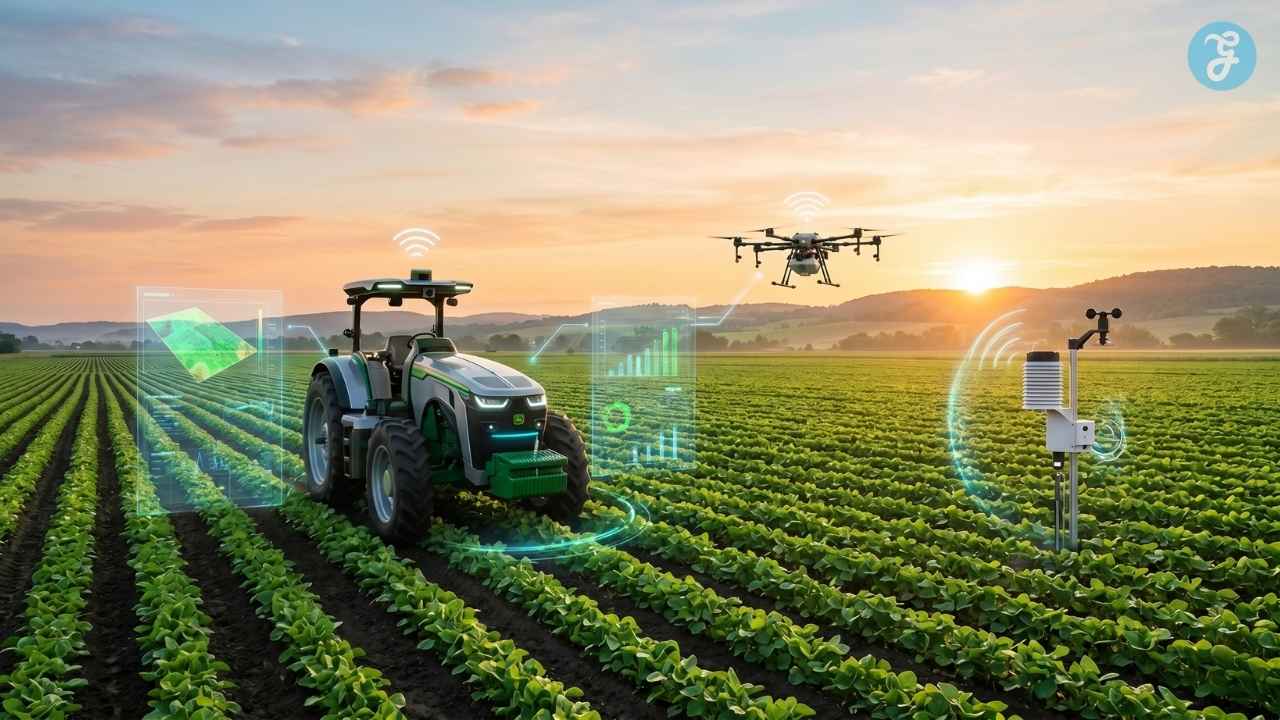
Precision Agriculture Platforms represent the most significant technological leap in modern farming since the invention of the mechanized tractor. As the agricultural sector navigates the complex realities of 2026, the global conversation has shifted entirely away from basic yield monitors and simple GPS autosteering. Today, American farmers are managing their operations down to the square inch, utilizing a sophisticated blend of edge computing, autonomous robotics, and highly predictive agronomic artificial intelligence.
This digital infrastructure is no longer considered a luxury for mega-farms; it has become a fundamental operational requirement for survival against rising input costs and volatile commodity markets. The transition toward a fully connected, data-driven farm requires a massive shift in how agricultural businesses approach technology. Hardware is now merely the delivery mechanism for software.
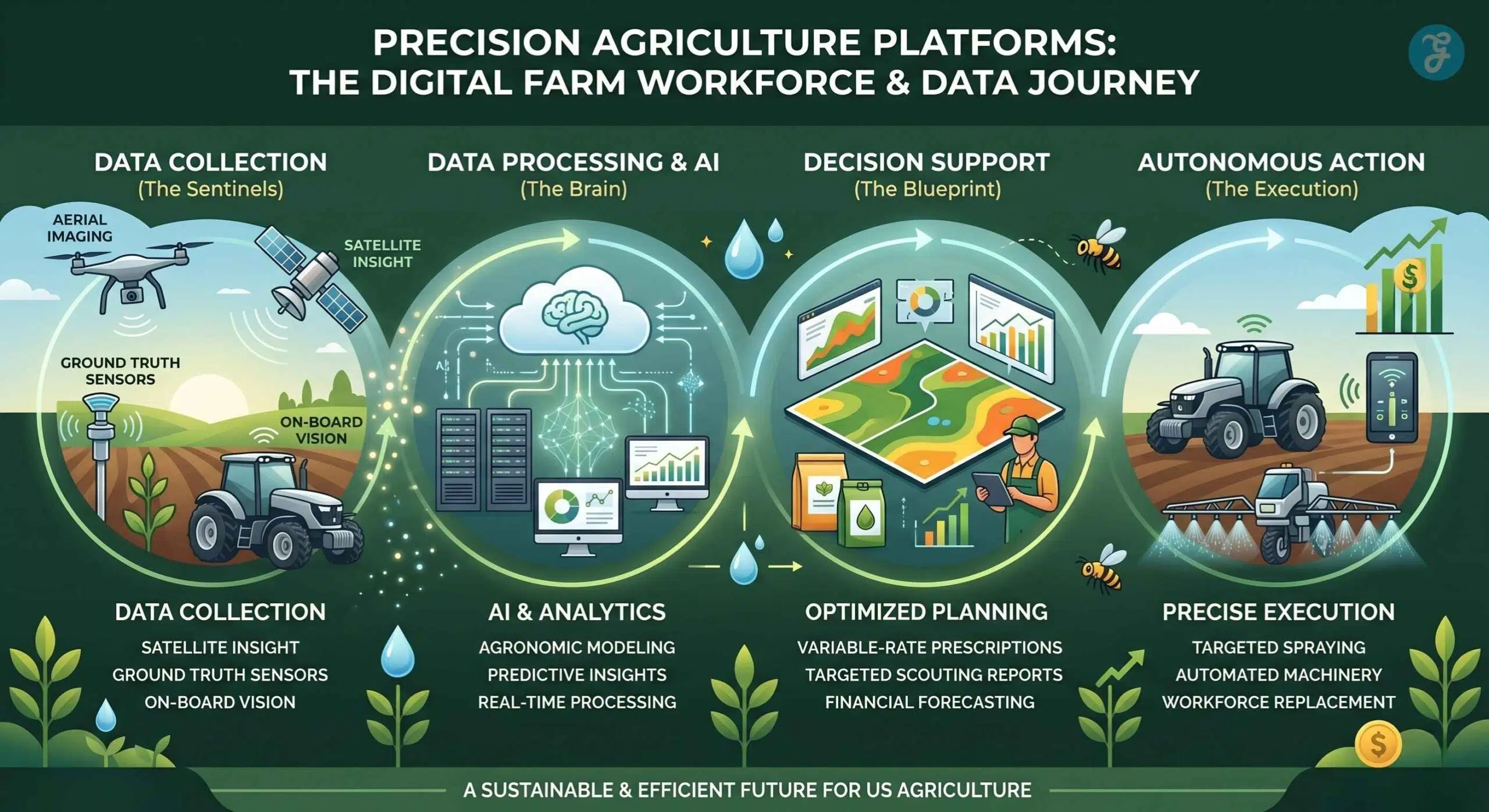
Tractors, sprayers, and combines have evolved into roving sensor hubs that collect gigabytes of localized data every time they enter a field. To make sense of this overwhelming flow of information, farmers rely on specialized digital ecosystems that translate raw numbers into actionable agronomic decisions.
The platforms dominating the North American market are those that can successfully merge mechanical engineering with advanced machine learning, offering tools that directly reduce chemical usage, optimize seed placement, and secure financial profitability.
Leading US Innovators in Agricultural Data and Automation
Navigating the crowded ag-tech marketplace requires an understanding of how different systems integrate into existing farm workflows. The following ten platforms represent the pinnacle of United States agricultural innovation. These companies are actively solving the most complex challenges in modern farming, ranging from hyper-local weather tracking to autonomous, sharpshooter weed control.
1. John Deere Operations Center
John Deere has successfully transcended its legacy as a traditional iron manufacturer, evolving into the most dominant and sophisticated data aggregator in the global agricultural sector. Their ecosystem is unmatched in its physical scale and computational power.
Target Operator: Large-scale row crop producers who prefer a unified, single-brand equipment ecosystem.
Technological Engine: The platform is powered by the integration of their autonomous 8R tractor fleets and the “See and Spray Ultimate” camera systems, which utilize advanced boom-level artificial intelligence.
Operational Impact: The system processes millions of high-definition images per second directly on the sprayer boom. Instead of broadcasting herbicides across an entire field, the AI identifies specific weed species and triggers individual nozzles to spray only the weed, drastically reducing chemical costs and environmental runoff.
Deployment Hurdle: Unlocking the maximum potential of the Operations Center requires a massive capital investment in proprietary John Deere hardware, locking the farmer into a highly specific green-iron ecosystem.
2. Climate FieldView
Operating as the digital central nervous system for tens of millions of acres across North America, Climate FieldView sets the industry standard for seamless agronomic data aggregation and high-level visualization.
Target Operator: Independent farmers and agronomists looking for a brand-agnostic data aggregator to manage mixed fleets.
Technological Engine: The core of the platform relies on a hardware-agnostic data drive, a “puck” that plugs directly into the CAN bus diagnostic port of almost any modern tractor or combine to capture live field data.
Operational Impact: FieldView utilizes advanced predictive analytics to bridge the gap between seed genetics and soil health. It allows farmers to instantly generate highly precise variable-rate seed scripts, adjusting the exact population of seeds planted in different topographic zones of a single field based on historical yield data.
Deployment Hurdle: Because the platform is owned by the massive pharmaceutical and chemical conglomerate Bayer, independent growers occasionally express hesitancy regarding long-term data privacy and input-agnostic objectivity.
3. Farmers Business Network (FBN)
FBN completely disrupted the traditional, localized agricultural retail model by democratizing farm data and creating a powerful, nationwide network effect among American producers.
Target Operator: Forward-thinking growers seeking total price transparency for chemical inputs and crowdsourced agronomic intelligence.
Technological Engine: FBN operates on a massive crowdsourced data engine, bolstered by an advanced AI agronomy advisor named “Norm,” which processes natural language queries regarding crop science and market trends.
Operational Impact: By pooling anonymized yield, seed performance, and chemical pricing data from thousands of farms, FBN broke the localized monopolies of rural cooperatives. The platform provides independent farmers with exact, data-backed hybrid recommendations tailored strictly to their hyper-local soil types, removing the guesswork from annual seed purchasing.
Deployment Hurdle: The overarching value of the entire FBN ecosystem relies heavily on the continued, active participation and honest data sharing of its vast member network to keep the predictive models accurate.
4. Trimble Agriculture
Trimble provides the critical, underlying digital infrastructure that prevents frustrating data silos for farmers who operate diverse, multi-brand fleets of agricultural machinery.
Target Operator: Diverse farming operations running multiple brands of tractors, combines, and specialized harvesting equipment.
Technological Engine: Trimble is the undisputed global leader in precision hardware integration, utilizing highly advanced GNSS (Global Navigation Satellite System) correction services like CenterPoint RTX and cloud-based ISOBUS software.
Operational Impact: Their in-cab displays and automated steering systems allow equipment from entirely different manufacturers to communicate flawlessly. This ensures absolute data continuity, meaning a farmer can map a field with a Case IH tractor in the spring and harvest it seamlessly with a New Holland combine in the fall without losing any localized data.
Deployment Hurdle: Setting up custom software integrations and calibrating hydraulic steering valves across older, legacy equipment often requires a steep learning curve and highly specialized, expensive dealer support.
5. Taranis
Taranis has fundamentally altered how crop scouting is executed by replacing manual field walking with hyper-fast aerial intelligence and advanced deep learning models.
Target Operator: Agronomy firms, crop consultants, and large-scale farmers who require exact, leaf-level threat detection across thousands of acres.
Technological Engine: The platform ingests incredibly high-resolution imagery captured by specialized drone fleets and low-orbit satellites, running the visual data through a proprietary crop-threat AI engine.
Operational Impact: Taranis captures images of a field at high speeds and can automatically identify specific weed species, calculate exact insect defoliation percentages, and detect early-stage nutrient deficiencies long before they are visible to the human eye from the edge of the field.
Deployment Hurdle: The service is heavily reliant on timely drone flights, meaning the data collection process can be severely hampered by extended periods of severe weather, rain, or high wind conditions.
6. Arable
Arable brings the power of a modern agricultural laboratory directly into the crop canopy, capturing the incredibly nuanced micro-climate data that high-altitude satellites routinely miss.
Target Operator: Specialty crop growers, premium vineyards, and researchers requiring hyper-local environmental and plant-health monitoring.
Technological Engine: The Arable Mark system is a sophisticated, unified in-field sensor suite that continuously measures weather metrics, plant growth stages, and soil moisture simultaneously from a single installation point.
Operational Impact: The hardware uses advanced acoustic sensors to measure the exact droplet size and volume of rainfall, while utilizing multi-band spectrometers to measure plant chlorophyll levels. This continuous data stream predicts highly specific localized threats, such as incoming frost events or the perfect humidity conditions for devastating fungal diseases.
Deployment Hurdle: Covering large, geographically diverse acreages requires the purchase and maintenance of multiple sensor units to build a truly accurate topographic map of the entire micro-climate.
7. Bushel
Bushel digitizes the final, and arguably most critical, step of the farming process by modernizing the agricultural supply chain and securing the financial settlements of the harvest.
Target Operator: Tech-forward farm managers, commercial grain elevators, and major agribusinesses looking to streamline the physical grain trade.
Technological Engine: A comprehensive fintech and supply-chain software platform that connects the farmer’s smartphone directly into the accounting software of grain buyers.
Operational Impact: Bushel has effectively eliminated the need for easily lost paper scale tickets and endless manual phone calls. Farmers can instantly view their digital scale tickets as a truck unloads, monitor real-time cash bids at local elevators, and digitally execute binding grain contracts based on live commodity market data.
Deployment Hurdle: For the farmer to realize any value from the app, their local, physical grain elevators and regional ethanol plants must also be paying subscribers integrated into the broader Bushel ecosystem.
8. Verdant Robotics
Verdant Robotics is proving to the industry that massive chemical reduction is not only environmentally responsible but highly profitable when driven by spatial artificial intelligence.
Target Operator: Specialty crop growers (such as apples, carrots, and leafy greens) who face strict chemical application regulations and incredibly high input costs.
Technological Engine: The company deploys multi-action autonomous rovers equipped with rapid-fire robotic nozzles, millimeter-accurate spatial AI, and heavy-duty localized processing units.
Operational Impact: As the rover autonomously navigates the field, its cameras index every single plant. It calculates the exact size and health of the crop in milliseconds, applying a micro-dose of fertilizer directly to the base of the plant while simultaneously shooting a highly targeted, millimeter-accurate dose of herbicide onto an adjacent weed.
Deployment Hurdle: The advanced robotic rovers currently operate at much slower field speeds compared to traditional, wide-boom broadcast spraying equipment, meaning they are not yet viable for massive, thousand-acre commodity crops.
9. Monarch Tractor
Monarch is aggressively solving the severe agricultural labor shortage in the United States while simultaneously bringing deep-tech data collection to smaller, specialized farming operations.
Target Operator: Vineyards, fruit orchards, dairy farms, and localized organic operations looking to electrify their fleets and automate routine maintenance tasks.
Technological Engine: The flagship MK-V is a fully electric, driver-optional smart tractor powered entirely by its proprietary WingspanAI data aggregation and fleet management platform.
Operational Impact: While a farmer deploys the MK-V to autonomously perform mundane, repetitive tasks like inter-row mowing or canopy spraying, the tractor utilizes its 360-degree camera array to collect continuous visual data. It acts as a roving, emission-free sensor hub that maps crop health and operational efficiency without burning a drop of diesel fuel.
Deployment Hurdle: The current limitations of battery density and the severe lack of high-voltage charging infrastructure in rural American fields limit the tractor’s application for heavy-draft, 24-hour broadacre tillage operations.
10. Sentera
Sentera provides the critical software link that bridges the gap between consumer-grade drone hardware and professional, actionable agronomic intelligence.
Target Operator: Independent agronomic advisors, commercial crop consultants, and tech-savvy farmers utilizing their own aerial drone fleets.
Technological Engine: The company centers around the FieldAgent platform, a cloud-based software suite that utilizes advanced computer vision and machine learning algorithms to stitch and analyze raw aerial imagery.
Operational Impact: Sentera excels at highly specific, immediate analytical tasks. For example, it can scan an entire newly emerged cornfield and generate an exact stand count, telling the farmer immediately how many plants successfully grew per acre. This allows for rapid, data-backed replanting decisions if the imagery reveals large, unprofitable planting gaps.
Deployment Hurdle: The software requires incredibly high-quality, perfectly timed drone imagery, making the farmer entirely dependent on purchasing capable drone hardware and obtaining proper FAA piloting licenses.
The Economics of Digital Agronomy
Adopting precision agriculture platforms fundamentally changes the financial structure of a farming operation. Historically, technology upgrades in agriculture were viewed entirely through the lens of Capital Expenditures (CapEx), buying a larger tractor or a wider planter to cover more acres in less time.
The data-driven farm revolution, however, relies heavily on Operational Expenditures (OpEx) through continuous Software-as-a-Service (SaaS) subscriptions and per-acre digital processing fees.
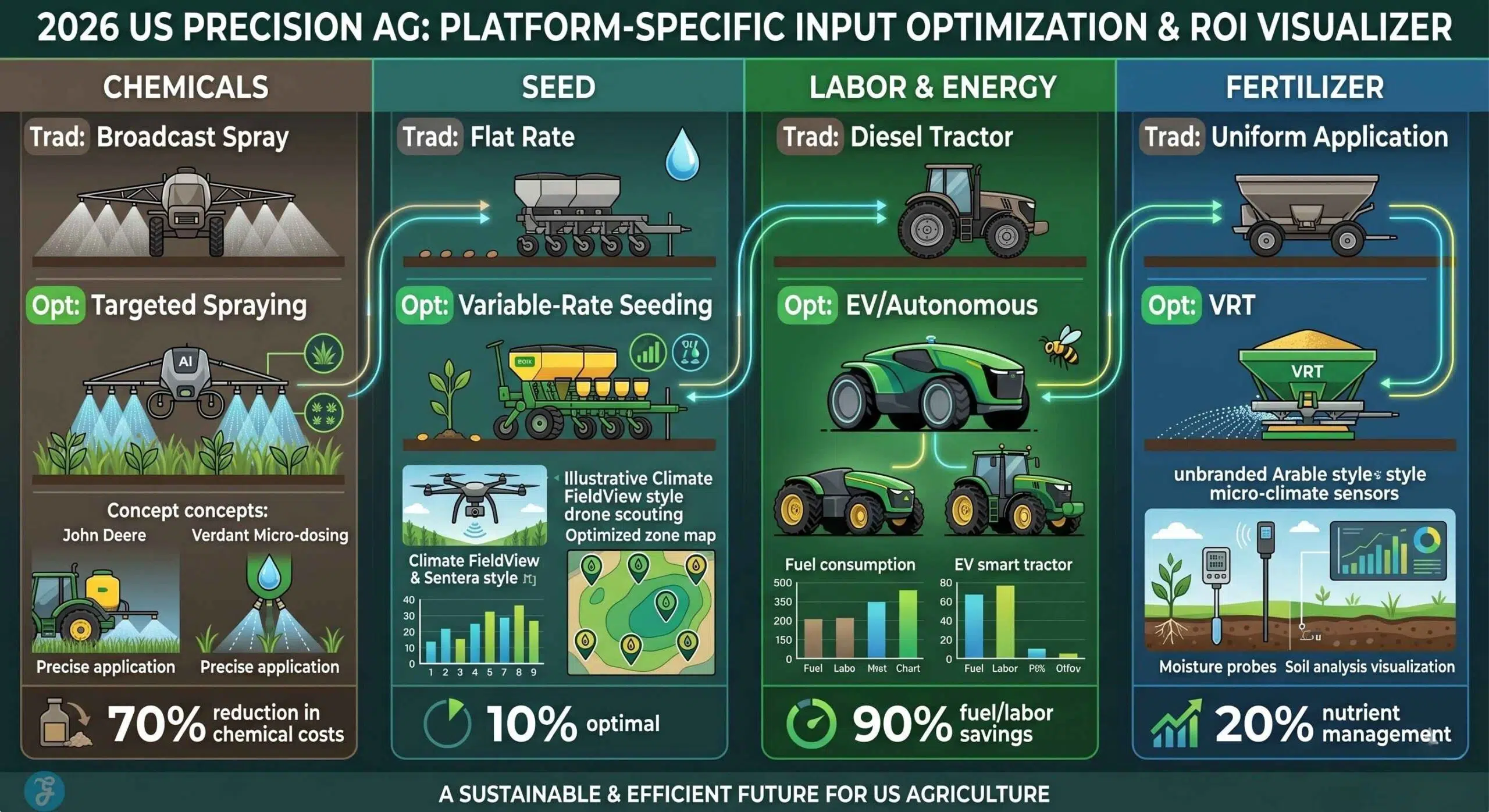
For farmers, the decision to invest in these platforms relies on rigorous Return on Investment (ROI) calculations. The value proposition is no longer about simply driving in a straight line; it is about input optimization. When a platform like John Deere’s See and Spray or Verdant Robotics can reduce herbicide usage by 60 to 80 percent, the savings on bulk chemicals immediately offset the cost of the technology.
Similarly, utilizing Climate FieldView to generate variable-rate seeding scripts ensures that expensive seed genetics are only planted heavily in the most fertile zones of a field, maximizing yield potential while eliminating wasted seed on barren hilltops. By transitioning from a flat-rate broadcast mentality to a highly targeted, data-backed application strategy, farms can insulate their profit margins against the extreme volatility of global fertilizer and chemical markets.
Overcoming Rural Connectivity Challenges
The most significant bottleneck facing the adoption of precision agriculture in the United States is the severe lack of reliable broadband connectivity in rural farming communities. Cloud-based agronomy platforms are practically useless if a tractor cannot upload its localized data or download a variable-rate prescription map because it is operating in a cellular dead zone.
To solve this critical infrastructure gap, the industry is pivoting rapidly toward “edge computing.” Rather than sending raw, heavy image files to a distant cloud server for processing, companies are installing military-grade graphics processing units (GPUs) directly onto the agricultural machinery.
This allows the tractor or the sprayer boom to run advanced AI models, analyze visual data, and execute a spraying command in milliseconds, entirely offline. Furthermore, 2026 has seen the mass integration of Low Earth Orbit (LEO) satellite internet systems, specifically Starlink, directly into the cabs of modern tractors.
By equipping machinery with durable, flat-panel satellite receivers, farmers can now maintain high-speed, continuous connections to their central data platforms, entirely bypassing the limitations of terrestrial cellular towers and ensuring their autonomous fleets never lose communication.
At a Glance: 10 US Precision Agriculture Platforms and Their Core Functions
To provide a clearer perspective on how these different systems fit into a comprehensive digital farm strategy, the following table summarizes 10 US Precision Agriculture Platforms’ core functions and primary technological deliverables.
| Platform Name | Primary Market Focus | Core Technology / Hardware | Key Operational Benefit |
| John Deere | Large Row Crop | Autonomous 8R / See & Spray | Weed-specific chemical reduction |
| Climate FieldView | Broadacre Aggregation | CAN bus Data Puck | Variable-rate seed scripting |
| FBN | Ag-Retail / Analytics | Crowdsourced AI (Norm) | Input price transparency |
| Trimble | Mixed Fleet Integration | GNSS / ISOBUS Displays | Cross-brand data continuity |
| Taranis | Aerial Threat Detection | High-Res Drone Imagery | Early-stage disease/pest ID |
| Arable | Canopy Micro-Climate | Unified Sensor Suite | Acoustic rain & frost prediction |
| Bushel | Grain Supply Chain | Fintech / API Integrations | Digital scale tickets & contracts |
| Verdant Robotics | Specialty Crop | Autonomous Rovers | Millimeter-accurate spraying |
| Monarch Tractor | Orchards & Vineyards | EV Smart Tractor (MK-V) | Driver-optional labor replacement |
| Sentera | Agronomic Analysis | FieldAgent Vision Software | Automated crop stand counts |
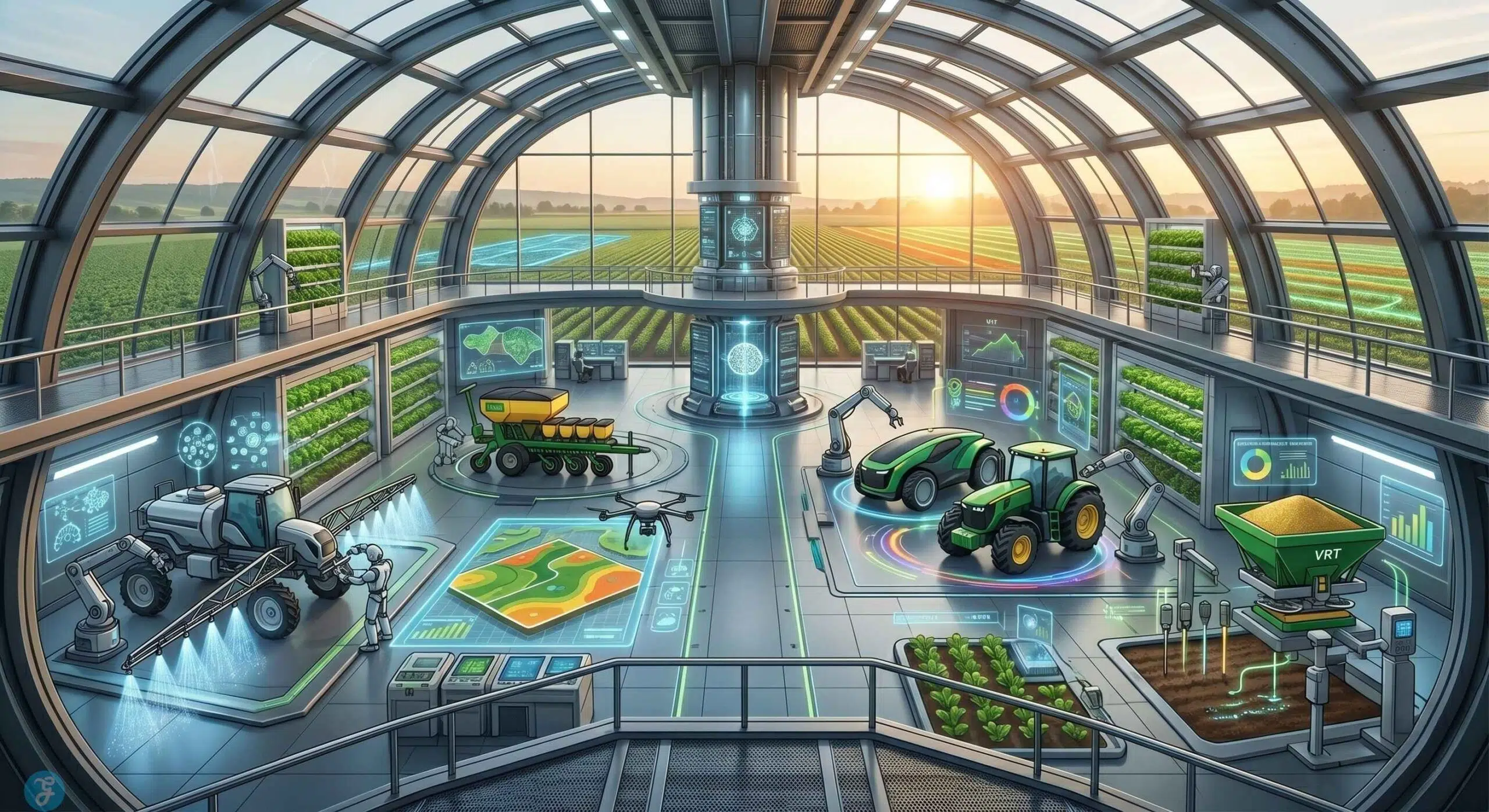
This structural breakdown highlights the reality that modern precision agriculture is not a single tool, but a highly interconnected web of sensors, software, and autonomous iron working in unison.
Finally: Cultivating a Profitable Tech-Driven Harvest
The integration of artificial intelligence, edge computing, and autonomous hardware has irrevocably altered the landscape of American agriculture. The ten platforms highlighted in this analysis are doing far more than just collecting data; they are actively translating billions of environmental and mechanical data points into actionable profitability.
As global populations continue to rise and environmental regulations regarding chemical runoff and water usage become increasingly strict, the margin for error in farming will only continue to shrink.
Embracing these precision agriculture platforms is no longer a futuristic concept reserved for tech enthusiasts; it is the baseline requirement for maintaining a sustainable and economically viable farm.
By utilizing technology to treat every square inch of a field as a unique, micro-managed ecosystem, the agricultural sector is proving that it can drastically reduce its environmental footprint while simultaneously achieving unprecedented levels of harvest efficiency and financial stability.
Frequently Asked Questions (FAQs) About Precision Agriculture Platforms
1. What is the difference between precision agriculture and digital agronomy?
Precision agriculture generally refers to the hardware and operational practices used to make farming more accurate, such as GPS autosteering, automated section control on planters, and variable-rate application machinery. Digital agronomy is the data science that drives those machines. It involves using software, artificial intelligence, and historical data to create the specific prescriptions, maps, and predictive models that tell the precision hardware exactly what to do in the field.
2. How does edge computing work on a modern tractor?
Edge computing means that the data processing happens physically “at the edge” of the network, which in this case is directly on the tractor itself. Instead of a tractor taking a picture of a weed, uploading it to the cloud via a cellular network, waiting for a server to identify it, and receiving a command to spray, the tractor is equipped with an onboard supercomputer. This onboard computer runs the AI model locally, identifying the weed and triggering the spray nozzle in milliseconds without needing an internet connection.
3. Do independent farmers own the data generated by their equipment?
Data ownership is one of the hottest debated topics in modern agriculture. Generally, under the American Farm Bureau Federation’s Ag Data Transparent guidelines, the farmer owns the raw data generated by their fields and machinery. However, when a farmer subscribes to a software platform, they usually grant the company a license to aggregate, anonymize, and utilize that data to train the company’s broader machine learning models. Farmers must carefully read End User License Agreements (EULAs) to understand exactly how their agronomic data is being monetized.
4. How does variable rate technology reduce fertilizer usage?
Traditional farming applies a flat, average rate of fertilizer across an entire field, regardless of the soil’s actual potential. Variable Rate Technology (VRT) uses digital soil maps and historical yield data to understand that different zones of a field have different nutrient requirements. The VRT software sends a prescription to the tractor, which automatically opens and closes the fertilizer valves as it drives across different zones, applying heavy amounts only where the soil can support a massive yield, and reducing application in poor soil areas, thereby eliminating waste.
5. What is the role of ISOBUS in precision farming hardware?
ISOBUS (ISO 11783) is the international communication protocol standard for the agricultural industry. Before ISOBUS, a farmer pulling a John Deere planter with a Case IH tractor would need two completely different computer monitors in the cab because the machines spoke different digital languages. ISOBUS acts as a universal translator, allowing implements and tractors from entirely different, competing manufacturers to communicate seamlessly on a single, standardized in-cab display, preventing expensive vendor lock-in for the farmer.