

You stare at your screen, ready to build cool web apps, but three big names pop up: React vs Vue vs Angular. Which one do you pick? It’s like choosing ice cream flavors when you just want a tasty treat without the brain freeze.
As a beginner in front-end development, you might feel stuck, wondering about learning curves, job chances, and how each fits your projects. Hey, I’ve been there, scratching my head over JavaScript frameworks, thinking, “Why can’t this be simpler?”.
React comes from Facebook and acts as a library for crafting user interfaces with reusable components and virtual DOM magic. Vue, made by Evan You, shines as a lightweight framework that’s easy for newbies.
Angular, backed by Google, offers a full setup with tools like dependency injection and two-way data binding. This post breaks it all down, comparing key features, performance, community support, and more to guide your choice.
Stick around. You’ll find your perfect match.
What Are React, Vue and Angular?
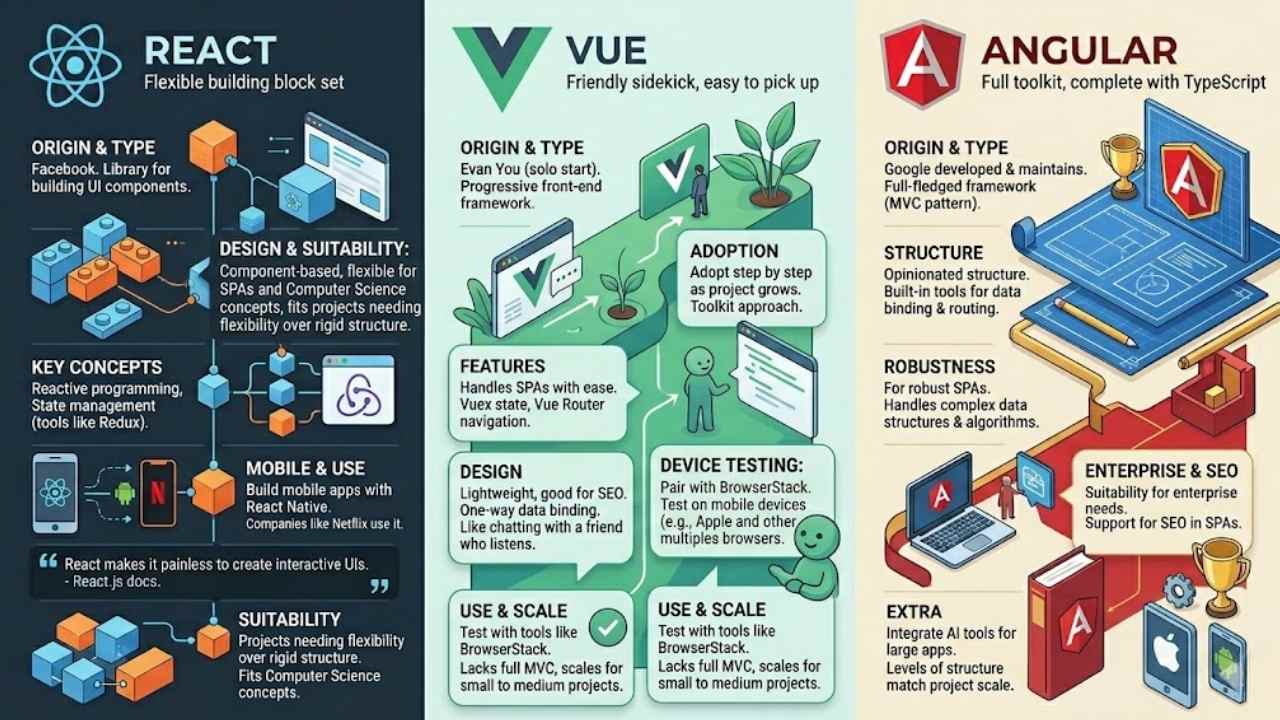
Hey, if you’re dipping your toes into front-end development, you might wonder about these big players that power modern web apps. React acts like a flexible building block set, letting you craft user interfaces with JavaScript, while Vue feels like a friendly sidekick that’s easy to pick up for quick projects, and Angular steps in as the full toolkit, complete with TypeScript support for those enterprise-level single-page applications.
Overview of React
Facebook created React as a library for building UI components in web development. Developers love its component-based architecture, which lets you reuse code blocks like Lego pieces.
This setup focuses on front-end applications, making it flexible for single page applications, or SPAs. React.js shines in reactive programming and state management, often with tools like Redux to handle data flow.
You can even build mobile applications using React Native, a big plus for software engineers eyeing cross-platform work. Companies like Netflix use it for smooth user interfaces, proving its power in real-world projects.
React makes it painless to create interactive UIs. – From the official React.js documentation.
React stands out as a UI library, not a full framework, giving you room to pick extra tools and libraries for tasks like optimization techniques or SEO in web applications. Its MIT license encourages open use, and community resources on platforms like Upwork help beginners explore design patterns.
If you study computer science, React fits well with concepts like data structures and algorithms, boosting your skills in frontend frameworks. Many turn to courses by experts like Maximilian Schwarzmüller to master it quickly.
This approach suits projects needing flexibility over rigid structure.
Overview of Vue
Vue.js stands out as a progressive front-end framework that you can adopt step by step. Evan You created it all by himself, and that solo start gives it a fresh, flexible vibe. Think of it like a toolkit you build on as your project grows, not a heavy load from the get-go.
Developers love how it handles single page applications, or SPAs, with ease. You get tools like Vuex for state management and Vue Router for smooth navigation. Plus, it plays nice with SEO, making your sites more visible on search engines.
This framework shines in its lightweight design, perfect for beginners dipping into front-end frameworks. It offers one-way data binding, which keeps things simple and predictable.
Imagine chatting with a friend who listens well but doesn’t interrupt – that’s Vue in action. You can pair it with developer tools like BrowserStack for testing across browsers. While it lacks the full MVC architecture of some rivals, Vue fits various programming languages and scales for small to medium projects.
Choices like this depend on what your app needs, balancing structure with freedom.
Overview of Angular
Angular stands out as a full-fledged framework that Google develops and maintains. Teams build robust single page applications, or SPAs, with it. This tool follows an MVC pattern, which means Model-View-Controller setup for a complete front-end solution.
You get opinionated structure right out of the box, packed with built-in tools for tasks like data binding and routing. Picture it as a sturdy toolbox, ready for big projects without needing extra pieces.
Developers love how it handles complex data structures and algorithms smoothly.
People pick Angular over others in framework comparisons because of its comprehensive features. It offers strong support for SEO in SPAs, even if that takes a bit of setup. Plus, you can integrate AI tools to boost efficiency in large apps.
The framework suits enterprise needs, with levels of structure that match your project’s scale. Choices like this depend on what you aim to build, folks.
Key Features and Strengths
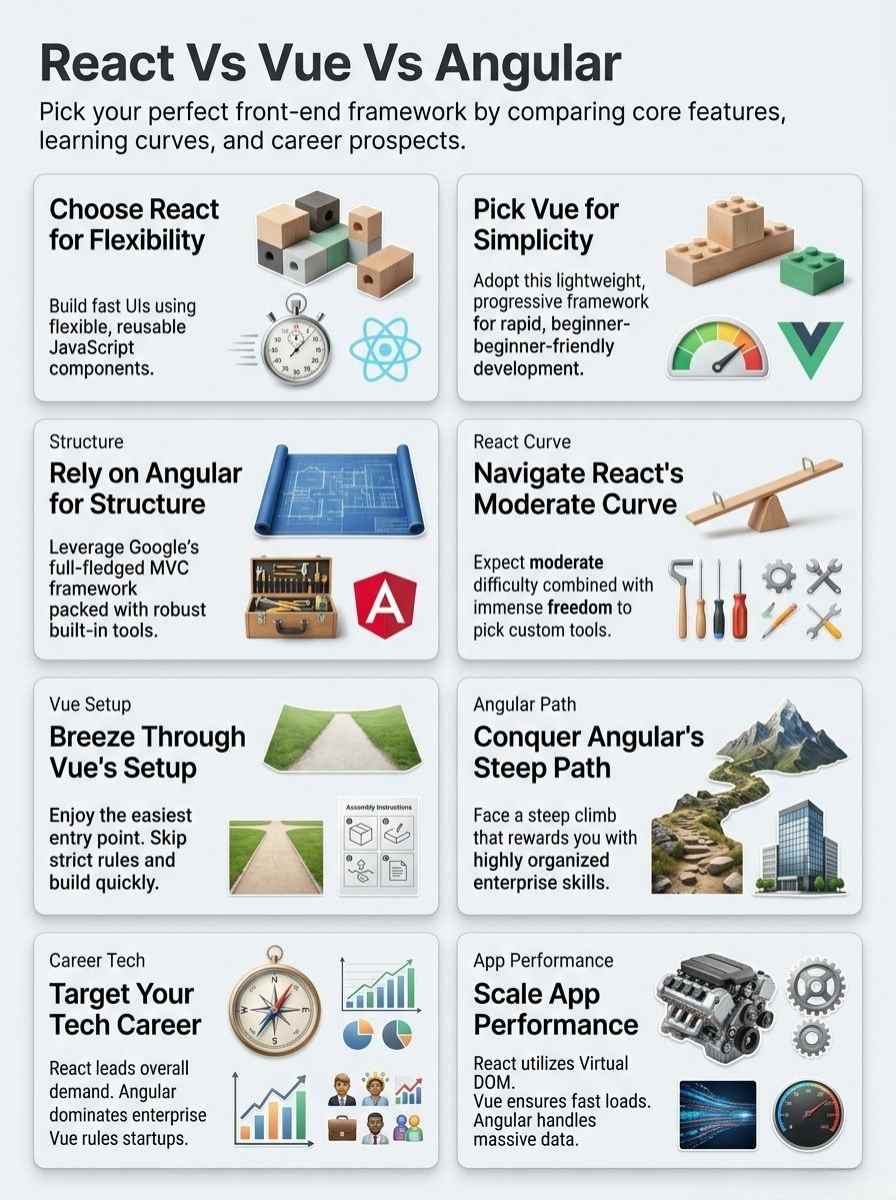
React shines with its component setup, letting you build single page applications that feel fast and flexible, much like piecing together a puzzle where every part fits just right.
Vue keeps things light and easy for starters, boosting SEO in your projects, while Angular packs a full toolkit for big apps, handling data flows like a pro.
React: Component-based library with flexibility
Facebook built React as a library that shines in creating user interface parts. Developers love it for building single page applications, or SPAs, that feel smooth and responsive. This tool focuses on reusable pieces, like buttons or forms, that you snap together like Lego blocks.
Picture crafting a dashboard where each section updates on its own, no full page reloads needed. React gives you freedom to pick extra tools, say for handling data structures and algorithms in complex apps.
Folks often pair it with libraries for routing or state management, keeping things light and flexible.
React is a library rather than a complete framework, focusing primarily on UI component development. – From key insights on front-end tools.
You gain tons of wiggle room with React’s setup, ideal for projects needing custom tweaks. Teams at big companies use it to scale up apps without heavy rules holding them back. Imagine tweaking SEO for better search engine optimization, React plays nice with server-side rendering tricks.
Evan You, who made Vue, might nod at React’s influence, but React stands out for its component-based approach. Google backs Angular as a full framework, yet React’s library style lets you mix and match, suiting varied needs.
All three options thrive in front-end work, with choices hinging on what your project demands, like flexibility over built-in structure.
Vue: Lightweight and beginner-friendly
Vue shines as a lightweight choice for front-end work. Evan You created it alone, and that solo start keeps things simple. Developers love how it acts as a progressive framework. You can add it step by step to your projects, without a full overhaul.
This setup fits well for building single page applications, or SPAs, where speed matters. Imagine dipping your toes in, rather than jumping into the deep end; Vue lets you grow at your own pace.
Beginners flock to Vue for its easy entry. It skips heavy rules and focuses on quick wins. Picture crafting user interfaces like snapping puzzle pieces together, no extra weight. This makes it great for small to medium projects, even when thinking about SEO tweaks.
Vue handles data structures well too, without the steep climb of something like AngularJS. Folks often say it’s like a friendly chat with code, not a tough lecture.
Angular: Full-fledged framework with built-in tools
Angular stands out as a full-fledged framework developed and maintained by Google. It packs opinionated structure with built-in tools that handle everything from routing to forms. Developers love how it follows the MVC pattern, offering a complete solution for front-end work.
This setup shines in building single page applications (SPAs), where you get robust features right out of the box. Imagine tackling a big project; Angular’s comprehensive kit means less time hunting for extras.
Picture enterprise teams choosing Angular over Vue and React for its all-in-one power. It delivers different levels of structure and flexibility based on project needs. All three options excel in front-end development, but Angular’s key features, architecture, and performance make it ideal for complex tasks like optimizing SEO or managing data structures and algorithms.
You gain tools that scale apps without extra hassle, fitting specific requirements perfectly.
Learning Curve Comparison
When you jump into these JavaScript frameworks, React gives you a moderate climb with tools like JSX and hooks that let you tinker freely, kinda like learning to cook by experimenting in your kitchen, while Vue feels like a gentle stroll for starters with its simple directives and single-file components that click fast, and Angular throws a tougher hill at you with its TypeScript modules and structured setup that pays off big once you get the hang of it—ready to see which one matches your speed? Keep scrolling!
React: Moderate learning curve with room for exploration
React shines with a moderate learning curve that lets you dive right into building cool stuff. Facebook created this library to focus on UI components, and it keeps things flexible.
You start with basics like JSX and hooks, then explore more as you go. Picture it like learning to ride a bike, you wobble at first but soon zoom around freely. This setup gives room for experimentation, especially when you tackle data structures & algorithms in your projects.
The beauty lies in React’s nature as a library, not a full framework, so you pick tools that fit your needs. Beginners often grasp the core quickly, then branch out to optimize for things like SEO in dynamic apps.
Evan You might have made Vue simpler, but React rewards curiosity with endless ways to innovate. Google backs Angular’s structure, yet React invites you to mix in libraries for scalability, turning learning into an adventure.
Vue: Easiest to learn for beginners
Vue shines as the easiest framework for beginners to pick up. Evan You created it alone, and that solo start keeps things simple. You can adopt Vue step by step, like adding pieces to a puzzle, without a big overhaul.
This progressive approach fits right into small projects or even tweaks on existing sites. Imagine dipping your toes in web development; Vue feels like a gentle stream, not a raging river.
It focuses on core ideas, so you build skills fast and see results right away.
New coders love how Vue skips heavy rules. You learn by doing, with clear docs that guide you along. Think of it as a friendly chat with a mentor, full of examples that click. For folks eyeing front-end jobs, starting here boosts confidence quick.
Plus, its lightweight setup helps with tasks like search engine optimization, making sites load smooth and rank well. You gain flexibility to grow, all while keeping the fun in coding.
Angular: Steep but structured learning path
Angular hits you with a steep climb at first, folks. Google built and maintains this full-fledged framework, packing it with opinionated structure and built-in tools that guide your every step.
Think of it like learning to drive a stick shift truck loaded with extras; you master the gears through a clear path, but it demands focus. As an MVC setup, it delivers a complete front-end solution, making big projects feel organized.
Developers often pick it over React or Vue for those comprehensive features, especially when project needs crave that solid structure and flexibility balance.
Imagine entering Angular’s environment, where the learning curve feels like scaling a well-marked trail. It offers a structured journey, yes, with tools that handle everything from data binding to routing right out of the box.
You build strong apps that even boost search engine optimization through clean code practices. Teams in enterprise spots love how it streamlines complex tasks, turning potential headaches into smooth rides.
Your choice boils down to what the project demands, but Angular’s setup rewards patience with powerhouse skills.
Performance and Scalability
React uses its virtual DOM to boost speed, making apps run smooth even as they grow big. Vue shines in quick loads for midsize sites, while Angular tackles huge projects with tools like lazy loading to keep things scalable.
How React handles performance and scalability
Facebook created React as a library for building UI components. This setup boosts performance through smart updates. Developers reuse parts, like puzzle pieces, to keep apps fast. Imagine stacking blocks; React only swaps the needed ones.
Scalability shines in big projects. Teams add features without full rewrites. Flexibility lets you pick tools for growth. Search engine optimization fits in too; React supports server-side rendering for better visibility.
UI focus makes React efficient. It handles large apps by breaking them into small bits. Code stays clean and quick. For scalability, integrate with other libraries. This adapts to project needs.
Developers love the control. Picture a toolbox; you grab what’s right. No bloat slows things down. Performance stays strong as apps expand.
Vue’s efficiency in small to medium-scale projects
Vue shines in small to medium-scale projects, thanks to its lightweight design. Evan You created this progressive framework, and you can adopt it step by step. That means you start simple, then add features as needed.
Picture a nimble bike versus a heavy truck; Vue zips through tasks without extra weight. Developers love how it handles updates fast, keeping apps responsive. For instance, a blog site with basic interactions runs smooth on Vue, no bloat in sight.
This efficiency boosts your work in real ways, like quick loads that help with search engine optimization. Vue fits projects that grow over time, not massive ones from the start. You build components incrementally, which saves time and effort.
Think of it as planting a garden; you add plants as space allows, not all at once. Teams find it easy to maintain code, even as the app scales a bit. Vue’s approach keeps things flexible and fun for everyday coding.
Angular’s robustness for large-scale applications
Angular handles big projects with ease. Google built and maintains this full-fledged framework. It uses an MVC setup, which stands for Model-View-Controller. This gives a complete fix for front-end work.
Teams pick it for the structured path and built-in tools. Picture a massive app, like a busy online store. Angular packs in features that keep things smooth.
You get strong support for scaling up. The opinionated style guides your choices. It beats React and Vue in full setups for huge tasks. Firms love it for enterprise jobs. Think of it as a sturdy toolbox, ready for heavy lifting.
Plus, it helps with search engine optimization in large sites. Your project needs decide the fit, but Angular shines in complex spots.
Job Market and Career Opportunities
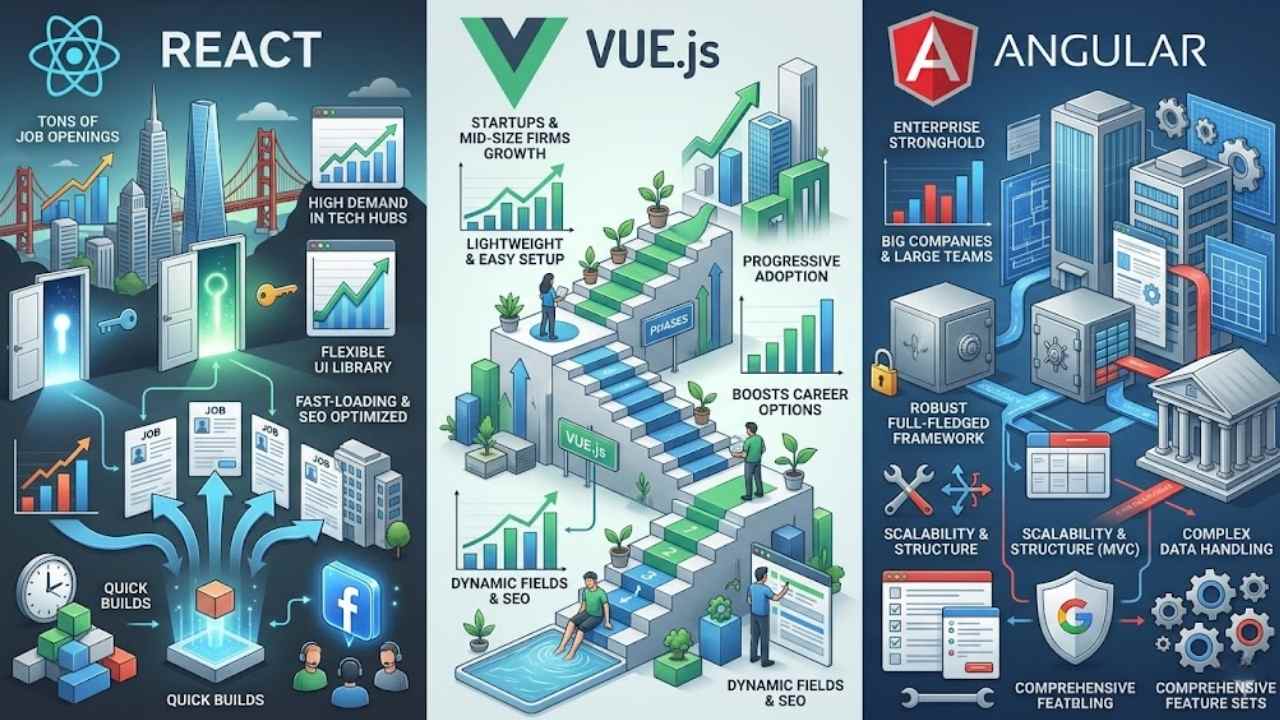
Wondering where the jobs hide in front-end development? React leads the pack with tons of openings for JavaScript coders, while Vue gains speed in startups, and Angular holds firm in big companies.
Demand for React developers
React powers many top apps, thanks to its start at Facebook as a library for building slick UI components. Companies love it for that flexibility in crafting user interfaces without a full framework tying them down.
Developers flock to jobs here because demand stays high in tech hubs like Silicon Valley. Imagine, you learn React and suddenly doors open at places optimizing sites for SEO with fast-loading pages.
It focuses on components, so teams scale projects easily.
Job listings for React skills outpace many others in front-end work. Firms seek pros who grasp its library approach over rigid setups. Evan You made Vue, and Google backs Angular, but React’s popularity draws steady gigs in startups and giants alike.
You pick it based on your project’s need for quick builds. That edge keeps the market buzzing for talent ready to engage with component-based designs.
Growth of Vue in the job market
Vue started small, created by Evan You as a progressive framework you can add bit by bit to projects. Jobs for Vue developers keep rising, especially in startups and mid-size companies that love its easy setup.
Imagine you pick up Vue for a quick app, and soon you’re in demand because firms seek that flexibility for front-end work. It fits various needs, from simple sites to complex ones, boosting your career options without the heavy structure of bigger tools.
Demand grows as more teams choose Vue for its lightweight feel, often over React or Angular for certain tasks. Evan You’s creation draws folks who want incremental adoption, like dipping toes in water before a full swim.
In the job scene, this means roles pop up in web dev, even touching SEO tasks since Vue handles search-friendly apps well. You get that edge, with communities sharing tips that land you gigs in dynamic fields.
Angular’s stronghold in enterprise environments
Big companies love Angular for good reasons. Google built and keeps this full-fledged framework, which acts like a solid toolbox for front-end work. It follows the MVC pattern, think of it as a clear blueprint that organizes your code neatly.
Teams in enterprise spots pick it because of those built-in tools, like routing and forms, that handle big projects without extra hassle. Imagine building a massive app, like a bank’s online system; Angular’s structure keeps everything running smooth and scalable.
You see, Angular shines in these large setups due to its opinionated style. It pushes a structured path, which cuts down on chaos in team environments. Developers appreciate how it packs comprehensive features right out of the box, making it ideal for complex needs.
For instance, if your project demands robust data handling or top-notch SEO integration, Angular steps up strong. Choices like this depend on what your work requires, but for enterprise muscle, it often wins out over lighter options like React or Vue.
Ecosystem and Community Support
React boasts a huge library of add-ons like Redux for state management and a buzzing crowd on sites such as GitHub and Stack Overflow, where folks swap tips like old friends at a coffee shop, while Vue draws in starters with its rising group of helpers sharing simple plugins like Vue Router through forums that feel welcoming and fun, and Angular shines with its own built-in kits like the CLI tool for quick setups backed by Google’s solid crew, so if you’re picking a side based on who’s got your back, stick around to see what clicks for you.
React’s vast ecosystem and resources
Facebook created React as a library that zeros in on building UI components. Developers love its vast ecosystem because it offers tons of tools and libraries to boost projects. You can pair it with Redux for state management, or use React Router for smooth navigation in apps.
This setup gives you flexibility, like picking your own adventure in a storybook. Communities on sites like Stack Overflow share tips that make learning fun and fast. Plus, with so many resources, you optimize your site for search engine optimization without breaking a sweat.
Evan You might have started Vue solo, but React draws from a huge pool of add-ons that Google-backed Angular can’t always match in sheer variety. Think of it as a toolbox crammed with gadgets for every job, from testing with Jest to styling with Material-UI.
Beginners find empathy in forums where pros swap stories about scaling apps. Google maintains Angular as a full framework, yet React’s community pumps out updates that keep things fresh.
You adapt it incrementally, much like adding spices to a recipe until it tastes just right.
Vue’s growing yet supportive community
Vue’s community thrives on passion and growth. Evan You kicked it off as a solo project, and now folks from all walks join in. They swap stories, like how one developer fixed a tough bug with group advice.
This crowd cheers for Vue’s progressive style, where you add bits as needed, no big leaps required. Imagine a cozy club that expands, always ready with a helping hand for your next app.
Support flows freely here, with forums buzzing and meetups popping up. Coders engage in talks on boosting SEO for Vue sites, sharing quick wins that rank pages higher. Empathy runs deep; if you hit a snag, someone relates and guides you through.
Humor sneaks in too, like jokes about “Vue-tiful” code that lightens the load. This setup fits small projects perfectly, drawing more fans each day.
Angular’s comprehensive official tools
Angular packs a punch with its official tools, straight from Google. Developers love how this full-fledged framework comes loaded with built-in features for front-end work. Think of it as a toolbox that handles everything, from data binding to routing, without extra hassle.
Angular follows the MVC pattern, which means Model-View-Controller setup keeps your code organized and efficient. You get structured paths for building apps, making large projects feel like a breeze.
Choose Angular when you need that complete solution, especially for enterprise-level tasks. Its opinionated style guides you, offering flexibility within clear rules. Folks often pick it over React or Vue for those comprehensive tools that boost scalability.
Plus, integrating seo practices becomes simple with Angular’s robust architecture. Your project requirements drive the decision, but this framework shines in delivering a full package for serious development.
Choosing the Right Framework for You
You face a big choice with React, Vue, and that other front-end tool from Google, each shining in different spots like React’s flexible components for quick builds, Vue’s easy start for new coders, and the full package for big apps.
Pick based on your project size, since small sites love Vue’s light touch, teams crave React’s vast add-ons, and enterprises rely on the structured setup for smooth scaling. This decision boosts your code speed, cuts bugs, and opens job doors in tech hubs everywhere.
Check out sites like Stack Overflow or official guides for more tips on these JavaScript gems. Jump in now, your perfect match awaits to spark your dev journey.
Final Words
We covered React’s flexible components, Vue’s easy start, and Angular’s full tools. Pick one that fits your needs; they all build great apps with simple steps. These frameworks boost your skills and open job doors in tech.
Check out official docs or free courses on sites like freeCodeCamp for more help. Jump in and code something today; you’ll see quick wins. I started with React years ago, and it sparked my love for web dev.
Frequently Asked Questions (FAQs) about React vs Vue vs Angular
1. What’s the big deal with React, Vue, and Angular anyway?
You’re building a web app, and React shines like a speedy sports car for its flexibility and huge community support. Vue feels like that easy-going friend who’s simple to pick up, while Angular is the structured powerhouse, perfect if you love a full toolkit right out of the box. Oh, and don’t forget, all three can boost your site’s SEO (search engine optimization) when you optimize components wisely.
2. Which framework is easiest for a newbie to learn?
If you’re just starting out, Vue is your best bet; it’s like riding a bike with training wheels, straightforward and fun. React comes next, offering quick wins once you grasp the basics.
3. How do these frameworks stack up for performance?
React often wins the race for speed in big apps, thanks to its virtual DOM magic. Angular packs a punch with built-in tools but can feel heavier; Vue strikes a nice balance, light and nimble, especially for smaller projects. Plus, smart use of any can enhance SEO (search engine optimization) by improving load times and crawlability.
4. Alright, which one should I learn first?
Dive into React if you aim for job opportunities; it’s everywhere, like the popular kid at school. But hey, if your goal is quick prototypes with solid SEO (search engine optimization) perks, Vue might steal your heart with its gentle learning curve.






















