Common Causes of Lower Back Pain
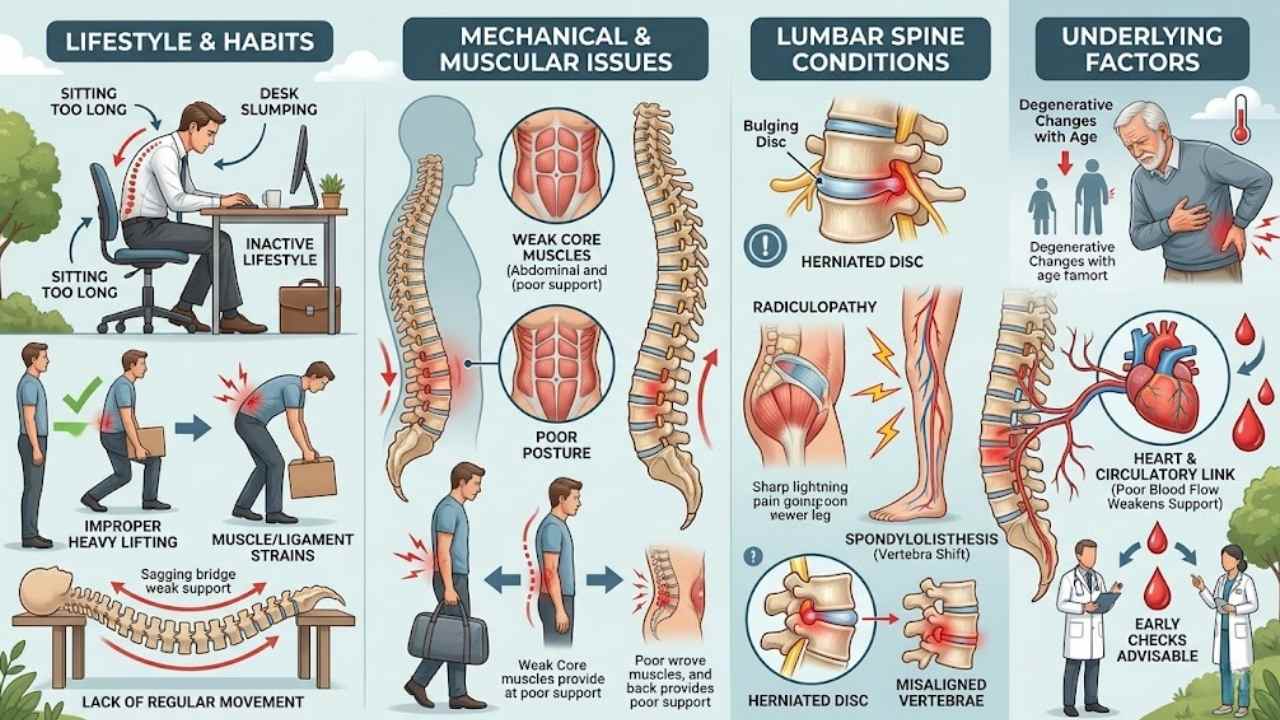
Lower back pain hits many folks hard, often from simple strains or bigger issues like herniated discs in the lumbar spine. Imagine this: you lift something heavy the wrong way, and bam, muscle pain flares up, turning a good day sour.
Radiculopathy can sneak in too, pinching nerves and sending sharp twinges down your legs, while spondylolisthesis shifts vertebrae out of place, adding to the misery. Folks with back problems know this all too well; it’s like your spine’s throwing a tantrum over poor posture or weak core muscles.
Orthopedics experts, such as those from the American Academy of Orthopaedic Surgeons, point out how everyday slips, like sitting too long at a desk, spark these troubles. Even heart and circulatory diseases tie in sometimes, as poor blood flow weakens back support.
Stretching and focused back and abdominal strengthening exercises are among the best ways to ease lower back pain. – Mayo Clinic Press
Aneurin Bevan University Health Board notes that conditions like these often stem from inactive lifestyles, making pain management a daily battle. Think of your lower back as a bridge; if the supports weaken from lack of movement, it sags under pressure.
Pharmacists and GPs see this often, advising early checks to avoid worsening. Entities like the Cedars-Sinai Connect app offer insights into adult health, linking back issues to factors such as age or heavy lifting.
Barry Shafer, a cardiac rehab specialist, points out that even heart matters can play a role in back discomfort.
Benefits of Exercise for Lower Back Pain Relief
Exercise fights lower back pain like a trusted friend, stepping in to ease your aches and keep them at bay. You gain relief through regular moves that target sore spots, and science backs this up with proof that aerobic exercise tackles chronic low back pain head-on.
Picture your spine getting stronger support from muscles you build up, much like adding bricks to a wobbly wall. Back exercises strengthen those key supporters around your spine, improve your posture, and cut down on pain levels over time.
Stretching and strengthening routines, such as therapeutic exercises like pelvic tilts or the cat camel, hit the back and its helper muscles directly. They prove one of the top ways to soothe that nagging discomfort.
Folks often see big changes with just 15 minutes a day of these back exercises, fitting easily into a healthy lifestyle. Certain moves, think lower back rotational stretch or cat stretch, boost mobility during your recovery, helping you move freer without that constant twinge.
Regular sessions prevent future episodes too, acting as your body’s own shield against flare-ups. Video tutorials guide you on proper form, making sure you nail techniques like the seated lower back rotational stretch.
Imagine ditching that stiff feeling after a long day, all thanks to consistent effort in physical therapy-inspired routines. You build resilience with exercises that relieve lower back pain, turning what feels like a burden into something manageable.
Strengthening your core and back, through things like pelvic tilts, creates a solid foundation that supports daily activities. Aerobic options add an extra layer, as studies show they ease chronic issues effectively.
People often share stories of how 15 minutes of back exercises daily transformed their pain levels, letting them enjoy life more. Therapeutic exercises, including the cat camel, enhance flexibility and cut discomfort, much like oiling a rusty hinge.
You avoid overdoing it by listening to your body, but the rewards show up in better posture and fewer aches. Regular practice stops pain from coming back, keeping you active and ready for anything.
Video resources from experts, perhaps someone like Kevork Hindoyan or Kimberly Baptiste-Mbadiwe, offer clear demos to get you started right.
Stretching Exercises for Lower Back Pain
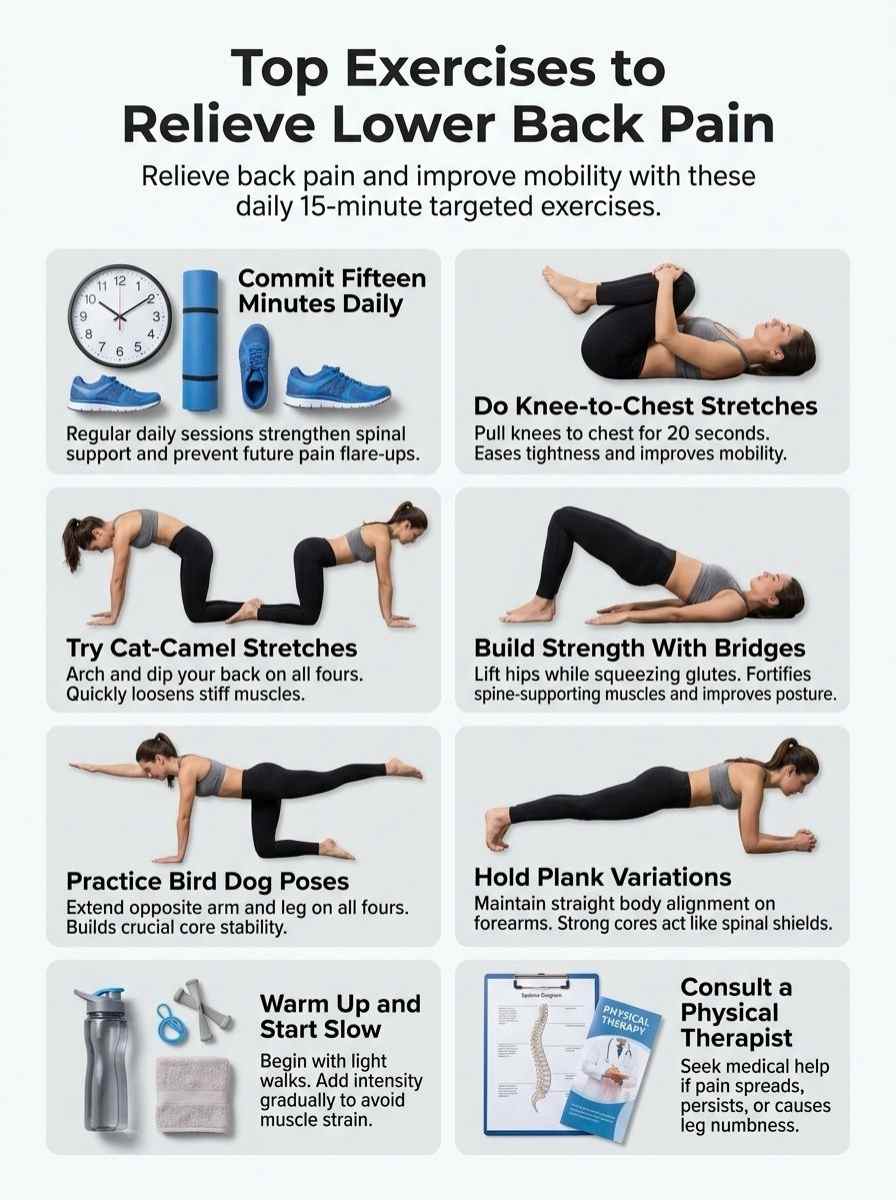
If your lower back feels like a rusty hinge that creaks with every move, gentle pulls like knee rolls and the lower back flexibility exercise can oil things up and bring sweet relief, so stick around to learn how they work their magic.
Knee-to-chest stretch
Lie on your back for the knee-to-chest stretch, a top lower back flexibility exercise that eases pain like a gentle hug for your spine. Pull one knee toward your chest, holding behind the thigh, and keep the other leg straight on the floor.
Hold for 20 seconds, then switch sides. This single knee hug targets tight muscles, much like unwinding a knotted rope, and helps improve mobility during recovery.
Try the double knee hug version next, pulling both knees to your chest at once while lying flat. Grab behind your knees, rock gently like knee rolls to loosen things up, and breathe deep.
Experts at HSS recommend this move, and folks like Andrew Scard swear by it for quick relief. Do it daily in just 15 minutes to strengthen support muscles and prevent future aches, blending in with routines from BHF events like the London to Brighton bike ride.
Lower back rotational stretch
Get on your back with knees bent and feet flat on the floor. Extend your arms out like a T. Drop both knees slowly to one side, and turn your head the other way. Feel that gentle twist in your lower back, easing tightness like wringing out a sponge.
Hold for 20 seconds, then switch sides. Repeat a few times.
People often pair this with a shoulder blade squeeze for better posture. Exercise targets the muscles that support your spine, just as stretching and strengthening ease lower back pain.
You can finish back exercises in 15 minutes a day. Think of it as your daily back rescue, no defibrillators needed, unlike CPR for emergencies. Videos show the right way to do it.
Regular back exercises help prevent future back pain episodes.
Cat-camel stretch
You feel that nagging lower back pain, right? Try the cat-camel stretch to loosen things up. Get on your hands and knees, like a table on the floor. Arch your back high, like a scared cat, and tuck your chin to your chest.
Hold it for a few seconds. Then, drop your belly low, like a camel’s hump, and lift your head. Repeat this flow 10 times. Stretching exercises like this target the back and supporting muscles, easing discomfort fast.
This move relieves lower back pain and boosts mobility during recovery. Do it daily in just part of your 15-minute routine. Back exercises strengthen the spine’s support and improve posture, helping prevent future episodes.
Check video tutorials for the right form; they make learning easy. Imagine your back thanking you, like a happy pet after a good stretch.
Child’s pose
Child’s pose feels like a gentle hug for your lower back, easing tension after a long day. Kneel on a mat, big toes touching, knees spread wide. Sit back on your heels, then fold forward, arms stretched out in front.
Let your forehead rest on the ground, breathe deep, and hold for 30 seconds. This stretch targets the muscles that support your spine, much like a calm wave washing away tightness.
People love it because it improves mobility during recovery, and you can do it in just part of your 15-minute daily routine.
Try this pose regularly to strengthen those back supporters and prevent future pain episodes. Imagine your spine thanking you as posture gets better. Grab a video tutorial online to nail the form, avoid mistakes, and feel the relief.
Stretching like this, along with focused strengthening, ranks among the top ways to ease lower back pain. Keep it simple, listen to your body, and build that habit for lasting comfort.
Strengthening Exercises for Lower Back Pain
If your lower back feels like a rusty hinge, strengthening moves can oil it up and get you moving freely again. Picture yourself building a sturdy core, like fortifying a castle wall, to fend off that nagging ache and boost your daily grit.
Bridge exercise
Lie on your back with knees bent and feet flat on the floor. Keep your arms at your sides. Lift your hips up toward the ceiling, squeezing your glutes and core muscles tight. Hold that position for a few seconds, then lower back down slowly.
This move strengthens the muscles that support your spine and improves posture, just like building a sturdy bridge over a river.
Repeat the bridge exercise for 10 to 15 reps, aiming to fit it into your 15-minute daily routine. You target your back and the muscles around it, easing lower back pain with regular practice.
Folks often find video tutorials helpful to nail the form, avoiding any slips. Strengthening like this relieves discomfort and boosts mobility during recovery, preventing future aches from sneaking up on you.
Bird dog
Get on all fours, with your hands under your shoulders and knees under your hips. Extend one arm straight ahead, and kick the opposite leg straight back. Hold that position for a few seconds, keeping your body level like a steady plank.
Switch to the other side, and repeat. This exercise builds strength in your back and core muscles, which support the spine and boost posture.
Do bird dog exercises regularly, in about 15 minutes a day, to ease lower back pain and prevent future issues. They target the muscles that keep you stable, much like training a loyal pup to stay put.
Stretching and strengthening like this improve mobility during recovery, and science shows such routines help with chronic discomfort.
Superman
Lie on your stomach, arms stretched out in front. Lift your arms, chest, and legs off the ground, like a superhero in flight. Hold that pose for a few seconds, then lower back down.
Repeat this move, folks, and feel those back muscles wake up. Back exercises strengthen the muscles that support the spine and improve posture, just what you need for relief. Do them in 15 minutes a day for effective results, easing that nagging lower back pain.
Stretching and focused back strengthening exercises rank among the best ways to ease lower back pain, and Superman fits right in. Certain exercises can help relieve lower back pain and improve mobility during recovery, no cape required.
Regular back exercises help prevent future back pain episodes, so keep at it. Exercise helps to ease back pain and prevent further discomfort when performed regularly. Stretching and strengthening exercises target the back and the muscles that support it.
Check video tutorials to learn the proper technique for performing back pain exercises, they make it easy to follow along.
Pelvic tilt
You feel that nagging lower back pain, right? Try the pelvic tilt to build strength in those key muscles. Lie flat on your back with knees bent and feet on the floor. Tighten your belly muscles, push your lower back into the ground.
Hold for a few seconds, then release. Do this exercise daily; it targets the back and the muscles that support it, just like fact says.
Back exercises like this one strengthen the muscles that support the spine and improve posture. Spend only 15 minutes a day, and you ease pain while preventing future episodes. Grab a mat if you want extra comfort.
Pull in those abs, tilt that pelvis; you got this, no sweat. Video tutorials show the right form, so check them out for guidance.
Core Exercises to Support the Lower Back
If your lower back feels like it’s carrying the weight of the world, building core strength can act like a trusty sidekick, stabilizing your spine and easing that nagging ache.
Picture your abs and back muscles teaming up like a dynamic duo, and stick around to discover simple moves that make it happen without the hassle.
Plank variations
Plank variations build a strong core, and that supports your lower back like a sturdy bridge holds up heavy traffic. You start with the basic plank by holding your body straight on your forearms and toes, engaging those abs and back muscles.
Exercise helps to ease back pain and prevent further discomfort when performed regularly, so aim for these in your routine. Mix it up with side planks, where you balance on one arm and the side of your foot, twisting a bit to target those oblique muscles.
Stretching and focused back and abdominal strengthening exercises are among the best ways to ease lower back pain, plus certain exercises can help relieve lower back pain and improve mobility during recovery.
Back exercises strengthen the muscles that support the spine and improve posture, making planks a smart choice for daily relief. Try the forearm plank variation first, keeping your elbows under your shoulders and holding for 20 to 30 seconds.
Regular back exercises help prevent future back pain episodes, and you can complete them in 15 minutes a day for effective results. Add knee planks if you’re new, dropping to your knees to ease the load while still firing up that core.
Video tutorials are available to learn the proper technique for performing back pain exercises, so check them out to avoid slips. Stretching and strengthening exercises target the back and the muscles that support it, turning your routine into a pain-busting habit.
Seated good mornings
Sit on a sturdy chair with your feet flat on the ground. Keep your knees bent at a right angle. Place your hands behind your head, or cross them over your chest. Hinge forward at your hips, like you’re bowing to an old friend, until your chest nears your thighs.
Feel that gentle pull in your lower back and hamstrings? Straighten back up to the starting position. Repeat this for 10 to 12 reps. You build strength in the muscles that support your spine this way.
Exercise like this eases lower back pain when you do it regularly. Aim for just 15 minutes a day to see results. Stretching and strengthening target the back and core, much like a trusty shield against discomfort.
Folks, imagine your spine thanking you after a quick session. Back exercises improve posture and prevent future episodes, so give seated good mornings a try. Video tutorials show the proper form, if you need a visual guide.
Side plank
Lie on your side, with your legs straight and stacked. Prop yourself up on one elbow, right under your shoulder, and lift your hips off the ground. Keep your body in a straight line, like a plank of wood, from head to heels.
Hold this pose for 20 to 30 seconds, then switch sides. You build core strength that supports your lower back, easing pain and boosting posture. Core work like this strengthens muscles around the spine, much like a sturdy belt holding everything in place.
Feel that burn in your sides? That’s your obliques waking up to guard your back. Start with short holds if you’re new, maybe just 10 seconds, and build from there. Pair it with other moves, and you might knock out a full routine in 15 minutes a day.
Exercises such as side planks relieve lower back pain, improve mobility, and help prevent future flare-ups. Check video tutorials online for the right form; they make it easy to follow along at home.
Tips for Starting and Maintaining an Exercise Routine
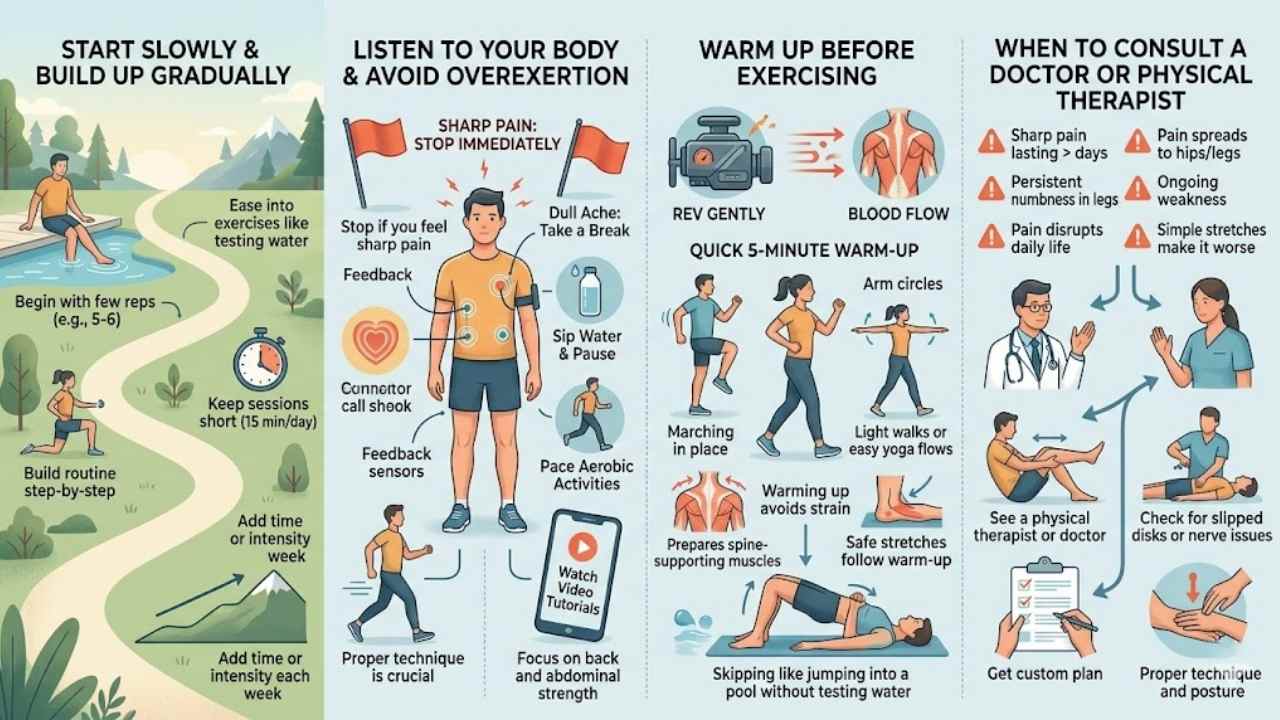
Hey, jumping into workouts with lower back pain can feel like walking a tightrope, but take it easy and ease in like you’re testing warm bathwater. Imagine: you warm up with light walks, pay attention to those twinges, and ramp up slow as molasses, keeping the fun alive without pushing too far.
Start slowly and build up gradually
Ease into your back exercises like dipping a toe in the pool before jumping in. You might feel tempted to push hard right away, but that can lead to more pain. Begin with just a few reps, say five or six, and do them in short sessions.
Exercise helps ease back pain and prevent further discomfort when you perform it regularly. Back exercises can finish in 15 minutes a day for effective results. Stretching and focused back and abdominal strengthening exercises rank as top ways to ease lower back pain.
They strengthen muscles that support the spine and improve posture. Regular back exercises help prevent future back pain episodes.
Build your routine step by step, like climbing a gentle hill instead of a steep mountain. Add more time or intensity each week as your body adapts. Imagine you start with basic stretches, then mix in strengthening moves after a few days.
Keep sessions brief at first to avoid strain. This approach lets you gain benefits without setbacks.
Listen to your body and avoid overexertion
Pay attention to what your body tells you during workouts. Stop if you feel sharp pain in your lower back. That twinge might signal too much strain, like a red flag waving in the wind.
Ease into routines slowly, and know that back exercises can wrap up in just 15 minutes a day for real results. Stretching and strengthening moves target your back and the muscles that hold it up.
They build strength in the spine’s supporters and boost your posture over time.
Push too hard, and you risk setbacks, but regular sessions help ease pain and ward off future episodes. Feel a dull ache? Take a break, sip some water, and try again later. Aerobic activities, backed by science, aid chronic low back pain when you pace yourself right.
Watch video tutorials to nail the technique and keep things safe. Certain exercises relieve discomfort and lift mobility as you recover, so tune in to your signals for the best path forward.
Warm up before exercising
Jump into your routine with a quick warm-up, folks. Imagine, you’re like a car engine on a cold morning – it needs to rev up gently to avoid sputtering out. Start with light activities, say marching in place or arm circles for five minutes.
This gets blood flowing to those back muscles, making stretches and strength moves safer. Exercise helps ease pain and prevent more issues when done right, and a warm-up sets you up for success.
Feel that twinge? A proper warm-up lets you listen to your body better, avoiding overexertion from the get-go. Try gentle walks or easy yoga flows before starting knee-to-chest stretches or bridges.
Back exercises strengthen spine-supporting muscles and boost posture, but skipping this step is like jumping into a pool without testing the water – risky business. Keep it to 15 minutes total if you’re short on time, and you’ll see results in mobility and relief.
When to Consult a Doctor or Physical Therapist
You feel sharp pain in your lower back that lasts more than a few days, so talk to a doctor right away. That discomfort might signal something serious, like a slipped disk or nerve issue.
Exercise helps to ease back pain and prevent further discomfort when performed regularly, but don’t push through intense symptoms alone. See a physical therapist if simple stretches, such as the knee-to-chest stretch, make things worse instead of better.
They guide you on proper form, you know, like pulling both legs toward your chest while lying on your back and holding behind the knees. Back exercises can be completed in 15 minutes a day for effective results, yet persistent numbness in your legs means professional help is key.
Stretching and strengthening exercises target the back and the muscles that support it, sure, but ongoing weakness calls for expert advice. Aerobic exercise has been scientifically shown to help with chronic low back pain, and pros can add that to your plan safely.
You notice pain spreading to your hips or down your legs, then reach out to avoid bigger problems. Certain exercises can help relieve lower back pain and improve mobility during recovery, but a doctor checks for underlying causes first.
Back exercises strengthen the muscles that support the spine and improve posture, and therapists tailor them to you. Regular back exercises help prevent future back pain episodes, so consult if pain disrupts your daily life.
Video tutorials are available to learn the proper technique for performing back pain exercises, but hands-on guidance beats guessing. Stretching and focused back and abdominal strengthening exercises are among the best ways to ease lower back pain, and experts ensure you start right.
Final Thoughts
You’ve learned about stretches like the knee-to-chest and child’s pose that ease tight muscles, plus strengthening moves such as bridges and bird dogs that build spine support. These exercises fit into just 15 minutes a day, making them simple to add to your routine without much hassle.
Regular practice relieves lower back pain, boosts posture, and cuts the risk of future flare-ups, turning a nagging issue into something you can manage. Check out online video tutorials for proper form, or talk to a physical therapist for personalized tips.
So grab your mat, start small, and feel the difference, because a stronger back means a freer you.
Frequently Asked Questions (FAQs) About Exercises for Lower Back Pain
1. What’s a good starting exercise for my lower back pain?
Try the cat-cow stretch, it’s like a gentle wave for your spine. You get on all fours, arch your back up like a scared cat, then dip it down like a happy cow. Do this daily, and you’ll feel that tightness ease up, no kidding.
2. Can strengthening my core help with lower back issues?
Absolutely, core workouts are your back’s best buddy. Planks build those muscles without much strain, holding the position for 20 seconds at first. Keep at it, and you’ll stand taller, like a tree rooted strong against the wind.
3. How do I avoid making my back pain worse with exercises?
Listen to your body, folks; if it hurts, stop right there. Start slow with walks or knee-to-chest pulls, they’re safe bets. Remember, it’s not a race, so ease in like dipping a toe in cool water.
4. Are there exercises I can do sitting down for lower back relief?
Sure thing, seated marches work wonders while you’re at your desk. Lift one knee at a time, like marching in place without standing up. This keeps things moving, helping pain fade away without much fuss.