You dream of big wins in forex trading, but leverage scares you. Many new traders jump in without grasping it, and they lose money fast. Imagine: you put down a small amount, yet control a huge trade.
Sounds thrilling, right? But one wrong move, like ignoring market volatility, and your trading account shrinks. Overleveraging hits hard, turning excitement into stress. We get it; we’ve all felt that knot in our stomach when a currency pair like EUR/USD swings wild.
Forex leverage lets you borrow from your broker to boost your position size, controlling way more than your own cash allows. This tool amps up rewards, yet it spikes risks too. Our blog breaks it down simple: from how leverage works with margin calls and pips, to smart tips like using stop-loss orders and building a solid trading plan.
You’ll learn to manage risk tolerance, avoid emotional trading, and pick the right leverage ratio for your style. Stick around; your next trade could change everything.
What is Forex Leverage?
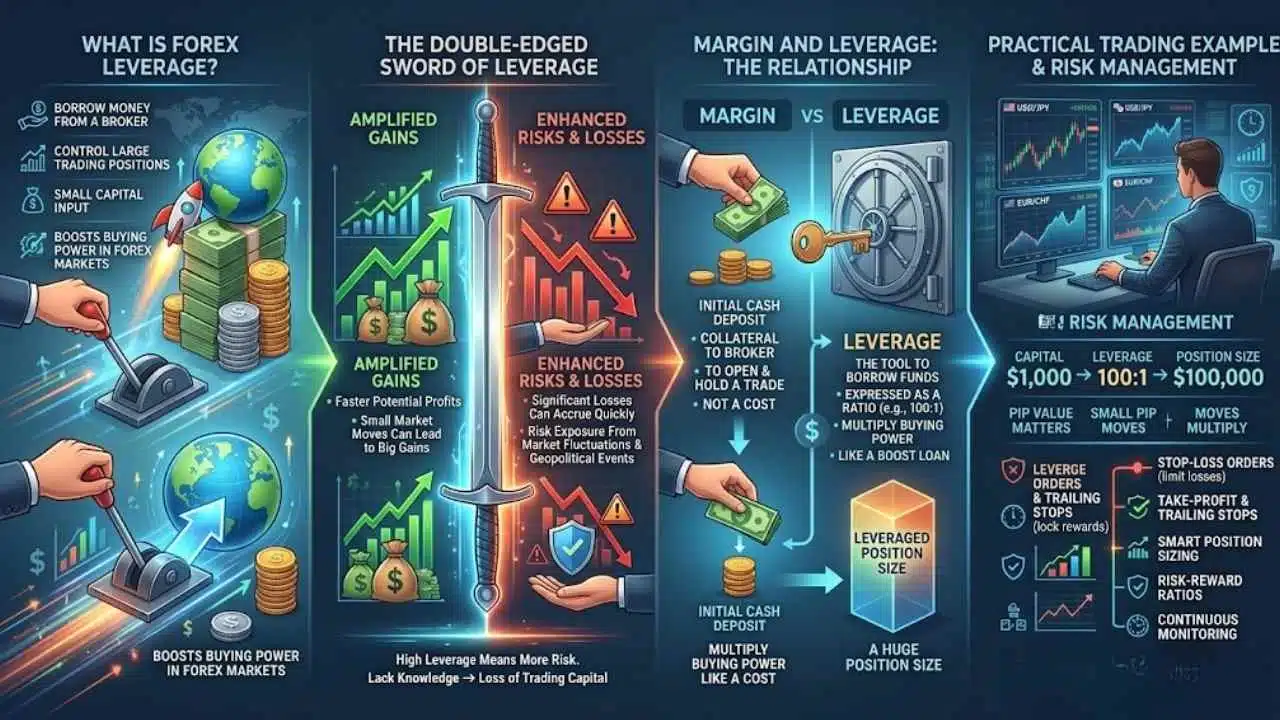
Forex leverage lets you borrow money from a broker to trade currencies and other financial instruments. Traders control big trading positions with small trading capital. This powerful tool boosts your buying power in foreign exchange markets.
Think of it as a double-edged sword, it amps up gains fast but can lead to huge losses if you misuse it. High leverage means more risk exposure, especially with market fluctuations from geopolitical events.
Low leverage keeps things safer for beginners. You open a position in currency pairs like USD/CHF or USD/JPY. Lack knowledge here, and you might lose all your trading capital.
Leverage is a powerful financial mechanism that enables traders to participate in currency markets with relatively small initial capital. – Adapted from key trading insights.
Brokers offer this in platforms like MetaTrader 4 or MetaTrader 5. It allows amplified returns on standard lots. Position sizing matters a lot in currency trading. Smart traders watch pip values closely.
They aim for good risk-reward ratios to handle risks. Demo accounts help you practice without real money at stake.
How Forex Leverage Works
Forex leverage acts like a booster rocket for your trades, letting you control large positions with just a fraction of the cash. Imagine: you put down a small margin as collateral, and your CFD broker lends the rest, turning a tiny investment into major market moves that can swing big profits or losses.
Definition of margin and leverage
Margin is the cash you deposit with your broker to open and hold a trade in foreign exchange trading. Brokers require this deposit as collateral. Leverage lets you borrow funds from that broker to control bigger positions.
You amplify your buying power this way. Think of leverage as a loan that boosts your trades, like using a small key to unlock a massive door. It involves borrowing money to invest in currency trading and other assets, such as CFDs.
Leverage acts as a double-edged sword. Gains speed up fast, but losses hit hard if you misuse it. Traders control position sizes much larger than their actual capital allows. This powerful tool enables participation in currency markets with small initial capital.
Lack knowledge about leverage, and you risk losing your entire trading capital. Brokers like PU Prime or T4Trade offer negative balance protection to shield you from owing more than you deposit.
Check Investopedia for clear explanations on risk management in this setup.
Practical examples of leveraged trading
Forex leverage lets you borrow cash from your broker to amp up trades in currencies and assets. It acts like a double-edged sword, speeding up wins or crashing into big losses if you mishandle it.
- Consider a trader with $1,000 in capital who spots a hot opportunity in the euro-dollar pair on TradingView; by using 100:1 leverage, they control a $100,000 position, and if the market moves just one pip in their favor, gains multiply fast, showing how this tool enables small-capital folks to join currency markets, but lacking knowledge here risks wiping out your entire trading capital.
- George Soros, famed from Market Wizards: Interviews with Top Traders by Jack D. Schwager, once bet big against the British pound with massive leverage, turning a smart trading strategy into billions, yet it highlights forex’s higher risk over stocks due to wild volatility and sky-high leverage levels that can lead to margin calls if things sour.
- Suppose you are in a volatile trading environment, eyeing Autochartist signals for a yen trade; with 50:1 leverage on $2,000, you manage a $100,000 position size, a key building block in risk management, and by setting stop-loss orders plus take-profit and trailing stops, you limit losses while locking in rewards, proving leverage’s power for higher returns but also its trap of emotional decisions from overleveraging.
- Jim Rogers might advise on efficient capital use in commodities, but apply it to forex: start with $500 and 200:1 leverage to handle a $100,000 trade, where understanding pip values and risk-reward ratios shapes your trading psychology, turning amplified buying power into profits, though misuse invites liquidation risks and underscores why position sizing plus continuous monitoring form essential trading strategies.
The Rewards of Using Forex Leverage
Imagine, you drop a modest sum into your trading account, and suddenly, it packs the punch of a much larger stake, letting you chase those euro-dollar swings with real muscle.
Yeah, leverage cranks up your shot at juicy gains, like a turbo boost on your capital, but stick around to see how it plays out without the pitfalls.
Amplified buying power
Forex leverage boosts your buying power like a turbo engine in a car. You borrow funds from your broker to control bigger trades than your own cash allows. Imagine: with just $1,000 in your account, a 100:1 leverage lets you handle a $100,000 position in the currency market.
Traders love this setup because it opens doors to markets with small starting capital. Position sizing becomes your key tool here; it helps you decide how much to trade without overdoing it.
This amplified power feels exciting, yet it demands smart moves. Leverage turns modest investments into chances for big plays in volatile forex pairs. You gain efficient capital use, stretching every dollar further.
Stop-loss orders act as your safety net, capping losses if trades go south. Many folks jump in with demo accounts first to test these waters safely.
Opportunity for higher returns
Leverage boosts your trading power like a turbo engine in a car, letting you chase bigger wins with less cash up front. Imagine putting down just $1,000 to control a $100,000 position in the currency market; that setup comes from borrowing funds from your broker.
Traders love this because it opens doors to hefty profits on small moves, say turning a 1% currency shift into a 100% return on your initial stake. It acts as a double-edged sword, sure, but on the bright side, it amplifies gains at high speed when trades go your way.
You control position sizes much larger than your actual capital would permit, and that means efficient plays in volatile spots.
This powerful tool lets folks with modest funds join the forex game and aim for those eye-popping returns. Picture a newbie trader spotting a euro-dollar swing; with leverage, they multiply their buying clout and snag profits that dwarf what straight cash could buy.
It enables participation in currency markets with relatively small initial capital, flipping the script on how you build wealth. Just think of it as borrowing a friend’s muscle to lift heavy weights, you get the glory if you succeed, but always keep an eye on that risk-reward ratio to stay smart.
Stop-loss orders help lock in those gains too, turning potential home runs into real scores without the full downside hit.
Efficient use of capital
Forex leverage lets you borrow cash from your broker to trade currencies with just a small chunk of your own money. This setup frees up your capital, so you can take on bigger trades without tying up all your funds.
Imagine it as using a credit card for a big purchase, you control a lot more than what you actually put down. Traders love this because it means efficient use of capital, allowing them to participate in currency markets with relatively small initial investments.
You get amplified buying power, and that can lead to higher returns if things go your way.
Think about it, leverage acts as a double-edged sword that boosts your game, but only if you play smart. Position sizing becomes key here, as it helps manage risks while you control those larger spots.
Stop-loss orders step in as your safety net, limiting losses so your capital stays efficient. With this approach, you avoid overcommitting, and keep your trading flexible. It’s all about making your money work harder for you in the volatile forex market.
The Risks of Using Forex Leverage
Sure, leverage in forex trading can supercharge your gains, but it also ramps up the chance of big losses, like when a margin call hits and forces you to sell off positions fast, or when overdoing it leads to rash choices driven by stress—think of it as playing with fire that might burn your account if you’re not careful, so keep reading to learn how to handle these pitfalls wisely.
Increased potential for losses
Leverage boosts your gains, but it cranks up losses too. Think of it like a double-edged sword, slicing through profits one way and your capital the other if things go south. You control big positions with little money, yet a small market dip wipes out your account fast.
Forex trading feels riskier than stocks, thanks to wild volatility and sky-high leverage options. Traders often lose everything when they ignore how this tool works.
Imagine, you bet big on a currency pair, and bam, a sudden shift hits hard. Losses pile up quick, way beyond your initial cash. Without solid knowledge, you risk your whole trading pot.
Stop-loss orders help cap the damage, but overconfidence leads to ignoring them. Stay sharp, or that amplified power turns against you in a flash.
Margin calls and liquidation risks
Margin calls happen when your account balance drops too low to support open trades. Brokers demand more funds to keep positions alive. You must add cash fast, or they close your trades.
This protects the broker from big losses on borrowed money. Think of it like a lender knocking on your door during a stormy market. Forex boosts this risk with its wild swings, far more than stocks.
High leverage levels make every dip feel like a cliff edge. Traders ignore this and face total wipeouts of their capital.
Liquidation risks spike if you skip that margin call. Brokers sell off your positions automatically to cover debts. You lose control, and losses pile up quick. Position sizing helps here as a core shield in risk management.
Stop-loss orders act like safety nets, capping damage before it hits critical levels. They limit potential losses in volatile currency trades. Picture overleveraging as juggling fire; one slip burns everything.
Knowledge gaps on these mechanics lead straight to empty accounts.
Overleveraging and emotional decision-making
Overleveraging hits hard when emotions take the wheel. You borrow too much from your broker, and suddenly a small market dip wipes out your account. Traders chase big wins, but greed clouds judgment, leading to rash moves.
Leverage feels like a rocket boost, yet it turns into a double-edged sword that slices deep into your capital. Imagine this: you ignore solid plans, double down on a losing trade, and poof, your funds vanish.
Knowledge gaps amplify the danger; folks without a grip on leverage mechanics often lose everything.
Emotional decisions fuel the fire in overleveraged spots. Fear grips you during volatility, prompting panic sells at the worst times. Stop-loss orders act as your safety net, cutting losses before they spiral.
Risk-reward ratios guide smarter plays, balancing potential gains against real threats. Think of it as playing poker with house money; overbet, and one bad hand cleans you out. Stay cool, stick to limits, and avoid letting feelings override facts in forex trades.
Key Concepts in Forex Leverage
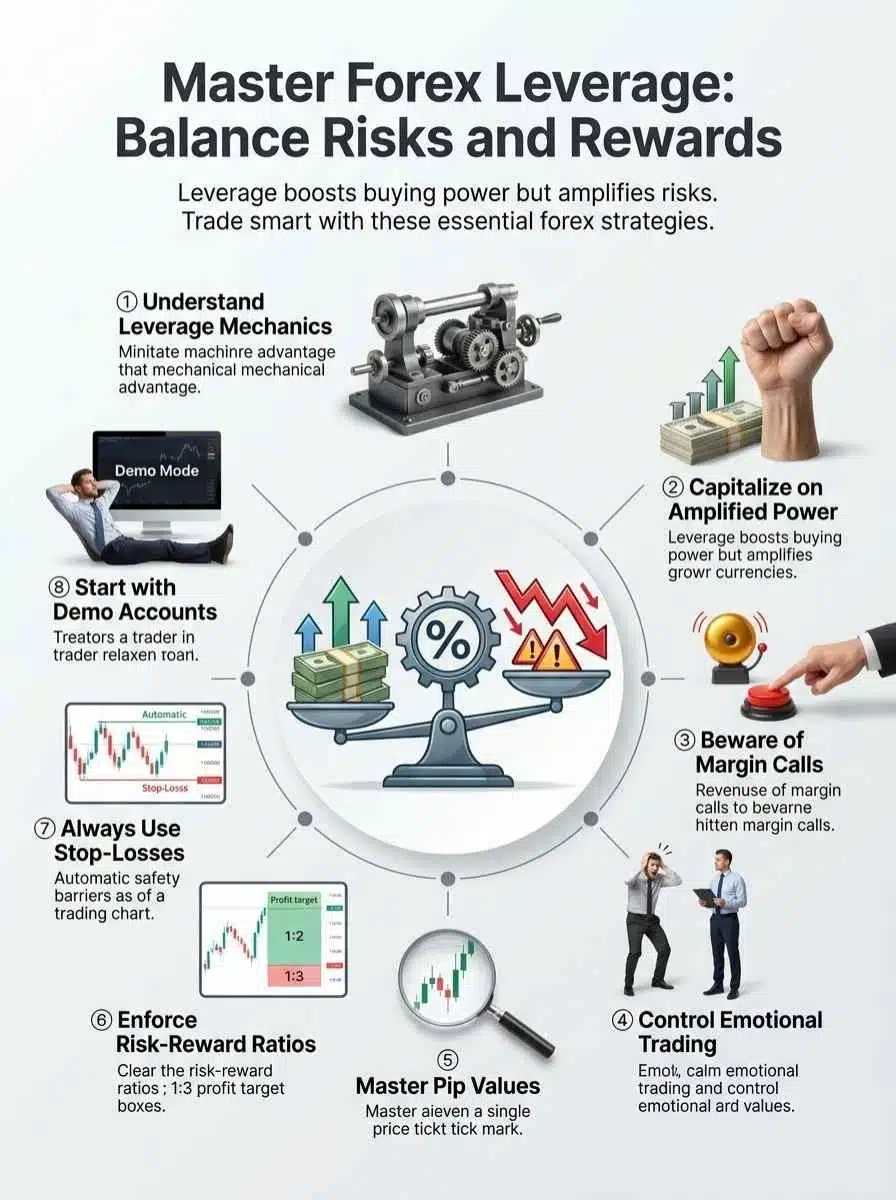
You spot a small price shift in currency pairs, and that’s your pip at work, boosting or slashing trade outcomes fast. Grasp the risk-reward balance next, like weighing a tightrope walk between possible gains and real losses, to sharpen your strategy.
Understanding pip values
Pip values show how much a single price tick changes your trade’s worth in forex. Traders use them to figure out profits or losses on each move. Say you trade EUR/USD, a pip often equals 0.0001.
With leverage, that tiny shift packs a big punch, turning small capital into large gains or wipes. Position sizing ties right in, acting as the core of smart risk plans to keep losses in check.
Grasp pips, and you master risk-reward ratios for stronger strategies. Consider this: a 1:2 ratio means you risk one pip’s value to chase two in return, like betting smart in a game.
Stop-loss orders lock in those limits, shielding your account from wild swings. Leverage amps it all up, so know your pips to trade sharp and stay ahead.
Risk-to-reward ratio explained
Traders often hear about the risk-to-reward ratio in forex, and it boils down to a simple idea. This ratio compares how much you might lose on a trade to how much you could gain. Say you risk $100 to make $300; that’s a 1:3 ratio, like betting small to win big.
Position sizing ties right into this, acting as the base for smart risk management. Stop-loss orders help cap those losses, while take-profit stops lock in gains. Leverage plays a part too, acting like a double-edged sword that ramps up both sides.
Picture a trader eyeing a currency pair, setting a stop-loss to risk just 1% of their capital. They aim for a reward twice that amount, creating a solid 1:2 ratio. Trailing stops can trail the price, securing profits as the trade moves your way.
This approach builds effective strategies, keeping emotions in check during volatile swings. New folks, grasp this early to avoid wiping out your account. Forex demands respect for these tools, turning potential pitfalls into steady paths.
Best Practices for Managing Forex Leverage
Hey, you know that feeling when you’re riding a bike downhill, fast and fun, but one wrong turn spells trouble? That’s leverage in forex trading, so let’s chat about smart ways to keep your ride smooth and safe, like setting firm brakes with stop-loss orders and testing the path on a demo account first.
Start with conservative leverage ratios
Go easy on leverage at first, folks. Pick low ratios, like 1:10 or less, to keep things safe. This approach lets you control bigger positions without betting the farm right away. Leverage boosts your buying power, sure, but it magnifies losses too, like a double-edged sword in your hand.
Traders often wipe out their capital by jumping in too fast, so ease into it. Think of it as dipping your toes in the pool before a cannonball dive.
Stay smart with position sizing from the start. Conservative ratios pair well with stop-loss orders to cap those potential hits. You gain efficient capital use and chase higher returns, but without the gut-wrenching risks.
Imagine a newbie trader who starts small; they learn the ropes, avoid margin calls, and build confidence. Forex volatility demands this caution, especially compared to steadier stock trades.
Use stop-loss orders
Stop-loss orders act as your safety net in forex trading. You set them to sell a position automatically if the market moves against you. This tool limits potential losses, especially with high leverage that amps up risks.
Traders rely on these orders to protect their capital from wild swings. Picture them as a seatbelt during a bumpy ride; they keep you from flying out the window. Pair them with take-profit orders to lock in gains when prices hit your target.
Trailing stops follow the market like a loyal dog, adjusting as prices rise to secure profits. You avoid emotional decisions by letting these mechanisms handle the exits. Forex demands this discipline since volatility can wipe out accounts fast.
Use them wisely to manage that double-edged sword of leverage. They form the core of smart risk strategies, helping you trade with confidence.
Monitor trades continuously
Keep an eye on your trades all the time. You control the action in forex, like a captain steering a ship through choppy waters. Markets shift fast, and volatility can spike without warning.
Check positions often to spot trouble early. Use tools like take-profit orders to lock in gains. Trailing stops help you ride the wave while protecting profits. Position sizing keeps risks in check, a core part of smart strategies.
Think of it as babysitting your money, hey, nobody wants surprises that wipe out capital.
Traders lose big when they ignore this step, especially with leverage amplifying every move. Stay alert to avoid margin calls that hit hard. Empathy here, we’ve all felt that gut punch from a bad trade.
Mix in risk-reward ratios to guide decisions. These ratios build strong plans, turning chaos into control. Picture chatting with a friend over coffee, “Dude, watch your back in this game.” Continuous monitoring feels like second nature once you start, and it saves you from emotional slips.
Practice with a demo account
Practice with a demo account before you start real forex trading. This tool lets you test leverage strategies with fake money, so you build skills without the sting of actual losses.
Traders often overlook this step, but it helps you grasp how leverage amplifies both gains and risks, like a trial run in a safe sandbox. You can experiment with position sizing, a key part of risk management, and set stop-loss orders to curb potential wipeouts.
Think of it as learning to drive in a simulator; you crash a few times, learn from mistakes, and avoid real-world disasters.
Demo accounts also let you play with take-profit and trailing stops to lock in wins, all while figuring out risk-reward ratios that suit your style. Leverage acts like rocket fuel for your trades, boosting buying power with small capital, but misuse it and you risk losing everything.
Newbies, give this a shot to sidestep emotional pitfalls and overleveraging traps. It’s your low-pressure way to see forex volatility up close, turning rookies into savvy players who trade smart.
Choosing the Right Leverage and Broker
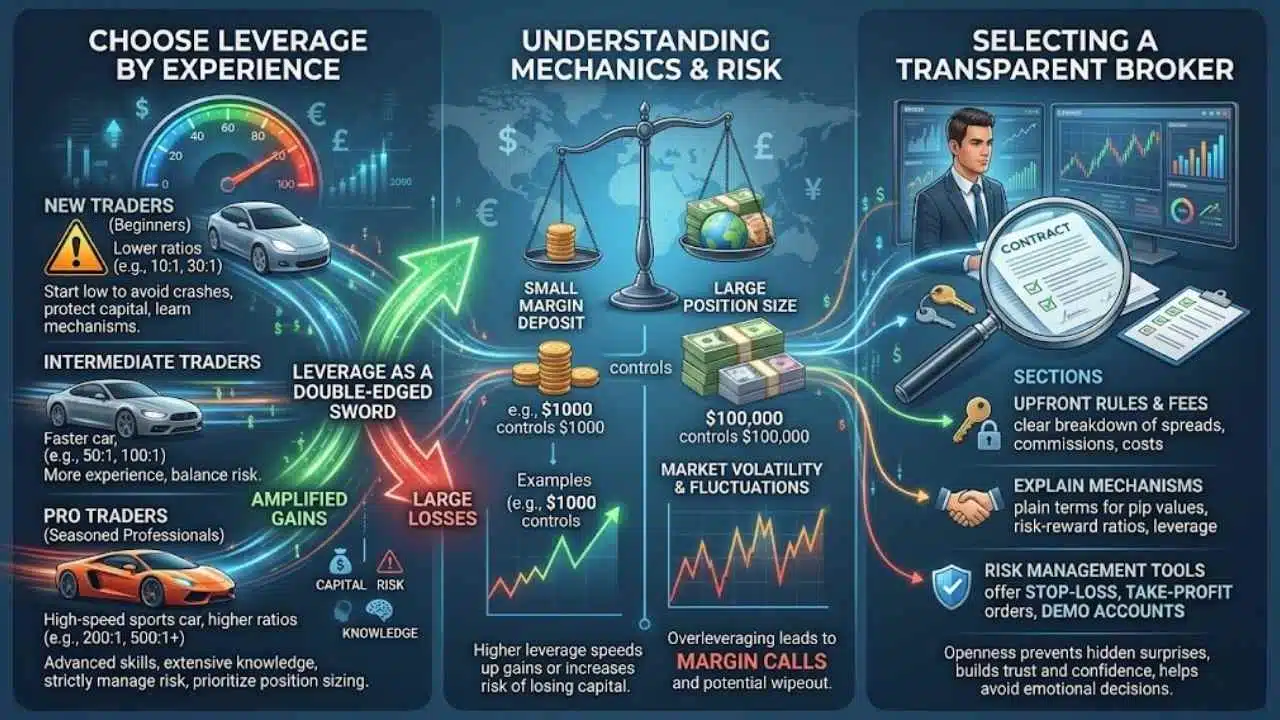
8. Choosing the Right Leverage and Broker: Hey, picking the perfect leverage ratio depends on your trading chops, so match it to your skill level like fitting a glove, and always go for a forex broker that shines with clear rules and fees to dodge nasty surprises—curious for tips on spotting the best ones? Stick around and read on!
Assessing leverage ratios based on experience
Pick your leverage ratio like you’d choose a car speed on a winding road, based on how long you’ve been driving. New traders, listen up, start low to avoid crashes. Leverage boosts your buying power, sure, but it acts like a double-edged sword that speeds up gains or slams you with big losses if you misuse it.
Experience matters here; beginners often risk losing all their capital without solid knowledge of these mechanisms. Think of it as borrowing to control huge position sizes with just a small chunk of your own money, a powerful tool for entering forex markets on a budget.
Seasoned pros can crank up the leverage, yet they know position sizing forms the base of smart risk management. You control trades far bigger than your actual funds allow, which opens doors to higher returns, but hey, don’t let overconfidence bite you.
Assess your skills honestly; if volatility scares you, dial it back. Tools like stop-loss orders help cap those potential hits, keeping your strategy sharp and your capital safe.
Importance of broker transparency
Broker transparency matters a lot in forex trading. You borrow money from your broker to amp up your trades, as leverage lets you control big positions with little cash. Pick a broker who lays out all the details, like margin rules and fees, right up front.
This setup acts like a clear map in a foggy forest, helping you dodge hidden pitfalls that could wipe out your capital. Traders often face high risks from market swings and overborrowing, so an open broker shares how leverage works without tricks.
They explain pip values and risk-reward ratios in plain terms, making sure you grasp the double-edged sword of amplified gains or losses.
Imagine chatting with a friend who hides key facts about a risky game, that’s no good. A transparent broker talks straight about stop-loss orders and take-profit tools, so you manage positions smartly.
They reveal leverage levels that fit your skill, avoiding emotional slips from overleveraging. With forex’s wild ups and downs, this honesty builds trust and keeps your capital efficient.
You practice safe trades, like starting small on a demo account, all thanks to clear info from the start.
Final Thoughts
Forex leverage boosts your trading power, but it demands smart handling to avoid big losses. You learned how margin lets you control large positions with little cash, and examples showed the ups and downs. Rewards shine through bigger returns and better capital use, yet risks like margin calls can wipe you out fast. Stick to basics like pip values and solid risk-reward ratios for steady plays.
Best moves include low leverage starts, stop-loss orders, and demo practice to build skills safely. Ready to trade smarter? Grab a trusted broker, test these tips today, and watch your confidence grow.