Are screens and exhausting schedules squeezing out storytime? Parents do not need a flawless, stress-free setup to cultivate lifelong book lovers. Building strong reading habits for children relies on small, steady moments that easily fit into busy, everyday real life.
Raising a passionate reader starts with warmth, autonomy, and repetition, a philosophy championed by longtime children’s literature experts like Maria Russo. It is entirely possible to make early literacy feel natural and achievable at home. Focus on establishing consistent nighttime reading rituals, scheduling regular library visits to encourage independent book choices, and balancing picture books with smarter, more intentional technology habits.
Consistency matters far more than perfection. By taking small steps and creating a welcoming environment, tired parents can successfully foster a deep, enduring love of literature. The key is simply starting small and staying committed to the journey, allowing stories to unfold organically without added pressure.
Why Early Literacy and Reading Habits Matter
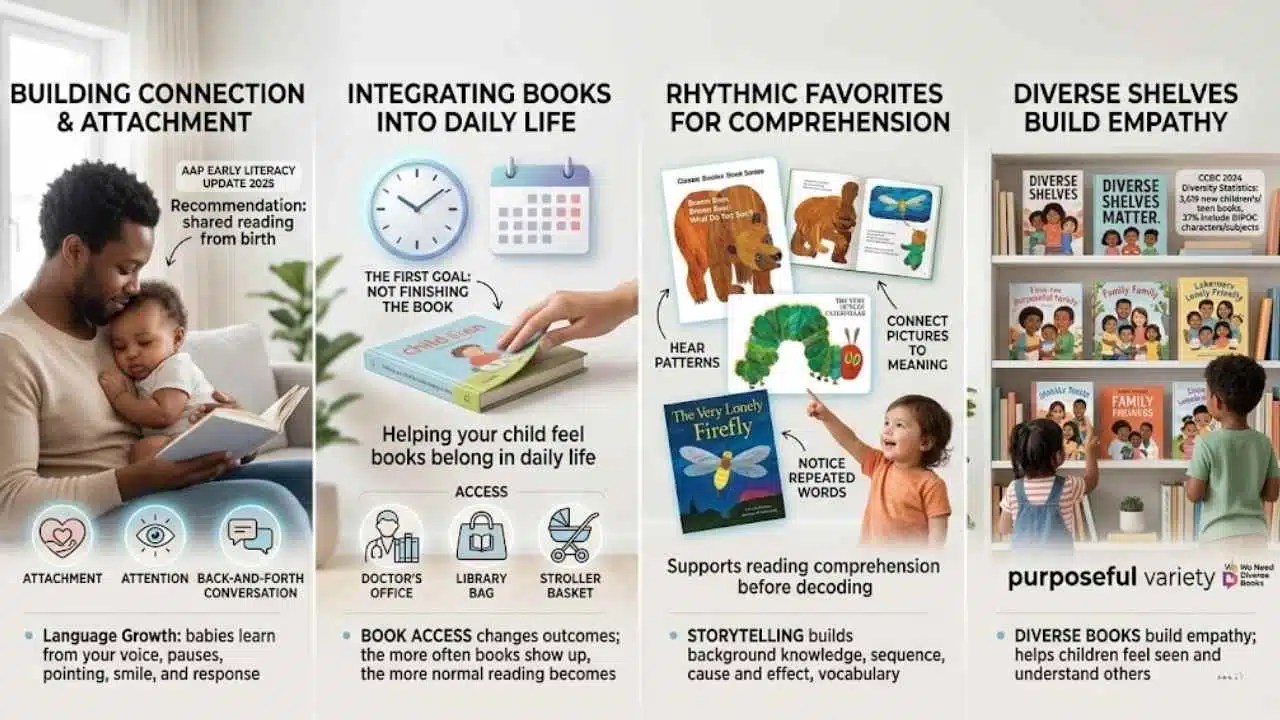
In its 2025 early literacy update, the American Academy of Pediatrics says shared reading should begin at birth and continue through at least kindergarten. That matters because reading aloud does more than teach words, it builds attachment, attention, and the back-and-forth conversation that powers literacy development.
The first goal is not finishing the whole book. The first goal is helping your child feel that books belong in daily life.
Simple children’s books do a lot of heavy lifting. Rhythmic favorites like Brown Bear, What Do You See?, The Very Hungry Caterpillar, and The Very Lonely Firefly help kids hear patterns, notice repeated words, and connect pictures with meaning, which supports reading comprehension long before they can decode print on their own.
Diverse shelves matter, too. The Cooperative Children’s Book Center’s 2024 diversity statistics counted 3,619 new books for children and teens, and 37% included at least one BIPOC primary character or subject. That is real progress, but it still means many families need to build variety on purpose, and groups such as We Need Diverse Books make that easier by highlighting stories that help children see both themselves and other people clearly.
- Reading early supports language growth: babies learn from your voice, your pauses, and the way you point, smile, and respond.
- Storytelling builds background knowledge: even a short picture book teaches sequence, cause and effect, and new vocabulary.
- Diverse books build empathy: a shelf with many cultures, family structures, and experiences helps children feel seen and helps them understand others.
- Book access changes outcomes: the more often books show up in your home, doctor’s office, library bag, or stroller basket, the more normal reading becomes.
Simple Strategies to Cultivate a Love for Books
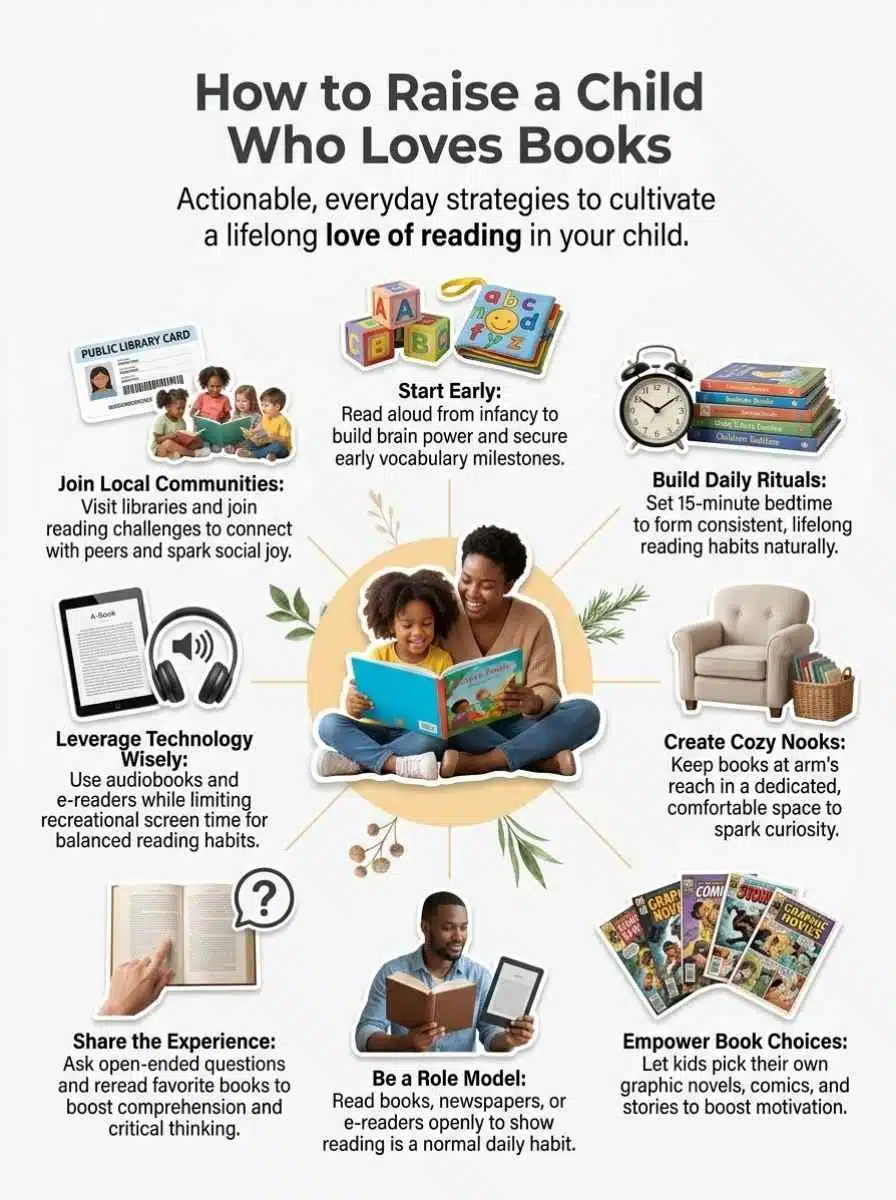
You do not need a complicated early education plan to start raising a book-loving kid. You need a few reading activities you can repeat without stress.
Start Early: Read Aloud From Infancy
Start reading aloud before your child can talk back. The American Academy of Pediatrics recommends shared reading from birth because those early book moments strengthen language, routine, and connection.
Scholastic’s latest Kids & Family Reading Report found that 51% of preschoolers ages 0 to 5 are read aloud to at home 5 to 7 days a week, but that number drops to 37% for ages 6 to 8 and 16% for ages 9 to 11. That drop is your reminder to keep the habit going even after your child starts school.
- Keep it short: ten to fifteen minutes of reading aloud before bed is enough to build momentum.
- Use books with rhythm: Dr. Seuss, In a People House, and other playful read-alouds help kids hear sound patterns that support early literacy.
- Reread without guilt: repetition builds confidence, vocabulary, and story memory.
- Let your child point and interrupt: naming pictures, asking questions, and flipping back a page are signs of engagement, not bad manners.
- Match books to real interests: if your child loves dinosaurs, trucks, ballerinas, or bugs, use that interest as the doorway.
- Use free book programs: in participating ZIP codes, Dolly Parton’s Imagination Library mails one free book each month until age five.
Make Reading a Daily Ritual
The best reading rituals are almost boring in the best possible way. They happen at the same time, in the same place, often enough that nobody has to debate them.
Bedtime is the classic choice, but it is not the only one. Breakfast poems, one chapter after school, or an audiobook during the ride to daycare all count as family reading.
- Read one picture book after bath time.
- Play a short audiobook during errands or carpool.
- Keep a breakfast basket with two or three books for slow mornings.
- End the day with one page if everyone is tired, one page still keeps the routine alive.
If you want reading comprehension to grow without making books feel like school, end with one easy question. Scholastic reports that 80% of parents with children ages 6 to 11 say conversation starters would help them support reading, which tells you the follow-up talk matters almost as much as the pages themselves.
Create a Dedicated Reading Space
A reading nook does not need a designer makeover. A lamp, a soft place to sit, and a small set of reachable books can do the job.
The official AAP Family Media Plan encourages screen-free zones before bed and one screen at a time. That makes a cozy reading corner especially useful because it gives books a place of their own instead of asking them to compete with every other device in the room.
- Keep books low and visible: front-facing covers help young children choose faster than tightly packed spines.
- Rotate a few titles each week: a small fresh stack feels new without overwhelming your child.
- Add comfort: a beanbag, rug, or couch corner helps children stay with a story longer.
- Use warm light: good lighting reduces frustration and makes the space feel calm.
- Let your child personalize it: stuffed animals, a favorite blanket, or a hand-drawn sign give the nook ownership.
Empower Your Child’s Reading Choices
One of the fastest ways to improve reading habits is to hand some control back to your child. Kids read more willingly when books feel chosen, not assigned.
Let Them Choose Their Books
Choice is not a bonus feature, it is the engine. Scholastic has reported that 89% of kids say their favorite books are the ones they picked out themselves.
That means your role is guide, not gatekeeper. You can narrow the shelf, set the budget, and steer by age range, but your child should still get a real vote.
- Offer a topic bin built around their current obsession, such as dinosaurs, space, jokes, or horses.
- Let them abandon a book that feels too hard or too dull.
- Turn library visits into a scavenger hunt, find one funny book, one fact book, and one surprise pick.
- Ask them to recommend a title to a sibling, cousin, or friend, sharing books builds pride.
Embrace All Formats: Novels, Comics, and More
If your child lights up for graphic novels, magazines, cookbooks, or audiobooks, count that as reading. The American Library Association’s 2025 Best Graphic Novels for Children list is a good reminder that comics are a serious part of children’s literature, not a lesser version of it.
Titles like Dog Man, Smile, and New Kid work well because the images support the text instead of replacing it. For many kids, that makes reading development feel possible sooner.
| Format | Best For | Why It Helps |
|---|---|---|
| Picture books | Babies, toddlers, and early elementary readers | They build vocabulary, story structure, and shared attention fast. |
| Graphic novels | Striving readers and kids who want visual support | Panels and illustrations help with context, pacing, and comprehension. |
| Audiobooks | Car rides, reluctant readers, and children who understand more than they can decode | They strengthen listening skills and keep kids in longer stories. |
| E-readers | Kids who like digital pages, larger fonts, or travel-friendly reading | They reduce clutter and make it easy to carry many titles at once. |
Avoid Pressuring Them with Quizzes or Expectations
Books stop feeling safe the minute every story turns into a test. If your child expects a quiz after every chapter, they may start avoiding the chapter.
Use talk instead of evaluation. A simple open question keeps the focus on ideas, feelings, and prediction, which is exactly where strong reading comprehension grows.
- “What do you think will happen next?”
- “Which part felt funniest or weirdest to you?”
- “Who would you want to be friends with in this story?”
- “Did this book remind you of anything in real life?”
Be a Reading Role Model
Children notice what adults repeat. If they see you pick up books, they learn that reading is something people do for comfort, answers, and fun.
Let Them See You Reading Regularly
Scholastic found that children’s primary reading role models are their parents (83%), followed by siblings (40%) and teachers (34%). That is a strong case for modeling, even if you only have a few minutes at a time.
- Read a novel, magazine, recipe, or sports page where your child can see you.
- Keep a book in the car, diaper bag, or kitchen drawer.
- Let your child notice you borrowing library books for yourself.
- Use your phone for an ebook sometimes, then say out loud that you are reading, not scrolling.
- Play an audiobook while folding laundry or driving, so books show up in more than one format.
Books create connection because they give families something easy to talk about. In the latest Scholastic family guide, 90% of parents agreed that books create opportunities for conversation.
You do not need a formal family book club. A quick comment over dinner, “That ending surprised me,” or, “This character reminds me of our neighbor,” teaches your child that stories belong in regular conversation.
Family reading works best when it feels active. Laugh at the same page, wonder about the same character, and let the story spill into the rest of the day.
Discuss Stories and Characters Together
Open-ended questions invite kids to think, not perform. They also help children practice prediction, memory, and emotional language.
- Ask your child to guess what a character will do next.
- Compare a story event to something that happened at school or home.
- Draw a favorite scene together after reading.
- Act out one page with silly voices.
- Invite older children to read aloud to younger siblings.
If you want help picking stronger discussion prompts, you are not alone. Many parents say they want exactly that kind of support, which is why simple questions work so well as a repeatable habit.
Reread Their Favorite Books
Rereading is not getting stuck. It is how many children build fluency, comfort, and confidence.
The American Academy of Pediatrics encourages familiar books because children often start to retell them from memory, which is an early literacy win. A child who can “read” back Brown Bear, What Do You See? from memory is practicing sequence, vocabulary, and story structure.
- Alternate pages with your child to keep repeats fresh.
- Look for new details in the pictures each time.
- Try the print version one night and the audiobook the next.
- Stop while the book is still fun, boredom helps no one.
Use Technology Thoughtfully
Technology can support reading development if you use it as a bridge to stories, not as background noise.
Explore Audiobooks and E-Readers
Libby, the library app from OverDrive, lets families borrow ebooks, audiobooks, and magazines with a library card. That is helpful for long drives, waiting rooms, and nights when you need a low-effort story option.
For struggling readers, tools built for access can make a huge difference. Bookshare is free for U.S. schools and qualified students, and it lets children listen to books with word highlighting, adjust text size and colors, and use formats that fit dyslexia, low vision, or other print barriers.
- Pair audio with the print book when possible.
- Slow narration speed slightly for younger listeners.
- Use headphones for focus if siblings are noisy.
- Choose one main reading app instead of bouncing between many.
Limit Screen Time to Foster Book Engagement
As of January 2026, the American Academy of Pediatrics’ Family Media Plan recommends screen-free zones during homework and before bed, plus a “one screen at a time” rule to reduce distraction. That guidance fits reading beautifully because books need calm, not constant interruption.
- Make bedtime a device-light window and a book-first window.
- Turn off autoplay and notifications on your child’s device.
- Keep entertainment screens out of the reading nook.
- Use paper books for winding down and save bright screens for earlier in the day.
Encourage Community and Social Reading
Reading gets easier to love when your child sees other book lovers in the wild. Community turns reading from a private task into a shared culture.
Visit Libraries and Bookstores Regularly
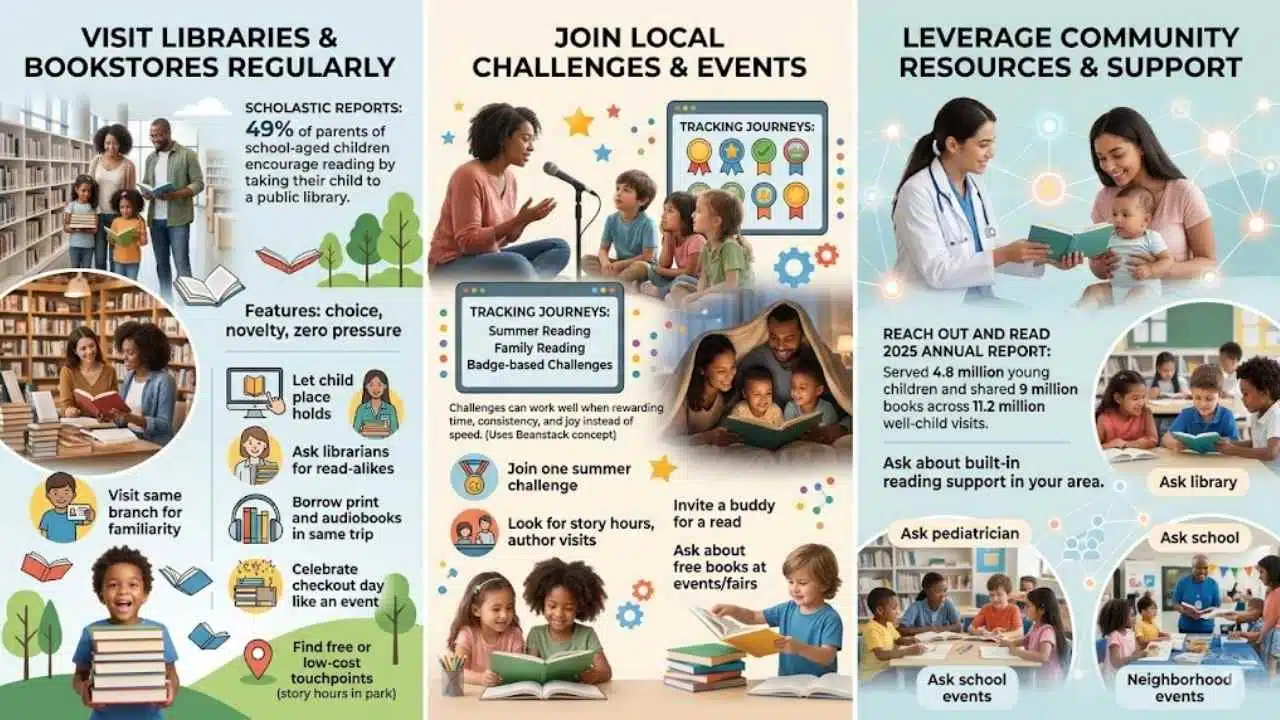
Scholastic reports that 49% of parents of school-aged children encourage reading by taking their child to a public library. That makes sense, because library visits combine choice, novelty, and zero pressure to buy the perfect book.
If you are local to Hoboken, you already have a strong model: Hoboken Public Library is still running Story Time in Church Square Park, and Little City Books continues to host children’s story time events. Even if you live somewhere else, those are exactly the kinds of free or low-cost community touchpoints worth finding nearby.
- Let your child place holds on books they are excited about.
- Ask librarians or booksellers for read-alikes instead of random browsing every time.
- Visit the same branch often enough that it feels familiar.
- Borrow print books and audiobooks in the same trip.
- Celebrate checkout day like a real event.
Participate in Local Reading Challenges or Events
Reading challenges can work well when they reward time, consistency, and joy instead of speed. Many U.S. libraries, schools, and bookstores now use Beanstack to track summer reading, family reading, and badge-based challenges.
Community help can start even earlier than the library. Reach Out and Read’s 2025 annual report says the program served 4.8 million young children and shared 9 million books across 11.2 million well-child visits, which is a good reminder to ask your pediatrician, library, or school what reading support is already built into your area.
- Join one summer reading challenge at a time, too many can feel like homework.
- Look for story hours, author visits, and family read-aloud nights.
- Invite a friend or cousin to do a simple buddy read.
- Ask about free books at pediatric visits, school fairs, and neighborhood literacy events.
Final Thoughts
Good reading habits grow from small, warm routines, not from pressure. A cozy spot, steady reading aloud, real choice, and simple family reading moments can do more than most parents expect.
Graphic novels count. Audiobooks count. Library visits count.
If you want to focus on one thing first, start with a short daily ritual and keep it kind. That is how early literacy becomes part of real life, and that is how you keep raising a child who loves to read.
Read one page tonight, then do it again tomorrow.
Frequently Asked Questions (FAQs) on Reading Habits for Children
1. How can I build strong reading habits to raise a child who loves books?
Read with your child every day, even for ten minutes. Make it a cozy habit, a place to land, like a small island of calm.
2. What if my child resists reading?
Start with books about things they already love, let them pick, skip the dull ones. Try silly voices, or read while they have a snack, children often join in when it feels fun. Be patient, a seed takes time to grow.
3. How do I pick books my child will enjoy?
Choose short books, with clear pictures and lively action, or ask a library worker for a good match. Follow your child, if they point, pick that book.
4. When should reading happen, and how long should sessions be?
Read at times that fit your family, morning, snack, or bedtime. Keep sessions short, five to twenty minutes, and stop while they still want more.