The Future of Work Disruption is no longer a looming theoretical concept; it is the immediate reality tearing through the fabric of modern corporate structures. Yet, as companies pour trillions into generative models and autonomous agents, a startling truth is emerging from the boardroom: the primary bottleneck to innovation is not algorithmic limitation, but human stubbornness.
We are witnessing a catastrophic failure of imagination among executives who attempt to force-fit revolutionary capabilities into legacy operational paradigms. When an organization fails to see a return on its massive technological investments, the root cause rarely lies within the code. Instead, the failure is almost entirely structural and psychological. The technology is ready, but the leadership is not.
Adapting to this shift requires a fundamental dismantling of outdated management philosophies and a radical embrace of new workforce dynamics.
The Illusion of Technological Bottlenecks
Understanding why corporate transformations stall requires us to look past the software and critically examine the humans dictating its use.
The Misdiagnosis of the AI Crisis
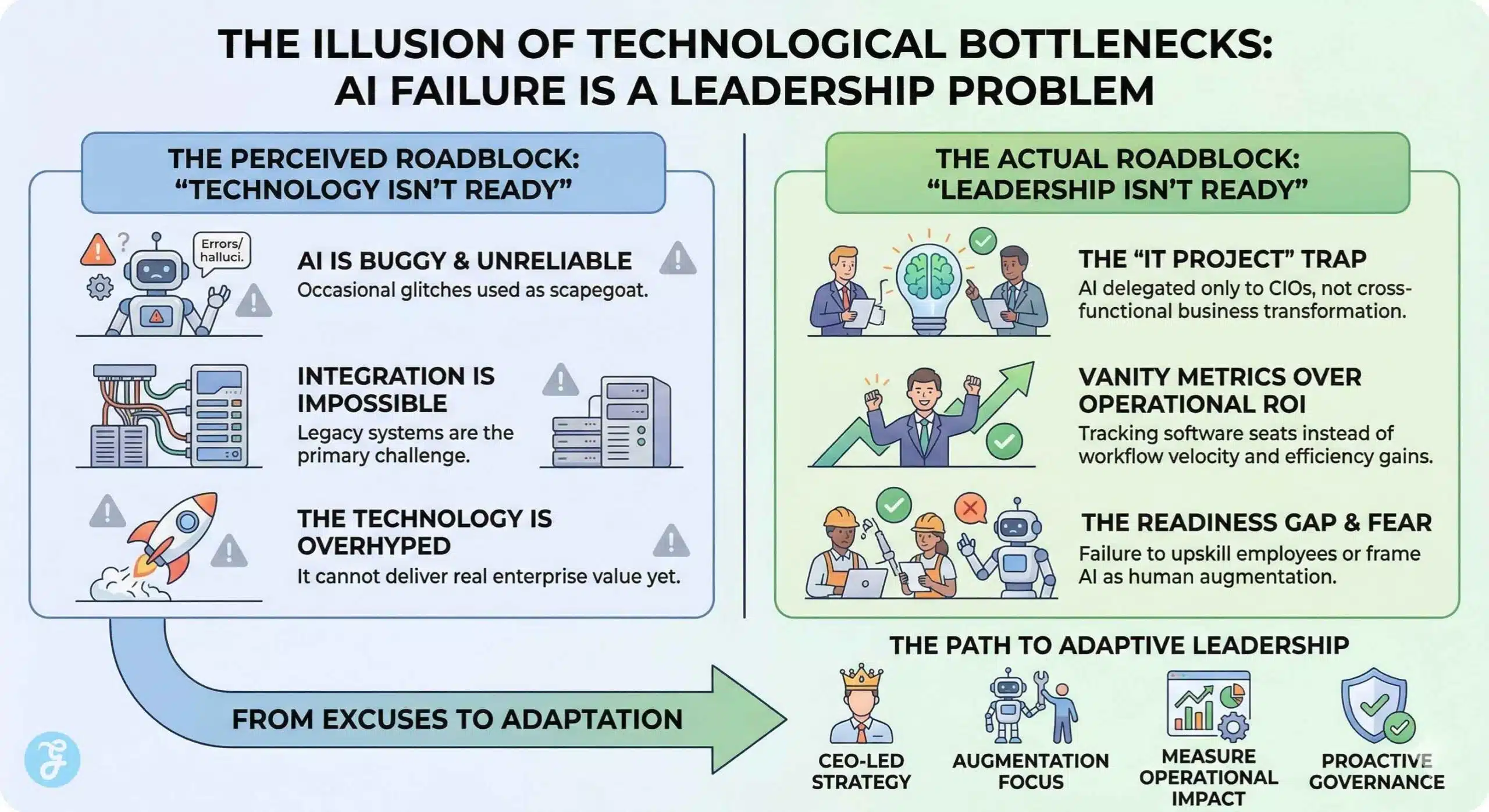
In the current business landscape, it is incredibly common to hear executives complain that artificial intelligence is simply not “ready” for enterprise-scale deployment. They point to occasional hallucinations, slight inconsistencies in output, or the integration hurdles of legacy systems as proof that the technology is overhyped. However, recent data completely dismantles this comforting narrative.
According to Gartner’s 2026 projections, global AI spending is expected to reach a staggering $2.52 trillion. Yet, despite this massive capital influx, many organizations find themselves stuck in what analysts call the “Valley of Disenchantment.”
The harsh reality is that the crisis is not technological; it is deeply organizational. When an AI initiative fails to deliver ROI, it is almost never because the large language model lacked parameters or the machine learning algorithm was flawed. The failure occurred because the organization’s human capabilities and internal processes were vastly underprepared for the integration.
Leaders misdiagnose their own systemic rigidity as a software defect. They expect a new technology to miraculously fix broken, inefficient workflows without requiring any foundational changes to how the business actually operates.
This misdiagnosis provides a convenient scapegoat for leadership teams who are unwilling to do the hard work of organizational restructuring. By blaming the tool, they absolve themselves of the responsibility to adapt.
However, the most successful companies in 2026 have realized that the success or failure of AI adoption depends almost entirely on the level of preparation of human capabilities. The technology is merely an amplifier; if you amplify a dysfunctional, siloed organization, you simply get faster dysfunction.
The C-Suite Disconnect: Vanity Metrics vs. Ground Reality
Executive leadership often fundamentally misunderstands what it means to become an AI-driven organization, treating a profound paradigm shift like a routine software update.
The “IT Project” Trap
One of the most fatal strategic errors an executive team can make is delegating artificial intelligence implementation exclusively to the Chief Information Officer (CIO) or the IT department. For decades, this is how businesses handled new technology: IT buys licenses, installs the software, runs a brief training seminar, and moves on to the next ticket.
But treating AI like a deployment of Microsoft Office or a new cloud storage solution completely misses the magnitude of the shift.
Artificial intelligence is not an IT initiative; it is a holistic business transformation. When it is siloed within the technical department, it is treated as a separate entity rather than an embedded core operating principle.
IT departments are brilliant at ensuring security, uptime, and access, but they are rarely equipped to fundamentally redesign the daily workflows of the marketing, finance, human resources, or product development teams.
Boston Consulting Group’s (BCG) “AI Radar 2026” report highlights that the paradigm has completely shifted. In organizations that are actually seeing massive returns, AI has moved out of the IT basement and into the top decision-making area for CEOs. Over 70% of executives now report that the CEO is the primary driver of AI strategy.
Leaders who still view this as an “IT project” are effectively abdicating their responsibility to steer the company through the most significant operational shift of the century. They check a box indicating that the software has been purchased, completely blind to the fact that the actual business remains unchanged.
Measuring What Matters
This fundamental misunderstanding of deployment strategy naturally leads to executives measuring—and misinterpreting—their own success through deeply flawed metrics. The corporate world is currently drowning in vanity metrics.
Boardrooms celebrate the fact that they have deployed 10,000 enterprise AI licenses across their global workforce, viewing the purchase itself as the accomplishment. They track login rates and API calls, patting themselves on the back for high initial engagement numbers.
However, these metrics are an illusion. A license deployed does not equal a workflow transformed. An employee logging into an AI portal to ask a novelty question or summarize one email does not represent operational integration.
Real adoption is failing behind these impressive-looking deployment dashboards. The metrics that actually matter are far more difficult to track, which is precisely why lazy leadership avoids them.
Instead of tracking software seats, adaptive leaders measure the velocity of their business processes. They look for “hours of repetitive work saved per week,” “increases in creative workflow velocity,” and “time-to-market reductions.”
If an enterprise spends millions on AI but its product development cycle still takes exactly as long as it did in 2024, the initiative has failed, regardless of how many licenses were activated. Leaders must shift their gaze from the IT dashboard to the operational bottom line, measuring the technology’s impact on cognitive load and human output.
The core of this disruption lies in the psychological and practical friction between human workers and autonomous tools, a friction that leaders actively exacerbate through poor messaging.
The Fear of Replacement
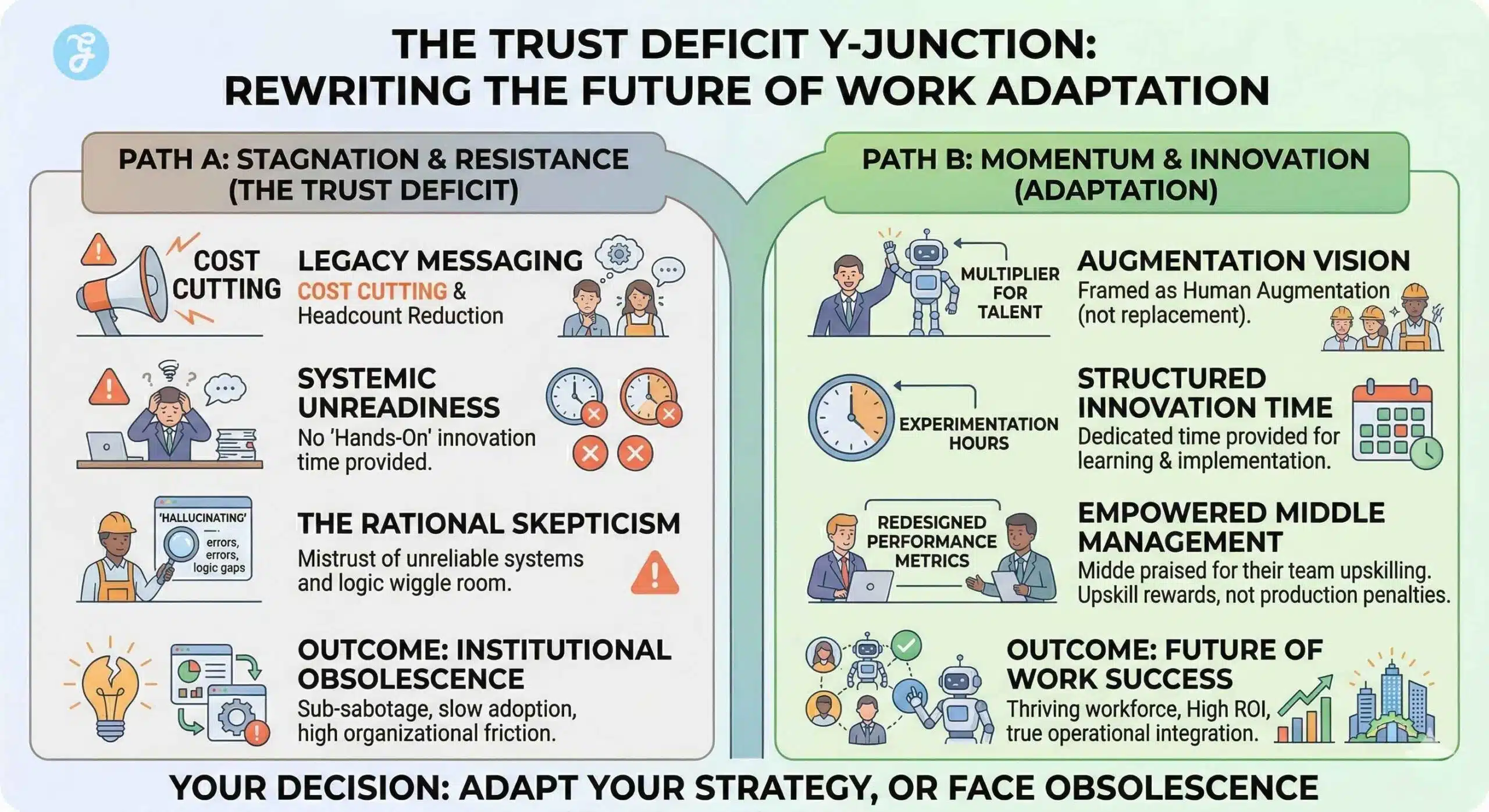
The language that leaders use to introduce autonomous tools directly dictates the level of friction, resistance, and outright sabotage they will encounter from their teams. For years, the prevailing media and corporate narrative surrounding AI has been one of pure automation: cost-cutting, streamlining, and headcount reduction.
When a CEO stands in front of a company and announces a massive AI investment using the language of “efficiency” and “synergy,” the workforce hears only one thing: layoffs.
This fear of replacement is not irrational; it is a perfectly logical response to a historically ruthless corporate environment. If artificial intelligence is positioned primarily as a mechanism to replace human labor, it guarantees aggressive internal resistance.
Employees will not willingly train the systems designed to take their livelihoods. They will find flaws in the output, refuse to integrate the tools into their daily habits, and silently watch the initiative fail.
To overcome this, leaders must aggressively shift the narrative and the actual strategy from automation to human augmentation. The goal is not to have an AI write a marketing campaign so the company can fire the marketing team.
The goal is to have the AI handle the tedious data analysis and A/B test generation so the human marketing team can elevate their strategic and creative thinking to levels previously impossible. Leaders who fail to communicate this vision of human elevation will find their technological investments stonewalled by a terrified, uncooperative workforce.
Creating “Hands-On” Innovation Time
Even if leaders successfully manage the psychological messaging, they often fail spectacularly at providing the practical structure required for adoption. There is a pervasive, almost delusional expectation among executives that employees will somehow learn, master, and integrate complex AI agents in the margins of their already overloaded schedules.
Asking an employee who is already working a chaotic 45-hour week to “figure out how AI can optimize your workflow” is not a strategy; it is a recipe for burnout. True organizational readiness requires dedicated, protected time on the clock for experimentation. You cannot mandate innovation without funding the time required to achieve it.
Leading companies in 2026 understand this intimately. According to recent industry benchmarks, organizations leading the AI transition are pouring up to 60% of their AI budgets strictly into retraining and improving the proficiency of existing personnel. They are not just buying the tool; they are buying the time for their employees to learn it.
This means instituting mandatory, unstructured experimentation hours. It means accepting a short-term dip in traditional productivity metrics to allow workers the breathing room to build the automated solutions that will eventually eliminate their own daily inefficiencies. Adaptation requires space, and it is the leader’s job to clear that space.
The Trust Deficit: Why Employees Resist AI Implementations
The refusal to adapt at the top trickles down, creating an environment where employees rationally distrust the new systems they are forced to use.
The Reliability Wiggle Room
When leaders demand immediate AI integration without providing proper training or establishing realistic expectations, they create a severe “trust deficit” on the ground floor. Executives often look at macro-level AI capabilities and assume the tools are infallible. But the employees actually using these systems day-to-day experience the “reliability wiggle room”, the subtle hallucinations, the logical leaps, and the contextual misunderstandings that AI agents still routinely produce.
Recent insights from organizational researchers, including those at MIT Sloan, reveal a fascinating shift: AI does not just accelerate execution; it participates in decision-making. It introduces suggestions and outputs that look incredibly reasonable, even when the underlying context is flawed. Because the system’s output looks authoritative, employees become hesitant to blindly trust it, but also hesitant to completely overwrite it. Correctness is no longer the same as confidence.
As a result, employees do not intentionally abdicate responsibility; rather, they escalate ambiguity. When an AI tool influences an architectural choice or a financial forecast, the employee seeks reassurance, pushing the decision up the chain of command. Leaders who do not understand this dynamic misinterpret this hesitation as stubbornness or incompetence.
In reality, it is a rational response to a changed decision environment. To fix this, leaders must actively normalize frameworks for “human-in-the-loop” verification. They must teach their employees how to be editors and directors of AI, restoring trust by explicitly stating that the human is the final, valued authority, not the machine.
Middle Management: The Forgotten Friction Point
To truly dissect why adaptation fails, we must shine a light on the structural bottlenecks occurring in the middle of the corporate hierarchy.
The Squeeze from Both Sides
In the grand narrative of corporate disruption, middle managers are almost entirely forgotten, yet they are the exact point where high-level strategy either succeeds or dies. Middle managers are currently experiencing an unprecedented squeeze from both sides. From above, the C-suite is demanding immediate, transformative ROI on their multimillion-dollar AI investments. From below, their direct reports are struggling with the trust deficit, lack of training time, and fear of replacement.
Because AI has expanded the “decision surface” of the company, middle managers are suddenly finding themselves acting as the final validators for a massive influx of AI-generated work. Output volume has increased, but because confidence in that output is shaky, the review process has become overwhelmingly burdensome.
Managers are spending hours verifying AI-generated code, double-checking AI-drafted reports, and untangling automated workflows that went slightly off course.
The core issue is that corporate incentives have not adapted to this reality. Middle managers are still evaluated on the traditional metrics of their team’s raw output and error rates. If a manager pauses production for a week to upskill their team on a new AI agent, their quarterly metrics will plummet, and they will be penalized by the exact same executives demanding AI adoption.
Until leadership completely overhauls performance evaluations to actively reward successful AI integration, upskilling, and the absorption of short-term learning curves, middle management will rationally act as the ultimate blocker to the future of work.
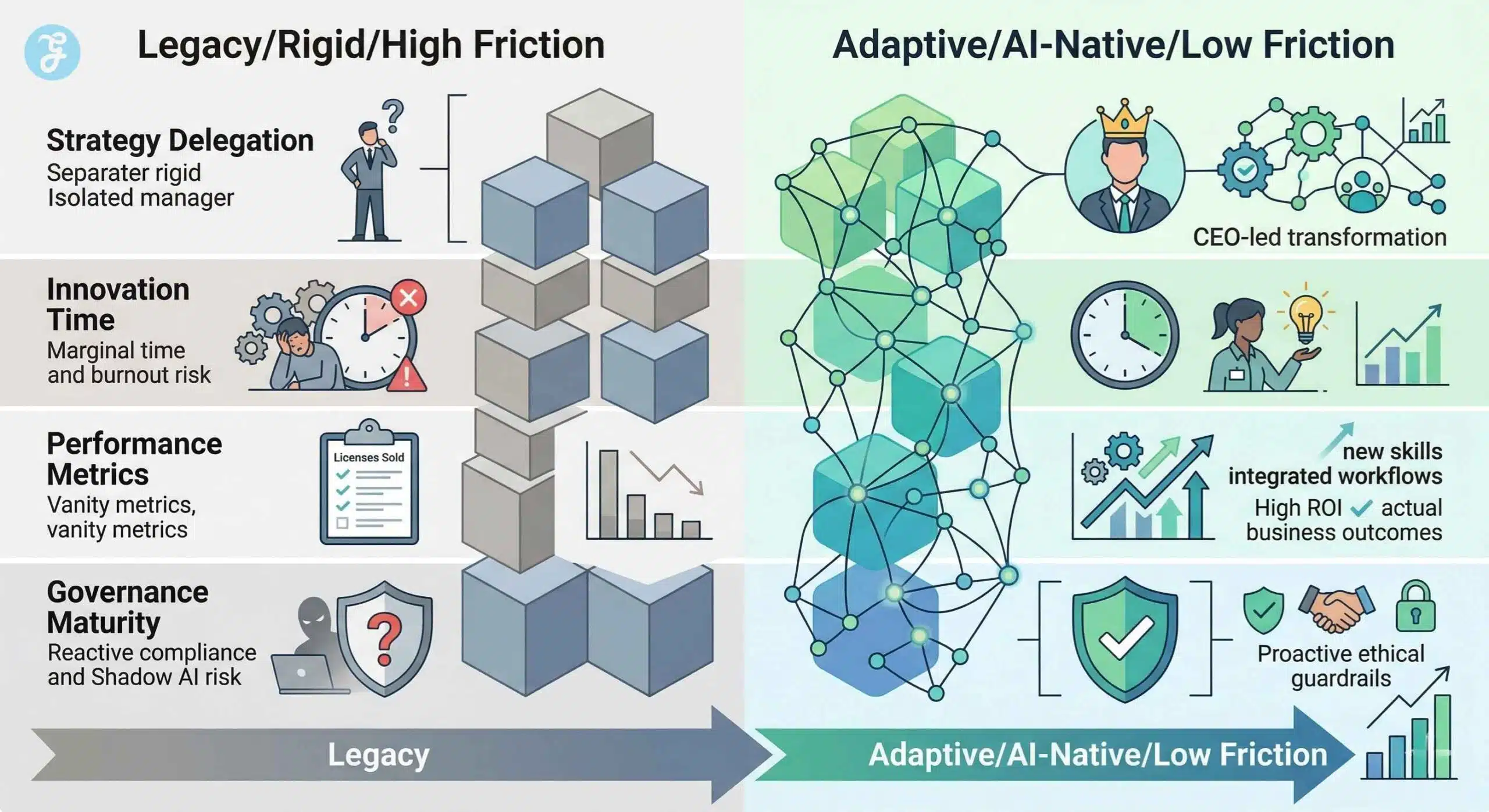
Before diving into the structural changes required to fix this broken system, it is crucial to clearly delineate the stark contrast between legacy leadership mentalities and the adaptive mindsets required today. The following breakdown illustrates exactly where traditional executives fall short and how adaptive leaders are thriving amidst this transition.
| Legacy Leadership Approach | Adaptive AI-First Leadership | Impact on Organization |
| Treats AI as an isolated IT software deployment | Treats AI as a holistic, CEO-led business transformation | Stagnation vs. True Innovation |
| Focuses heavily on automation, efficiency, and headcount reduction | Focuses on talent augmentation, upskilling, and human elevation | High turnover vs. High engagement |
| Measures success by software licenses purchased and login rates | Measures actual workflow integration and time saved | Wasted budget vs. High ROI |
| Expects employees to learn new tools in the margins of their current work | Provides structured, protected time for experimentation and learning | Burnout vs. Rapid capability growth |
| Blames stalled projects on employee “resistance to change.” | Addresses the “readiness gap” by building psychological safety | Mistrust vs. Seamless collaboration |
Redesigning the Corporate Infrastructure
Adaptation requires more than just a change in attitude; it requires a literal rewriting of the company’s operational DNA.
Establishing Clear Governance and Guardrails
The failure of leadership to move quickly and decisively has birthed one of the most dangerous trends in the modern corporate landscape: the explosion of “Shadow AI.” Because executives have spent years debating policies, moving slowly on procurement, or failing to provide adequate, sanctioned tools, employees have simply taken matters into their own hands. They are under pressure to perform, they know these tools exist, and they will use them, with or without permission.
According to Deloitte’s 2026 State of AI in the Enterprise report, worker access to AI rose by 50% in the previous year alone, yet only one in five companies possesses a mature governance model to oversee its use. Even more alarming, recent industry data shows that over 70% of office workers admit to using AI tools without IT approval.
This unauthorized use bypasses all official security protocols, leading to horrific vulnerabilities. Employees routinely paste proprietary code, sensitive client financial data, and unreleased strategic plans into public, consumer-grade large language models to save a few hours of work. The cost of this leadership vacuum is staggering, with data breaches tied to Shadow AI averaging upwards of $670,000 per incident.
To halt this invisible risk, leaders must urgently establish clear, pragmatic governance and guardrails. This is not about issuing blanket bans, which only drive the behavior further underground, but about creating a responsible AI policy that empowers employees safely.
It requires establishing a pre-approved list of vetted tools, extending Data Loss Prevention (DLP) protocols to cover browser-based AI interactions, and implementing Zero Trust architectures. More importantly, it requires building a culture of security awareness where employees understand why governance matters, ensuring that the corporate infrastructure supports innovation without sacrificing institutional integrity.
The Cost of Executive Inaction
The grace period for digital transformation has officially expired. The disruption sweeping through the global economy is unyielding, and it is exposing the deepest flaws in traditional corporate hierarchies. Artificial intelligence has proven its immense capability; it is no longer waiting on technical breakthroughs to deliver value.
It is waiting on CEOs, vice presidents, and directors to fundamentally change how they view their workforce, how they measure success, and how they manage the delicate intersection of human intuition and machine efficiency.
Leaders who continue to treat this era as a passing IT trend, who refuse to fund the necessary retraining, and who lead through fear rather than empowerment, are actively engineering their own obsolescence.
The companies that will dominate the next decade are those led by executives who recognize that true transformation is fundamentally human. The technology is merely the catalyst; adaptability is the ultimate competitive advantage. Failure to pivot now is not just a missed quarterly target; it is the final step toward institutional irrelevance.
Finally: The Ultimate Leadership Mandate
The AI revolution has already arrived, but the true test remains one of human resilience and executive vision. We can no longer afford leadership that hides behind technical excuses or clings to industrial-era management metrics. The future of work disruption demands leaders who are bold enough to fundamentally redesign their organizations around human augmentation, psychological safety, and continuous learning.
Artificial intelligence will not replace visionary leaders, but leaders who refuse to adapt will inevitably be replaced by those who do. The technology is waiting; the only question left is whether you have the courage to evolve.