Iran full-fledged war became the Iranian president’s description of his country’s confrontation with the United States, Israel and European powers, as Tehran faces renewed UN-backed restrictions tied to its nuclear program and the fallout of mid-2025 military strikes on Iranian nuclear sites.
What the president said
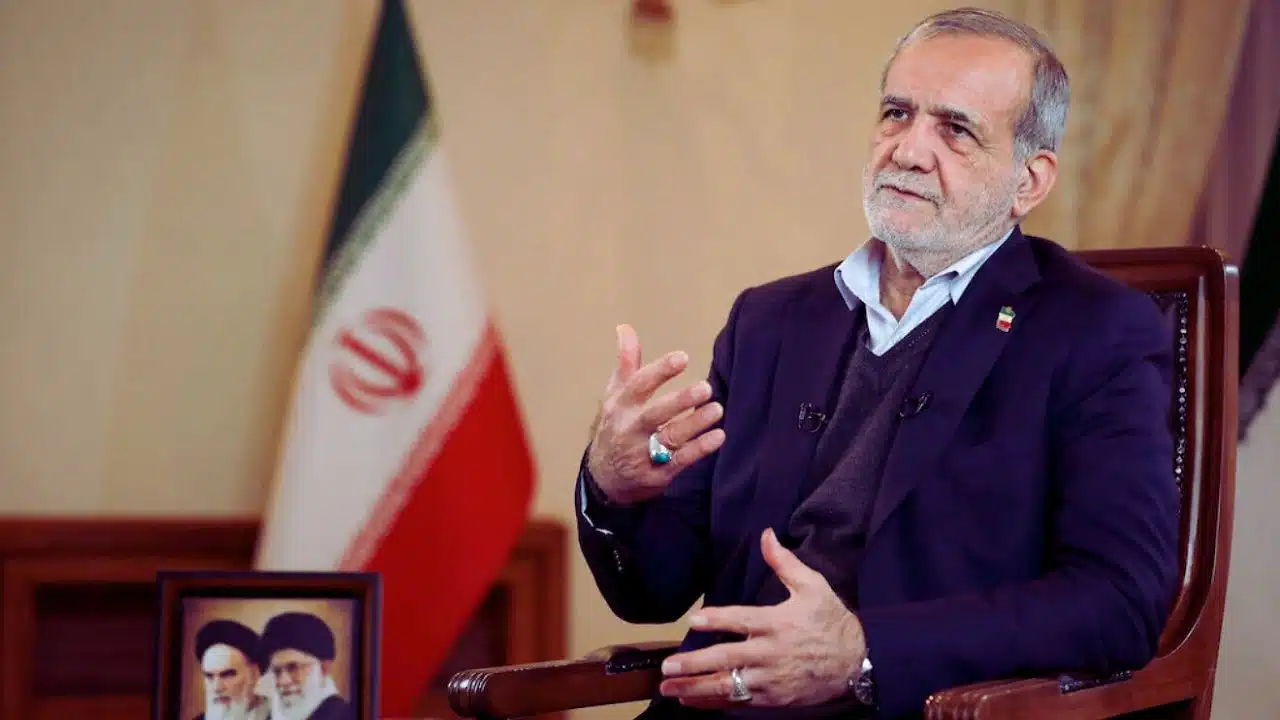
Iranian President Masoud Pezeshkian said Iran is in a “full-fledged war” with the United States, Israel and Europe, arguing these powers do not want Iran “to stand on its feet.”
His remarks were published in an interview carried by the official website associated with Iran’s Supreme Leader Ayatollah Ali Khamenei.
Pezeshkian also compared the current confrontation to the 1980–1988 Iran–Iraq War, saying today’s conflict is “more complicated and more difficult,” as pressure plays out across political, economic, security and media fronts rather than only conventional battlefields.
Why Tehran calls it “war”
Iranian officials and state-aligned messaging increasingly frame sanctions, diplomatic isolation, cyber pressure, and targeted strikes as parts of a single campaign aimed at weakening the country and limiting its regional influence.
Pezeshkian’s comments also came with a deterrence signal, with reports quoting him warning that another attack would bring a stronger response from Iran.
The statement lands amid heightened uncertainty about whether diplomacy can resume or whether pressure will intensify, especially as Israel and the US continue to present Iran’s nuclear activities as a security threat.
Military backdrop: strikes on nuclear sites
In June 2025, President Donald Trump announced US strikes on three Iranian nuclear facilities—Fordow, Natanz and Isfahan—calling the operation “very successful.”
US reporting on the operation said the strikes involved bunker-buster munitions, and that Washington also sent diplomatic messages indicating it did not seek broader escalation or “regime change” as part of that action.
Separate reporting at the time noted there was no independent damage assessment immediately available, while Iranian nuclear authorities confirmed the sites were attacked and said the nuclear program would continue.
Key events timeline
| Date (2025) | Event | What was reported | Why it matters |
| Jun 21 | US strikes on Fordow, Natanz, Isfahan | Trump announced attacks on three nuclear sites in Iran. | Marked a major escalation and tied the nuclear file directly to military action. |
| Aug 28 | “Snapback” triggered by E3 | France, Germany and the UK said they triggered the snapback mechanism due to Iran’s “significant non-performance.” | Started the process to restore pre-JCPOA UN restrictions. |
| Sept 27 | UN restrictions reinstated | E3 said multiple older UN Security Council Iran resolutions were reinstated after the snapback process. | Reintroduced UN-based constraints and widened pressure on Iran’s nuclear activities. |
| Dec 27 | Pezeshkian: “full-fledged war” | Iran’s president said Iran is in a full-fledged war with the US, Israel and Europe. | Signaled Tehran views the dispute as systemic and ongoing, not a single crisis. |
The sanctions snapback and the nuclear dispute
France, Germany and the United Kingdom (the “E3”) said they triggered the JCPOA “snapback” mechanism on 28 August 2025, arguing Iran remained in significant non-performance of its commitments.
They said that, as a result, UN Security Council resolutions from 2006–2010 were reinstated as of 27 September 2025 through the snapback process described under UN Security Council Resolution 2231.
In their joint statement, the E3 cited an International Atomic Energy Agency (IAEA) report dated 4 September 2025, saying Iran held enriched uranium at 48 times the JCPOA limit and that Iran’s stockpile was “entirely outside of IAEA monitoring,” including what they described as 10 “Significant Quantities” of high enriched uranium.
UN resolutions the E3 said were reinstated
| UN Security Council resolution (year) | Status described by E3 after snapback | Notes from E3 statement |
| 1696 (2006) | Reinstated (snapback) | Part of the set of pre-JCPOA measures restored after snapback. |
| 1737 (2006) | Reinstated (snapback) | Restored as part of the snapback outcome. |
| 1747 (2007) | Reinstated (snapback) | Restored as part of the snapback outcome. |
| 1803 (2008) | Reinstated (snapback) | Restored as part of the snapback outcome. |
| 1835 (2008) | Reinstated (snapback) | Restored as part of the snapback outcome. |
| 1929 (2010) | Reinstated (snapback) | Restored as part of the snapback outcome. |
Regional and diplomatic context
Reporting around the interview tied Pezeshkian’s comments to regional tensions and to anticipated high-level coordination between Israel and the US, including a planned meeting between Israeli Prime Minister Benjamin Netanyahu and President Donald Trump.
In the E3’s snapback statement, the European governments said the reimposition of UN sanctions was “not the end of diplomacy,” while urging Iran to return to compliance with its safeguards obligations and avoid escalation.
The gap between Tehran’s framing—pressure as a “full-fledged war”—and Western demands—nuclear transparency, monitoring access and limits on enrichment—has hardened the political space for compromise.
Final thoughts
Pezeshkian’s “Iran full-fledged war” message signals Tehran is preparing its public for a prolonged confrontation where sanctions and political pressure are treated as strategic threats, not temporary bargaining tools.
At the same time, the snapback process restores UN-centered restrictions that can expand enforcement risk for trade, shipping, and financial channels linked to Iran, increasing the cost of continued nuclear escalation.
The next phase will likely hinge on whether Iran and Western governments can re-establish monitoring and negotiations, or whether military deterrence and economic restrictions become the primary instruments shaping the dispute.