Anthropic on Dec. 18, 2025 expanded Claude’s Skills and published the Agent Skills open standard, aiming to make reusable AI workflows easier to manage in organizations and portable across skills-compatible tools.
Why Anthropic is betting on “skills” as the next layer for workplace AI?
Businesses have experimented with chatbots for drafting emails, summarizing documents, and answering questions. But those wins often stall when teams try to scale the same tool across departments with consistent results. The core problem is repeatability: a great prompt in one person’s hands can become a messy output in another person’s hands.
Anthropic’s answer is the anthropic-agent-skills-open-standard approach instead of treating every request as a one-off prompt, package “how we do this task” as a reusable, structured unit that can be shared, versioned, and audited.
In Anthropic’s framing, an AI agent becomes more reliable when it can load the right operational knowledge at the right moment—without dragging an entire policy library into every conversation. That idea is central to Skills: keep the agent fast, but allow deeper guidance when a task clearly calls for it.
This matters now because “agentic” tools are moving from demos to daily workflows. Once agents can access files, run code, and connect to systems, the risk of inconsistency rises too the same model can behave differently depending on who prompted it, what context it saw, and what tools were available. Skills are meant to standardize that layer.
What Agent Skills are and how they work in plain language?
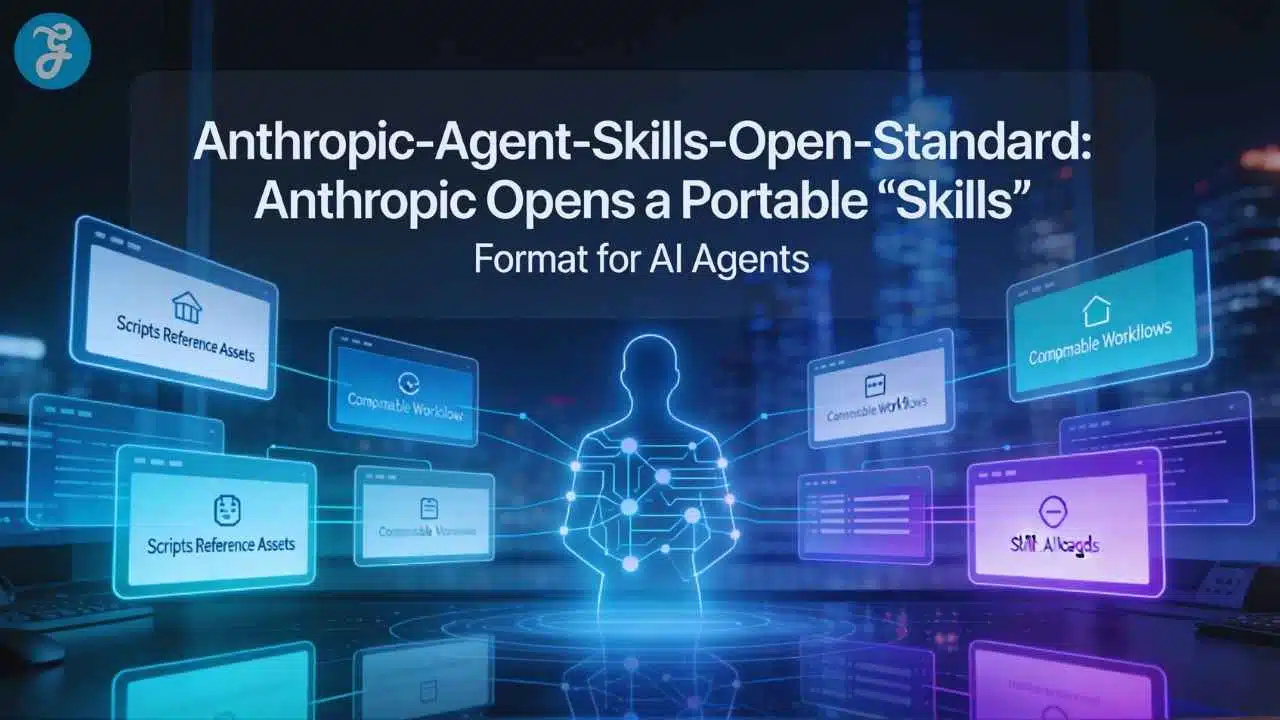
Agent Skills are essentially folders that teach an agent how to do a task consistently. At minimum, a Skill includes a single instruction file. It can also include scripts, reference documents, and templates—organized so an agent can pull in extra materials only if needed.
A key design goal is progressive disclosure:
- The agent first learns only what each Skill is for (so it can decide whether it applies).
- If a Skill is relevant, the agent loads the detailed instructions.
- If it needs extra resources—like a checklist, a policy page, or a script—it loads those on demand.
That structure is meant to reduce “prompt sprawl,” where teams keep pasting longer and longer instructions into chats, slowing down work and increasing errors.
What’s inside a typical Skill folder?
| Skill element | What it does | Why it helps teams |
| SKILL.md (required) | Describes what the Skill does and when to use it | Creates a single, auditable source of truth for a workflow |
| YAML metadata (in SKILL.md) | A strict name + a descriptive summary | Helps agents discover the right Skill automatically |
| scripts/ (optional) | Executable code (where supported) | Improves reliability for tasks better handled by code than text generation |
| references/ (optional) | Policies, long documentation, examples | Keeps detailed context out of the main prompt until needed |
| assets/ (optional) | Templates and static resources | Makes outputs consistent (formats, tables, document layouts) |
How Skills are invoked during real work?
Anthropic describes Skills as composable more than one Skill can be used in a single workflow. For example, a team could combine a “brand guidelines” Skill with a “press release format” Skill and a “fact-check checklist” Skill to standardize a newsroom-style output.
In practice, “activation” relies heavily on how well a Skill is described. The clearer the description of “when to use,” the easier it is for an agent to choose the right Skill without guesswork.
What changed in December 2025: management, distribution, and deployment?
Anthropic’s December expansion focuses on making Skills easier to deploy responsibly in organizations—especially where admins need control over what workflows are available and what resources an agent is allowed to use.
Organization-wide enablement and governance
For business plans, Skills aren’t just a personal feature. Admins can enable Skills at the organization level, which matters for two reasons:
- Standardization: teams can use the same workflow definitions instead of reinventing prompts.
- Governance: admins can reduce the risk of employees importing unreviewed Skills that contain unsafe instructions or scripts.
This is where Skills move from “power-user customization” into “company capability.” A central Skills library can encode approved processes—like editorial tone rules, compliance steps, customer support triage, or finance reporting templates.
Distribution via shared libraries and marketplaces
Anthropic has supported distributing Skills through version control and through a public Skills repository. That makes Skills easier to maintain like software you can update a workflow, track changes, and roll improvements across a team.
This distribution model also creates room for partner and community ecosystems—where vendors, consultants, and developers publish ready-to-use Skills for common workflows. The larger the library of trustworthy Skills, the less time teams spend building from scratch.
Skills in the API and execution environments
Anthropic also positions Skills for developers building agentic systems on the Claude API. In that environment, Skills become a way to ship procedural knowledge alongside tools like code execution and file handling.
The practical implication is important if you allow an agent to run code for reliability, you also need a safe way to define what that code is allowed to do and when it should run. Skills provide the packaging; the execution environment provides the guardrails.
The open standard: what “anthropic-agent-skills-open-standard” actually standardizes
The headline step is making Agent Skills an open standard with a public specification. The most concrete part is the strict, shared format for SKILL.md—including required metadata and recommended structure.
The most important rule: consistent naming and descriptions
A Skill must have:
- A name with strict constraints (lowercase, hyphenated, length-limited).
- A description that explains what it does and when to use it.
Those constraints are not cosmetic. They are meant to make Skills portable and interoperable, because different tools can rely on the same rules to validate and load Skills.
Optional fields that matter for real deployments
The spec also allows optional fields that become important in enterprise use:
- License: clarifies how a Skill may be reused or distributed.
- Compatibility notes: flags environment requirements such as needing certain system tools or network access.
- Metadata: allows organizations to add internal identifiers, versions, owners, or compliance tags.
- Allowed tools (experimental): signals pre-approved tools a Skill may use, helping constrain agent behavior.
Progressive disclosure becomes part of the standard
The spec doesn’t just define file names—it also defines an expected loading pattern:
- Metadata loads by default for all Skills.
- Full instructions load only for activated Skills.
- Resources load only as needed.
This is one of the most practical ideas in the standard because it addresses a day-to-day bottleneck: context is finite, and pushing everything into every prompt is expensive and error-prone.
Adoption and interoperability
The Agent Skills site positions the format as supported by multiple AI development tools, including developer environments and coding agents. The emphasis is interoperability: “build once, deploy across multiple agent products.”
Even with a shared format, portability is not perfect in practice. Different products have different tool permissions and runtime capabilities. A Skill that relies on code execution, file operations, or internet access may behave differently depending on the environment. The spec’s compatibility notes exist largely because of this reality.
What it means for businesses, creators, and the broader agents ecosystem?
Anthropic’s move is less about a single new feature and more about pushing a workflow layer into a shared industry direction.
For enterprises: fewer “prompt tribes,” more repeatable work
Most organizations see a familiar pattern:
- A few experts learn how to prompt well.
- Others copy partial prompts or outdated templates.
- Outputs drift over time.
- Trust erodes, and adoption stalls.
Skills are designed to replace that with:
- Shared workflow packages.
- Controlled rollout by admins.
- Versioned updates.
- Clear boundaries around what an agent should do.
If implemented well, that can improve consistency in high-stakes work like customer support, finance reporting, regulated industries, and publishing workflows.
For builders and partners: a new unit of reuse
For developers and consultants, Skills can become a reusable deliverable—like a template library, but designed for agents. Instead of selling a long prompt document, a provider can ship a Skill folder with validated metadata, structured instructions, and optional scripts.
That can also reduce duplication across agent products. If multiple tools support the same format, teams can keep one “workflow source” and adapt only the tool-specific execution parts.
For end users: better outputs without memorizing prompting tricks
For everyday users, the promise is simple fewer “prompting gymnastics.” A well-written Skill can guide an agent through a workflow step-by-step, including edge cases and success criteria, without forcing the user to remember every rule each time.
What comes next?
- Skills are increasingly positioned as a governance-friendly way to scale AI workflows, not just a power feature.
- The open standard pushes Skills beyond a Claude-only idea and invites cross-tool adoption.
- The next challenge is quality: Skills will only help if they are well-written, well-reviewed, and kept current.
- Expect more tooling around validation, testing, and lifecycle management—because Skills behave more like software assets than simple prompts.