

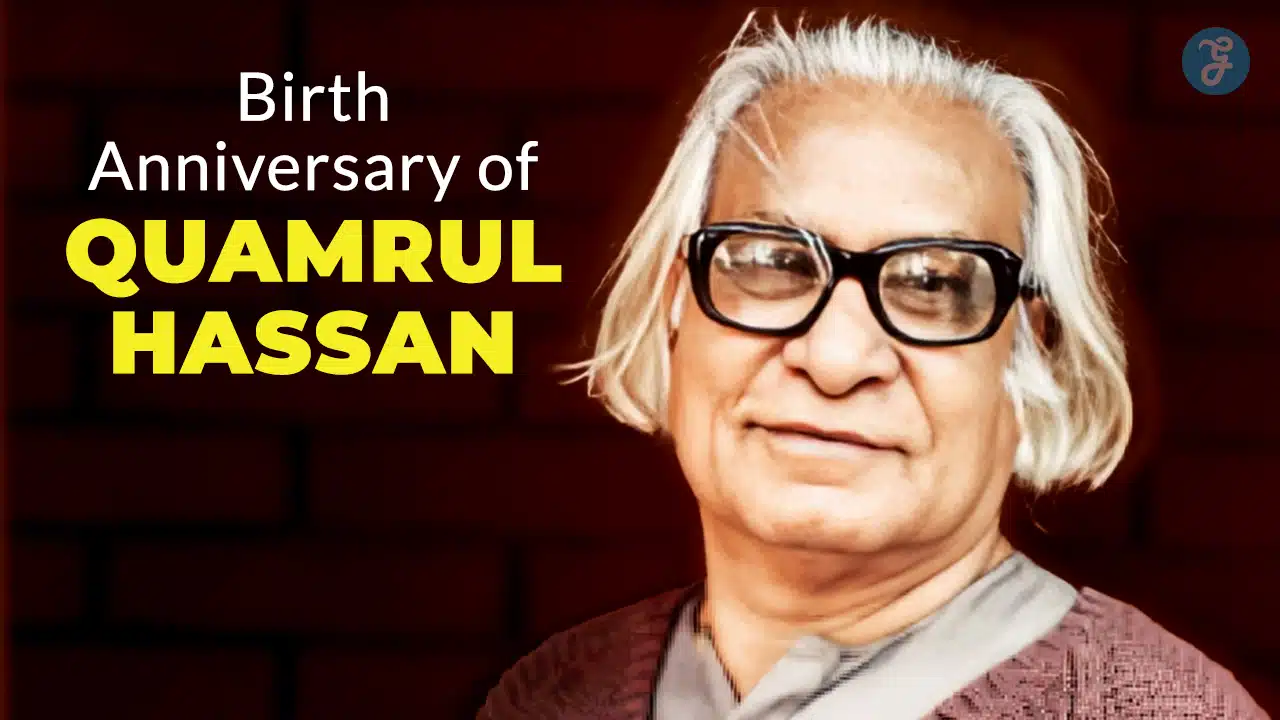
If Quamrul Hassan were alive today, he would be 104 years old. Yet his work still feels vivid, urgent, and uncomfortably relevant. His lines, colors, and symbols continue to speak to our politics, our culture, and our conscience.
Often remembered as the “Potua of Modern Bengal,” Quamrul Hassan was more than a painter. He was a bridge between folk tradition and modern art, between rural Bengal and urban elites, and between beauty and protest. At 104, his legacy still shapes how we see ourselves as Bengalis and as citizens of a struggling yet hopeful republic.
This article explores why his art has not faded with time, how he helped define our national visual identity, and why his fearless voice still matters in today’s Bangladesh.
Who Was Quamrul Hassan
Quamrul Hassan was born in 1921 and grew into one of the most influential visual artists of twentieth-century Bengal. He studied in Calcutta, worked in both undivided India and Pakistan, and eventually became a central cultural figure in independent Bangladesh.
He was:
- A painter and graphic artist
- A designer of posters, stamps, logos, and state symbols
- A teacher and mentor
- A fierce political satirist
From nationalist posters to textbook illustrations, his work reached people far beyond galleries. He wanted art to live in the streets, in homes, and in the minds of ordinary people, not only on white walls in elite spaces.
Why Was Quamrul Hassan Called the “Potua of Modern Bengal”
In older usage, the word “potua” described rural scroll painters and folk artists who moved from village to village. Many urban elites once saw them as minor or low-level artists. Quamrul Hassan did the opposite. He wore the word with pride.
He studied folk forms like patachitra, terracotta, rural toys, and village wall paintings. Then he used that visual language in a modern way. He mixed:
- Bold, flowing lines
- Flat yet expressive colors
- Stylized human and animal figures
- Repeated motifs from village life and folk myths
By doing this, he showed that the so-called village style was not backward at all. It was powerful, flexible, and deeply rooted in Bengali memory. He pulled the potua into the modern age and refused to separate “folk art” from “fine art.” That is why the title “Potua of Modern Bengal” feels like a crown, not an insult.
Blending Folk Traditions With Modern Art
Quamrul Hassan was trained in modern techniques, but he refused to copy Europe. Instead, he asked a simple question. What does modernity look like when it grows from Bengali soil?
You can see his answer in:
- The curved backs of farmers and fishermen
- The posture of village women carrying water
- The faces of folk musicians and bauls are depicted with expressive features.
- The stylized birds, fish, and animals that appear again and again
He simplified forms, exaggerated curves, and flattened space. At the same time, he kept the warmth and rhythm of folk art. The result was a style that felt new, yet completely familiar. It was modern art that spoke the language of the people.
This fusion did two important things. It gave Bengali culture its modern visual identity. It also protected folk forms from being forgotten or treated as outdated.
Art as a Weapon: His Political and Social Satire
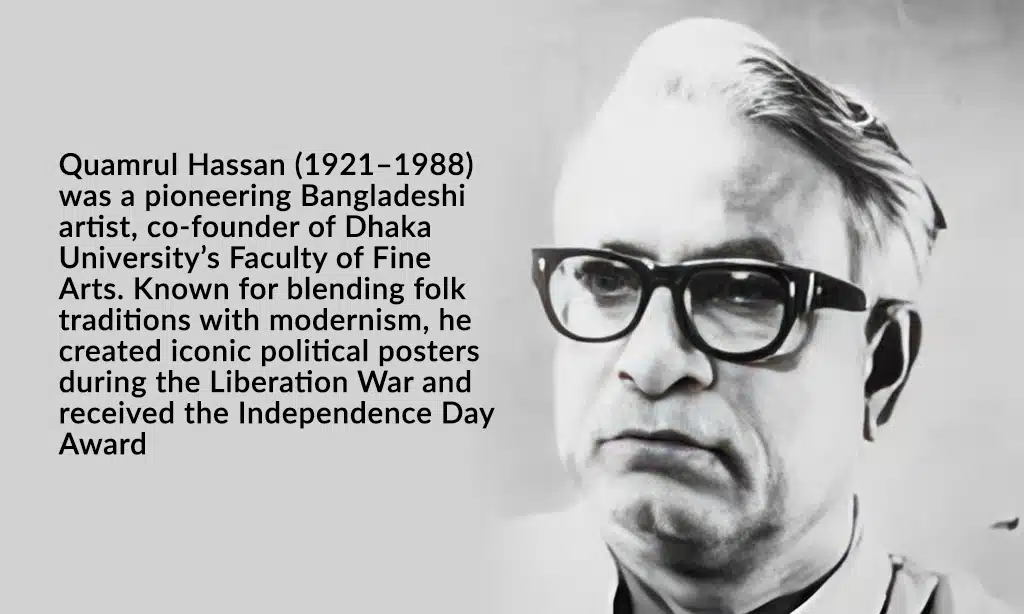
Quamrul Hassan did not paint only for beauty. He painted to speak. And often, he painted to accuse.
One of his most famous images portrayed a dictator as a monstrous beast with the caption that called for the beast to be killed. The image spread quickly. It became a symbol of resistance in a time of fear and censorship.
This was not the only time he used art as a political weapon. Across his career, he drew and painted:
- Greedy faces with swollen stomachs and sharp teeth
- Twisted figures that represented corruption and cruelty
- Scenes that exposed social inequality and moral decay
He had a clear sense that art should stand with the oppressed, not with the powerful. His work serves as a reminder that a brush can be more powerful than a sword when it conveys the truth without fear.
Shaping the Visual Identity of a New Nation
After independence, Bangladesh needed not only a constitution and institutions but also a visual language. Quamrul Hassan helped create that language.
He contributed to:
- State emblems and insignias
- Stamps and posters
- Textbook illustrations and public murals
- Designs for cultural institutions and national events
Many people in Bangladesh grow up seeing his works in classrooms, government offices, and public spaces, even if they do not always know his name. His visual choices shape how we see the farmer, the worker, the mother, the river, the flag, and even the enemy.
He helped answer a silent question. If you had to draw Bangladesh, how would it look?
A Humanist Eye: The Ordinary People at the Center
One of the most powerful things about Quamrul Hassan is who he chose to center. He rarely glorified kings, businessmen, or high officials. Instead, he looked at:
- The rickshaw puller is struggling through traffic
- The fisherman pulling in his net
- The mother is feeding a child.
- The village woman walking barefoot on a dusty path
- A rural craftsman shapes clay or weaves cloth.
He painted ordinary people with dignity and sensitivity. Work may have bent their bodies, yet their presence remains strong. Even when he exaggerated forms, he never turned them into jokes.
Through this humanist eye, he taught viewers an important lesson. A nation is not its rulers. A nation is its people.
5 Reasons Why Quamrul Hassan Still Matters at 104
Why does an artist who died decades ago still feel so present? There are several reasons.
1. He protects our cultural memory
In a globalized media environment, it is easy to lose track of our roots. Quamrul Hassan’s art is a storehouse of Bengali visual memory. The textures, colors, and forms in his work keep our cultural references alive.
2. He represents artistic courage
He showed that artists must not remain neutral when injustice grows. His posters and satirical works still inspire those who believe that creativity must stand with conscience.
3. He proves folk culture is not inferior
In a world where Western trends often dominate, his work is a reminder that local traditions can generate world-class modern art.
4. He offers a model for future fusion
Younger artists today experiment with digital media, animation, and global styles. Quamrul’s method offers a roadmap. Look inward first. Then bring your culture into dialogue with the world.
5. He Believed Art Is for the People
At a time when art is increasingly commercialized, his philosophy feels revolutionary.
What Quamrul Hassan Means for Young Artists Today
For young painters, designers, illustrators, animators, and graphic storytellers, Quamrul Hassan’s life carries several messages.
Start from your own soil: You can learn from everywhere, but your deepest power comes from your own stories, textures, and landscapes.
Respect folk traditions: Folk art is not just nostalgia. It is a massive archive of forms and symbols that can still speak in fresh ways.
Do not be afraid of politics: You do not have to be partisan, but you cannot ignore injustice. When you see something wrong, your art can say what many cannot say aloud.
Think beyond galleries: He designed posters, stamps, public art, and textbooks. Follow his example. Let your work reach people in daily life, not only in formal art spaces.
Remember that style is not enough: Technique matters, but so does heart. His lines are powerful not only because they are skillful but also because they carry honesty and empathy.
The Potua Who Still Holds Up a Mirror
At 104, Quamrul Hassan remains a living presence in our cultural imagination. He was a potua, a modernist, a nationalist, a satirist, and above all, a humanist.
He showed us:
- How to be modern without losing our roots
- How to honor folk traditions while creating new forms
- How to criticize power without losing love for people
- How to make art that is both beautiful and brave
In every folk-inspired graphic, every bold political cartoon, and every modern painting that uses a rural motif with pride, there is a faint echo of his work. Quamrul Hassan did not simply paint Bengal. He helped Bengal see itself. That is why, at 104, the “Potua of Modern Bengal” still shapes our cultural identity.
Frequently Asked Questions
Here are the most frequently asked questions people have about Quamrul Hassan and his legacy.
Why is Quamrul Hassan called the “Potua of Modern Bengal”?
He is called the “Potua of Modern Bengal” because he took the visual language of traditional village potuas and scroll painters and used it in modern art. He proved that folk aesthetics could stand at the center of modern Bengali identity rather than at the margins.
What made his art style unique?
His style was unique because it combined folk motifs with modern simplification and bold design. He used strong lines, stylized figures, and flat areas of color while keeping the warmth and rhythm of rural art. This mix allowed his work to feel both contemporary and deeply rooted in Bengali culture.
How did Quamrul Hassan influence the visual identity of Bangladesh?
He influenced the visual identity of Bangladesh through his work on posters, state symbols, stamps, textbooks, and public art. His images of farmers, workers, mothers, and freedom fighters helped create a shared visual language that people connect with the country’s history and ideals.
Was Quamrul Hassan involved in politics?
He was not a career politician, but his art was strongly political. He created satirical and critical images against dictatorship, corruption, and injustice. One of his most famous works portrayed a military ruler as a beast, which became a powerful symbol of public resistance.
Why is his work still relevant today?
His work is still relevant because the issues he cared about are still with us. Questions of justice, equality, cultural identity, and the dignity of ordinary people remain central in Bangladesh and beyond. His art offers both inspiration and warning, reminding us that culture without conscience is empty.
























