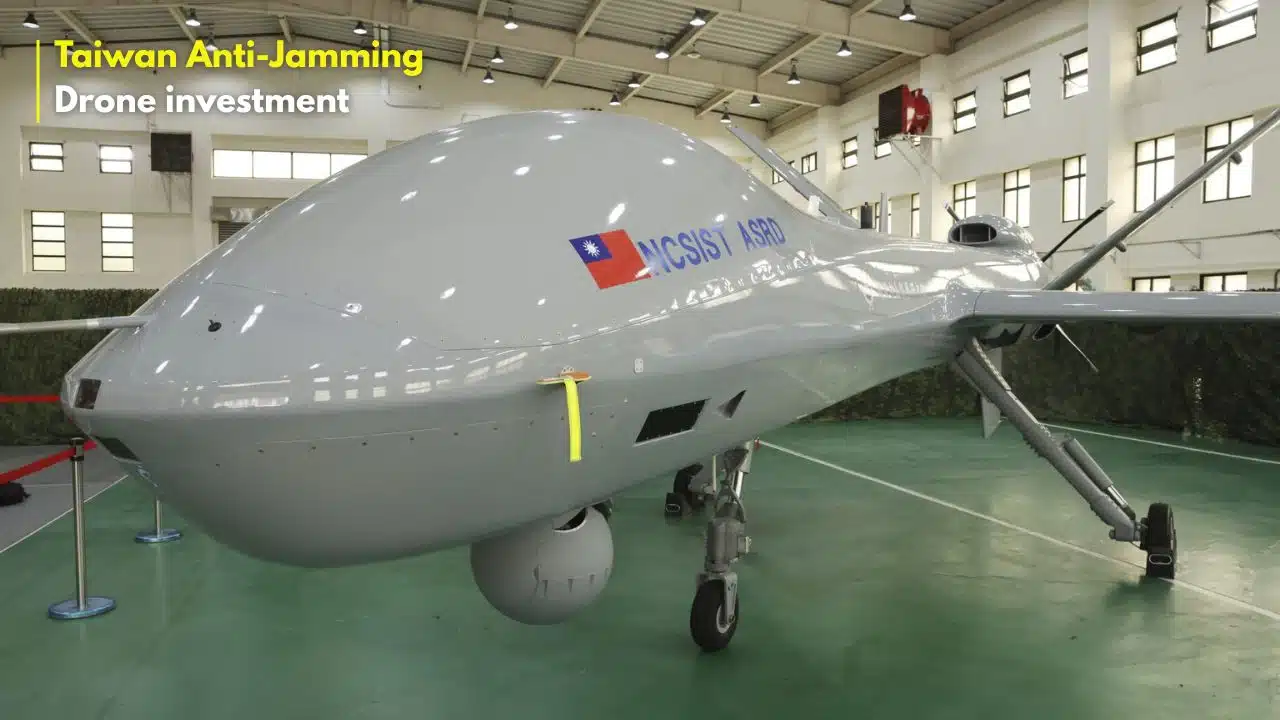
In a decisive move to fortify its asymmetric defense capabilities, Taiwan’s Ministry of National Defense (MND) has allocated a targeted $32 million (approx. NT$1 billion) tranche specifically for advanced anti-jamming drone technology. While the sum appears modest compared to multi-billion dollar fighter jet procurements, defense analysts argue this specific investment represents a critical pivot in Taiwan’s survival strategy: shifting from “hardware dominance” to “electronic resilience.”
This allocation, confirmed by defense officials this week, is the first phase of a strategic hardening of Taiwan’s “Drone National Team.” It directly addresses the “soft underbelly” of unmanned warfare exposed in Ukraine and the Middle East: the extreme vulnerability of small drones to Electronic Warfare (EW) and GNSS (Global Navigation Satellite System) denial.
At a Glance: The “Hardened” Drone Initiative
-
The Catalyst: Recent PLA exercises demonstrating the ability to sever drone-to-pilot links within seconds.
-
The Investment: $32 Million (NT$1 Billion) strictly for EW resilience (AESA radars, CRPA antennas, encrypted datalinks).
-
The Context: Part of the massive $1.4 Billion (NT$44.2 Billion) “Democratic Drone Supply Chain” plan approved in October 2025.
-
The Tech: Moving beyond GPS—utilizing “visual odometry” and “inertial guidance” to fly blind when satellites are jammed.
-
The Geopolitics: A move to align with the U.S. “Replicator” initiative, ensuring Taiwan’s drones can interface with American systems.
The Strategic Context: Why $32 Million Matters Now
To understand the significance of this investment, one must understand the changing nature of the threat in the Taiwan Strait.
For years, the People’s Liberation Army (PLA) has intensified its “gray zone” tactics—coercive actions that stop short of war. A key component has been the deployment of high-powered jamming ships and aircraft capable of creating a “GPS blackout” zone. In such an environment, a standard commercial drone—even a high-end one—is rendered useless. It either drifts away, crashes, or initiates an emergency landing, potentially falling into enemy hands.
The $32 million investment is not for buying more drones; it is for buying the brains and shields that allow existing drones to survive.
Decoding the Tech: What is Taiwan Buying?
The MND’s procurement list, though classified in specifics, centers on three pillars of technology that transform a fragile commercial drone into a military-grade asset.
1. CRPA (Controlled Reception Pattern Antenna)
The crown jewel of this investment is the mass adoption of CRPA technology.
-
The Problem: Standard GPS antennas listen to signals from all directions. A jammer simply screams louder than the satellite, drowning out the signal.
-
The Solution: CRPA uses an array of multiple antennas to detect where the jamming signal is coming from and mathematically “nulls” or ignores that specific direction, while still listening to satellites from other angles.
-
The Cost: Historically, these units cost $10,000+ each. Taiwan’s domestic manufacturers are aiming to drive this down to under $1,000 per unit for mass deployment.
2. Compact AESA Radars
Funds are flowing to companies like Tron Future Tech to miniaturize Active Electronically Scanned Array (AESA) radars. Unlike old mechanical radars, AESA can scan thousands of frequencies simultaneously.
-
Application: These radars can detect incoming hostile drones and locate the source of enemy jamming, allowing Taiwan’s forces to target the jammer itself.
3. Visual Odometry & Inertial Navigation
When the electronic spectrum becomes too “hot” and all radio signals are jammed, the drone must fly autonomously.
-
Visual Odometry: The drone uses onboard cameras to track the terrain below it, calculating speed and position by watching how the ground moves relative to the camera (similar to an optical mouse on a mousepad).
-
Inertial Measurement Units (IMUs): High-grade sensors that track movement without any external reference.
Comparison: Standard vs. Hardened Drones
| Feature | Standard Commercial Drone | Taiwan’s New “Hardened” Standard |
| Navigation | GPS / GLONASS dependent | Multi-constellation GNSS + CRPA + Visual Backup |
| Jamming Reaction | Drifts, Returns Home, or Crashes | Switches to Inertial/Visual flight; continues mission |
| Datalink | Unencrypted Radio (2.4GHz) | AES-256 Encrypted Frequency Hopping |
| Radar Signature | High | Reduced (Composite materials) |
| Supply Chain | Often includes Chinese components | 100% “Non-Red” (Taiwan/US/allied sourced) |
The “Non-Red” Supply Chain: Security by Design
A critical stipulation of the $32 million fund is the absolute exclusion of the “Red Supply Chain”—components manufactured in China.
In the past, even military-grade drones often contained Chinese-made flight controllers, batteries, or transmission modules. This posed two risks: Backdoors (hidden code sending data to Beijing) and Kill Switches (remote deactivation).
Yu-Jiu Wang, CEO of Tron Future Tech, a primary beneficiary of the new contracts, highlighted this shift at a recent defense forum in Hsinchu:
Tron Future has recently secured contracts totaling nearly NT$1 billion ($32M) to equip the Taiwanese Army and Navy with these hardened systems, confirming their pivotal role in this new strategy.
The $1.4 Billion Roadmap: A Global Drone Hub
This anti-jamming initiative is merely the tip of the spear. In October 2025, the Executive Yuan approved a comprehensive NT$44.2 billion (US$1.4 billion) roadmap extending to 2028.
Key Goals of the Roadmap:
-
Monthly Production Capacity: Scale up to produce 15,000 military-grade drones per month by 2027.
-
Testing Infrastructure: Establishment of a dedicated drone testing range in Chiayi, equipped with EW simulators to stress-test drones against jamming.
-
Global Certification: Aligning Taiwan’s drone standards with U.S. military specifications to facilitate exports.
This roadmap effectively positions Taiwan to become the “Arsenal of Democracy” for unmanned systems, filling the gap left by the exclusion of DJI and other Chinese manufacturers from Western markets.
Geopolitical Ripple: The U.S. “Replicator” Connection
International observers note that Taiwan’s push for anti-jamming tech dovetails perfectly with the U.S. Department of Defense’s “Replicator” initiative, which aims to field thousands of autonomous systems to counter China’s mass.
A defense analyst from the Center for Strategic and International Studies (CSIS), speaking on condition of anonymity, told English News:
Discussions are reportedly ongoing to integrate Taiwanese anti-jamming modules into US-made “Switchblade” loitering munitions.
The Human Element: Soldiers on the Frontline
For the troops stationed on Kinmen and Matsu—islands located just kilometers from the Chinese coast—this technology changes the daily reality.
Currently, soldiers face frequent harassment from Chinese civilian drones that drop propaganda leaflets or simply hover to surveil defenses. Soldiers have often been forced to throw stones or use basic signal guns with limited effect.
With the deployment of Tron Future’s portable anti-drone radars (funded by this tranche), frontline troops will receive:
-
Early Warning: Passive detection of drones 5km away.
-
Soft Kill Capability: Portable “rifles” that can direct a narrow beam of jamming energy to sever the drone’s control link without affecting friendly communications.
Conclusion: A Necessary Evolution
Taiwan to Invest $32M in Anti-Jamming Drone Tech is a headline that speaks to a deeper maturation in Taipei’s defense philosophy. It acknowledges that in the 21st century, airspace is not just about aerodynamics; it is about the electromagnetic spectrum.
As Defense Minister Wellington Koo stated earlier this month: “We cannot match the enemy in tonnage or headcount. We must match them in innovation and resilience. This investment ensures that our eyes remain open, even when the enemy tries to blind us.”