

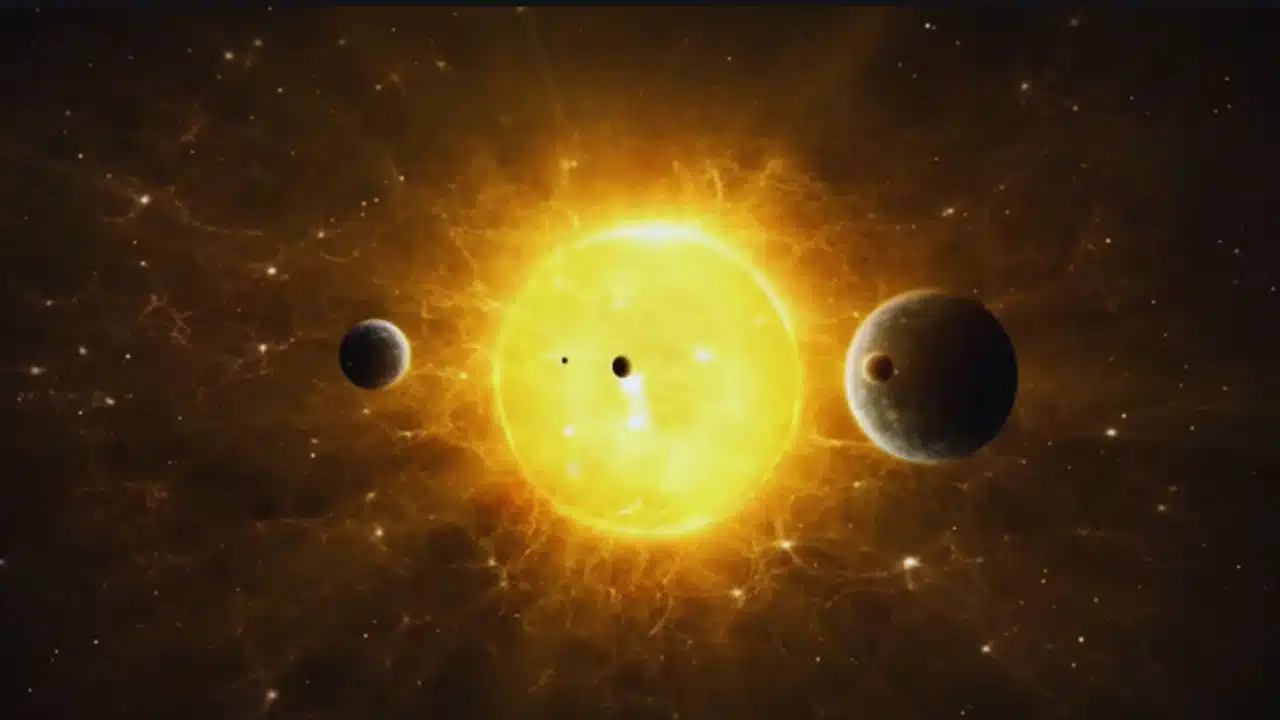
A powerful wave of solar activity has shaken space operations and global communications this week, after the Sun launched a sequence of intense eruptions that collided on their way toward Earth. The resulting geomagnetic storm quickly became one of the strongest in nearly two decades, overwhelming monitoring agencies, altering astronaut routines aboard the International Space Station, and triggering rare auroral displays across regions that almost never see them.
The chain of disruptions began when multiple coronal mass ejections — massive explosions of magnetized plasma from the Sun — erupted within a short span of each other. As these CMEs travelled through space, they merged into what scientists call a “cannibal storm,” a phenomenon that significantly amplifies magnetic strength and enhances the storm’s impact when it eventually sweeps across Earth’s magnetic field.
Radiation conditions around Earth intensified enough to force launch delays for Blue Origin’s highly anticipated New Glenn rocket mission. Originally planned for November 9 and then re-targeted for November 12, the launch carrying NASA’s twin Mars-bound ESCAPADE orbiters was repeatedly pushed back as engineers assessed the risks of sending sensitive scientific instruments through the heightened solar radiation environment. Spacecraft electronics, communications systems, and propulsion subsystems are particularly vulnerable during strong solar storms, and NASA took an unusually cautious approach due to the strength of the incoming solar particles.
After several days of monitoring, engineers received improved solar weather forecasts, and Blue Origin was finally able to launch. The flight succeeded not only in deploying NASA’s Mars satellites but also in demonstrating the first successful booster landing of the New Glenn rocket — a major milestone for the company. Even with this success, the mission highlighted how dependent modern space operations are on space-weather conditions and how rapidly solar activity can derail carefully planned timelines.
Meanwhile, aviation systems, maritime operators, and radio-dependent industries worldwide reported intermittent disruptions. High-frequency radio channels, commonly used for long-distance communication, experienced blackouts. GPS accuracy briefly degraded in some regions. Airline routes that rely on polar communications — particularly transpolar flights — were placed on alert as the radiation levels temporarily rose above normal levels in upper atmospheric layers.
These widespread effects underscored a growing reality: as the world becomes increasingly reliant on satellites, global connectivity, and space-based infrastructure, solar storms pose a more serious operational risk than most people realize.
Unprecedented Solar Activity Erupts From Sunspot Region AR4274
The extraordinary solar disturbance originated from a hyperactive sunspot region known as AR4274, which burst to life between November 9 and 11. Within three days, it produced three powerful X-class solar flares, the strongest class of solar radiation events. Among them, an X5.1-class flare that peaked early on November 11 was the most intense flare recorded so far in 2025.
The X5.1 flare had immediate consequences. It unleashed a surge of X-rays and ultraviolet radiation that struck Earth’s atmosphere within minutes, causing strong radio blackouts across Africa and Europe. These sudden bursts of energy ionized the upper layers of the atmosphere, making it impossible for many long-distance radio systems to operate during the peak of the flare.
Solar scientists monitoring the event noted that the storm could be one of the largest in nearly twenty years. Ground-based sensors detected unusually high levels of solar energetic particles — levels not seen since 2005. These particles can penetrate spacecraft shielding, interfere with electronics, and pose radiation hazards to astronauts.
The National Oceanic and Atmospheric Administration’s Space Weather Prediction Center confirmed that geomagnetic storm conditions escalated to G4 “severe” levels, the second-highest category on the geomagnetic scale. A G4 storm is powerful enough to cause widespread voltage fluctuations, disrupt navigation systems, degrade satellite operations, and create visible auroras at much lower latitudes than usual.
The Sun is currently in the middle of its solar maximum, the peak of its 11-year activity cycle during which sunspots and eruptions become more frequent and more energetic. Scientists expect elevated solar activity to continue through late 2025 and possibly into 2026, meaning more strong eruptions could follow.
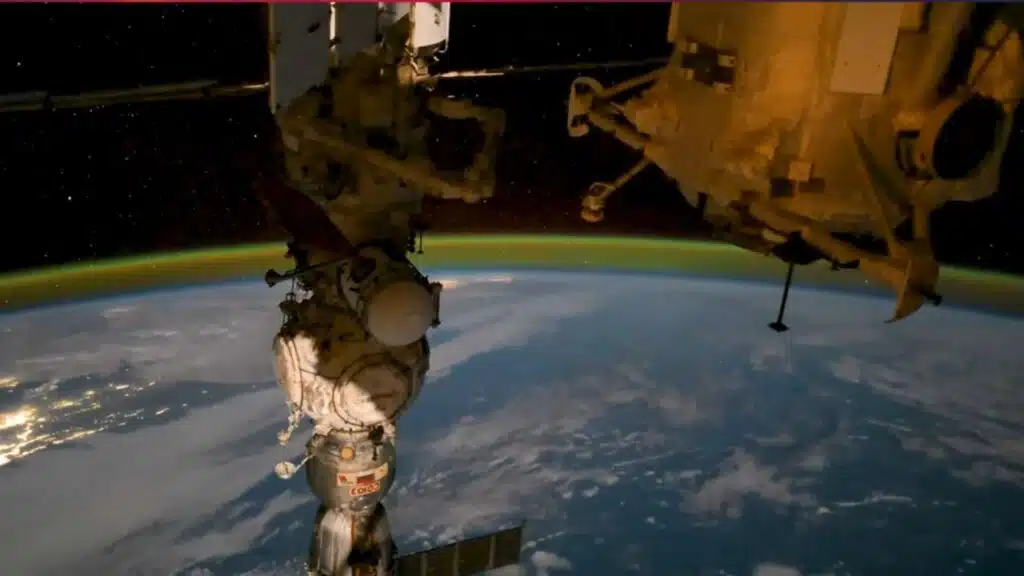
Astronaut safety became a pressing concern as the radiation wave approached Earth. Crew members aboard the International Space Station — which orbits outside much of Earth’s protective atmosphere — were instructed to modify their sleep arrangements and avoid specific high-exposure areas of the station. Russian cosmonauts Oleg Platonov, Sergey Ryzhikov, and Alexey Zubritsky spent the night inside the station’s laboratory module, one of the more shielded areas, and followed strict protocols to minimize radiation exposure.
Global Impacts and Rare Auroras Across the World
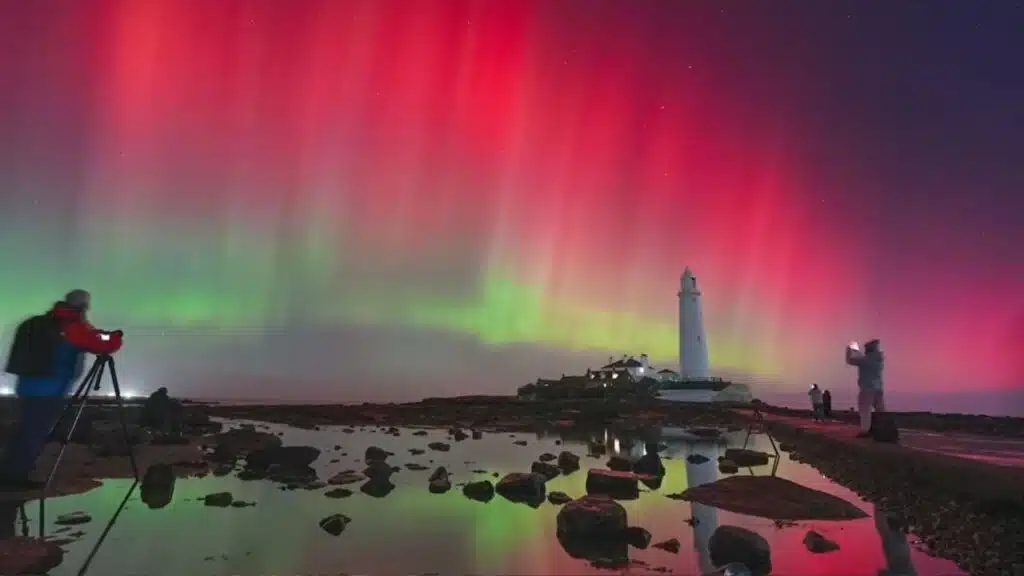
The effects of the solar storm were felt not only in space and in communication networks but also in the sky itself. As the storm slammed into Earth’s magnetosphere, it produced spectacular auroral displays far beyond the usual polar regions. Residents across Florida, Texas, Georgia, and other southern U.S. states reported seeing colorful curtains of light — a rare experience for regions that almost never fall within the auroral oval.
These unusual auroras are a telltale sign that the geomagnetic disturbance was extremely strong. Under normal conditions, auroras occur near the poles, where Earth’s magnetic field lines converge. But during a G4 storm, the magnetic disturbance expands dramatically, allowing charged particles to travel farther toward the equator and creating auroras in places that typically sit thousands of kilometers away from the Arctic or Antarctic circles.
Observers shared images of vibrant greens, purples, and reds streaking across the sky. Some reported that the lights were visible overhead instead of near the horizon — a sign of particularly intense geomagnetic activity. For many people in the southern United States, this was the most visible and widespread auroral event in their lifetime.
The storm’s impacts on Earth and in orbit served as a stark reminder of how deeply interconnected Earth’s technology is with solar behavior. Power grid operators and satellite companies maintained elevated monitoring protocols, and navigation signals experienced periodic disturbances. Even though major grid failures were avoided, experts emphasized that storms of this scale highlight ongoing vulnerabilities in global infrastructure.
As solar maximum continues, scientists expect more frequent flares, more intense CMEs, and potentially more storms like this. Agencies around the world are working to improve forecasting tools, strengthen spacecraft resilience, and educate industries about preparedness.





















