Many people worry about how their personal data gets used online. Companies often store and control this data, leaving users with little say. This lack of trust is a big issue in today’s digital world.
Web3 offers a solution by creating a safer, more open space using blockchain technology. Combined with artificial intelligence [AI], it opens doors to smarter systems that let users keep control of their information.
In this blog, you’ll learn how Web3 and AI work together to shape decentralized networks.
Ready to explore? Keep reading!
The Role of Web3 in Decentralized AI Networks
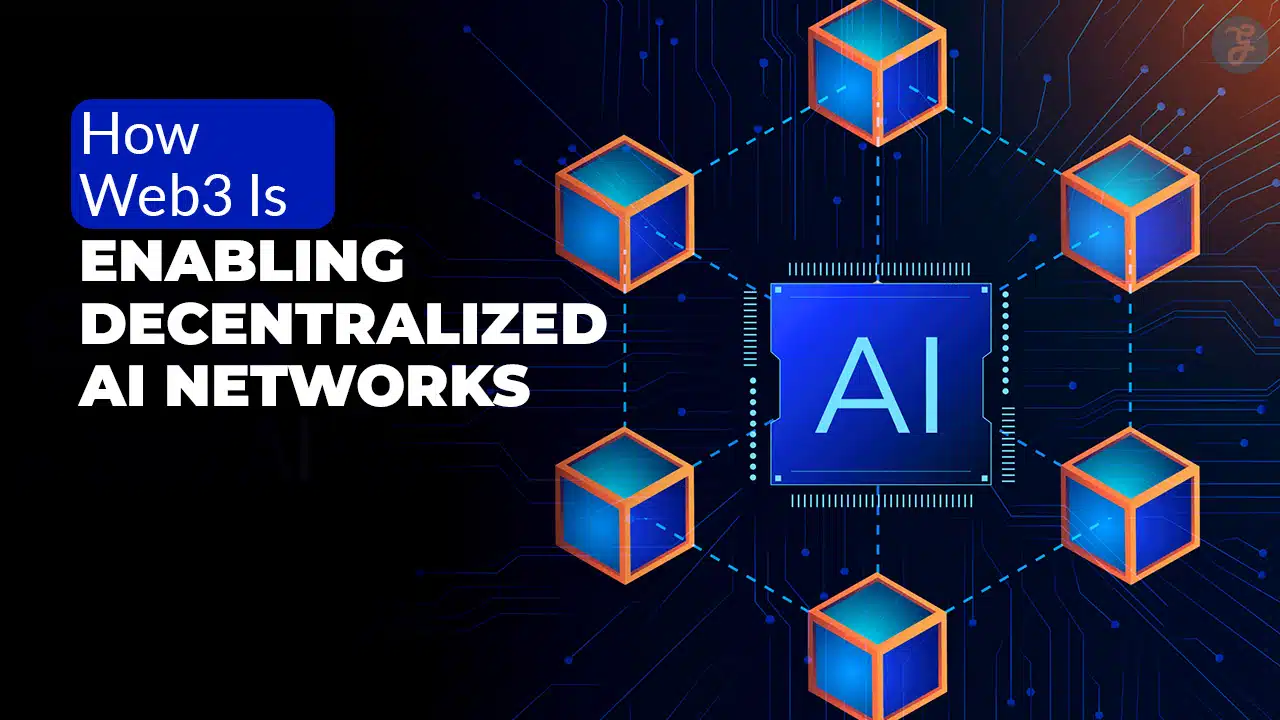
Web3 makes AI networks more open and fair. It uses blockchain systems to share control, not keep it in one place.
Decentralized data storage and management
Data storage in blockchain networks keeps information safe. Instead of putting data on just one server, it spreads across many nodes. This makes hacking harder and boosts security.
Blockchain technology also increases transparency while protecting privacy with encryption. Users can control their own digital identities and decide who gets to access their info.
AI models rely on clean, accurate datasets for learning. Decentralized systems improve this by sharing data fairly using smart contracts. Projects like Ocean Protocol let users sell or share unused data without giving up ownership rights.
AI-powered marketplaces built on distributed computing create more chances for innovation and teamwork in machine learning tasks.
Tokenization and incentive mechanisms
Tokenization lets users earn rewards. Web3 platforms use blockchain technology to create digital assets for value exchange. Tokens can represent data, computing power, or AI models.
These tokens fuel decentralized AI marketplaces. For example, researchers sell machine learning models using cryptocurrencies. This system creates fair access and boosts innovation.
Incentives drive participation in these networks. Peer-to-peer networks reward contributors with tokens for sharing resources like storage or algorithms. Smart contracts automate payments based on clear terms, eliminating trust issues.
Tokens turn contributions into opportunities,” as many developers say today. This transparent setup promotes growth within decentralized AI ecosystems without gatekeepers blocking progress.
AI in Web3: Key Applications
AI is reshaping how decentralized applications work, bringing smarter features to users. These tools can analyze data faster and power services like fraud detection or better recommendations.
Intelligent dApps
Smart contracts power intelligent dApps. These apps use machine learning algorithms to adapt and improve over time. For example, AI-powered smart contracts can automate tasks like fraud detection or secure multi-party computation.
Natural language processing [NLP] enables better user engagement through chatbots or personalized recommendations.
Decentralized applications also allow peer-to-peer networks to share data securely. Users gain control of their digital assets while interacting in a transparent system. Intelligent dApps enhance decision-making by using predictive modeling and data analysis for services like decentralized finance or supply chain management.
Decentralized AI model training and deployment
AI models train and work directly on peer-to-peer networks in decentralized systems. This keeps data local, improving privacy and security. Using blockchain technology, these systems create trust while sharing data and resources openly.
Platforms like Ocean Protocol let users sell unused computational power or datasets for AI training.
Decentralized marketplaces allow developers to deploy AI-powered smart contracts across public blockchains. These contracts automate tasks such as fraud detection or predictive modeling without central control.
Federated learning enhances model building by combining knowledge from multiple sources without exposing raw data. This approach boosts efficiency and supports ethical machine learning practices.
Benefits of Combining Web3 and AI
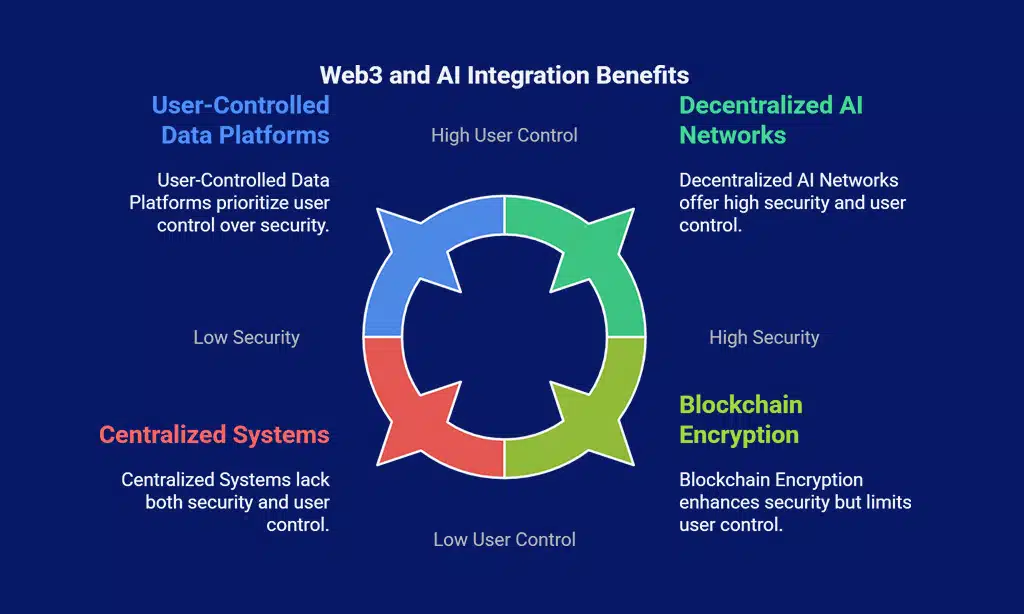
Web3 and AI together create safer, smarter systems. They give people more power over their own data like never before.
Enhanced security and privacy
Blockchain technology protects data through encryption. Smart contracts add layers of safety by automating rules, reducing human errors. Decentralized AI networks limit vulnerabilities seen in centralized systems.
Peer-to-peer networks prevent single points of failure, making hacking harder.
Data privacy improves with decentralized platforms like Ocean Protocol. Users control their digital assets and identities without intermediaries. Machine learning models process sensitive information without exposing raw data, offering safer ways to share insights while keeping personal details private.
User sovereignty and data governance
Users gain control over their data in decentralized AI networks. Web3 allows them to own, manage, and sell their digital assets without middlemen. This puts power back into the hands of individuals, not corporations.
Smart contracts enable secure transactions of sensitive information like digital identities. Peer-to-peer networks ensure data integrity while protecting privacy. With blockchain technologies, users can trust that no one tampered with their information or abused it for profit-making schemes.
Challenges in Building Decentralized AI Networks
Building decentralized AI networks isn’t a walk in the park. Issues like data sharing and trust among systems make it tricky for teams to work smoothly.
Interoperability and standards
Interoperability connects different decentralized AI networks. It allows systems to share data and work together smoothly. Using blockchain technology ensures that all parties follow the same rules for communication.
Without shared standards, platforms struggle to interact effectively, slowing progress.
Smart contracts can help maintain these common rules. They automate processes while ensuring transparency and security. Peer-to-peer networks also play a big role here by supporting seamless exchanges of information across platforms.
Clear standards make decentralized AI marketplaces user-friendly and trustworthy.
Addressing trust and ethical concerns
Building decentralized AI networks must handle trust and fairness. Smart contracts on blockchain technology create transparency, removing middlemen. This protects data integrity and ensures users control their digital identities.
Peer-to-peer networks also provide better traceability for actions within the system.
Bias in AI models remains a challenge. Decentralized applications [dApps] can help by promoting open-source collaboration. Developers can share machine learning techniques to improve accuracy and reduce errors.
With Web3, ethical issues like data privacy and regulatory compliance gain attention, ensuring safer systems for everyone involved.
Takeaways
Web3 and AI together are reshaping technology. Decentralized networks bring more security, trust, and freedom to users. AI boosts these systems with smarter tools like natural language processing or machine learning.
This mix also gives people control over their data while creating new ways to share models and resources. Imagine building fairer systems for finance, trading, or even digital identities.
Take action now—explore how you can join this tech shift today!
FAQs on How Web3 Is Enabling Decentralized AI Networks
1. What is Web3, and how does it relate to decentralized AI networks?
Web3 is the next phase of the internet, built on blockchain technology. It helps create decentralized AI networks by using peer-to-peer systems, smart contracts, and data ownership tools.
2. How do decentralized AI networks protect data privacy?
Decentralized AI uses blockchain’s consensus mechanisms to secure data integrity. This protects sensitive information while giving users control over their digital identities.
3. What role do DAOs play in decentralized AI?
Decentralized autonomous organizations [DAOs] allow people or businesses to manage AI-powered projects collaboratively without relying on central authorities.
4. Can Web3 improve machine learning models like recommendation systems or predictive analytics?
Yes, Web3 enables better training for machine learning models through shared resources in decentralized marketplaces while maintaining user empowerment and data privacy.
5. How does Web3 address cybersecurity risks like fraud detection or deepfakes?
With tools like permissionless blockchain protocols and ai-powered smart contracts, Web3 strengthens security against threats such as fraud or manipulated content.
6. Why are decentralized finance [DeFi] platforms important for artificial intelligence in Web3?
DeFi platforms use automated trading and predictive modeling powered by artificial intelligence to improve financial services within the web3 ecosystem efficiently and transparently.