Web3 is revolutionizing the internet by introducing a decentralized, user-centric ecosystem powered by blockchain technology.
This next iteration of the internet is reshaping how we think about data privacy, digital ownership, and the potential of decentralized applications (DApps).
As the Web3 ecosystem continues to evolve, developers are increasingly tasked with choosing the best programming languages to build blockchain-based applications, smart contracts, and decentralized networks.
In this article, we’ll take a detailed look at the 7 best programming languages for Web3 developers, providing insights into each language’s strengths, weaknesses, ideal use cases, and practical considerations.
By the end of this guide, you’ll have a comprehensive understanding of which language fits your Web3 development needs, ensuring that your projects are efficient, scalable, and secure.
What is Web3?
Web3 is a decentralized, blockchain-powered version of the internet that removes intermediaries, giving users control over their data and assets. It relies on blockchain technology to ensure transparency, security, and immutability.
Smart contracts, DeFi (decentralized finance), NFTs (non-fungible tokens), and DApps are integral to the Web3 ecosystem. Each of these elements requires specialized programming languages to enable secure, scalable, and efficient applications.
Why Web3 Development Requires Specialized Programming Languages?
Unlike traditional web development, Web3 programming involves interacting with blockchain networks, writing smart contracts, and ensuring the decentralized nature of applications.
This brings unique challenges such as ensuring data integrity, optimizing performance, and managing transaction costs. As a result, choosing the right programming language is critical to ensure your Web3 project is secure, efficient, and future-proof.
The Importance of Choosing the Right Programming Language
Selecting the correct programming language for Web3 development has far-reaching implications. The wrong choice could result in higher costs, security vulnerabilities, poor performance, or a limited developer ecosystem.
In contrast, the right language can optimize performance, enhance security, and accelerate the development process. The best programming languages for Web3 developers offer the right balance of efficiency, compatibility, and scalability, making it essential to align your project needs with the most suitable language.
Key Considerations When Choosing a Programming Language for Web3 Development
When deciding on the best programming language for your Web3 project, consider the following factors:
Blockchain Compatibility
Each blockchain ecosystem may support different languages. For example, Ethereum uses Solidity for smart contracts, while Polkadot and Solana use Rust. When choosing a language, ensure that it’s compatible with the blockchain you plan to build on. This compatibility will ensure that your project runs efficiently on the desired network.
Security and Reliability
Given that Web3 applications often involve financial transactions or sensitive data, security is paramount. Certain languages, like Rust and Vyper, offer advanced security features, such as memory safety and formal verification, to prevent vulnerabilities like reentrancy attacks and data manipulation.
Developer Community and Ecosystem
A strong developer community and well-established ecosystem can significantly speed up the development process. Languages with a large, active community offer extensive documentation, libraries, and frameworks that simplify development. A robust ecosystem also ensures continued support and innovation.
Performance and Scalability
Scalability is another critical factor in Web3 development. Some languages are optimized for high-performance applications, ensuring that decentralized networks or smart contracts can handle large volumes of transactions and data. Go, Rust, and C++ are known for their performance capabilities and low-latency processing.
The 7 Best Programming Languages for Web3 Developers
Below are the 7 best programming languages for Web3 developers, each with their unique advantages, ideal use cases, and relevant considerations. We’ve also included a table for each language to provide a quick reference guide to its strengths and weaknesses.
1. Solidity
Solidity is the de facto language for developing smart contracts on the Ethereum blockchain. It is a statically typed language that was specifically created to interact with the Ethereum Virtual Machine (EVM). Solidity enables the creation of decentralized applications (DApps) and facilitates the execution of smart contracts on Ethereum-based platforms.
Why Solidity is Essential for Smart Contract Development
Solidity is the most widely adopted language for Web3, especially for smart contract development. Given Ethereum’s dominance in the blockchain space, Solidity is critical for Web3 developers looking to build applications on Ethereum and other EVM-compatible chains like Binance Smart Chain (BSC), Avalanche, and Polygon.
Pros and Cons of Solidity for Web3 Development
| Pros | Cons |
| Well-established with extensive developer resources. | Gas fees on Ethereum can be expensive. |
| Rich documentation and a mature ecosystem. | Limited scalability on Ethereum’s base layer. |
| Large community support and frequent updates. | Vulnerabilities in contract design can lead to exploits. |
Example Use Cases for Solidity
- DeFi Platforms: Smart contracts that automate lending, borrowing, and asset management (e.g., Aave, Uniswap).
- NFTs: Tokenized digital assets for ownership and trading (e.g., OpenSea, Rarible).
- DAO Governance: Decentralized autonomous organizations that govern decision-making through smart contracts.
2. Rust
Rust is a systems programming language designed for performance, safety, and concurrency. Known for its memory safety features, Rust eliminates many common bugs found in other languages, such as memory leaks and data races. In the Web3 space, Rust is used extensively in blockchain development, particularly in platforms like Solana, Polkadot, and Near Protocol.
How Rust Enhances Security and Performance
Rust’s emphasis on memory safety and performance makes it ideal for developing secure, high-performance blockchain systems. It’s a perfect choice for developers who need to build efficient consensus mechanisms, complex blockchain logic, or performance-intensive applications.
Pros and Cons of Rust for Web3 Development
| Pros | Cons |
| Memory safety prevents critical security vulnerabilities. | Steeper learning curve compared to other languages. |
| High performance with low latency for blockchain applications. | Smaller ecosystem compared to more widely used languages. |
| Strong concurrency support for handling blockchain transactions. | More complex syntax may slow down development. |
Example Use Cases for Rust in Web3
- Blockchain Protocols: Solana’s high-performance blockchain is built in Rust, optimizing transaction throughput.
- Smart Contracts: Parity’s Substrate framework, used by Polkadot, is written in Rust.
- DeFi and Crypto Infrastructure: Rust is also used for building fast, secure financial protocols and cryptographic tools.
3. JavaScript
JavaScript is the backbone of modern web development, and it’s increasingly important in the Web3 space, especially for building decentralized applications (DApps). With frameworks like Web3.js and Ethers.js, JavaScript enables developers to interact with blockchain networks like Ethereum, making it essential for front-end development in Web3 applications.
JavaScript Frameworks for Web3
JavaScript developers can use libraries such as Web3.js and Ethers.js to facilitate interactions with Ethereum and other blockchain networks. These frameworks allow developers to connect their DApps to blockchain nodes, submit transactions, and query data from smart contracts.
Pros and Cons of JavaScript for Web3 Development
| Pros | Cons |
| Familiar to most developers with a wide range of resources. | Limited in handling backend blockchain logic directly. |
| Active ecosystem with tons of libraries and tools. | Security concerns such as cross-site scripting (XSS). |
| Great for building user interfaces and integrating with blockchain via APIs. | Can be inefficient for performance-heavy operations. |
Example Use Cases for JavaScript in Web3
- DApp Front-End Development: Building interactive and user-friendly interfaces (e.g., decentralized exchanges like Uniswap).
- Wallet Integrations: Using JavaScript to integrate wallets such as MetaMask into Web3 applications.
- Blockchain Explorers: Developing real-time tracking and exploration tools for blockchain transactions.
4. Go (Golang)
Go, or Golang, is a statically typed, compiled programming language known for its simplicity, concurrency support, and high performance. Go is widely used in blockchain infrastructure, especially for building nodes, consensus algorithms, and network protocols. Platforms like Ethereum’s Geth and Cosmos SDK are written in Go.
Why Go is Gaining Popularity in Web3
Go’s low latency and excellent concurrency handling make it ideal for blockchain development. It simplifies the creation of efficient blockchain nodes that can handle high volumes of transactions, making it a popular choice for developing blockchain infrastructure.
Pros and Cons of Go for Web3 Development
| Pros | Cons |
| Excellent support for concurrency and scalability. | Limited smart contract development capabilities. |
| Fast execution and low resource consumption. | Smaller ecosystem for Web3 than languages like JavaScript or Solidity. |
| Simplicity and readability make it easy to learn. | Lacks features for more complex decentralized application logic. |
Example Use Cases for Go in Web3
- Blockchain Nodes: Geth (Go Ethereum) powers the Ethereum network’s infrastructure.
- Consensus Mechanisms: Cosmos and Tendermint are built using Go to enable scalable and interoperable blockchains.
- DeFi Backend Development: Go is used to build high-performance financial protocols and applications.
5. Python
Python is a versatile, high-level programming language used extensively for its simplicity and readability. In Web3 development, Python is popular for backend applications, blockchain analytics, and cryptographic operations. It is often used in combination with libraries such as Web3.py to interface with Ethereum and other blockchain networks.
How Python is Used in Web3 Development
Python is used for tasks such as smart contract deployment, interacting with blockchain nodes, and performing blockchain analytics. It is also widely used for blockchain-related research and prototyping due to its easy-to-understand syntax and wealth of libraries.
Pros and Cons of Python for Web3 Development
| Pros | Cons |
| Simple and easy to learn for beginners. | Not ideal for performance-heavy or high-speed applications. |
| Extensive libraries for cryptography and blockchain analytics. | Slower execution compared to compiled languages like Go or C++. |
| Great for backend development and blockchain research. | May not be suitable for on-chain applications. |
Example Use Cases for Python in Web3
- Blockchain Analytics: Python is used for data mining and analyzing blockchain transactions.
- Cryptography: Libraries like PyCryptodome are used for implementing secure blockchain cryptographic protocols.
- Smart Contract Testing: Python is great for automating the testing of smart contracts before deployment.
6. Vyper
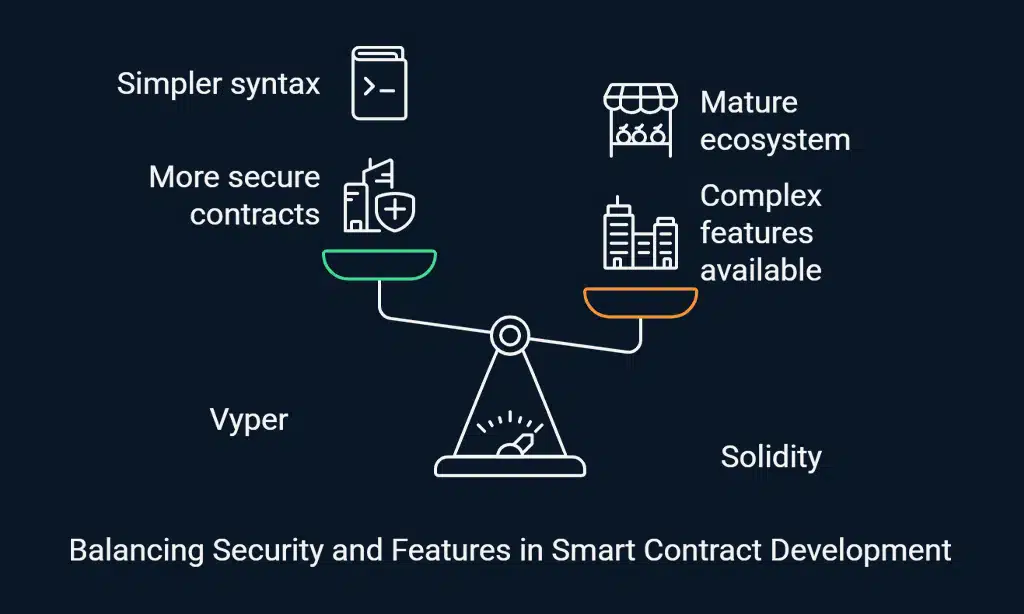
Vyper is a Pythonic programming language for writing smart contracts on the Ethereum blockchain. It is designed to be simpler and more secure than Solidity, emphasizing readability, security, and minimalism. Vyper is gaining popularity among developers who require highly secure, auditable smart contracts.
Advantages of Using Vyper in Web3
Vyper’s emphasis on simplicity and security makes it ideal for high-risk applications where contract auditing and security are essential. Unlike Solidity, Vyper intentionally leaves out complex features that could introduce vulnerabilities, such as infinite loops and function overloading.
Pros and Cons of Vyper for Web3 Development
| Pros | Cons |
| More secure and auditable than Solidity. | Less mature, with fewer resources and community support. |
| Simple and transparent syntax. | Limited features compared to Solidity. |
| Great for building secure financial contracts and DAOs. | Smaller ecosystem and fewer developer tools. |
Example Use Cases for Vyper in Web3
- High-security Smart Contracts: Vyper is ideal for developing financial contracts and other critical applications that require thorough auditing.
- Governance Protocols: Decentralized autonomous organizations (DAOs) can use Vyper to implement secure voting and governance mechanisms.
7. C++
C++ is a powerful, object-oriented language that has long been used for systems programming. In the Web3 space, C++ is a preferred language for building performance-critical applications like blockchain protocols and consensus algorithms. Bitcoin, for example, is written in C++.
Why C++ is Still Relevant in Modern Web3
C++ offers unparalleled control over system resources, making it the ideal choice for applications that require high performance, low latency, and deep hardware interaction. For blockchain developers focused on building consensus mechanisms, C++ provides the necessary tools to ensure scalability and security.
Pros and Cons of C++ for Web3 Development
| Pros | Cons |
| High performance and low-level memory control. | Steep learning curve, especially for beginners. |
| Used by high-performance blockchain platforms like Bitcoin and EOS. | Requires manual memory management, leading to potential bugs. |
| Great for developing complex consensus algorithms. | Lack of modern language features like garbage collection. |
Example Use Cases for C++ in Web3
- Bitcoin Core: Bitcoin’s reference implementation is written in C++.
- Consensus Algorithms: EOS and other high-performance blockchains use C++ to implement scalable consensus mechanisms.
- Blockchain Protocols: Many blockchain protocols rely on C++ for their foundational infrastructure.
Choosing the Right Language for Your Web3 Project
Selecting the best programming languages for Web3 developers depends on various factors, including your project’s specific requirements. Here’s a quick checklist:
- Blockchain Platform: Ensure the language is compatible with the blockchain you’re targeting.
- Security: Prioritize languages with strong security features, especially for DeFi and high-risk applications.
- Performance Needs: For high-performance applications, languages like Rust and Go are excellent choices.
- Community and Ecosystem: A larger ecosystem and developer community can reduce development time and offer valuable resources.
Match the Language to Your Web3 Project Type
Different types of Web3 projects demand different languages. For example:
- Smart Contract Development: Solidity, Vyper.
- DeFi Projects: Solidity, Rust.
- Blockchain Infrastructure: Go, Rust, C++.
- DApp Front-End: JavaScript, Python.
Future-Proofing Your Web3 Development
Web3 technologies are evolving rapidly. While Solidity and Rust are currently the dominant languages, staying adaptable and open to new languages and tools will help you remain competitive. Keep an eye on emerging trends like Layer 2 scaling solutions, ZK-Rollups, and the Ethereum 2.0 upgrade, as these could influence the languages you use.
Wrap Up
The best programming languages for Web3 developers are integral to the success of decentralized applications, smart contracts, and blockchain platforms.
By understanding the strengths and limitations of languages like Solidity, Rust, JavaScript, Go, Python, Vyper, and C++, you can make informed decisions about which language aligns with your project’s goals and technical requirements.
As Web3 continues to evolve, staying up-to-date with new tools, frameworks, and programming languages will ensure that your projects are not only successful but also scalable and secure for the future of decentralized applications.
By leveraging the right programming languages, you’ll be better equipped to contribute to the next generation of the internet—an internet that is decentralized, transparent, and owned by its users.