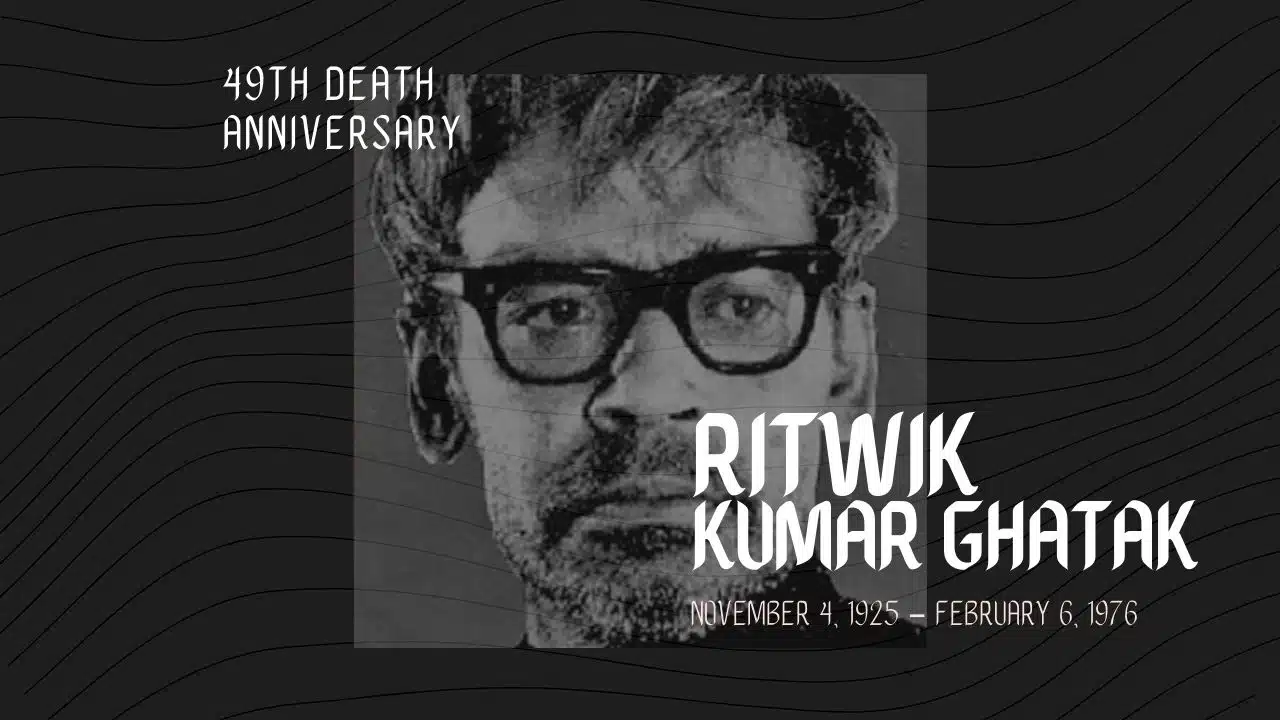
Ritwik Ghatak was a filmmaker ahead of his time, a cinematic visionary whose works remain some of the most powerful portrayals of human suffering and resilience.
Despite his immense contribution to Indian cinema, he is often overshadowed by his contemporaries like Satyajit Ray and Mrinal Sen. The legend of Indian cinema died on February 6, 1976.
As we mark the 49th death anniversary of Ritwik Ghatak on February 6, 2025, it is essential to remember the genius of this forgotten maverick and his enduring impact on global cinema.
The Man Behind the Lens: Who Was Ritwik Ghatak?
Born on November 4, 1925, in Dhaka (then part of British India, now Bangladesh), Ritwik Ghatak grew up witnessing the turmoil of partition and the displacement of millions. These experiences profoundly shaped his storytelling, making displacement, loss, and identity recurring themes in his films.
Unlike his contemporaries, Ghatak struggled with alcoholism and financial instability, which further marginalized his work. Yet, his passion for storytelling never faded, leaving behind a cinematic legacy that is studied and admired today.
Unique Storytelling: What Made Ritwik Ghatak a Maverick?
Ghatak’s storytelling was unconventional and deeply experimental. He used melodrama not for commercial appeal but as a tool to amplify emotions. His films incorporated elements of Bengali folk traditions, Brechtian theater, and poetic realism, making them unique in Indian cinema.
His use of sound was particularly revolutionary—often blending classical music with jarring noises to evoke emotions. Unlike Satyajit Ray’s restrained realism, Ghatak’s style was raw, intense, and unapologetically theatrical.
Cinematic Masterpieces: A Legacy in Frames
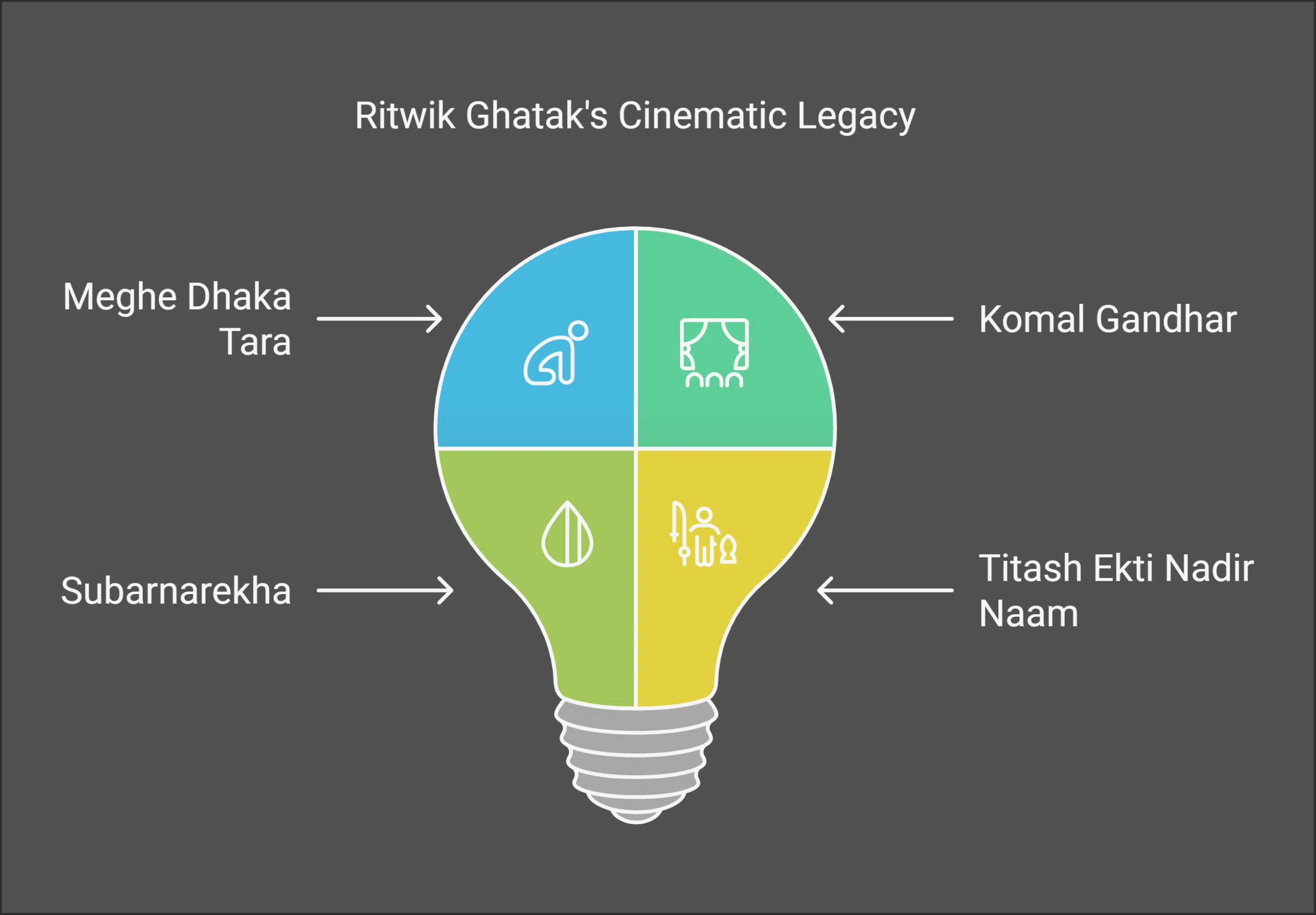
As we observe the 49th death anniversary of Ritwik Ghatak, it is imperative to revisit his cinematic masterpieces that continue to captivate audiences and film scholars alike. Ghatak’s films were not just works of art but powerful commentaries on the socio-political issues of his time.
His deep-rooted storytelling, unique visual language, and experimental use of sound set him apart from his contemporaries. Each of his films carries a signature style that delves into themes of displacement, human suffering, and resilience.
Meghe Dhaka Tara (1960)
Considered his magnum opus, this film tells the tragic story of a refugee woman struggling to support her family after Partition. The haunting cry “Dada, ami banchte chai” (Brother, I want to live) remains one of the most powerful moments in Indian cinema.
Komal Gandhar (1961)
A semi-autobiographical film about the divide between leftist cultural movements in post-independence India. It explored political ideologies through the lens of a theater troupe.
Subarnarekha (1965)
A gut-wrenching film about caste, class struggle, and dreams crushed by society. It showcased the bleak realities of post-Partition Bengal through stunning visuals and deep symbolism.
Titash Ekti Nadir Naam (1973)
A unique narrative about the lives of fishermen living by the Titash River. Ghatak brought out the pain of a community slowly fading away, mirroring his own concerns about cultural erosion.
Despite their brilliance, Ghatak’s films were not commercially successful during his lifetime, adding to his struggles as a filmmaker.
The Misunderstood Genius: Why Was Ghatak Overlooked?
While his peers gained international recognition, Ghatak remained on the fringes. His political ideologies, controversial statements, and rebellious attitude distanced him from the mainstream industry. He frequently clashed with censorship boards, and his films deemed too radical often faced distribution challenges.
His battles with alcoholism further damaged his career, leaving him in financial distress. It was only after his death in 1976 that film scholars and critics began to fully appreciate his genius.
Ritwik Ghatak’s Influence on Indian and Global Cinema
Many renowned filmmakers have credited Ghatak as an inspiration. His influence is evident in the works of directors like Mani Kaul, Kumar Shahani, and Anurag Kashyap. Internationally, his films have been rediscovered by cinephiles, with retrospectives held in prestigious film festivals.
The Film and Television Institute of India (FTII), where he taught in the later years of his life, continues to uphold his cinematic philosophy, inspiring new generations of filmmakers.
Why Ritwik Ghatak’s Films Remain Relevant Today
Ritwik Ghatak’s films remain relevant today because they address universal themes of migration, displacement, and social inequality—issues that still dominate global discourse.
His works were deeply rooted in the trauma of the partition, a historical event that continues to shape South Asian identities. The emotional depth of his storytelling allows audiences to connect with the struggles of marginalized communities, making his films timeless.
Furthermore, his experimental approach to cinema—combining melodrama, folk traditions, and striking sound design—has influenced generations of filmmakers. The rise of independent and parallel cinema movements globally has drawn heavily from his raw and expressive style.
As modern societies grapple with identity crises, forced migrations, and economic disparities, Ghatak’s films serve as an artistic mirror, urging introspection and change.
Additionally, with the advent of film restoration projects and digital platforms, his works are now more accessible to newer audiences, allowing a fresh appreciation of his cinematic genius. As the world continues to struggle with issues of displacement and cultural erosion, Ghatak’s narratives offer a compelling, humanized perspective that remains as powerful today as when they were first made.
The themes Ghatak explored—migration, cultural displacement, and economic struggle—are still pertinent today. His ability to humanize large-scale socio-political issues makes his films timeless. As societies continue to grapple with identity crises and migration challenges, Ghatak’s narratives resonate more than ever.
Takeaways
Despite the struggles he faced, Ritwik Ghatak’s cinema remains an eternal voice of resistance and emotion. His films, though underappreciated during his lifetime, have cemented his legacy as one of India’s greatest filmmakers.
On the 49th death anniversary of Ritwik Ghatak, it is time to reintroduce his works to new audiences and give him the recognition he truly deserves.
Ritwik Ghatak was not just a filmmaker; he was a revolutionary artist whose voice still echoes through the frames of his films. Let us honor his memory by revisiting his masterpieces and ensuring his cinematic legacy continues to inspire future generations.