

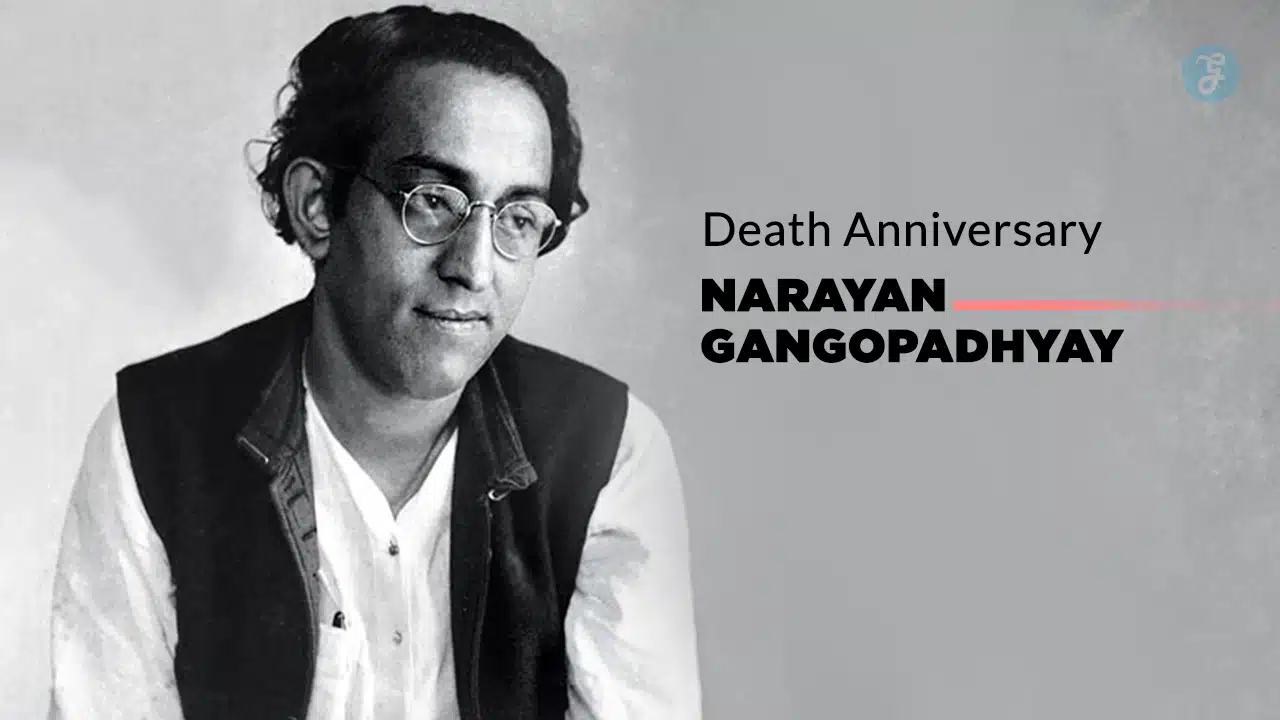
When you hear the name Narayan Gangopadhyay, what comes to mind? For millions of Bengali readers, the answer is instantaneous: a booming, good-natured voice shouting, “De La Grande Mephistopheles! Y-a-a!”
The mind immediately conjures an image of Tenida, the iconic leader of the Potoldanga charmurti (the “famous four”), holding court on his rickety cot, bragging about his (mostly imaginary) exploits over a feast of aloo kabli. Today, November 6, 2025, marks the 55th death anniversary of the man who created this immortal character. And while Tenida is, without question, one of the greatest gifts to Bengali children’s literature, the sheer, blinding popularity of this one creation has often cast a shadow over the other towering achievements of its creator.
Narayan Gangopadhyay (1918-1970) was not just a humorist for children. He was a master novelist who painted epic sagas, a razor-sharp short-story writer who dissected human psychology, a beloved professor who inspired a generation, and a witty satirist who poked fun at the society he lived in.
On this 55th anniversary of his passing, it’s time to look beyond Potoldanga and explore the other facets of the genius we call Narayan Gangopadhyay.
The Master Novelist: Chronicler of a Turbulent Era
While Tenida’s world was one of harmless fun and fantastical adventures, Narayan Gangopadhyay’s serious novels were grounded in the harsh, complex, and often tragic realities of 20th-century Bengal. He was a novelist of epic scope, tackling themes of partition, famine, social upheaval, and the profound, almost spiritual connection between man and nature.
Upanibesh (The Colony): An Epic of the Riverlands
If you read only one “serious” novel by Gangopadhyay, it should be Upanibesh. Published in three volumes, this is his magnum opus. The novel is set in the shifting, treacherous char lands (river islands) of the Padma River in pre-partition East Bengal.
It tells the story of the displaced, the dispossessed, and the outcasts who try to build a life on this unforgiving land, only to be threatened by the river, by feudal landlords, and by rising communal tensions. The river itself—the “Kirtinasha” (destroyer of glory)—is a central character, a godlike force that gives life and takes it away. Upanibesh is a powerful, sprawling saga about the indomitable human spirit fighting against the forces of nature and society. It’s a far cry from a ghondogol (brouhaha) in Potoldanga; this is Bengali literature at its most profound.
Lalmati (The Red Soil): The Song of Rarhbangla
Where Upanibesh is about the “water” of East Bengal, Lalmati is about the “earth” of West Bengal, specifically the Rarh region (Birbhum, Bankura) known for its distinctive red soil.
This novel is a brilliant exploration of a society in flux. It captures the decline of the old feudal zamindar system and the rise of a new, often ruthless, industrial class. Gangopadhyay, who spent considerable time in this region, writes with a deep, almost primal connection to the land. You can feel the heat, smell the dry earth, and hear the rhythms of the tribal madol drum. Lalmati is a socio-political document wrapped in beautiful, lyrical prose, showcasing his mastery over landscape and social commentary.
His other novels, like Shilalipi (The Inscription) and Samrat O Shresthi (The Emperor and the Merchant), further cemented his reputation.
A Glimpse at His Major Novels
| Novel Title | Publication Period (Approx.) | Core Themes |
| Upanibesh | 1950s | Partition, human struggle, man vs. nature, river-island life |
| Lalmati | 1950s | Decline of feudalism, social change in Rarhbangla, industrialization |
| Shilalipi | 1949 | The Bengal Famine of 1943, urban decay, human survival |
| Samrat O Shresthi | 1955 | Psychological drama, class conflict, complex human relationships |
The Surgeon of the Short Story
Narayan Gangopadhyay didn’t just write short stories; he was a scholar of them. He earned his D.Phil from the University of Calcutta in 1960 for his seminal research on the evolution of the Bengali short story. This academic rigor is visible in his own work. He was a master surgeon, capable of laying bare the darkest corners of the human psyche or capturing a moment of social tragedy with breathtaking precision.
Dissecting the Darkness: Nokrochorit and Bitangsa
Gangopadhyay was a contemporary of other “dark” masters of the form, like Manik Bandyopadhyay. He was not afraid to explore the unsettling, the morbid, and the psychologically fragile.
His story “Nokrochorit” (The Story of Norko, or Hell) is a chilling example. It’s not a supernatural horror story but a psychological one, exploring a man’s descent into a private, self-made hell. “Bitangsa” is another masterpiece, a terrifyingly tense story about a man’s growing paranoia and obsession with a bird, which becomes a symbol of his own trapped, decaying life. These stories show an author in complete control of his craft, building atmosphere and suspense to an unbearable crescendo.
The Mirror to Society: Itihas and Trophy
He was also a deeply empathetic chronicler of his times. His story “Itihas” (History) is one of the most powerful and heartbreaking stories ever written about the Bengal Famine of 1943. It’s a story of desperate hunger, of a man reduced to an animal state, and of the shattering of human dignity.
He wrote about class conflict, the hypocrisy of the middle class (bhadralok), and the small, quiet tragedies of everyday life. His short stories prove that the same hand that wrote with the broad, generous humor of Tenida could also write with the sharp, precise, and often painful incision of a scalpel.
‘TNG Sir’: The Professor Who Became a Legend
For thousands of students at City College and later at the University of Calcutta, Narayan Gangopadhyay was not a novelist or a humorist. He was simply “TNG Sir”—one of the most brilliant and beloved professors of his generation.
By all accounts, he was a spellbinding lecturer. Former students, including many who became famous writers themselves (like Sunil Gangopadhyay and Soumitra Chatterjee), have written about the magic of his classes. When TNG Sir lectured on modern Bengali literature—a subject he helped legitimize in academia—the halls would be packed. Students from other departments would sneak in, filling the windowsills and doorways just to hear him speak.
He taught with a passion and insight that brought literature to life. He wasn’t just a dry academic; he was a creator who understood the creative process from the inside. He could deconstruct a poem by Jibanananda Das or a novel by Rabindranath Tagore with an electrifying clarity that left his students in awe. This identity as a teacher and a scholar was fundamental to who he was.
‘Sunanda’: The Witty Satirist Hiding in Plain Sight
Finally, there was another, lesser-known persona: ‘Sunanda.’ This was the pseudonym Narayan Gangopadhyay used to write sharp, witty, and satirical columns and essays, most notably for Desh magazine.
If Tenida’s humor was broad, warm, and boisterous, Sunanda’s humor was urbane, sophisticated, and biting. In these columns, he took on the mantle of a social critic, poking fun at the pretensions of the Kolkata elite, the absurdities of politics, and the changing social norms of the post-independence era.
This work shows his incredible range as a humorist. HHe wasn’t just a “children’s writer”; he was also a first-rate satirist in the tradition of Parashuram (Rajshekhar Basu). These columns are a delight to read even today, proving that his wit was not only timeless but also incredibly versatile.
Final Words: Celebrating the Complete Man of Letters
On his 55th death anniversary, it’s clear that we have only loved one part of Narayan Gangopadhyay’s vast legacy. The immortality of Tenida is secure—he will live on as long as the Bengali language is spoken.
But the true genius of Narayan Gangopadhyay is that the same man created the innocent, braggart Tenida and the psychologically scarred characters of Nokrochorit. He could paint the epic, sprawling canvas of Upanibesh and also craft the jewel-like precision of a four-page short story. He was a man who could hold a university lecture hall spellbound with his analysis of Tagore and, in the next moment, write a satirical column that had the city’s intellectuals laughing at themselves.
To truly honor him, we must celebrate all of him: the master novelist, the sharp-eyed short-story writer, the legendary professor, and the witty satirist. Tenida was his masterpiece of joy, but his complete works are a masterpiece of life.






















