

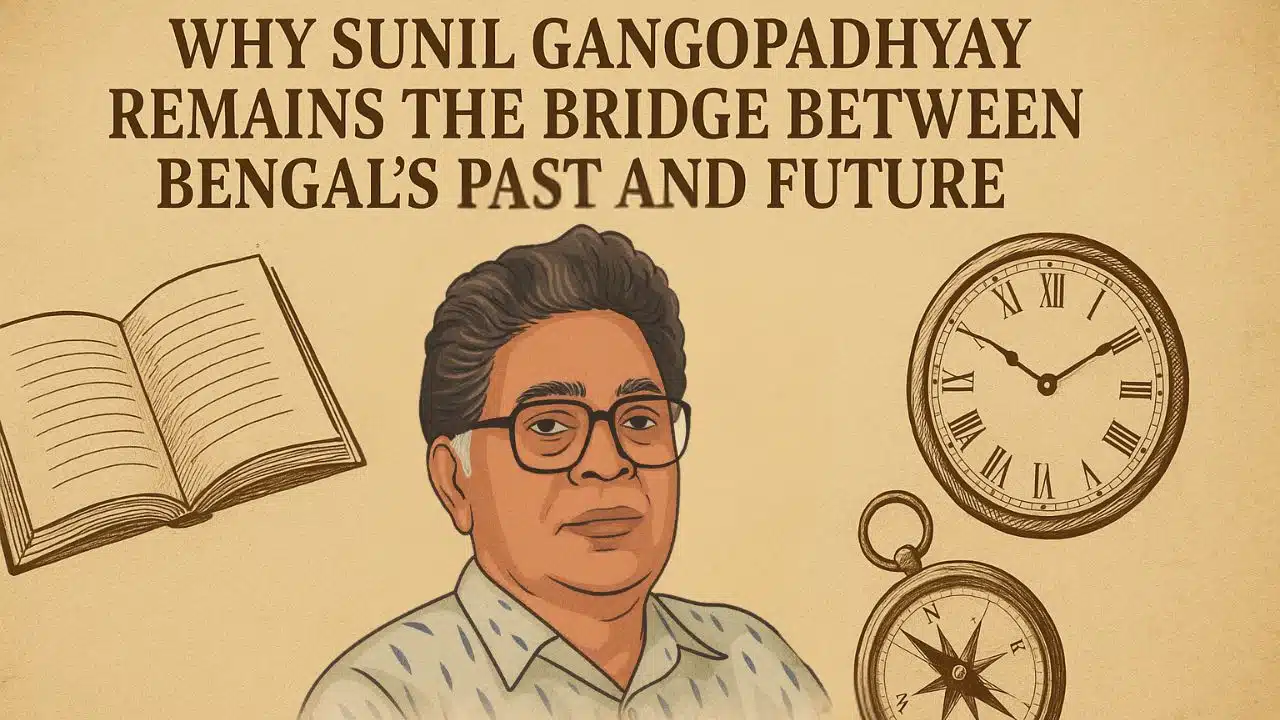
On September 7, 1934, a literary voice was born in Faridpur, now in Bangladesh, that would one day reshape the landscape of Bengali literature. Sunil Gangopadhyay, poet, novelist, critic, editor, and cultural thinker, carried forward the torch of Bengal’s rich literary tradition into the modern age. His works not only preserved the echoes of the past but also created pathways for Bengal’s evolving identity in a rapidly changing world.
Today, on his 91st birth anniversary, readers remember Sunil not just as a celebrated writer but as a bridge between two eras—a man who could look back into Bengal’s history with reverence while imagining a future with fresh energy and imagination.
From his bold modernist poetry to his sweeping historical novels and the ever-popular Kakababu adventures, Sunil Gangopadhyay remains a timeless figure whose influence transcends generations.
Sunil Gangopadhyay: A Voice Rooted in Bengal’s History
Born in Faridpur (now in Bangladesh) in 1934, Sunil Gangopadhyay’s childhood was shaped by both the beauty and the turbulence of Bengal. His family later migrated to Kolkata, a city that would become the backdrop of much of his literary journey.
From a young age, Sunil was deeply influenced by Bengal’s rich literary heritage—Rabindranath Tagore’s universal humanism, Kazi Nazrul Islam’s fiery rebellion, and Jibanananda Das’s lyrical modernism. Yet, instead of merely following in their footsteps, he chose to carve his own path.
Through his poetry, short stories, and novels, Sunil captured the political, social, and emotional transformations of Bengal. He wrote of freedom struggles, the trauma of Partition, and the search for individual identity in a society caught between tradition and modernity.
His writing often reflected a Bengal that was looking back at its glorious past yet uncertain about its future—and this tension became central to his literary vision. Sunil’s voice was, therefore, not just personal but profoundly historical, echoing the anxieties, hopes, and aspirations of a generation navigating change.
The Poet Who Captured a New Bengal
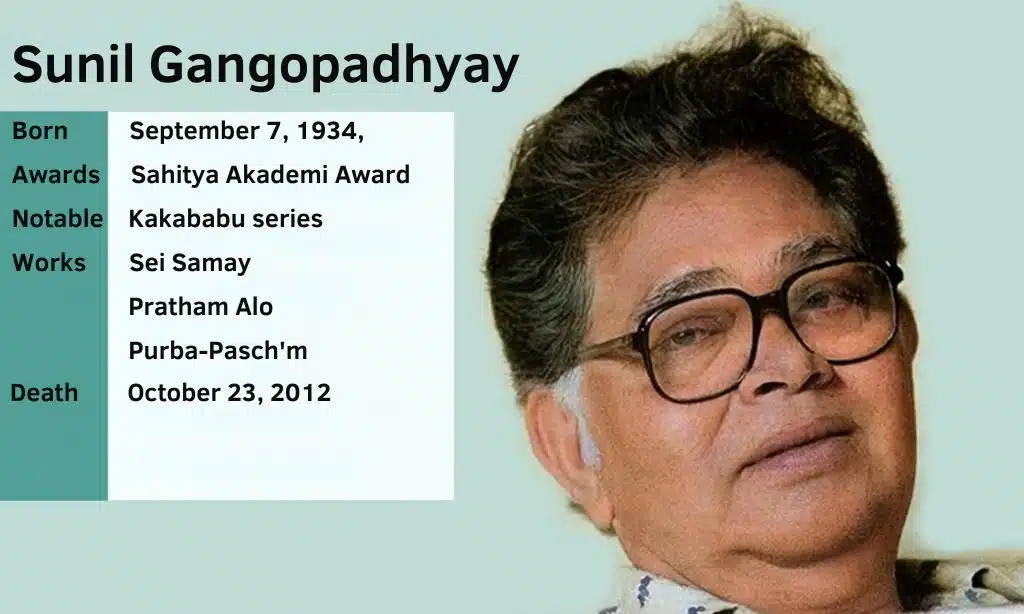
In the early 1950s, a restless young poet named Sunil Gangopadhyay began reshaping the language of Bengali poetry. Along with a group of like-minded friends, he co-founded the literary magazine Krittibas in 1953, which soon became the epicenter of modern Bengali poetry. Krittibas was not just a publication—it was a revolution, introducing a new style of writing that broke away from tradition and spoke directly to a generation living through post-Independence uncertainty.
Sunil’s poetry was bold, experimental, and intensely personal. Collections like Eka Ebong Koekjon (1958) and Ami Ki Rokom Vabe Beche Achi (1966) captured the loneliness, disillusionment, and burning questions of urban youth. His words echoed with the anxieties of a changing Bengal, torn between hope and despair.
Yet, despite his sharp modernism, Sunil never abandoned the emotional depth that defined Bengali literature. His verses often carried a lyrical tenderness, weaving love, rebellion, and self-discovery into timeless expressions. Through his muse “Nira,” an almost mythical figure in his poetry, he gave voice to unspoken desires and inner struggles that resonated with readers across decades.
As a poet, Sunil Gangopadhyay became the mirror of a generation—one that wanted freedom not only from colonial rule but also from social constraints, old values, and outdated ways of thinking. He gave Bengal a new poetic language to face its modern reality.
The Novelist Who Rewrote History and Identity
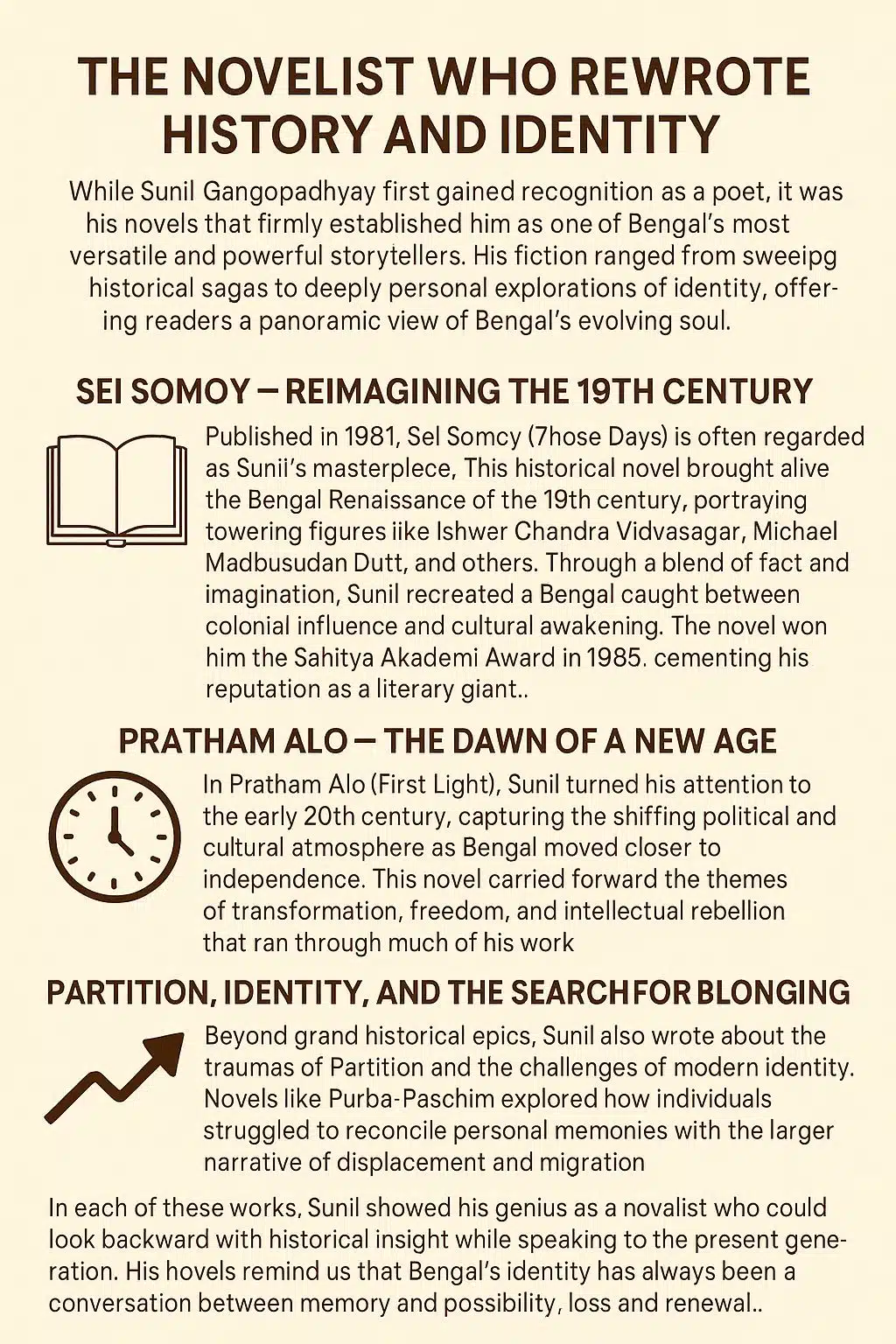
While Sunil Gangopadhyay first gained recognition as a poet, it was his novels that firmly established him as one of Bengal’s most versatile and powerful storytellers. His fiction ranged from sweeping historical sagas to deeply personal explorations of identity, offering readers a panoramic view of Bengal’s evolving soul.
Sei Somoy: Reimagining the 19th Century
Published in 1981, Sei Somoy (Those Days) is often regarded as Sunil’s masterpiece. This historical novel brought alive the Bengal Renaissance of the 19th century, portraying towering figures like Ishwar Chandra Vidyasagar, Michael Madhusudan Dutt, and others. Through a blend of fact and imagination, Sunil recreated a Bengal caught between colonial influence and cultural awakening. The novel won him the Sahitya Akademi Award in 1985, cementing his reputation as a literary giant.
Pratham Alo: The Dawn of a New Age
In Pratham Alo (First Light), Sunil turned his attention to the early 20th century, capturing the shifting political and cultural atmosphere as Bengal moved closer to independence. This novel carried forward the themes of transformation, freedom, and intellectual rebellion that ran through much of his work.
Partition, Identity, and the Search for Belonging
Beyond grand historical epics, Sunil also wrote about the traumas of Partition and the challenges of modern identity. Novels like Purba-Paschim explored how individuals struggled to reconcile personal memories with the larger narrative of displacement and migration.
In each of these works, Sunil showed his genius as a novelist who could look backward with historical insight while speaking to the present generation. His novels remind us that Bengal’s identity has always been a conversation between memory and possibility, loss and renewal.
Kakababu: The Future of Bengal Through Adventure
Among all of Sunil Gangopadhyay’s creations, none has captured the imagination of children and young adults quite like Kakababu. Officially known as Raja Roy Chowdhury, Kakababu is a disabled former archaeologist who embarks on thrilling adventures across India and beyond. His sharp mind, fearless attitude, and unyielding spirit turned him into a cultural icon—proving that true strength lies in courage and intelligence, not physical ability.
Inspiring Generations of Young Readers
Through more than 35 Kakababu novels, Sunil introduced generations of Bengali children to the excitement of exploration, history, and mystery. From the icy landscapes of the Himalayas to the deserts of Egypt, Kakababu and his nephew Shontu traveled widely, uncovering secrets and solving puzzles along the way.
These stories were not just entertainment—they were lessons in curiosity, bravery, and morality. For countless young readers, Kakababu was their gateway into both literature and the wider world.
A Symbol of Bengal’s Future
By creating Kakababu, Sunil ensured that his literary influence extended into the future. While his historical novels preserved Bengal’s cultural memory, the Kakababu adventures planted seeds of imagination in the minds of younger generations. This balance between heritage and forward-looking creativity is exactly why Sunil remains the bridge between Bengal’s past and future.
From Page to Screen
The popularity of Kakababu also transcended books. Several films and TV adaptations—such as Sabuj Dwiper Raja, Ek Tukro Chand, Mishawr Rohosyo, and Kakababur Protyaborton—brought the character alive for wider audiences. Even today, the Kakababu franchise continues to introduce Sunil’s vision to new readers and viewers.
Sunil Gangopadhyay on Screen: A Literary Bridge to Mass Culture
Sunil Gangopadhyay’s influence was never confined to the printed page. His stories, with their vivid characters and layered themes, naturally attracted filmmakers and television directors who brought his creations into mainstream culture.
Collaborations with Satyajit Ray
One of the most celebrated adaptations of Sunil’s work was Aranyer Din Ratri (Days and Nights in the Forest), directed by Satyajit Ray in 1970. The novel, and later the film, explored the disillusionment of young urban men seeking escape in nature but confronting their own insecurities and desires instead. Ray’s adaptation not only brought Sunil’s narrative to life but also secured its place in world cinema.
The Kakababu Phenomenon on Screen
The Kakababu adventures made a seamless transition to film and television. Beginning with Sabuj Dwiper Raja (1979) and followed by popular adaptations like Ek Tukro Chand (2001), Mishawr Rohosyo (2013), Yeti Obhijaan (2017), and Kakababur Protyaborton (2022), Kakababu became a household name. These adaptations introduced Sunil’s beloved characters to a new generation who might not have first encountered them through books.
Bringing Literature to Popular Culture
Adaptations of his novels ensured that Sunil’s work reached audiences who might not have been avid readers. His ability to write stories that were both literary and accessible made them ideal for cinema and television. Whether through the art-house brilliance of Satyajit Ray or the mass appeal of Kakababu films, Sunil’s presence in visual culture widened his legacy far beyond the world of literature.
In this way, he became not only a literary icon but also a pop culture figure, reinforcing his role as a bridge between Bengal’s intellectual traditions and its evolving, modern storytelling.
The Global and Contemporary Relevance of His Works
Though deeply rooted in Bengal, Sunil Gangopadhyay’s themes have universal resonance. His writings speak to timeless human concerns—identity, freedom, love, and the constant tension between tradition and modernity.
A Mirror for Today’s Youth
Much like the post-Independence generation he originally wrote for, today’s youth in Bengal and beyond face uncertainties in a rapidly changing world. Sunil’s characters—restless, questioning, sometimes disillusioned—feel strikingly contemporary. Whether it is the alienation in his poetry or the quest for belonging in his novels, his works continue to echo the inner struggles of young readers.
Beyond Bengal: A Universal Voice
While Sunil celebrated Bengal’s cultural soul, his works were never parochial. In novels like Sei Somoy and Pratham Alo, he examined colonialism, social reform, and intellectual freedom—issues that connect with the histories of many nations. His poetry, translated into multiple languages, resonates with readers who may never have walked the streets of Kolkata but recognize the universal rhythm of longing and self-discovery.
The Digital Age Connection
Even in the 21st century, Sunil’s works feel fresh. His explorations of alienation, displacement, and freedom speak powerfully in an age of globalization and migration. For many readers of the Bengali diaspora, his writings serve as a literary homecoming, bridging cultural memory with modern identity.
This ability to remain timeless and relevant across eras is what sets Sunil Gangopadhyay apart. His words transcend geography and generations, ensuring his place not just as a Bengali writer but as a global literary figure.
Final Words: Celebrating Sunil Gangopadhyay at 91
On his 91st birth anniversary, remembering Sunil Gangopadhyay is not just an act of homage to a great writer but also a reminder of how literature can hold together the threads of time. He was a poet of urban loneliness, a novelist of historical depth, and a storyteller for children whose imaginations he ignited with Kakababu.
Sunil remains the bridge between Bengal’s past and its future—connecting the wisdom of Tagore and Vidyasagar’s age with the restless energy of modern Bengal. His works continue to inspire readers to look back with respect and look forward with courage.
As Bengal and the world change, his voice endures—reminding us that culture is never static. It is a living dialogue between memory and aspiration, loss and hope. And in that dialogue, Sunil Gangopadhyay will forever remain a guiding light.






















