


Mark Zuckerberg Declares AI War on Traditional Advertising Industry


Meta CEO Mark Zuckerberg has unveiled a transformative vision for the advertising industry, aiming to automate the entire ad creation and delivery process using artificial intelligence (AI). This approach, termed “infinite creative,” seeks to simplify advertising by allowing businesses to input their objectives and budget, with Meta’s AI handling the rest—from content creation to audience targeting and performance measurement.

Meta’s AI-Driven Advertising Model

In a recent interview with Stratechery’s Ben Thompson, Zuckerberg detailed this AI-centric advertising strategy. He envisions a system where businesses provide their goals and financial parameters, and Meta’s AI generates tailored ads, identifies optimal audiences, and continuously refines campaigns based on performance data. This model eliminates the need for traditional creative input, manual targeting, and external performance assessments.

Zuckerberg describes this as redefining advertising into an “AI agent” that delivers measurable business results at scale.

Industry Reactions and Concerns

The advertising community has expressed significant concerns regarding this shift. One major issue is the potential lack of transparency, as Meta would be responsible for both ad creation and performance reporting, raising questions about accountability. An agency CEO commented, “No clients will trust what they spit out as they are basically checking their own homework.”

Brand safety is another critical concern. With Meta’s recent changes to content moderation—such as replacing third-party fact-checkers with a community-based system—advertisers worry about their content appearing alongside inappropriate or harmful material.

Despite these concerns, many advertisers continue to invest in Meta’s platforms due to their vast reach and effective targeting capabilities. Some industry professionals suggest that brand safety controls are limited and that advertisers must adapt to the evolving digital landscape.

Meta’s Financial Performance and AI Investments
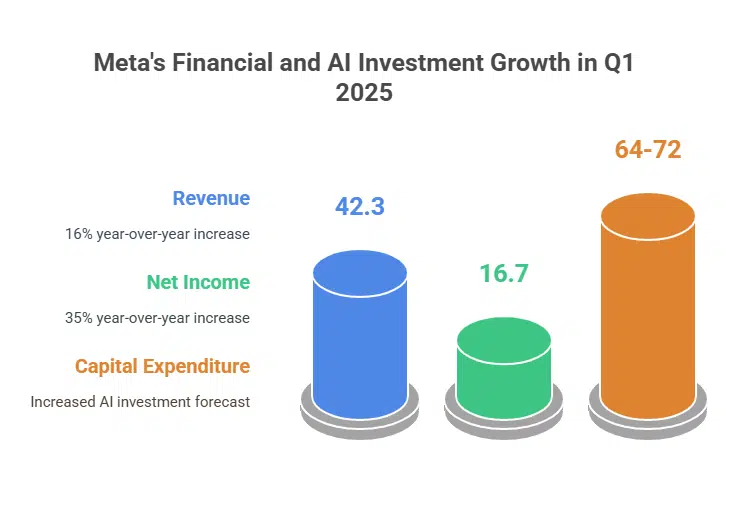
Meta's Financial Performance and AI Investments

Meta’s financial results reflect the growing impact of AI on its advertising business. In the first quarter of 2025, the company reported revenues of $42.3 billion, a 16% increase year-over-year, with net income rising 35% to $16.7 billion.

To support its AI initiatives, Meta has increased its capital expenditure forecast for 2025 to between $64 billion and $72 billion. These investments aim to enhance AI infrastructure and develop new tools like Llama 4 and a standalone AI assistant app.

Implications for the Advertising Industry

Meta’s AI-driven approach could significantly disrupt traditional advertising models. By automating creative development, targeting, and performance analysis, the role of ad agencies and creative professionals may diminish. This shift could lead to cost savings for businesses but also raises concerns about the quality and authenticity of AI-generated content.

Furthermore, the consolidation of ad creation and performance reporting within a single platform like Meta challenges the industry’s reliance on third-party verification and accountability. As AI continues to evolve, the advertising industry must navigate these changes carefully, balancing innovation with transparency and brand integrity.

Mark Zuckerberg’s vision for AI-powered advertising represents a significant shift in how businesses approach marketing. While offering potential efficiencies and scalability, it also introduces challenges related to transparency, brand safety, and the role of human creativity. As Meta continues to develop and implement these AI tools, the advertising industry will need to adapt and address these concerns to ensure responsible and effective marketing practices.



Subscribe to Our Newsletter

Related Articles

Top Trending

How Influencer Marketing Pricing Really Works
Landing Page Mistakes That Kill Conversions
7 Landing Page Mistakes That Kill Conversions (And How to Fix Them)
Why EdTech Pilots Fail
Why EdTech Pilots Fail: Lessons From Real School Rollouts
Best Public Datasets for Practicing Machine Learning
10 Best Public Datasets for Practicing Machine Learning
Ethical Dilemmas of AI: illustration showing AI ethics, algorithmic bias, data privacy, automation, human judgment, values, deepfakes, and the challenges AI creates for technology and humanity
9 Ethical Dilemmas AI Forces Us to Confront

Technology & AI

Best Public Datasets for Practicing Machine Learning
10 Best Public Datasets for Practicing Machine Learning
Ethical Dilemmas of AI: illustration showing AI ethics, algorithmic bias, data privacy, automation, human judgment, values, deepfakes, and the challenges AI creates for technology and humanity
9 Ethical Dilemmas AI Forces Us to Confront
Why Canva Became the Default Design Tool
Why Canva Became the Default Design Tool for Marketers
An infographic showing a computer and phone with security icons illustrating the process of two-factor authentication
What Is Two-Factor Authentication and Which Type Is Safest?
How data breaches happen through stolen credentials, compromised systems, network infiltration, and the theft of sensitive business information.
How Data Breaches Happen: The Anatomy of a Modern Attack

GAMING

Online Color Game Philippines
Online Color Game Philippines: What Every Beginner Should Know Before Playing
Ways to Reduce Game Development Costs
12 Ways Studios Cut Game Development Costs
NFT game development cost
How Much Does NFT Game Development Cost? A Realistic Budget Breakdown
Reasons Why You No Longer Need the Best Roblox AI Scripter
Forget Best Roblox AI Scripter: 10 Reasons Why You No Longer Need It
Blockchain Platforms for Game Development
The 9 Best Blockchain Platforms for Game Development

Business & Marketing

Raising Seed Capital for SaaS
Raising Seed Capital for SaaS: A Practical Founder’s Blueprint
marketing funnel
What Is a Marketing Funnel and How to Map Yours Step-by-Step
Mobile app for your business planning shown with app wireframes, performance analytics, budgeting notes, and multiple devices used to evaluate development decisions.
10 Questions to Ask Before Deciding on a Mobile App for Your Business
CAC Payback
Why CAC Payback Matters Far More Than Cheap Customer Acquisition
LTV to CAC ratio
The LTV to CAC Ratio: What It Is and Why Everyone Quotes It

EdTech & E-Learning

Why EdTech Pilots Fail
Why EdTech Pilots Fail: Lessons From Real School Rollouts
calendar activities for early learners
7 Calendar Activities for Early Learners to Build Time Sense
Global Disparities in AI Learning
Global Disparities in AI Learning: Why Some Students Are Left Behind
How Long Does It Take a Child to Learn the Alphabet
How Long Does It Take a Child to Learn the Alphabet? A Real Timeline
Games to Encourage Early Language Skills
I Tried 8 Games to Encourage Early Language Skills [One Flopped]

Software & Apps

Why Canva Became the Default Design Tool
Why Canva Became the Default Design Tool for Marketers
TikTok Story Viewer
TikTok Story Viewer: 10 Best Tools To View TikTok Stories Privately
Best Browser Based Tools that Replace Desktop Apps
10 Best Browser-Based Tools that Replace Desktop Apps
How to Convert OST to PST Free Online
How to Convert OST to PST Free Online?
Mobile app for your business planning shown with app wireframes, performance analytics, budgeting notes, and multiple devices used to evaluate development decisions.
10 Questions to Ask Before Deciding on a Mobile App for Your Business


















