
Artificial Intelligence (AI) is transforming every aspect of our lives—from the way we work and communicate to how we address complex global challenges.
However, despite AI’s potential to drive innovation, one significant obstacle remains: the gender gap. Historically, the field of AI has been dominated by men, with women often underrepresented in critical research, development, and leadership roles.
But this is rapidly changing. Women are not just entering the AI landscape—they are reshaping it. They are creating ethical frameworks, introducing innovative solutions, and breaking through barriers that have long hindered their participation in the tech industry.
This article will explore how women are overcoming challenges, driving the evolution of AI, and contributing to a more inclusive tech industry.
Understanding the AI Gender Gap in Tech
The AI gender gap refers to the unequal representation of women in AI-related roles and leadership positions within the tech industry. Though women’s participation in tech-related fields has increased over the years, AI remains one of the most male-dominated sectors.
In 2021, a study by the World Economic Forum revealed that women make up just 22% of the global AI workforce. Despite this, the role of women in reshaping AI is growing significantly.
Key Statistics on Women in AI and Tech
Here are some critical statistics that illustrate the extent of the gender gap in AI:
| Statistic | Insight |
| Women represent only 22% of the global AI workforce | Women are a minority in AI development, particularly in technical roles. |
| Just 12% of computer science graduates are women | Gender disparity in computer science education affects long-term AI workforce participation. |
| Only 12% of women of color work in AI-related jobs | Women of color face double barriers to entry and advancement in the field. |
| Women-led tech startups are 2.5 times more likely to succeed | Despite lower representation, women-led AI startups show higher success rates. |
These statistics reveal the scale of the challenge and the opportunities that lie ahead. However, they also point to an emerging trend: women are increasingly contributing to AI’s development, and their impact is being felt across industries.
The Challenges Women Face in the Tech Industry

Despite the exciting progress, women face numerous barriers in AI, from gender bias to a lack of leadership opportunities. These obstacles significantly affect their participation in AI development and innovation.
Gender Bias and Stereotypes in AI Development
Gender biases are deeply embedded in AI systems themselves. Often, AI systems are trained on biased data sets that perpetuate gender stereotypes. A notable example is the issue of biased facial recognition algorithms, which historically performed better with male faces, particularly those of white individuals, and had lower accuracy for women and people of color. This highlights the importance of diverse teams—women and other underrepresented groups—who can identify and address these biases in AI design.
Practical Example: Gender Bias in AI Algorithms
The gender bias in AI algorithms became evident in the infamous case of Amazon’s AI recruitment tool. Amazon had developed an AI system that was supposed to help with hiring by screening resumes, but it was found to be biased against women.
This was because the tool was trained on resumes submitted to Amazon over a ten-year period, which had been overwhelmingly male. As a result, the algorithm penalized resumes that used female-specific terminology or included experiences typically associated with women. This example shows how unchecked biases in the development process can perpetuate gender inequalities.
Limited Access to Leadership Roles for Women in Tech
Another challenge that women face is the glass ceiling in leadership roles. Women are often overlooked for senior leadership positions, particularly in technical areas like AI. This lack of representation in leadership reduces their ability to influence AI policies, funding decisions, and the development direction of technology.
Practical Solution: Gender-Inclusive Leadership Training
One solution to this issue is the rise of leadership training programs specifically targeted at women. Initiatives like Leaders in Tech provide women with the skills and mentorship needed to break through the glass ceiling and step into leadership roles.
The Impact of Workplace Culture on Women in AI
Workplace culture plays a pivotal role in supporting or hindering women in AI. The tech industry’s traditionally male-dominated environment can create an isolating experience for women. They may find themselves excluded from critical networking opportunities or even face discrimination based on gender.
Practical Example: The Role of Women’s Networks
To combat this, many women have turned to networking organizations and support groups. Initiatives like Women in Tech, TechWomen, and Women Who Code provide mentorship, peer support, and professional networking, helping women navigate the challenges of the tech world.
How Women Are Reshaping the AI Landscape?
While the obstacles are substantial, women are actively reshaping AI and the broader tech industry. Through innovation, leadership, and advocacy, they are making an indelible mark on the field.
Women Innovators Leading AI Research and Development
Women are leading AI’s most groundbreaking developments. Take Fei-Fei Li, the professor at Stanford University, who is known for her pioneering work in computer vision and AI. She co-founded AI4ALL, an initiative aimed at increasing diversity and inclusion in AI by providing young people, especially women, with access to AI education.
Another notable example is Rashida Richardson, a leading expert in AI and racial justice. She has led numerous initiatives aimed at ensuring AI systems are developed in a way that serves all communities, not just those traditionally represented in tech.
Key Figures in AI Innovation
| Innovator | Contribution to AI | Notable Work/Initiative |
| Fei-Fei Li | Computer vision, AI ethics | Co-founder of AI4ALL, leading AI for Good projects |
| Rashida Richardson | AI and racial justice | Advocacy for AI ethics, addressing biases in law enforcement AI |
| Kate Crawford | AI ethics, data systems | Author of Atlas of AI, examining AI’s impact on society |
| Joy Buolamwini | AI bias, computer vision | Founder of The Algorithmic Justice League, AI fairness advocate |
Empowering Women Through Education and Training in AI
Education is a key lever for empowering women in AI. Numerous programs are focused on increasing women’s participation in AI, from coding boot camps to online courses, offering the skills necessary to thrive in the tech world.
Notable Programs Empowering Women in AI
| Program | Focus | Target Audience | Key Offering |
| Women Who Code | Networking, coding workshops, career development | Women in tech | Workshops, hackathons, mentorship |
| AI4ALL | Increasing diversity in AI education | High school students | AI summer camps, scholarships |
| The Anita Borg Institute | Empowering women to pursue technical careers | Women in computing | Conferences, mentorship programs |
| Girls Who Code | Encouraging young girls to pursue coding and technology | Girls aged 11-18 | Coding programs, summer immersion |
These programs equip women with the technical expertise and confidence needed to take on AI roles and become leaders in the field.
The Role of Diversity in AI Innovation
Diversity is not only a moral imperative but also a crucial element for fostering innovation. AI that is developed by diverse teams is more likely to produce equitable, ethical, and efficient solutions.
The Importance of Diverse Perspectives in AI Technology
Diverse teams bring a broader set of experiences, ensuring that AI systems are developed with different cultural, social, and personal considerations in mind. This leads to the creation of AI that is more inclusive and reflective of society at large.
Practical Example: Ethical AI Development
One example of the importance of diversity in AI is Microsoft’s Fairness Toolkit, which helps developers identify and mitigate biases in AI systems. By integrating diverse perspectives, the toolkit ensures that AI models work fairly across a variety of demographic groups.
How Diversity Drives Innovation in AI
Innovation thrives when people from different backgrounds collaborate. Diverse teams are more likely to challenge conventional wisdom, experiment with new ideas, and find solutions that serve a broader range of people. In the context of AI, this means developing technologies that benefit society as a whole, rather than perpetuating existing inequalities.
Case Study: Women-Led AI Startups Driving Innovation
Women-led AI startups are showing the world that diverse leadership breeds innovation. Take Coded Bias, founded by Joy Buolamwini, which addresses the problematic biases in AI systems. This startup has led the charge in highlighting how AI technology can perpetuate racial and gender inequality. By tackling these issues head-on, women are fostering more ethical approaches to AI development.
Initiatives and Programs Supporting Women in AI
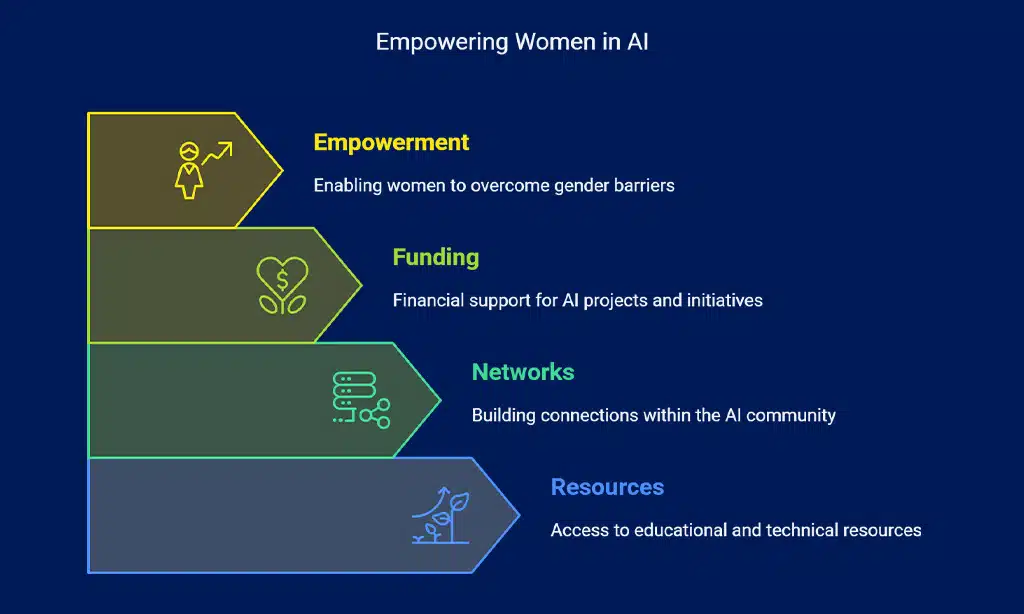
Organizations, both large and small, are playing a pivotal role in supporting women in AI. These initiatives provide access to resources, networks, and funding that empower women to break through the gender barriers in AI.
Women in Tech Organizations and Their Impact
Organizations such as Women in AI and Women Who Code are creating opportunities for women to network, learn, and grow in their careers. These organizations also provide mentorship, job placement support, and events that bring women together to share knowledge and expertise.
Notable Women in AI Organizations
| Organization | Focus | Key Activities |
| Women in AI | Promoting women’s contributions to AI | Conferences, training, and collaborations |
| Women Who Code | Empowering women through coding workshops | Hackathons, networking, mentorship |
| Girls Who Code | Encouraging young girls to pursue careers in tech | Coding camps, school programs |
| AnitaB.org | Creating a supportive community for women in tech | Scholarships, events, and mentorship |
The Future of Women in AI and Tech
Looking ahead, the future of women in AI appears bright. With more women entering the field and more support systems in place, we are likely to see gender parity in AI leadership roles and technical teams within the next decade. As more women enter AI education programs and mentorship networks, they will become influential in shaping future AI development.
The Path Forward: Closing the Gender Gap in AI
The road to closing the gender gap in AI isn’t easy, but it is paved with significant opportunities. By creating more inclusive education systems, fostering mentorship networks, and encouraging organizations to adopt gender-inclusive hiring practices, the industry can make substantial strides. We can expect women to play an even more central role in AI research, policy development, and industry leadership in the coming years.
Wrap Up: The Ongoing Journey of Women Reshaping the Tech Industry
Women are already reshaping the AI landscape, and the impact of their contributions will only grow. Through innovation, advocacy, and education, they are breaking down barriers and driving AI development that is more inclusive, ethical, and reflective of society’s diverse needs. The AI gender gap may still exist, but women are transforming it into an opportunity for progress.
As the world continues to evolve, it’s clear that women will be at the forefront of AI’s future. By supporting initiatives that promote gender equality in AI, we can ensure that the next generation of AI systems will be developed by a workforce that is diverse, inclusive, and innovative—making AI work better for all.