


In a dramatic turn of events at Wimbledon 2025, the prestigious Grand Slam tournament faced a heated controversy involving Russian tennis star Anastasia Pavlyuchenkova and British hopeful Sonay Kartal.
The match, held on Centre Court during the fourth round of the women’s singles, was marred by a technical failure in the tournament’s new electronic line-calling (ELC) system, which led to confusion, a missed call, and an outburst from Pavlyuchenkova, who claimed the game was “stolen” from her.
The incident has reignited the global debate over the increasing use of technology in professional tennis, with players and fans questioning whether automation is harming the integrity and human touch of the sport.
The Match: When Technology Went Silent
The incident unfolded during a tightly contested first set. With Pavlyuchenkova leading and just one point away from winning the game, Kartal struck a backhand that visibly sailed beyond the baseline. The audience, commentators, and Pavlyuchenkova herself assumed it was clearly out. However, no “out” call came from the automated system — which had replaced human line judges at Wimbledon this year — and the point continued.
Pavlyuchenkova, assuming the ball was out, stopped playing, only to find that play was not officially halted. Umpire Nico Helwerth intervened, temporarily stopping the match and informing spectators that he needed to check if the Hawk-Eye Live system, responsible for tracking the ball in real time, was functioning correctly.
While the crowd waited in silence, Helwerth was seen speaking on the phone to officials. After a few minutes of uncertainty, he declared that the system failed to track the ball on that point, and therefore the point would be replayed.
Pavlyuchenkova’s Protest: “They Stole the Game from Me”
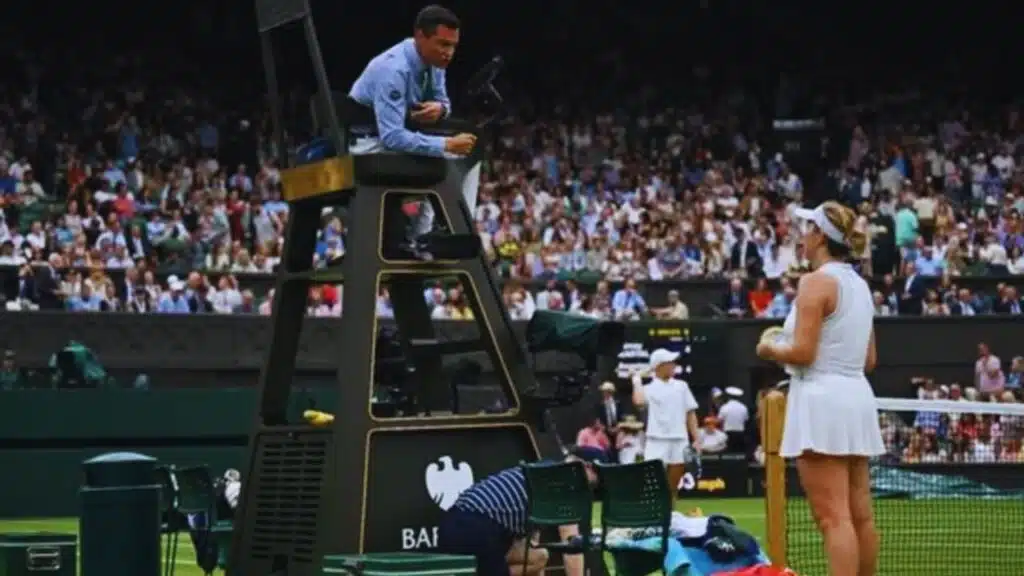
The decision sparked visible frustration from Pavlyuchenkova, who argued the point should have been awarded to her based on what was a clearly out ball. Instead, the match resumed, and Kartal capitalized on the moment — winning the replayed point, breaking serve, and taking a 5-4 lead.
At the changeover, Pavlyuchenkova was overheard telling Helwerth:
“You took the game away from me. They stole the game from me.”
Despite the controversy, the experienced Russian managed to regain her composure, eventually winning the match 7-6(3), 6-4, and advancing to the quarterfinals. However, her emotional response and the controversial interruption left a mark on what should have been a straightforward match.
Wimbledon’s Official Statement: System Error Caused by Human Intervention
In response to the backlash, the All England Lawn Tennis and Croquet Club (AELTC) issued an official statement on Monday, admitting that the problem occurred due to “human error.” The statement explained that the Hawk-Eye operators had manually deactivated the ball-tracking system, which resulted in its failure to register the out ball during the crucial point.
“Following our review, we have removed the ability for Hawk-Eye operators to manually deactivate the ball tracking,” the AELTC told Source.
This means that moving forward, the system will be fully automated and will no longer allow manual shutdowns, even by trained operators.
Wimbledon also confirmed that multiple out calls were missed during the same game. While Helwerth correctly called two of them, the critical third — the one that led to the replay — went unnoticed due to the system being offline. Organizers added that the umpire had no knowledge the system had been deactivated and acted based on standard protocols, which require a replay of the point when the system cannot provide a clear outcome.
“We have apologized to the players involved,” the AELTC added. “The system, while typically accurate, failed due to human error and we have since adjusted our internal processes to prevent this from happening again.”
Players Call for a Human-Technology Balance
After the match, Pavlyuchenkova expressed her concerns during a press conference, emphasizing the need for backup systems and more human involvement during crucial moments.
“It was a very confusing situation, especially when the umpire decided to replay the point. In such key moments, we need clarity. There should be something like football’s goal-line technology, where a clear decision is shown to all.”
She further pointed out that while technology can be helpful, completely replacing human officials removes the “charm” and spontaneity of tennis. Reflecting on how tennis felt during the COVID-19 pandemic, she said:
“During Covid, we didn’t even have ballkids. It just felt robotic. If we remove umpires too, the sport loses its emotional, human element.”
Pavlyuchenkova’s sentiment is echoed by others. Emma Raducanu, Britain’s top-ranked female player, recently said the automated calls seemed “dodgy,” and Jack Draper has also shared skepticism about the system’s reliability.
Locker Room Debate: Players Divided on Full Automation
Swiss star Belinda Bencic revealed that the new system has been a hot topic in the locker room, with many players questioning how much control and accuracy the technology actually offers. While most players acknowledge the general accuracy of Hawk-Eye, there are concerns about over-reliance, especially in situations when human judgment might be necessary to resolve disputes.
In previous tournaments, human line judges served not only as officials but also as fail-safe options in case of tech failures. At Wimbledon this year, their complete removal has sparked questions over what happens when tech malfunctions, as it did on Sunday.
Technology in Tennis: Useful Tool or Unreliable Crutch?
Wimbledon is not the first major tournament to adopt full automation. Both the Australian Open and the US Open have implemented Hawk-Eye Live in recent years. The system is designed to increase efficiency and accuracy, especially in fast-paced matches where human error is common.
Hawk-Eye’s technology uses high-speed cameras and computer vision to track the ball’s trajectory. In theory, this removes subjectivity and enhances consistency. However, the events at Wimbledon 2025 prove that even the most advanced tech can fail without proper checks and balances.
Experts in sports technology, like Dr. Matthew Taylor, a professor of sports engineering at Loughborough University, note that:
“Technology in sports should complement — not replace — human officials. Redundancies must be built in to account for system errors, just like in aviation or medicine.”
Wimbledon’s Quick Fix: But Is It Enough?
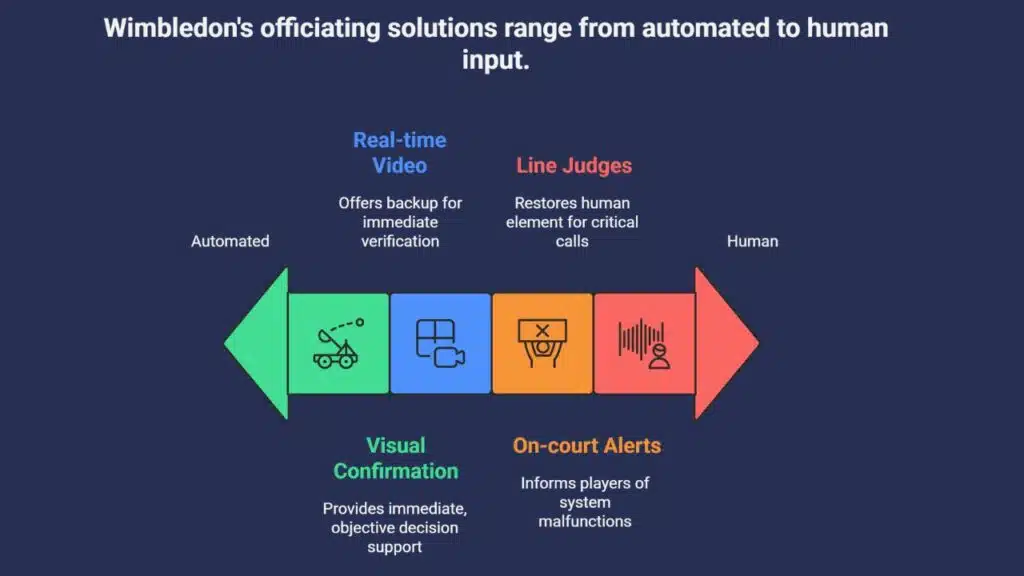
While Wimbledon’s decision to disable manual system overrides is a step forward, critics argue that more needs to be done. Suggestions from players and analysts include:
- Adding visual confirmation systems, similar to football’s goal-line tech.
- Having real-time backup video feeds that can be used for immediate verification.
- Restoring a limited number of human line judges for critical matches or final rounds.
- Including on-court alerts for players when the system fails — so they are aware in real time.
What This Means for the Future of Tennis
The Pavlyuchenkova-Kartal match will likely become a case study in balancing technology and human oversight in sports. As tennis continues to modernize, the sport’s governing bodies — including the ITF, WTA, and ATP — must find ways to ensure fairness, clarity, and player confidence in decision-making systems.
For Wimbledon 2025, the incident is a blemish on an otherwise smooth tournament. But for players like Pavlyuchenkova, it was a frustrating moment that could have changed the outcome of the match if she had not managed to recover.
A Match to Remember, and a Lesson for All
Anastasia Pavlyuchenkova’s emotional reaction to the missed call and her eventual victory show the mental strength elite players must summon amid adversity. However, the controversy highlights a bigger issue — technology is only as reliable as the humans who manage it.
As Wimbledon evolves, so must its systems of accountability and transparency. The 2025 edition may be remembered not just for champions crowned, but for the match that forced tennis to rethink the line between tech and tradition.
The Information is Collected from CNN and Yahoo Sports.






















