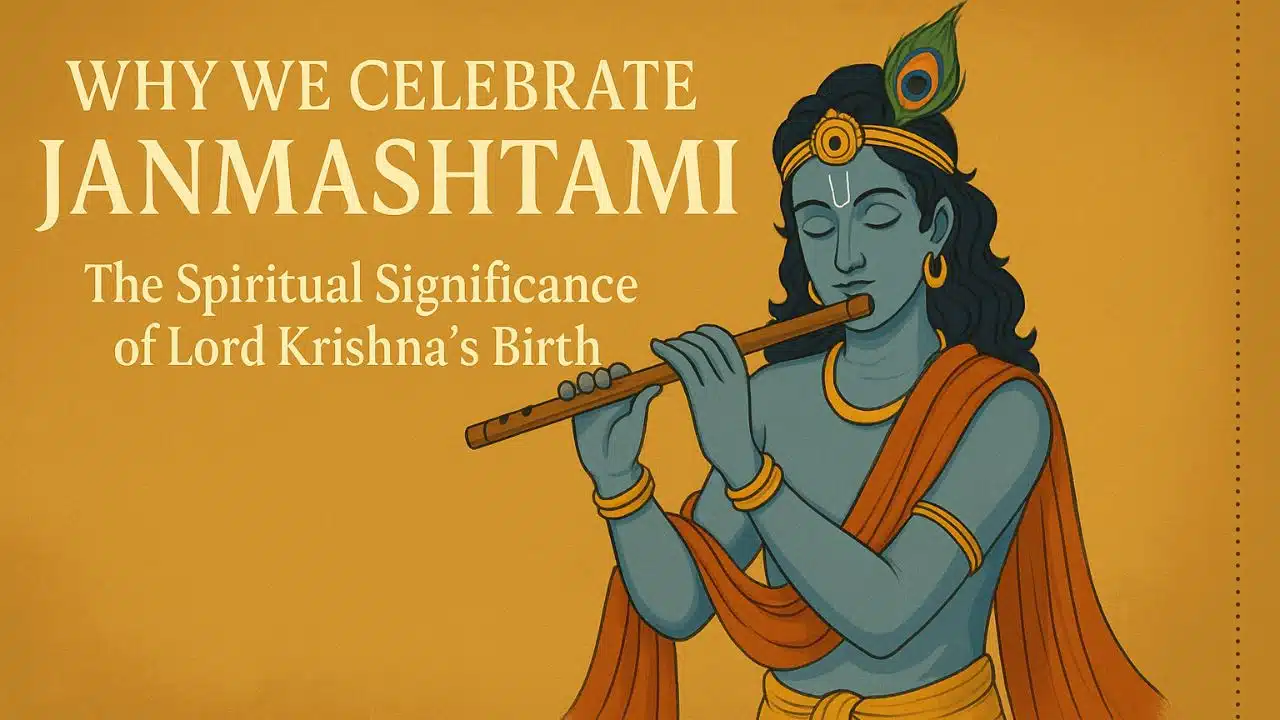
Janmashtami, also known as Krishna Janmashtami or Gokulashtami, is one of the most celebrated Hindu festivals across the world. It marks the birth of Lord Krishna, the eighth incarnation of Lord Vishnu, who came to Earth to restore Dharma (righteousness) and end the rule of evil. This festival is not just about rituals, fasting, and prayers; it is about rediscovering timeless spiritual values that Krishna’s life and teachings symbolize.
Every year, millions of devotees celebrate Janmashtami with devotion, joy, and festivity. From temples in Mathura and Vrindavan to processions in Dhaka and New York, Krishna’s birth is honored with cultural richness and deep faith. But why do we really celebrate Janmashtami? Beyond the grand ceremonies lies a profound spiritual significance that continues to inspire generations.
The Story Behind Lord Krishna’s Birth
The story of Krishna’s birth begins in the city of Mathura, ruled by the cruel King Kansa. A prophecy declared that the eighth child of his sister Devaki would be his destroyer. Out of fear, Kansa imprisoned Devaki and her husband, Vasudeva, killing their children one by one.
On the night of Krishna’s birth, miraculous events unfolded. Despite heavy guards, divine intervention allowed Vasudeva to carry the newborn Krishna across the Yamuna River to Gokul, where he was raised by Nanda and Yashoda.
This story is not just mythology; it is symbolic. Krishna’s birth at midnight represents light emerging from darkness, hope rising in despair, and divine protection in times of suffering.
Why We Celebrate Janmashtami
Janmashtami is more than just the commemoration of Lord Krishna’s birth. It is a festival that reminds us of spiritual truths, moral values, and divine love. Every aspect of Krishna’s life carries a symbolic meaning that continues to inspire humanity across generations. The reasons behind this celebration go beyond rituals and mythology—they connect to universal human values that remain timeless.
Victory of Good Over Evil
Krishna’s arrival symbolized the end of Kansa’s tyranny. His life reminds us that truth and righteousness will always prevail, no matter how strong evil may appear. Janmashtami is a reminder that in difficult times, divine justice will find its way.
Symbol of Divine Love and Compassion
Lord Krishna is often depicted with Radha and the Gopis, playing his flute. These stories highlight Krishna as the embodiment of pure, selfless love. His bond with Radha reflects eternal devotion, teaching us that spiritual love goes beyond material desires.
Lessons of the Bhagavad Gita
Perhaps Krishna’s greatest contribution to humanity is his teachings in the Bhagavad Gita. As Arjuna’s guide on the battlefield of Kurukshetra, Krishna explained the essence of life:
-
Perform your dharma (duty) without attachment.
-
Every action (karma) has consequences.
-
True devotion (bhakti) leads to liberation.
These timeless principles give Janmashtami its spiritual depth.
Celebration of Eternal Joy (Ananda)
Krishna is known as Makhanchor (the butter thief), a playful child who spread joy everywhere. His flute represents harmony, inviting every soul to experience divine bliss. Janmashtami reminds us to embrace life with innocence, laughter, and spiritual joy.
The Rituals and Their Spiritual Meaning
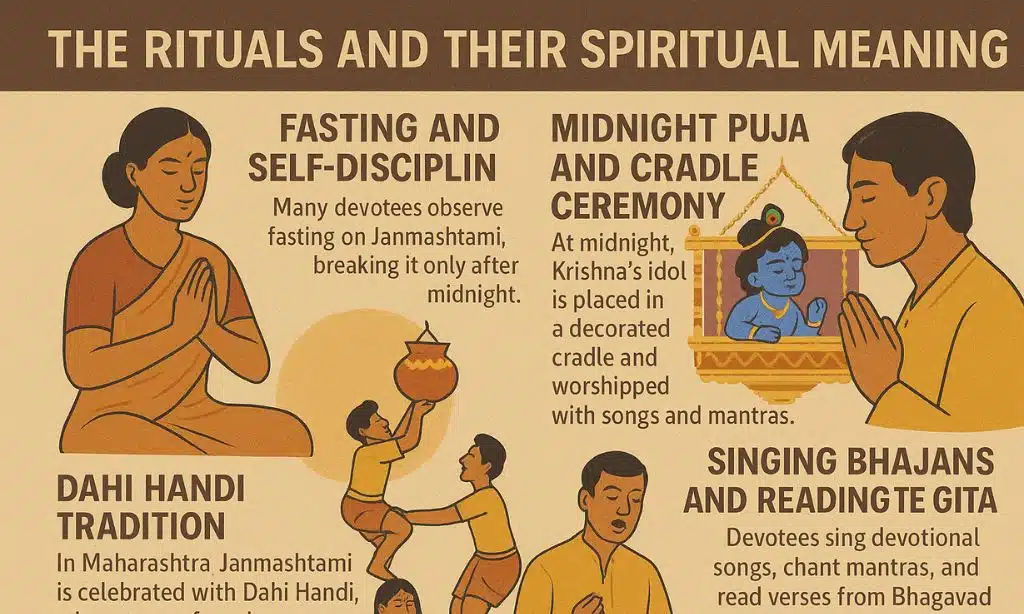
Janmashtami is celebrated with vibrant traditions, devotional practices, and joyful festivities. Yet, every ritual performed during this sacred festival carries a deeper spiritual meaning. These customs are not just symbolic—they are reminders of how Krishna’s divine presence continues to guide the human soul toward purity, devotion, and inner peace.
Fasting and Self-Discipline
Many devotees observe fasting on Janmashtami, breaking it only after midnight. This ritual represents self-control, cleansing, and dedication to God.
Midnight Puja and Cradle Ceremony
At midnight, Krishna’s idol is placed in a decorated cradle and worshipped with songs and mantras. The cradle represents welcoming divinity into one’s heart.
Dahi Handi Tradition
In Maharashtra, Janmashtami is celebrated with Dahi Handi, where teams form human pyramids to break a pot of curd hung high. This symbolizes Krishna’s love for butter but also teaches teamwork, humility, and persistence.
Singing Bhajans and Reading the Gita
Devotees sing devotional songs, chant mantras, and read verses from the Bhagavad Gita. These practices help reconnect with Krishna’s wisdom and bring peace to the mind.
Janmashtami Across the World
Janmashtami is not confined to India—it is a global celebration of spirituality.
-
Mathura & Vrindavan (India): Temples are decorated with lights, and Raslila plays depict Krishna’s childhood and youth.
-
Dwarka (Gujarat): Known as Krishna’s kingdom, celebrations here are majestic with seaside rituals.
-
Bangladesh: In Dhaka and Chattogram, colorful processions and temple ceremonies draw thousands of devotees.
-
Nepal, Mauritius, USA, UK: Hindu communities worldwide organize bhajans, cultural shows, and community feasts.
The worldwide celebrations reflect how Krishna’s message of love and righteousness transcends borders.
Modern Relevance of Krishna’s Teachings
Although Lord Krishna lived thousands of years ago, his words in the Bhagavad Gita and his actions in the Mahabharata continue to guide humanity today.
In an era where people are often trapped by stress, ambition, and material desires, Krishna’s philosophy shows us how to live a balanced and meaningful life. His teachings are not limited to temples or scriptures—they can be applied in our homes, workplaces, and even in how we deal with society.
Dharma in Daily Life
Janmashtami inspires us to reflect on our duties—whether as a parent, student, worker, or leader. Living by dharma means fulfilling responsibilities with honesty and commitment.
Overcoming Ego and Material Desires
Krishna taught detachment from material possessions and ego. In today’s consumer-driven world, this message is more relevant than ever. Inner peace comes from simplicity and selflessness.
Leadership and Moral Courage
Krishna’s role in the Mahabharata is often seen as a model of strategic leadership. He guided Arjuna to make decisions rooted in righteousness, showing us that ethical leadership can shape history.
Takeaways
Janmashtami is much more than a religious festival—it is a philosophy of life. From his miraculous birth to his divine teachings, Krishna embodies love, wisdom, and justice.
By celebrating Janmashtami, devotees are not just honoring the birth of a deity but embracing values that bring meaning to human life: courage against evil, love without conditions, duty without attachment, and joy in every moment.
As we celebrate Janmashtami 2025, let us look beyond rituals and truly reflect on Krishna’s timeless teachings. His birth reminds us that in every age, whenever darkness rises, light will surely return.