

Why is sustainable waste management important? This question has become increasingly critical as our global population grows and consumption patterns evolve.
Sustainable waste management is crucial for protecting our environment, conserving natural resources, mitigating climate change, and fostering economic growth.
The Significance of Sustainable Waste Management
Sustainable waste management refers to the practices and strategies aimed at reducing, reusing, and recycling waste to minimize its impact on the environment. It encompasses a range of activities, from waste prevention and minimization to collection, treatment, and disposal methods that prioritize environmental protection and resource conservation.
Environmental Benefits
One of the primary reasons sustainable waste management is crucial is its positive impact on the environment. Proper waste management practices help reduce pollution, conserve natural resources, and mitigate climate change. Here are some key environmental benefits:
- Reduction in Greenhouse Gas Emissions: Sustainable waste management practices can significantly reduce greenhouse gas emissions. In 2016, it was estimated that 1.6 billion tonnes of carbon dioxide equivalent greenhouse gas emissions were generated from solid waste treatment and disposal, accounting for 5% of global emissions. By implementing better waste management strategies, we can potentially reduce these emissions to 2.38 billion tonnes of CO2-equivalent per year by 2050.
- Conservation of Natural Resources: Recycling and reusing materials help conserve valuable natural resources. For example, recycling one ton of paper can save 17 trees and 7,000 gallons of water.
- Protection of Ecosystems: Proper waste management prevents the contamination of soil, water, and air, thereby protecting ecosystems and biodiversity. The Convention on Biological Diversity notes that effective waste management protects green and blue spaces, allowing them to cater to both biodiversity and human well-being.
Economic Benefits
Sustainable waste management also offers significant economic advantages:
- Job Creation: The circular economy principles associated with sustainable waste management could potentially create 7-8 million jobs globally.
- Cost Savings: Effective waste management can lead to substantial cost savings for businesses and municipalities. Analysts suggest that circular economy principles could save over £500 billion globally.
- Resource Recovery: Recycling and waste-to-energy processes can recover valuable resources, creating new economic opportunities. In 2018, 69 million tons of MSW were recycled in the United States, a 2.2% increase from 2015.
Challenges in Implementing Sustainable Waste Management
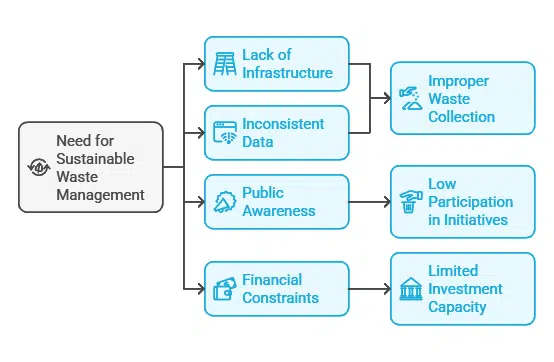
Despite its importance, implementing sustainable waste management practices faces several challenges:
- Lack of Infrastructure: Many developing countries lack the necessary infrastructure for proper waste collection and treatment. In low-income countries, only about 48% of waste is collected in cities, dropping to 26% outside urban areas.
- Inconsistent Data: The lack of standardized and consistent data on waste generation and management hinders effective policy-making and implementation.
- Public Awareness: Insufficient public awareness and education about proper waste management practices can lead to low participation rates in recycling and waste reduction initiatives.
- Financial Constraints: Implementing sustainable waste management systems often requires significant upfront investments, which can be challenging for many municipalities and developing countries.
Best Practices in Sustainable Waste Management
To address these challenges and maximize the benefits of sustainable waste management, several best practices have emerged:
1. Waste Reduction and Prevention
The most effective way to manage waste is to prevent its generation in the first place. This can be achieved through:
- Encouraging businesses to adopt sustainable packaging practices
- Promoting consumer awareness about reducing waste
- Implementing policies that incentivize waste reduction
2. Recycling and Composting
Recycling and composting are crucial components of sustainable waste management:
- In 2018, the recycling rate (including composting) in the United States was 32.1%
- Composting of food and yard waste can significantly reduce methane emissions from landfills
3. Waste-to-Energy Technologies
Converting waste to energy can help reduce landfill usage while generating power:
- In 2018, 34.6 million tons of MSW in the United States were combusted with energy recovery
- Advanced technologies like anaerobic digestion can produce biogas from organic waste
4. Extended Producer Responsibility (EPR)
EPR policies hold manufacturers responsible for the entire lifecycle of their products, including disposal:
- This approach encourages the design of products with recyclability and sustainability in mind
- It can help reduce the burden on waste management systems
5. Smart Waste Management Systems
Leveraging technology can improve the efficiency of waste management:
- IoT devices and sensors can optimize waste collection routes
- Data analytics can provide insights for better waste management planning
Global Perspective on Waste Management
The state of waste management varies significantly across different regions:
| Region | Waste Collection Rate | Recycling Rate | Landfill Rate |
| Europe and Central Asia | 90% | 56.3% (EU, 2022) | 20.9% (EU, 2022) |
| North America | 90% | 32.1% (US, 2018) | 50% (US, 2018) |
| Sub-Saharan Africa | 44% | Data not available | Data not available |
Source: World Bank, Eurostat, EPA
The Future of Sustainable Waste Management
As we look to the future, several trends are shaping the landscape of sustainable waste management:
- Circular Economy: There is a growing emphasis on transitioning from a linear “take-make-dispose” model to a circular economy that prioritizes resource efficiency and waste minimization.
- Technological Advancements: Emerging technologies like artificial intelligence and blockchain are being explored to improve waste tracking, sorting, and recycling processes.
- Policy Developments: Many countries are implementing stricter regulations and targets for waste reduction and recycling. For example, the European Union aims to recycle 65% of municipal waste by 2035.
- Increased Public Awareness: Growing environmental consciousness is driving consumer demand for sustainable products and better waste management practices.
Takeaways
So, why is sustainable waste management important? It is essential for creating a cleaner, healthier, and more sustainable world for current and future generations. By adopting sustainable waste management practices, we can protect our environment, conserve resources, reduce pollution, and create economic opportunities.
As we face the challenges of a growing global population and increasing consumption, sustainable waste management will play a pivotal role in building a more sustainable and resilient future.





















