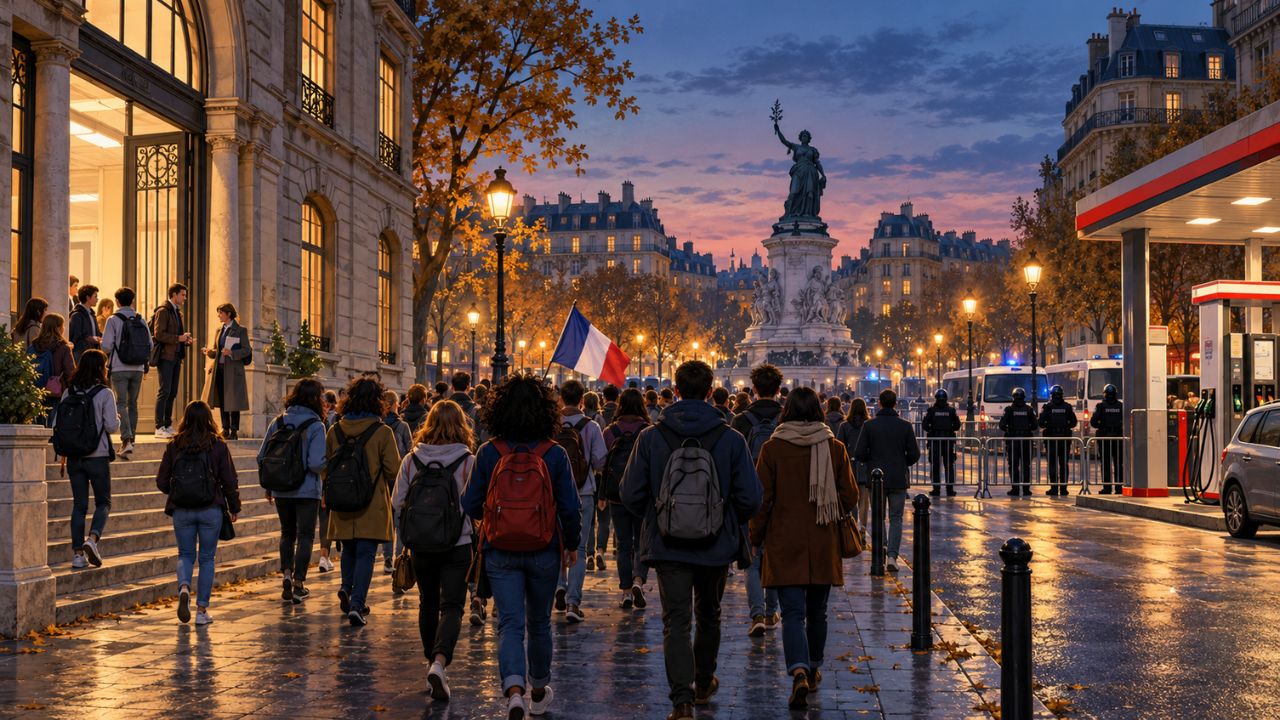
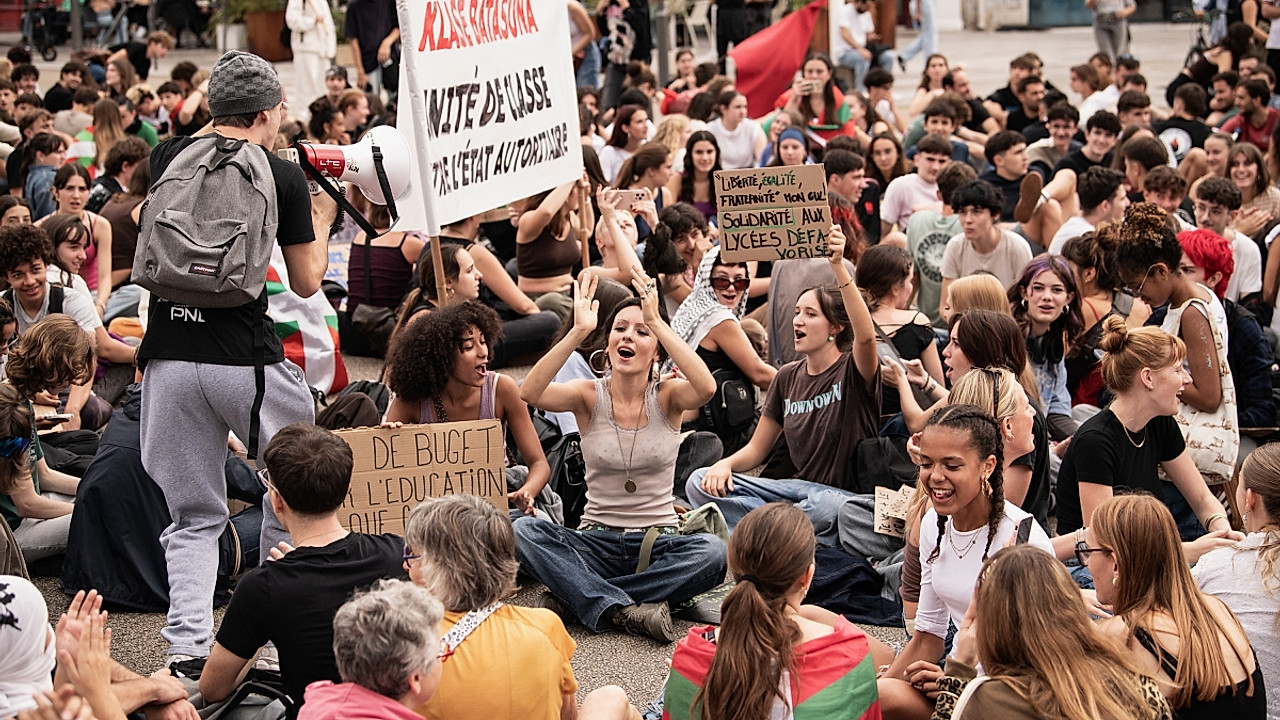
Why is France protesting? France’s protests began with high school students demanding teachers and better conditions in their classrooms. They widened as people angry about fuel prices, living costs, and public services joined the marches. On 17 October, hundreds of thousands demonstrated across the country. Most marched peacefully, but rioting and looting in several cities prompted arrests and local curfews.
The government is now trying to answer the protesters’ demands while preventing another violent weekend.
Why did students begin protesting?
The first school blockades began in and around Paris in late September. Students complained about missing teachers, crowded classrooms, buildings in poor condition, and long school days. Some were also frustrated by Parcoursup, the system for applying to higher education, and wanted clearer explanations of how admissions decisions are made.
In Marseille, a teacher told Reuters that she had 37 pupils in her class. At the start of lessons, she said, they had to look in nearby rooms for spare chairs and desks. Her account puts a practical detail behind the students’ demands: they want the staff and space to get through an ordinary school day.
The movement soon reached well beyond the schools where it began. The Interior Ministry counted 71,500 people at demonstrations across France on 8 October, including 24,500 at the main Paris march. Students were joined by teachers and others who saw the school dispute as part of a wider problem with public services.
Read about the 2025 France protests here.
How did fuel prices enter the picture?
By mid-October, groups protesting the cost of living were preparing to march alongside students. They brought their own concerns: the price of filling a car, pressure on household budgets and the difficulty of maintaining services when public finances are tight.
The fuel-price increase is substantial. France’s statistics agency reported that overall consumer prices in September were 3.1% higher than a year earlier. Energy prices had risen 21.3% over that period, while diesel prices had risen 44.1%. Those are changes over 12 months, not increases that happened during September alone.
The Middle East conflict has disrupted oil shipments and refining, adding pressure to fuel markets across Europe. That helps explain the price shock. It does not explain why French pupils were missing teachers or protesting the condition of their schools. The two sets of grievances met in the same marches.
Some of the people calling for action identify with the Yellow Vests, a movement that began in 2018 over fuel taxes. Its return gives the current demonstrations a familiar image, but the school protests have their own origin and demands.
Why is France protesting, and what happened on 17 October?
The nationwide marches brought those frustrations together. Interior Minister Laurent Nuñez estimated that 550,000 people took part; organisers put turnout at 800,000. These are competing estimates, not a confirmed headcount.
Most demonstrators were peaceful. Violence nevertheless broke out in and around marches in Paris, Marseille, Lyon and other cities, then continued in some places afterward. Shops were looted, public buildings were attacked, and fire badly damaged the historic city hall in Limoges. Authorities reported about 2,400 arrests over the weekend. Being arrested does not establish that a person committed an offence.
President Emmanuel Macron and Prime Minister Sébastien Lecornu have blamed radical far-left groups and opportunistic looters for parts of the violence. Policing researcher Sebastian Roché has argued that far-left groups alone cannot explain its scale. The causes and perpetrators of particular attacks remain matters for investigators and courts.
There are questions about the authorities’ response as well. Interior Minister Nuñez offered to resign after the security failures; Macron refused his resignation and called for an account of what went wrong. Human Rights Watch has also reported serious injuries to young people from police weapons during the preceding school protests. On 20 October, parliamentary groups agreed to begin setting up an inquiry into both the weekend’s violence and the policing of it.
Is France under curfew?
There is no nationwide curfew. Restrictions have been imposed locally, and they do not all apply to the same people or run for the same hours.
In Paris, the first curfew covered areas around Place de la République and Les Halles from 11 p.m. on Monday, 19 October, until 6 a.m. Tuesday. Demonstrations in certain areas were separately banned from 8 p.m. The curfew did not cover the entire capital, and that first order had expired by Tuesday morning.
Lille and several nearby towns imposed an 8 p.m. to 6 a.m. curfew for minors for two nights. Nice announced an overnight restriction for minors in its centre. Marseille said it would introduce a curfew for minors in commercial areas hit by the looting from Tuesday night. Other cities have used their own local measures, including restrictions on gatherings.
The distinction matters if you live in, work in, or plan to visit one of these places. A ban on a particular demonstration is different from a curfew, and an order covering minors in one district is different from a citywide restriction. Local orders may also be extended or changed.
Lecornu said targeted curfews contributed to quieter streets on Monday night. That is the government’s assessment after one night; it remains too early to judge their lasting effect.
Read more about the India student protests 2026 here.
What has the government promised?
On education, the government says it will send more than 3,000 substitute teachers to high schools with the greatest need. It is also examining school timetables, building conditions, the clarity of higher education admissions and how students can take part in decisions affecting them. A national consultation for pupils remains open until 23 October, with a summary expected later in the month.
The different school complaints require different people to act. Teacher staffing falls to the national education system. Public high school buildings, including their facilities, are the responsibility of France’s regional authorities. Sending a substitute teacher may restore a missed lesson; repairing a classroom or its heating is another job.
On fuel, the government has announced a release of 10 million barrels of diesel from strategic stocks. It expects the measure to reduce pump prices by an average of 12 to 18 euro cents a litre from November through January. That is a projected reduction for diesel, not a discount already in place at every petrol station.
The government has also announced support for businesses damaged in the unrest, including help intended to protect jobs and planned interest-free loans for affected shops. Those measures address the damage left by the rioting. They do not settle the original disputes over schools or living costs.
Read more about the Ladakh Gen Z protests here.
Why is the crisis hard to resolve?
The protesters do not have one demand that a single announcement can satisfy. A school may need a teacher immediately, a building may need repairs, and a driver may need relief at the pump. The government’s responses are arriving on different timetables.
Money is part of the difficulty. The government is seeking to bring its budget deficit down from a projected 5.4% of economic output this year to 5.0% in 2027. Its proposed budget must pass through a divided parliament. Demands for more spending on services and relief for households are therefore landing during an already difficult budget debate.
The political stakes are rising ahead of France’s 2027 presidential election, but the most immediate question is simpler. Can the next large demonstrations proceed safely, and will people see the promised changes in their schools and household bills?
Read more about the Madagascar Gen Z protests here.
What happens next?
Student groups and Yellow Vest activists have called for more demonstrations on Saturday, 24 October. As of 20 October, major labour unions including the CGT had not joined that Saturday call. Unions have separately called for strikes and rallies on 5 November. Lecornu has invited political parties to talks on Thursday.
Mainland schools are on their scheduled autumn break and are due to reopen on 2 November. A school closed during the break is not necessarily still blockaded.
That return to class will provide one measure of the government’s response: whether missing teachers have arrived and whether students notice any improvement. The other tests come sooner, on the streets this weekend, and later, when the government’s promised diesel relief is due to reach the pump.