
A child may know the alphabet song, recognize several letters, and enjoy listening to stories but still struggle to read a simple word. That gap often puzzles parents. Knowing a letter’s name is not the same as knowing how the letter helps represent a sound inside a word.
What is phonics? It is the teaching of relationships between sounds in spoken language and the letters or letter groups used to represent them. Children apply those relationships to read unfamiliar words and spell words they hear.
For example, a child can blend the sounds represented by m, a, and t to read mat. Later comes the understanding that letters can work together, as sh does in ship.
Phonics gives children a practical route into reading and spelling. It is not the whole of reading instruction, but it is an essential part of learning to read an alphabetic language such as English.
What Is Phonics in Everyday Terms?
Written English uses letters to represent spoken language. A phoneme is a distinct sound in a word. A grapheme is the letter or group of letters used to represent that sound.
In map, the three letters represent three sounds. In ship, sh is a two-letter grapheme representing one sound. The number of letters and sounds in a word therefore does not always match.
Children need to do more than recall isolated sounds. They must learn how to use them within words. Two processes are central:
- Blending means combining sounds to read a word. A child looks at sun, says the sounds from left to right, and joins them to say the whole word.
- Segmenting means breaking a spoken word into sounds for spelling. A child hears fish, identifies its sounds, and chooses letters to represent them.
Blending supports reading, while segmenting supports spelling. Practising both makes the connection between reading and spelling much clearer.
How Phonics Instruction Usually Develops
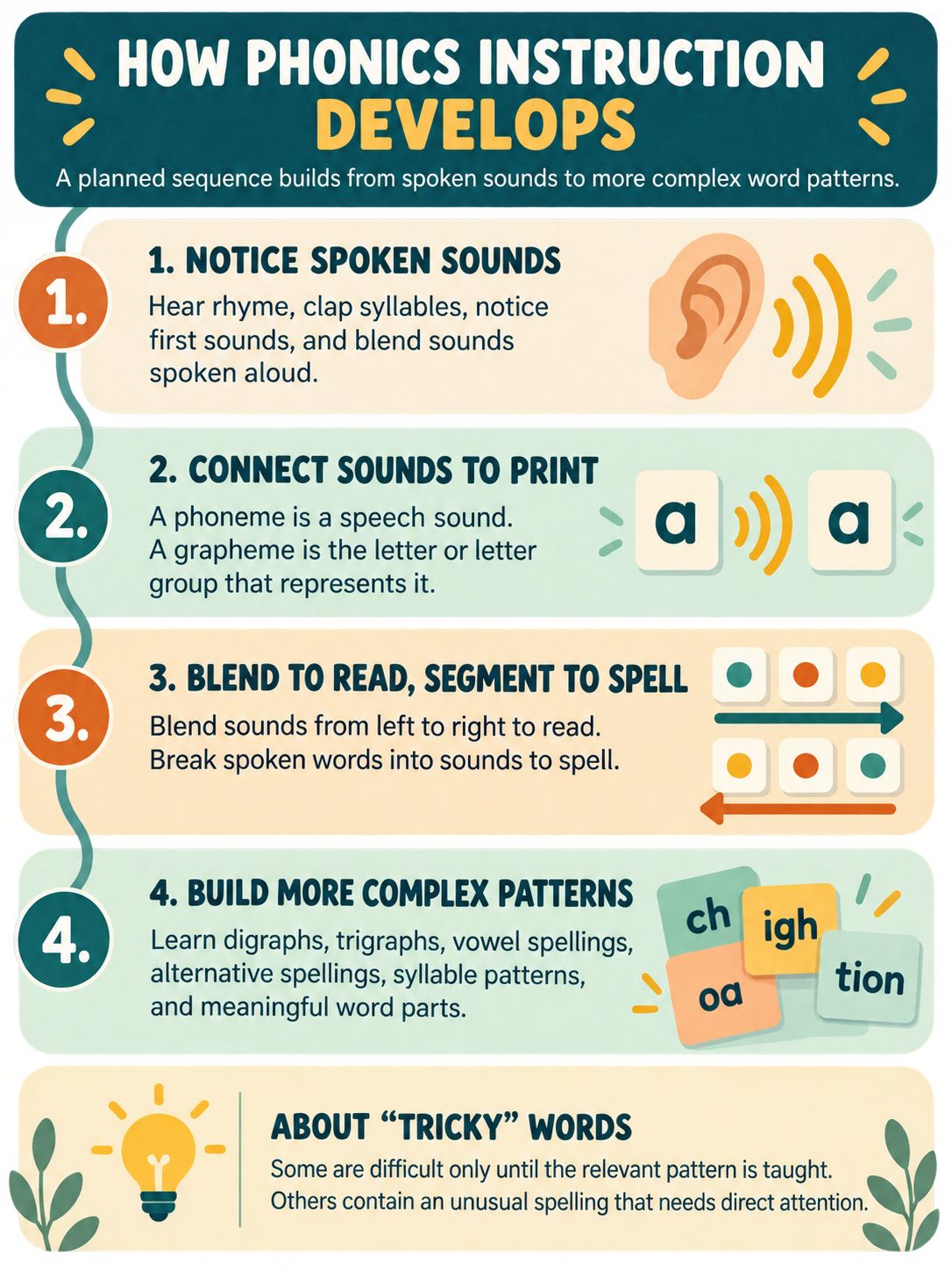
The teaching order varies by country, curriculum, and program. What matters is that it is planned, with time to revisit and use familiar relationships before more complex patterns are added.
Children learn to notice sounds in spoken words
Hearing how words can be divided and combined supports the move into print. Activities may include identifying rhyme, clapping syllables, noticing a word’s first sound, or blending sounds spoken aloud.
These activities develop phonological awareness. Phonemic awareness is the more specific ability to notice and work with individual phonemes. Both are oral language skills. They become phonics when those sounds are connected to written letters.
Letters and sounds are connected directly
Children learn common relationships between graphemes and phonemes. Knowing that s is called “ess” does not by itself help a child blend sat; the child also needs the sound associated with the letter.
Children blend to read and segment to spell
After learning a small, useful set of relationships, children can read simple words. A child might look at map, say each sound from left to right, and then combine them. As the word becomes familiar, the child no longer needs to sound out every part aloud.
Spelling runs in the opposite direction. The child hears a word, separates it into sounds, and chooses graphemes to represent them. An early attempt may be plausible without being correct because not every relevant pattern has been taught.
The code becomes more complex
English does not offer a simple one-letter, one-sound match in every word. Children gradually learn:
- Digraphs and trigraphs such as sh, ch, and igh
- Common vowel spellings such as ai, ee, and oa
- Sounds with more than one possible spelling
- Graphemes with different pronunciations in different words
- Syllable patterns and meaningful word parts
- Common words containing an unusual or not-yet-taught spelling
Some “tricky” words are only temporarily difficult because the relevant pattern has not been taught. Others contain an unusual spelling. Treating all of them as shapes to memorize hides the parts that are regular.
Why Explicit, Systematic Teaching Matters
Research supports phonics instruction that is both systematic and explicit. Systematic means that skills follow a planned sequence. Explicit means the teacher explains and demonstrates the relationship instead of expecting children to discover it independently.
A focused lesson might review sh, blend it in shop and fish, ask children to build or write one of those words, and then use the pattern in a short passage. That sequence is more useful than presenting sh on a flashcard and assuming recognition will transfer automatically to reading.
Programs differ in terminology and sequence. Evidence comparing individual commercial programs is more limited than the broader evidence for systematic phonics. Quality and consistency matter more than claims that one brand is the only valid choice.
Good instruction also responds to the child’s errors. One child may recall individual sounds but struggle to blend them. Another may blend accurately while confusing similar-looking letters. Giving both children the same extra worksheet misses the point: they need practice aimed at different skills.
Phonics Is Essential, but It Is Not the Whole of Reading
Phonics helps children identify written words, but identifying a word is not the same as understanding a text. Reading also draws on vocabulary, fluency, background knowledge, and an understanding of sentences and longer passages.
A child can pronounce a word without knowing what it means. Another may understand sophisticated stories read aloud but lack the decoding skill to read them independently. They need different support.
A strong early literacy routine includes:
- Direct teaching of letter-sound relationships and word-reading skills
- Practice with words and text that match what has been taught
- Read-alouds using engaging stories, nonfiction, and poetry
- Conversation that builds language, knowledge, and vocabulary
- Opportunities to spell and write
The familiar argument that parents must choose between phonics and enjoyable books is unhelpful. Children need direct help with written words and regular access to language and ideas beyond what they can currently decode alone.
Guessing From Pictures Is Not Reading the Word
Beginning readers sometimes look at an illustration, notice the first letter, and guess a word that would fit the scene. A child may see a horse and say pony even though the printed word is horse.
The guess may make sense, but it does not show that the child identified the written word. Pictures are valuable for enjoying and discussing a story. They should not replace attention to the letters when a child is decoding.
When a child gets stuck, useful prompts include:
- “Look at all the letters.”
- “Move from left to right and blend the sounds.”
- “Does the word you said match the whole written word?”
Context still matters for comprehension. Once the word has been decoded, the child should check whether it makes sense in the sentence. The important distinction is that meaning confirms the reading; it should not replace looking closely at the print.
Supporting Phonics at Home Without Creating Another School Day
Home practice works best when it matches school instruction. Ask which patterns have been introduced and how the school pronounces them. This avoids competing routines and material the child has not yet been taught.
A brief practice session can include:
- Review a few known spelling-sound relationships.
- Blend several short words and build or write one or two of them.
- Read a short, well-matched decodable book or passage.
- Finish with an enjoyable book read aloud by an adult.
Stop when attention or patience runs out. Focused practice is more useful than turning reading into a long test.
Keep consonant sounds clean
Adults sometimes add an extra vowel to consonants, turning the sound for m into “muh” or the sound for t into “tuh.” The added vowel can make blending harder: “muh-a-tuh” does not join neatly to make mat.
Follow the model used by the child’s teacher rather than creating a separate pronunciation system at home.
Let children move letters around
Magnetic letters, paper tiles, or handwritten cards let children change words without the added demand of handwriting. A child can turn sat into mat, then change mat to map. The movement makes each sound change visible.
Correct the part that caused the error
If a child reads stop as spot, “Try again” gives little guidance. “Look at the middle two sounds. Which comes first?” directs attention to the actual problem.
Allow a short pause before helping. If the child still cannot continue, model the difficult part and let the child blend the word. Repeated failure is not productive practice.
Decodable Books and Storybooks Do Different Work
Decodable books let beginners practise relationships they have learned. Early examples can sound limited because the author is working with a restricted set of patterns. Their purpose is decoding practice, not replacing children’s literature.
Storybooks, nonfiction, poems, songs, and oral storytelling expose children to richer vocabulary, ideas, sentence structures, and humor. Adults can read these aloud even when the text is well beyond the child’s independent reading level.
The practical answer is to use both. Let children read well-matched text themselves, then share books that stretch their language, curiosity, and knowledge.
Mistakes That Can Slow Progress
The most common mistake is adding material before earlier learning is secure. More flashcards will not fix weak blending. Reduce the number of patterns, use them in words, and build up again.
Do not accept a guess merely because it fits the picture or begins with the right letter. If the word is horse and the child says pony, the answer is not close enough for decoding practice.
Two other habits deserve attention:
- Do not teach every common word as a picture to memorize. Many high-frequency words are fully or partly explained by phonics. Point out the regular sections and teach the unexpected part directly.
- Do not assume a harder book means better progress. If an adult has to rescue nearly every sentence, read that book aloud and choose a better-matched text for independent practice.
A plausible but incorrect spelling can reveal which sounds a child heard and which patterns remain uncertain. Correct it, but use the error as information rather than treating it as carelessness.
When a Child Continues to Struggle
Children progress at different rates, and difficulty with a newly introduced pattern does not by itself indicate a reading disorder. Persistent problems despite clear teaching and supported practice deserve closer attention.
Speak with the teacher if the child continues to struggle with letter-sound relationships, blending simple words, separating words into sounds, or applying previously taught patterns.
Ask specific questions:
- Which skills can the child do independently, and where does reading break down?
- What extra instruction is being provided?
- Which patterns should be practised at home?
- When will progress be reviewed?
Hearing, speech and language development, attention, previous instruction, and familiarity with the language used at school may affect performance. Speaking more than one language is not itself a disorder. Assessment should distinguish language differences, including accent and dialect, from genuine difficulty and should consider the child’s abilities across their languages where possible.
Parents are not expected to diagnose the cause. Their useful role is to describe what they are seeing, ask for a clear instructional response, and seek an appropriate professional assessment if concerns remain.
Final Thoughts
Understanding what is phonics makes the next step clearer. Find out which patterns the child has already learned, practise those patterns in a few words, and choose reading material that allows the child to use them successfully. Keep richer books in the routine by reading them aloud.
Watch what happens when the child gets stuck. Forgetting a sound, failing to blend, reversing the order of sounds, and guessing from the first letter are different problems. A specific observation gives a teacher far more to work with than “reading is hard.”
Phonics offers a dependable way into unfamiliar print. The wider work of reading—building knowledge, vocabulary, fluency, and understanding—continues around it. Children need both.
Frequently Asked Questions
What is the difference between phonics and phonemic awareness?
Phonemic awareness is the ability to hear and work with individual sounds in spoken words. Phonics connects those sounds to written letters. A child can practise phonemic awareness without seeing any print, but a phonics activity always involves written language.
At what age should children start learning phonics?
There is no single starting age because school systems and children’s development differ. Preschool children can enjoy rhymes, songs, alphabet play, and conversations about sounds. Planned phonics teaching usually begins when formal reading instruction starts. Starting earlier is not automatically better if the activities are developmentally unsuitable or create pressure.
Why can my child say the letter sounds but not read a word?
Remembering individual sounds and blending them are separate skills. A child may correctly identify every letter in map but struggle to hold the sounds in sequence and combine them. Practise with two- or three-sound words, model the blend once, and then let the child try. If the problem continues, tell the teacher that blending—not sound recall—appears to be the difficulty.
Should children memorize sight words?
Children do need to read many common words quickly, but that does not mean every word should be learned as a visual shape. Show the parts that follow familiar phonics patterns and draw attention to any unexpected spelling. This gives the child something more useful than a whole-word memory test.