Research notes for writers often look complete until the final fact-check begins. Then an editor discovers that a statistic has no survey year, a quotation has lost its surrounding context, or a product price was copied without a check date. A saved link is not enough if nobody can find the passage that supports the claim.
Useful notes create a small evidence trail. They show what the writer found, where it came from, how it will be used, and what remains uncertain. Purdue University Northwest frames the basic test through three questions: What did you find, where did it come from, and why does it matter?
Professional standards follow the same principle. The Society of Professional Journalists emphasizes accuracy and source identification. The Associated Press requires online information to be vetted and attributed. Google Search Central also encourages original, accurate content with clear authorship.
The ten notes below turn those broad principles into a practical pre-publishing routine for journalists, bloggers, content marketers, freelance writers, and nonfiction authors.
Why Research Notes for Writers Need More Than Saved Links
A bookmark only records where a page was found. It does not explain which sentence matters, whether the source is reliable, or how the evidence fits the draft. When that context is missing, writers must repeat their research during editing. Worse, a weak claim may survive because nobody has time to trace it properly.
Good research notes do not need to become another complicated project. A document, spreadsheet, or database is enough when every important claim can be connected to its source, context, limitations, and verification status.
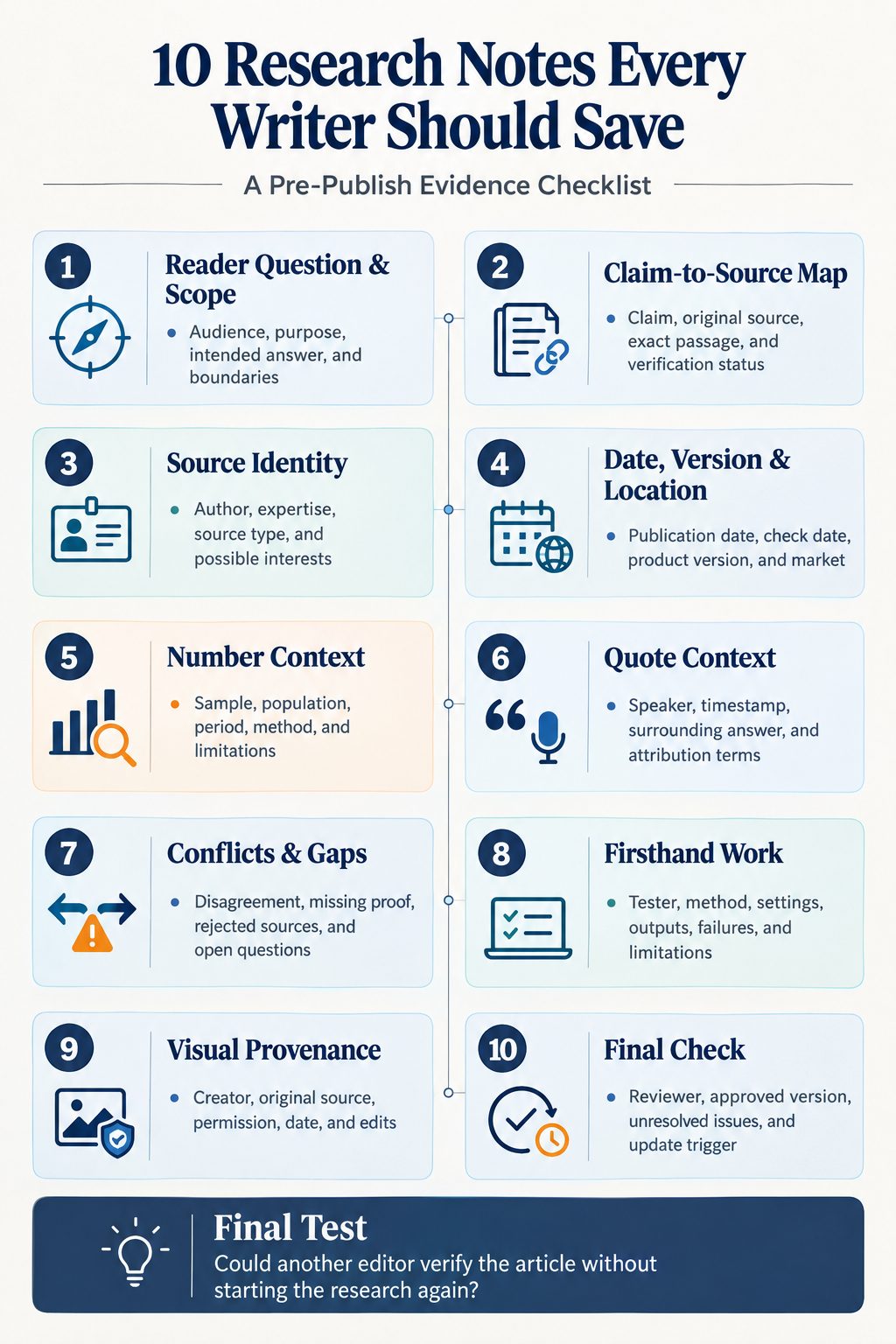
1. Save the Reader Question and Scope
Research can expand in several directions at once. One report introduces a new term, another raises a related issue, and the original article slowly loses focus.
Start with one sentence that identifies the reader, the question, and the intended outcome. Add any boundary that changes the answer.
For example:
This article helps freelance writers decide which AI-assisted writing tasks still require human review. It covers research, drafting, and editing workflows, but not legal or medical advice.
Use that sentence to judge every source. If a report does not help answer the central question, it may belong in another article. When the scope changes for a valid reason, update the note deliberately rather than letting the draft drift.
2. Build a Claim-to-Source Map
A source list shows what a writer opened. A claim-to-source map shows what each source actually proves.
For every important factual statement, record the wording used in the draft, the original source, the exact page or passage, the date checked, and the verification result. A practical system for taking notes effectively also keeps exact quotations, paraphrases, and personal interpretations clearly separated.
Suppose a draft says that a fictional writing tool costs $20 per month. The working note could look like this:
| Field | Example Record |
|---|---|
| Draft claim | The individual plan starts at $20 per month. |
| Original source | Official pricing page |
| Evidence location | Individual plan row in the pricing table |
| Checked | November 2, 2026 |
| Scope | US pricing; taxes and annual discounts excluded |
| Status | Supported as of the check date; verify again before publication |
The source must support the exact claim, not merely discuss the same topic. If the source says “from $20” for one market, the article should not turn that into a universal fixed price.
3. Record Who Produced the Information
A polished page can still be weak evidence. Note who created the information and why that person or organization is in a position to know it.
For a study, record the authors, journal, research design, and any relevant funding or conflict statement. For product information, distinguish official documentation from an independent test or customer opinion. For an interview, save the source’s role and direct connection to the subject.
A company is usually the strongest source for what it announced, but not necessarily for whether its product performs better than a competitor. A press release can confirm the wording and date of an announcement. It cannot provide independent proof of success.
These short labels are often enough:
- Primary or secondary source
- Official claim or independent evidence
- Expert analysis or personal experience
- Sponsored or affiliated source
- Named, anonymous, or background source
4. Keep the Date, Version, and Location
Some facts expire quickly. Software menus change. Prices move. Job openings close. Rules and public guidance can vary by country or state.
Save the publication date, last-update date, and the date you checked the source. For software, include the platform, version, model, account plan, or interface. For legal, financial, education, travel, or policy information, record the relevant jurisdiction.
Avoid notes such as “the current price is $20.” A stronger record says where that price applied, when it was checked, what it included, and when it should be reviewed again.
This context also prevents false freshness. Updating the date at the top of an article does not make the information current unless the changeable claims were checked again.
5. Preserve the Meaning Behind Every Number
A statistic can be copied correctly and still mislead readers. The missing detail may be the denominator, sample, location, measurement period, or survey method.
Save the number and unit together with:
- Who collected the data
- The sample or population
- Data-collection dates
- Country or market
- Measurement method
- Important limitations
If the article contains a calculation, keep the inputs, formula, assumptions, and rounding rule. “Sixty-two percent preferred option A” means little unless readers know whether that refers to 50 volunteers, 500 customers, or all account holders.
Writers who want to make claims easy to verify should connect every important number to its original source, date, population, and measure. If those details cannot be recovered, narrow or remove the claim instead of hiding the gap behind “studies show.”
6. Keep Quotations With Their Context
Do not save only the sentence you hope to publish. Keep the question that prompted it, the surrounding answer, the speaker’s name and role, and the page number or timestamp.
For an interview, also record the date, format, agreed attribution terms, and whether the quotation was translated. Follow the publication’s interview policy and any applicable consent or recording requirements.
Label each note as an exact quotation, paraphrase, summary, or writer interpretation. This prevents a paraphrased idea from appearing later as the speaker’s exact words.
Quotations should not be taken out of context or silently repaired. If the original wording is unclear, a faithful paraphrase is often safer. Confirming the facts in a statement also does not give a source control over the article’s final language.
7. Save Disagreement and Missing Evidence
Research notes should preserve evidence that challenges the working angle, not only material that supports it.
Add a small “Challenges and Gaps” section. Record credible sources that disagree, limitations in the strongest evidence, and questions that remain unanswered. If two numbers conflict, note whether they use different definitions, samples, markets, or time periods.
Keep a brief record of rejected sources as well. A source may be outdated, circularly cited, commercially biased, or unable to support the claim attached to it. Recording the reason prevents another editor from reopening the same page and repeating the assessment.
A simple status system keeps the process manageable:
- Supported
- Partly supported
- Conflicting
- Unverified
- Outdated
- Removed from the draft
- Specialist review needed
8. Document Firsthand Work Honestly
Articles based on interviews, experiments, product testing, site visits, or personal experience require more than a claim that the work happened.
For a product test, record who performed it, when it happened, the device or plan used, the task, settings, inputs, outputs, failed attempts, and relevant limitations. Keep original files or screenshots when privacy, permission, and publication policies allow.
Strong content authenticity depends on traceable sources, clear ownership, original value, and known media history. A vendor demonstration or public screenshot does not prove that the writer personally tested the product.
If no firsthand work occurred, describe the article as research-based. Clear third-person reporting is more credible than invented “I tested” or “we found” language.
9. Track Where Visual Material Came From
Images, charts, screenshots, audio, and video need their own source notes. Record the creator or owner, original location, creation or capture date, permission or license, and any reuse restrictions.
For screenshots, include the page or app shown, version, account type, date, and any redaction. For charts, retain the underlying data, units, calculation method, and labels. If an AI-generated image is used as an illustration, record the tool and creation details required by the publisher. Do not present it as documentary evidence.
Keep the original asset separate from the publishing copy when annotations or privacy edits are needed. Never alter a documentary image in a way that hides a warning, changes a result, or creates a feature that was not present.
10. Save the Final Check and Update Trigger
The last note should show what was checked, who reviewed it, and what could make the article outdated.
Record the final draft version, fact-check date, reviewer, resolved corrections, disclosure decision, and any remaining limitation. Add recheck triggers for prices, product versions, regulations, deadlines, rankings, or other fast-changing facts.
A documented content approval workflow should identify who approved which version and whether any conditions remained. A casual “looks good” message becomes difficult to audit once several versions exist.
This record also supports transparent corrections. If an error appears later, the editor can see which source supported the original wording, identify what changed, and correct the article without hiding its history.
A Reusable Research Note Template
Writers do not need ten separate documents. Use one row per important claim, quotation, calculation, or asset. A compact template can contain these fields:
| Field | What to Record |
|---|---|
| Article and section | Working title and the relevant draft section |
| Claim or evidence | Exact statement, quotation, number, or asset |
| Original source | Author, publisher, title, DOI, URL, or interview record |
| Evidence location | Page, paragraph, table, timestamp, or filename |
| Context | Source type, date, version, market, population, or method |
| Limitations | Uncertainty, disagreement, exclusions, or missing proof |
| Status | Supported, partial, conflicting, unverified, or removed |
| Final check | Reviewer, check date, and next update trigger |
Keep the research record beside the final draft in a location the editor can access. Retain permitted copies or stable archive references for important sources that may change or disappear.
What Makes a Research Note Worth Keeping
Research notes for writers do not need elaborate software or hours of extra administration. They need enough context to reconstruct the evidence and understand the editorial decision.
Before publishing, ask one question: could another editor verify the important parts of this article without starting the research again? If not, the missing note is part of the unfinished work.